

All-Weather Soles for Children: Grip and Features Checked
Good grip in all-weather children's shoes is achieved by three things working together: a soft, grippy rubber compound, a directional tread with lugs and channels, and a flexible, thin sole that allows ground contact. If you pay attention to this combination when buying, you will get a shoe that sits securely on wet pavement, forest floor and school corridors alike, without restricting foot development. Test marks such as SRA, SRB or SRC can serve as an initial guide, but they do not replace a practical test in the shop.
Five features you can check immediately when buying:
- Rubber compound: Sole feels soft and slightly sticky, not hard or shiny
- Tread depth and direction: visible lugs or sipes that drain water and dirt
- Flexibility: Sole can be bent across with one hand without creasing
- Heel edge: slightly raised, rounded heel for stability on stairs
- Fit: 12–17 mm space in front of the longest toe, secure heel hold
Table of Contents
- What sole features create real grip in all-weather children's shoes?
- Why are flexible, barefoot-like soles good for children?
- How do you check grip and fit when buying?
- When does a sole lose its grip, and how do you care for it properly?
- What questions should you ask the retailer before buying?
- Key Takeaways
- Ebmini's view: Why grip and the barefoot principle are not contradictory
- Ebmini All-Weather Barefoot Shoes: What they specifically offer
- Useful sources on all-weather soles and children's shoes
What sole features create real grip in all-weather children's shoes?
The slip resistance of a sole depends on three measurable factors: material, tread design and contact surface. This applies to adult shoes as well as children's shoes, but for children, a fourth factor is added: the sole must not block natural movement.
Material: Why soft rubber compounds grip better on wet surfaces
Natural rubber and soft synthetic rubber compounds adhere much better to wet surfaces than hard plastics like PU or TPE, because they microscopically adapt to irregularities. The price for this is faster abrasion. Soft compounds grip better on wet floors, but wear out faster than harder variants. Shore A hardness is a useful comparative value: values below 50 Shore A stand for very soft, adhesive compounds; values above 65 Shore A for more abrasion-resistant, but weaker on wet surfaces soles. For all-weather models that are frequently used outdoors, a medium range with a slight tendency towards the softer side is sensible.
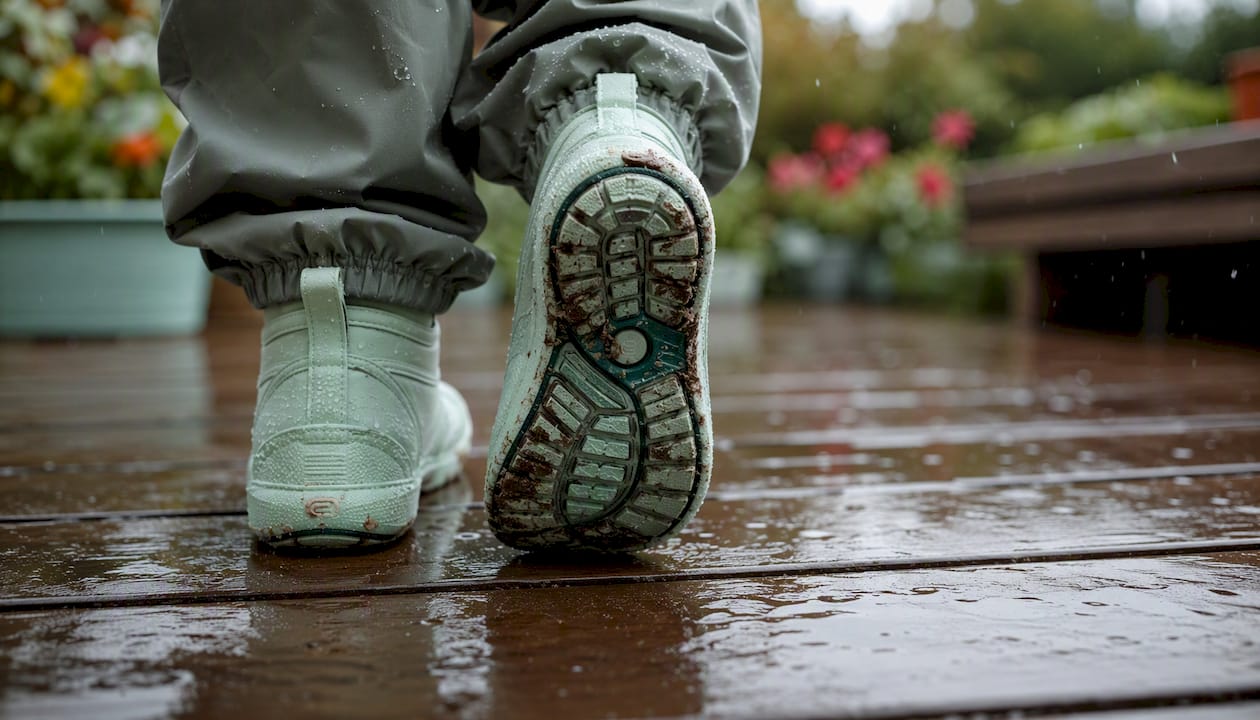
Tread Design: Lugs, Sipes and Channels
A tread works similarly to a car tire: channels drain water away, lugs grip into soft ground, sipes increase micro-interlocking on smooth, wet surfaces. Tread design is crucial for draining water and dirt. Fine transverse sipes, also called siping, significantly improve grip on tiles and wet stone. Deep, directional lugs grip on forest floor and gravel. A tread that is only oriented in one direction works well when going downhill, but weaker when avoiding sideways. For children who run in all directions, a multidimensional tread is the better choice.
| Feature | Effect on grip |
|---|---|
| Soft rubber compound | Better wet grip, higher abrasion |
| Deep lugs | Grip on soft ground (earth, gravel) |
| Transverse sipes (siping) | Micro-interlocking on wet, smooth surfaces |
| Drainage channels | Water drainage, prevents aquaplaning effect |
| Raised heel edge | Stability when going downhill and on stairs |
| Large contact area | Even pressure distribution on flat surfaces |
Pro Tip: For children who spend a lot of time on wet outdoor surfaces, a softer compound with a deep tread is worthwhile. Those who mainly use indoors and dry paths benefit more from a larger contact area with a flatter, wider tread. The Ebmini guide to children's shoes and temperature ranges explains more about the temperature behavior of sole materials.
Why are flexible, barefoot-like soles good for children?
Stiff, overly cushioned soles may seem safe, but they do the opposite: they reduce ground sensation and weaken the small foot muscles, because they hardly have to work actively anymore. Winter shoes that are too stiff reduce joint mobility and weaken muscle training, as studies show.
Physiotherapists recommend anatomically shaped, flexible soles that do not choose cushioning so strongly that ground perception is lost. Soles should allow natural movements and maintain forefoot flexibility to actively promote stability, rather than passively replacing it.
Three physiological benefits of flexible soles with good grip:
- Ground sensation is maintained: Thin soles allow pressure stimuli to pass through, training balance and coordination
- Muscle activation: Foot and lower leg work actively, instead of relying on support structures
- Safe movement development: Good grip prevents slipping without restricting freedom of movement
Flexible soles and their benefits for foot development is explained in detail by Ebmini in its own guide. Eltern.de recommends flexible, barefoot-like soles combined with weather protection for healthy foot development in everyday life.
How do you check grip and fit when buying?
These tests together take less than five minutes and provide more information than any advertising promise.
- Thumb Pressure Check: Press firmly on the bottom of the sole with your thumb. If the material yields and springs back immediately, the compound is elastic enough for good grip. If a dent remains, the material is too hard or already brittle.
- Flex Test: Bend the sole crosswise with both hands. It should bend easily without creasing or resisting. If you need force, the sole is too stiff.
- Tilt/Incline Test: Place the shoe on a slightly inclined surface (a shoebox lid is sufficient). A good sole will stay put, a bad one will slide off immediately.
- Test walk on wet ground: Let the child walk a few steps on a damp tile or wet pavement. Observe whether the foot lands securely or slips away.
- Fit Check: After putting on the shoe, slide a finger between the heel and the edge of the shoe. It should just fit. Press on the toe box from the outside: there should be enough air between the longest toe and the tip of the shoe.
Pro Tip: Let the child run briefly in the store and stop abruptly. If they slip or their heel lifts out of the shoe, either the sole or the lacing does not fit. Professional size consultation and fit checklist help with uncertainties.
What a negative test result means:
- Sole too hard on thumb pressure: choose a different model or check size
- Flex test fails: sole unsuitable for barefoot principle, seek advice
- Fit check shows too little toe room: try the next size
When does a sole lose its grip, and how do you care for it properly?
Wear does not always appear as a visible hole. Often, loss of grip is gradual.
Main causes of decreasing slip resistance:
- Abrasion: Lugs become flat, tread depth decreases, smooth shiny spots appear
- Embrittlement: Sole breaks when bent or no longer shows resilience, contact area decreases sharply
- Cracks and detachment: Sole detaches at the edges, water penetrates
- Clogged tread grooves: Dirt and small stones in the channels cancel out the drainage effect
Regular care significantly extends the lifespan. Brush the sole with a soft brush and lukewarm water after every outdoor use. Direct heat, i.e. radiators or dryers, makes rubber brittle. If you use two pairs alternately, you give each pair time to dry completely and significantly reduce abrasion per pair.
Pro Tip: Perform a quick visual check every six to eight weeks: check tread depth with your fingernail, bend the sole, look for cracks. If the sole no longer shows resilience when bent or the lugs are worn down to less than one millimeter, a new pair is more sensible than resoling, as the upper material of children's shoes is often worn out at the same time.
What questions should you ask the retailer before buying?
A good purchasing decision requires concrete answers, not glossy promises.
- What rubber mix is the outsole made of, and what is its Shore A hardness?
- How deep is the tread, and is it multidirectional?
- Are there test marks such as SRA, SRB or SRC, or are laboratory tests for wet grip available?
- Is the upper material waterproof, and if so, by which membrane or coating?
- What warranty and return options are there for fit problems?
- How often should the sole be checked with intensive use?
Features you can check yourself on the shoe:
- Flexible toe area: sole bends in the forefoot area without resistance
- Heel hold: heel cap fits snugly, no lateral tilting
- Adjustability: lacing or Velcro allows individual adjustment
- Toe box: wide enough for all toes to lie flat
After purchase: Document the measured inner length and recheck the fit after six to twelve weeks of intensive use. Children's feet grow quickly, and a shoe that has become too tight immediately loses its safety advantage. The Ebmini guide to children's foot width helps determine the correct width.
Key Takeaways
Non-slip all-weather children's soles need a soft rubber compound, a multidirectional tread, and enough flexibility for the foot to actively participate.
| Topic | Details |
|---|---|
| Three core features | Soft rubber compound, multidimensional tread, flexible sole ensure all-weather grip. |
| Quick pre-purchase test | Thumb pressure, flex test and tilt test show in two minutes if a sole is good. |
| Fit rule of thumb | Sufficient air in front of the longest toe and a snug heel fit are mandatory. |
| Recognizing wear | Smooth lugs, embrittlement, or lack of resilience when bending are clear signs for replacement. |
| Ebmini | Barefoot shoes with ultra-thin, non-slip sole, wide toe box and zero drop for all-weather use. |
Ebmini's view: Why grip and the barefoot principle are not contradictory
The most common concern parents express is: "Isn't a thin sole more dangerous?" The answer is no, if the compound is right. An ultra-thin sole made of soft rubber often grips better on wet pavement than a thick, hard foam sole, because it conforms to the ground instead of sliding over it.
The barefoot principle does not mean sacrificing protection. It means designing protection in such a way that the foot still works. Waterproof materials, a grippy tread and a flexible construction are not mutually exclusive. They are interdependent if done correctly. Ebmini develops its all-weather models in cooperation with orthopedists precisely for this reason: not because it is a marketing argument, but because rigid soles weaken children in the long term.
Parents who are unsure about the size or model can find detailed size advice, customer reviews from everyday life and clear warranty regulations at Ebmini. This removes uncertainty when buying online.
Ebmini All-Weather Barefoot Shoes: What they specifically offer
If you're looking for an all-weather shoe that meets all the criteria mentioned, Ebmini offers models with an ultra-thin, non-slip rubber sole, waterproof upper material, and a wide toe box for natural toe alignment. Zero drop means that the heel and forefoot are at the same height, which supports posture and muscle development. The sole is flexible enough for the bend test, but grips on wet surfaces due to the soft compound and multidirectional tread.
Size consultation, customer reviews, and a transparent return policy are available directly in the shop. Check out Ebmini barefoot shoes for children and use the size consultation to find the right model for your everyday life.
Useful sources on all-weather soles and children's shoes
Test marks like SRA, SRB and SRC are useful as an initial guide, but they do not replace practical tests in the store. Everyday checks often provide better indications of actual grip behavior.
Further resources for parents:
- Nanga: Five most important features of non-slip soles explains material, tread and flexibility in a practical way
- Nanga: Physiotherapist recommendations on sole properties with concrete buying tips and tests
- Nanga: Simple home remedies for slip resistance on tiles, parquet and wet floors
- Hanwag: Sole know-how and tread design explains technical background of lugs and channels
- Eltern.de: Children's shoes in winter with recommendations for flexible barefoot soles and weather protection
- RP-Online: Fit and inner length of children's winter shoes with the 12–17 mm thumb rule
- Ebmini: All-season shoes for children with an overview of features for all-weather models
- Ebmini: Weather Protection in Outdoor Kids' Shoes explains waterproof materials and care
| Topic | Source |
|---|---|
| Checking non-slip properties | Nanga: Features and practical tests for children's soles |
| Physiotherapeutic recommendations | Nanga: Three sole properties according to experts |
| Tread design and technology | Hanwag: Sole know-how |
| Fit and inner length | RP-Online: Thumb rule 12–17 mm |
| All-weather models and barefoot principle | Ebmini: Guide and product collection |


