

Barefoot Sandals for Children: The Right Way
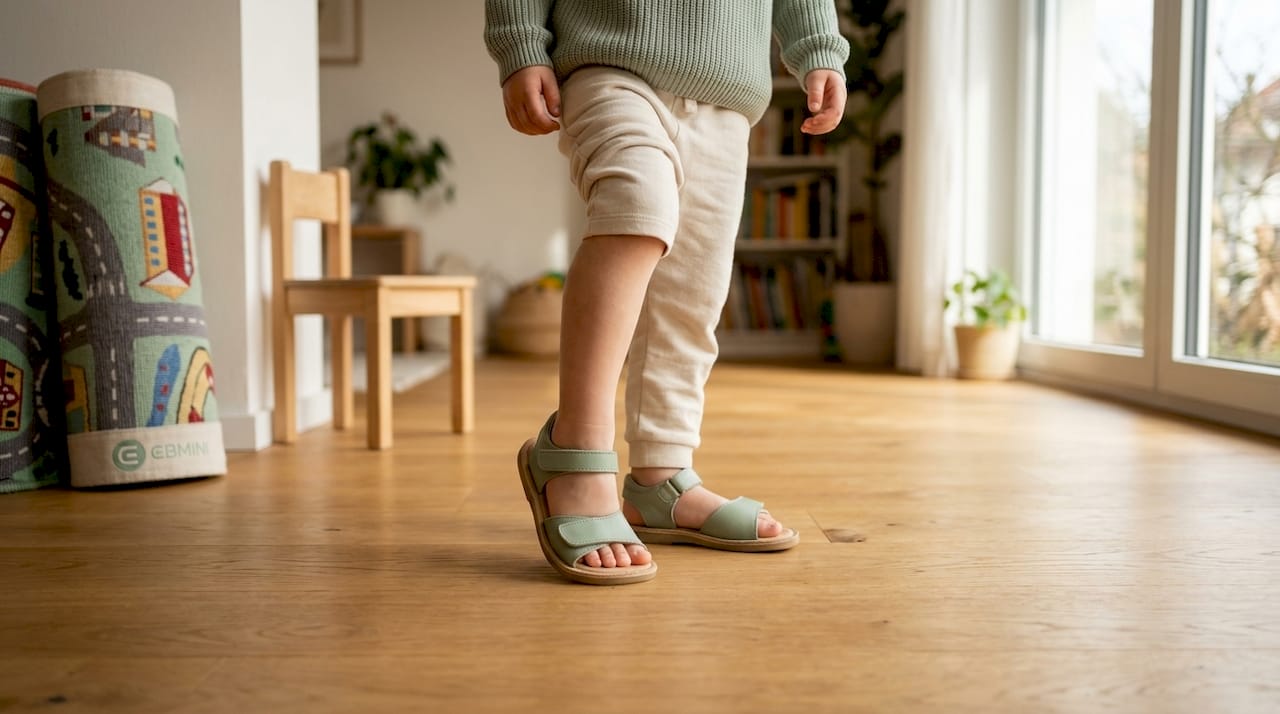
Barefoot sandals, also known as minimalist shoes or barefoot shoes in technical jargon, are sandals with a thin, flexible sole and a flat zero-drop construction that mimics the foot's natural ground contact. The barefoot feel is achieved when the sole is thin enough for the mechanoreceptors on the sole of the foot to sense the ground and for the foot muscles to work actively. Models such as the Groundies Noto 2.0 Kids with a 2.5 mm sole or the Froddo Flexi Open Sandal with a 3 mm natural rubber sole show how consistently this principle can be implemented. For children between 1 and 10 years of age, this type of shoe is particularly valuable because the foot is still growing and being shaped during this phase.
How is the barefoot feel achieved with sandals?
The barefoot feel is not created by a thin sole alone. It is based on the sensory connection between the sole of the foot and the ground, which is mediated by mechanoreceptors. These receptors are located in the skin of the sole of the foot and respond to pressure, vibration, and texture. The more information they receive, the better the child regulates balance, posture, and body awareness.
Typical barefoot-feel sandals meet the following criteria:
- Sole thickness of 2 to 3 mm: The thin, flexible sole allows uneven ground to be felt without injuring the foot.
- Zero Drop: Heel and forefoot are at the same height. This promotes a natural, upright gait without heel pressure.
- Flexible materials: Natural rubber, soft leather, or recycled plastics allow the sole to move with the foot.
- Wide toe box: The toes can spread out and actively participate in the rolling motion, which is often prevented in conventional shoes.
- No heel padding, no insoles with support: Supportive insoles prevent the foot muscles from working on their own.
Pro Tip: Ask your child to stand on a hard floor in the sandal and then go on tiptoes. If the sole rolls with the foot and does not feel stiff, the flexibility is sufficient for a true barefoot feel.
The combination of these features ensures that the foot is not passively supported, but actively reacts to the ground. This is the crucial difference to conventional children's sandals with thick cushioning and rigid soles.
How should barefoot-feel sandals fit children?
The fit of barefoot sandals is more crucial than the model itself. A poorly fitting sandal disrupts the natural gait mechanics and reduces the training effect that the barefoot principle promises. Incorrect sizes lead to children compensating, i.e., twisting their foot or curling their toes to hold the sandal.
The following steps help with the correct fit check:
- Foot fully on the insole: The entire foot, from heel to toes, must lie flat on the insole. No part of the foot should be hanging in the air.
- 0.5 to 1 cm space in front of the toes: This distance gives the foot room when rolling and prevents the toes from hitting the front edge. Specific fit criteria confirm this value as a minimum requirement for children's sandals.
- No lateral overhang: The foot must not extend beyond the sole on either the inside or the outside. This indicates a sole that is too narrow.
- Heel fits securely: The heel lies completely in the heel cup or on the heel area of the sole. It must not slip out.
- Straps fit comfortably: No strap should press or cut in. At the same time, the sandal must remain stable on the foot when walking.
Pro Tip: Always measure your child's foot in the afternoon. Children's feet swell during the day, and a sandal that fits perfectly in the morning may become too tight in the afternoon.
Comparison: Barefoot sandal versus conventional children's sandal
| Feature | Barefoot Sandal | Conventional Children's Sandal |
|---|---|---|
| Sole thickness | 2 to 3 mm | 8 to 15 mm |
| Zero Drop | Yes | Rarely |
| Toe box | Wide, curved | Often pointed or narrow |
| Sole flexibility | Very high | Low to medium |
| Foot muscle training | Active | Passive |
| Cushioning | Minimal | High |
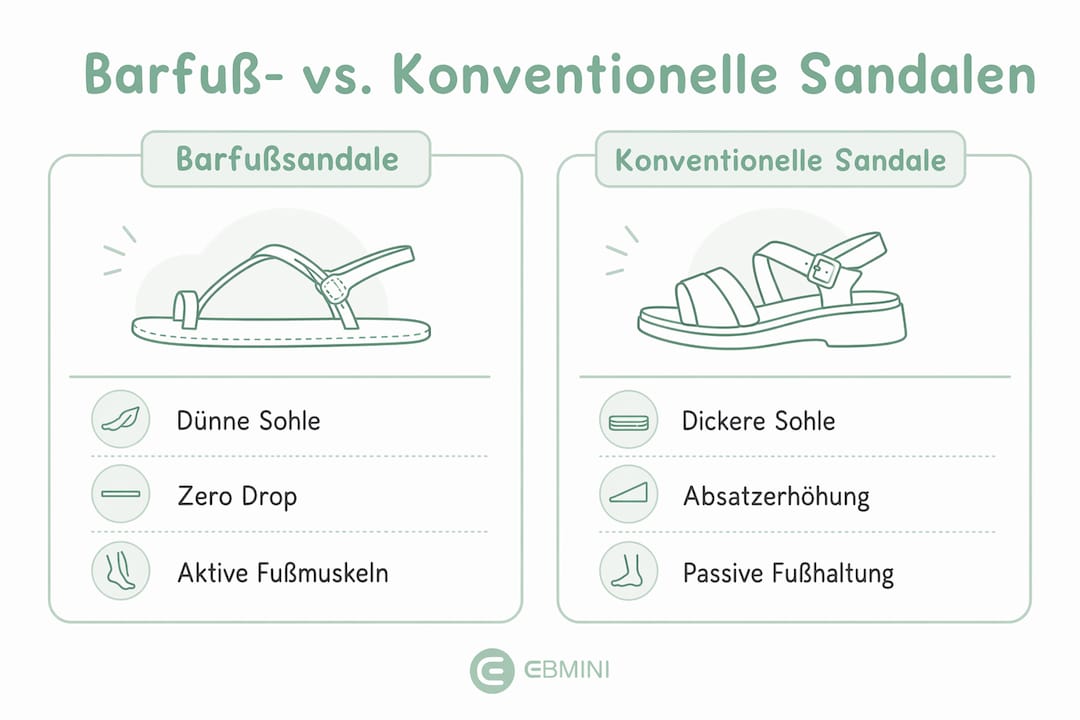
This comparison shows that barefoot sandals are not simply lighter versions of normal sandals. They follow a different design principle that challenges the foot instead of pampering it.
How to introduce barefoot-feel sandals to children?
Switching to barefoot sandals requires patience. The foot muscles of children who have previously worn conventional shoes are accustomed to passive support. Too quick a change leads to muscle soreness, fatigue, or rejection of the new shoes. Gradual acclimatization is therefore not an optional tip, but a necessary protective measure for the foot.
Practical recommendations for getting started:
- Week 1 to 2: Wear the sandals only at home, on carpet or parquet. Short wearing times of 30 to 60 minutes daily are sufficient.
- Week 3 to 4: Short walks outside on flat ground, for example on asphalt or grass. Maximum 20 to 30 minutes at a time.
- From week 5: Gradually extend wearing times and expand to uneven surfaces such as gravel or forest paths.
- Observe daily: Look for redness, pressure points, or complaints about tired legs. These are signs that the wearing time is still too long.
- Readjust straps: Children's feet swell with warmth and movement. Adjustable straps must therefore be adjusted throughout the day to avoid pressure points.
- Check fit regularly: Children's feet grow quickly. Check every four to six weeks to ensure there is still enough room in front of the toes.
Many children adapt more easily if they are allowed to choose the sandals themselves. Acceptance increases if the child helps decide on the model and color. More practical tips for gradual acclimatization can be found in the Ebmini blog.
What are the benefits of barefoot walking for children's foot development?
Barefoot walking promotes foot muscles, balance, and circulation when the ground is suitable, such as grass, sand, or a streambed. Barefoot-feel sandals transfer this effect to everyday life because they offer protection and sensory feedback at the same time.
“Barefoot walking stimulates proprioception, which improves body awareness and movement coordination in children and can prevent misalignments."
Proprioception refers to the body's ability to perceive its own position in space. In children, this system is still developing. Every step on a natural surface provides the brain with new information and trains the neural connections between the foot and the brain. Conventional shoes with thick cushioning significantly reduce this flow of information.
Health benefits at a glance
| Benefit | Effect on children |
|---|---|
| Foot muscle training | Strengthening of the short foot muscles that support the arches |
| Improved proprioception | Better balance and coordination |
| Natural toe position | Prevention of splayfoot and hallux valgus |
| Improved circulation | Warmer feet, more active sole of the foot |
| Natural gait pattern | Upright posture, less joint overload |
Parents often observe improved natural movement patterns in children when they wear barefoot-feel sandals. This is because the children unconsciously begin to use their feet more actively. They roll more consciously, place their feet flatter, and use their toes as natural stabilizers. This effect does not occur immediately, but develops over weeks of regular wear.
The stimulation of mechanoreceptors through changing contact points on the sole of the foot generates differentiated signals, similar to walking on natural ground. This is why ground contact is more important than cushioning when it comes to healthy foot development. In addition, a foot massage with a salt stone can further promote circulation and sensory awareness after wearing the sandals.
Key findings
Barefoot-feel sandals for children promote healthy foot development only when sole flexibility, zero-drop construction, and correct fit work together.
| Point | Details |
|---|---|
| Sole thickness and Zero Drop | A 2 to 3 mm sole without heel elevation allows for true sensory feedback. |
| Fit as the basis | The foot must lie completely on the insole, with 0.5 to 1 cm space in front of the toes. |
| Gradual acclimatization | Start at home with short wearing times and gradually increase them over four to five weeks. |
| Check adjustable straps daily | Children's feet swell. Straps must be readjusted during the day. |
| Long-term benefits | Regular wear improves proprioception, gait pattern, and foot muscle strength in children. |
What I've learned after years with barefoot sandals
At Ebmini, we repeatedly see that parents underestimate the fit and overestimate the model. The truth is: a well-fitting sandal of a simpler model does more for foot development than a technically perfect model in the wrong size. This sounds obvious, but in practice, many parents buy half a size too large because the child is growing quickly. The result is a sandal that flaps when walking, forces the toes to curl, and negates the entire training effect.
What else we notice: Children who grow up with barefoot sandals from the beginning do not need a long acclimatization phase. The challenge only arises when children have worn conventional shoes for years and then switch. Here, patience is the only way. Two weeks at home, then short distances outside, then more. Anyone who skips this process risks the child rejecting the sandals because their feet hurt.
Another point we consider important: the quality of the sole determines the longevity of the barefoot effect. Cheap materials lose their flexibility after a few weeks. A sole made of natural rubber or high-quality composite materials remains flexible for an entire season and consistently gives the foot the feedback it needs. This is not a luxury, but a prerequisite for the sandal to fulfill its purpose.
The combination of protection and freedom of movement is what distinguishes barefoot sandals from simply walking barefoot. On hot asphalt, on gravel paths, or in the city, children's feet need protection. Barefoot sandals provide this protection without restricting the foot's function. This is the core of what we want to achieve with our products.
— Ebmini
Discover healthy barefoot sandals for children at Ebmini
Ebmini develops barefoot sandals for children that meet all the described criteria: flexible soles of 2 to 3 mm, zero-drop construction, wide toe box, and multi-adjustable straps for daily adjustment. Each model is tailored to the needs of growing children's feet, from the first walking phase to active school-aged children.
The collection includes models for different foot widths and age groups. All sandals are lightweight, water-friendly, and suitable for everyday use. If you are looking for comfortable barefoot sandals that allow for true sensory feedback, you will find a well-thought-out selection at Ebmini with detailed sizing advice and customer reviews. Also check out the barefoot shoes for children if you are looking for year-round options.
FAQ
What are barefoot-feel sandals for children?
Barefoot-feel sandals are sandals with a thin, flexible sole (2 to 3 mm) and zero-drop construction that mimic natural ground contact. They enable sensory feedback through the mechanoreceptors of the sole of the foot and promote active foot muscle training.
How do you choose the right size for barefoot sandals?
The foot must lie completely on the insole, with 0.5 to 1 cm space in front of the toes and no lateral overhang. Measure the foot in the afternoon, as children's feet swell during the day.
From what age can children wear barefoot sandals?
Barefoot sandals are suitable from the first confident steps, i.e., from about 12 to 18 months. The sole protects the foot without restricting natural development and is recommended for children up to 10 years of age.
How long does it take to get used to barefoot sandals?
For children who have previously worn conventional shoes, it takes four to five weeks to get used to them. Start with short wearing times at home and gradually increase them.
Are barefoot sandals also suitable for everyday life and school?
Yes, provided the sandals fit securely on the foot and the straps are adjustable. For longer school commutes or uneven terrain, models with multiple straps and a grippy sole, such as those offered by Ebmini in its children's collection, are recommended.


