

Barefoot Shoes for Kids: Sandals Doctors Recommend
Buy your child a lightweight sandal with zero drop, a wide toe box, and a flexible sole, along with a secure but soft heel fixation. These three features are considered minimum standards by pediatric orthopedists because they allow the foot to move as it naturally does. The DGOU confirms: walking barefoot on varying surfaces promotes the development of the arch, and a flat foot in children is usually completely normal in the first few years.
Before buying sandals, check three things directly in the store or from the product photo:
- Can the sole be easily rolled up by hand in the forefoot area?
- Does the toe area visibly have more width than the heel section?
- Is the heel strap secure without restricting the joint?
If you answer "yes" to all three points, you've found sandals that orthopedically support growth instead of hindering it.
Key Takeaways
Barefoot-style children's sandals with zero drop, a wide toe box, and a flexible sole promote natural foot development and should complement, not completely replace, more stable shoes.
| Topic | Details |
|---|---|
| Check three core criteria | Bend the sole, check toe box from above, test heel strap for secure, soft hold. |
| Check size monthly | Measure in the afternoon, leave enough room for toes in front of the longest toe. |
| Gradual transition | Increase wearing time over three to four weeks instead of switching to full-time immediately. |
| Observe usage limits | Choose more stable shoes in cold weather, with broken glass, or on long asphalt stretches. |
| Ebmini as a suitable option | Offers zero drop, wide toe box, and non-slip, partly waterproof soles according to these criteria. |
Table of Contents
- What are barefoot sandals for children and for what age are they suitable?
- The three most important features when buying children's sandals
- How to measure the right size and fit?
- When are barefoot sandals useful and when are they not?
- Which materials are suitable for non-slip, durable sandals?
- When should you consult a pediatric orthopedist?
- Recommendation: Why Ebmini sandals are a suitable choice
- Sources
- FAQ
What are barefoot sandals for children and for what age are they suitable?
A barefoot-style children's sandal has four fixed characteristics: zero drop, meaning no height difference between heel and toes, a thin, flexible sole, a wide toe box, and light heel support without a rigid counter. This construction differs fundamentally from classic children's shoes with supported soles and elevated heels.
Such sandals are particularly valuable in three phases: when learning to walk between one and three years of age, during kindergarten with lots of barefoot play, and during primary school when children cover long distances daily. In all these phases, the barefoot feeling provides a training stimulus for balance and body awareness that a supported shoe simply cannot offer.
An important note for clarification: this solely concerns children's shoes, not fashionable barefoot sandals for adult women. The demands on a growing child's foot are a completely different matter than adult fashion.
The three most important features when buying children's sandals
Pediatric orthopedic sources are strikingly in agreement here: a good children's sandal can be recognized by three core criteria – a flexible, thin sole with no heel-to-toe drop, a wide toe box, and stable but light heel support. Each of these features can be tested in a few seconds.
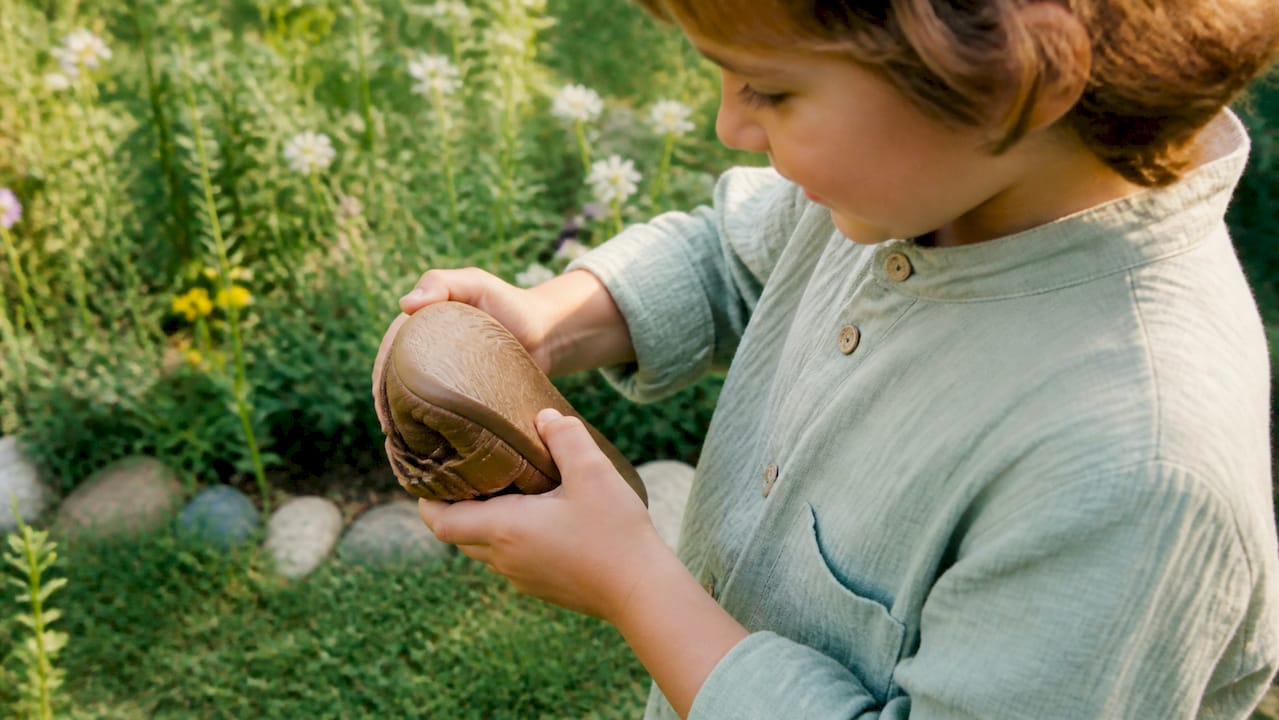
The sole. Take the sandal in both hands and twist it lightly. A good sole flexes at the metatarsophalangeal joints, not in the middle of the foot. Literature reviews on children's shoes recommend flat soles without arch support for toddlers, as cushioning and pronation supports are usually unnecessary until school age.
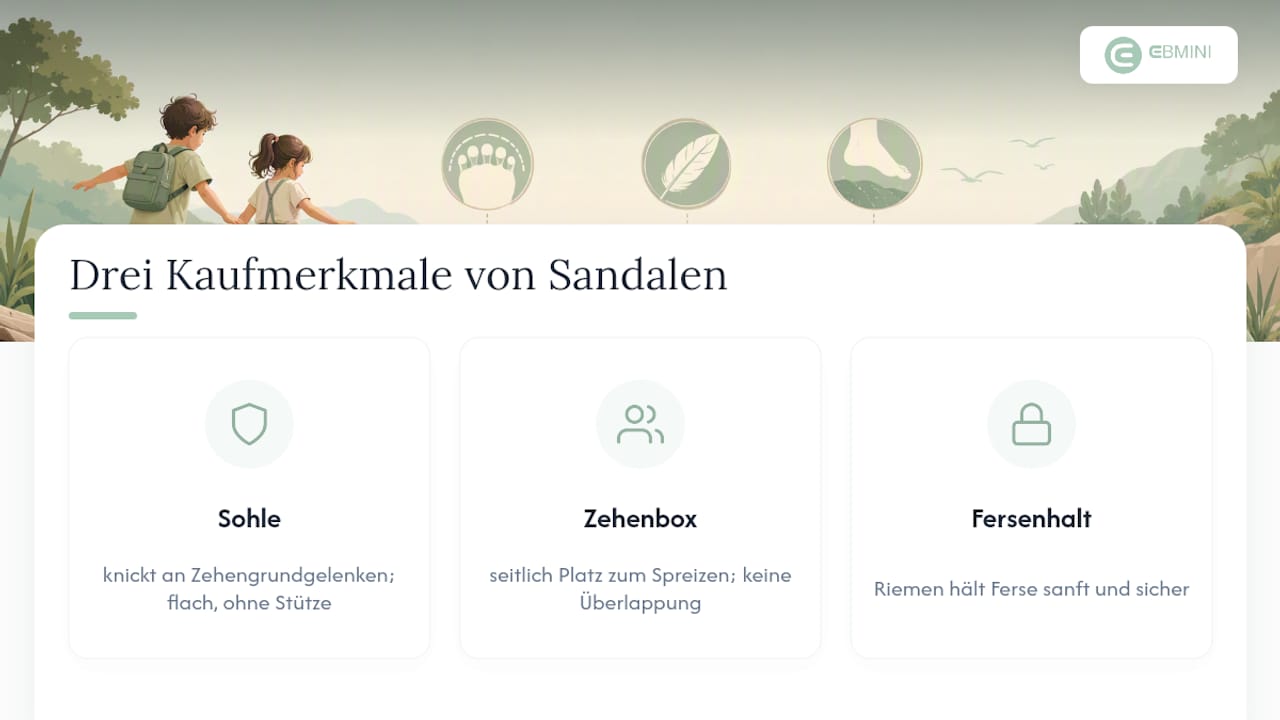
The toe box. Place your child's foot on the insole and look from above to see if the toes still have room to spread sideways. Narrow toe boxes force the toes to overlap, which over time changes the natural toe alignment.
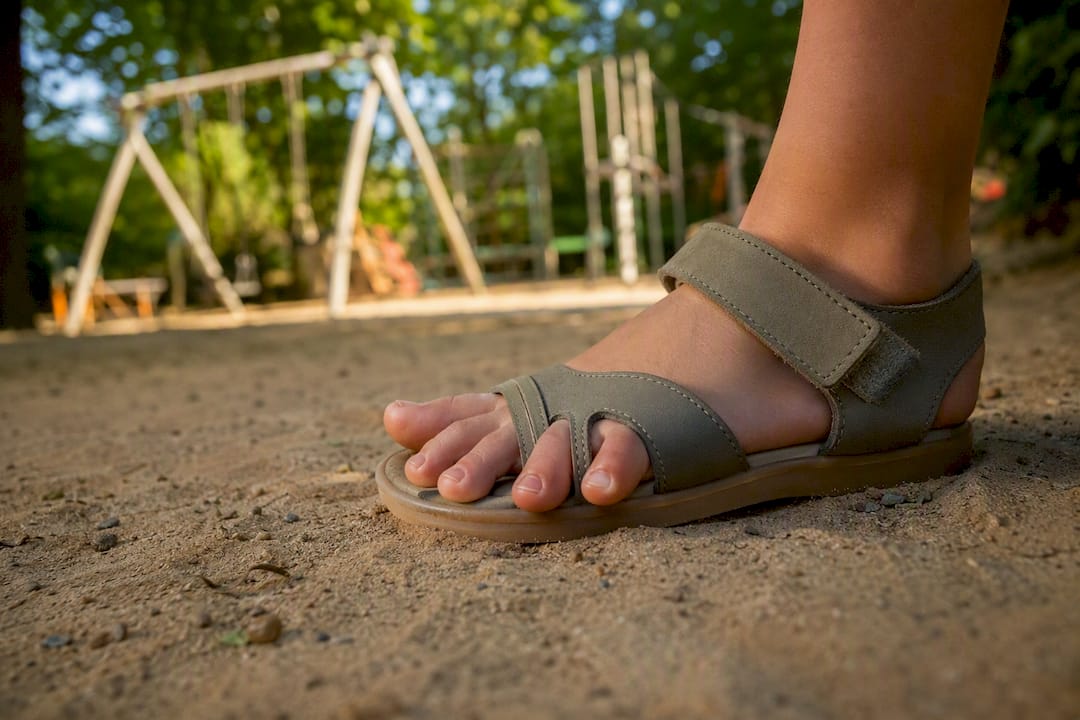
The heel hold. A strap should hold the heel gently but securely in place so that the sandal does not slip off during movement.
Pro Tip: For everyday playground use, a non-slip sole profile is almost as important as these three criteria. A child who slips on a wet slide or damp stone gains nothing from the best toe box.
How to measure the right size and fit?
Children's feet grow unevenly and often faster than parents think. A simple measurement routine is enough to avoid expensive mispurchases.
- Remove the insole from the sandal and have your child stand on it in the afternoon, as feet tend to swell slightly throughout the day.
- Mark the longest toe with your finger and then leave enough room for the foot to roll off towards the tip.
- Check if there is still enough width on the left and right for the small toes, without them overlapping.
- Have your child stand briefly, walk a few steps, and jump lightly once to test if the strap holds.
Because children can grow up to three shoe sizes per year, monthly checks are worthwhile, especially during growth spurts in spring and summer. Warning signs for sandals that are too small include red pressure marks on the toes, a child suddenly limping, or taking off their shoes unusually often. More about practical measurement can be found in the guide on toe freedom in children's sandals.
When are barefoot sandals useful and when are they not?
For playgrounds, sandpits, lawns, and short walks to kindergarten, barefoot-style sandals are almost always a better choice than supported shoes. They allow the foot to work instead of immobilizing it. For long asphalt stretches, cold autumn days, or sports activities with a high risk of injury, more stable shoes with more protection are often the more practical solution.
The transition to barefoot shoes should be gradual. Children who have only worn supported shoes need time for their muscles and tendons to adapt to the new load. Start with one to two hours daily in the first week and increase wearing time over three to four weeks instead of switching to full-time immediately.
- Indoors and on soft ground: unconditionally suitable.
- Sandpit, lawn, short walkways: ideal for everyday use.
- Sharp stones, broken glass, very cold ground: additional protection or different shoes needed.
- Long hikes or intense sports: more stable shoes are more sensible.
Pro Tip: Keep a pair of more robust shoes in your backpack. This way, you can switch depending on the activity without having to reschedule the entire outing.
Barefoot shoes strengthen foot muscles and improve balance but offer less protection from cold and sharp objects. This trade-off is part of every purchasing decision.
Which materials are suitable for non-slip, durable sandals?
Leather breathes well and adapts to the foot's shape, but it dries slower when wet than synthetic membranes. Textile uppers are light and flexible but wear out faster at the seams. Waterproof synthetic soles withstand puddles and sand without the sandal becoming stiff after drying.
After playing in sand or water, clear water and a soft cloth are usually sufficient. Let the sandals air dry, never directly on a heater, as adhesives on the sole and straps can become brittle. Check the seams on the heel strap every few weeks, as that's where they tend to tear first with daily use.
Practical for everyday life are:
- A Velcro fastener that even a four-year-old can open themselves.
- A non-slip sole profile for wet playground equipment.
- Washable insoles to prevent odor in summer.
When should you consult a pediatric orthopedist?
Most abnormalities in a child's foot are harmless and will resolve themselves. However, there are clear warning signs when a doctor's visit is advisable: persistent pain when walking, a noticeably one-sided gait, unusually quick fatigue on short distances, or a visibly one-sided malposition.
- Pain that lasts longer than a few days.
- A foot that visibly tilts inward or outward when walking.
- Constant limping without an apparent injury.
- A child who suddenly refuses to play sports or go for walks.
The DGOU clarifies: a flat foot is often normal in young children, and barefoot walking promotes precisely the development that will straighten this foot later. In most cases, therapy is not necessary as long as there is no pain or clear abnormalities.
From a parent's perspective: a brief assessment and a practical everyday tip
I've rummaged through enough children's shoe racks to know: the prettiest shoe is rarely the best. Pediatric orthopedic practice is clear on this; function before aesthetics is key. What really helps in everyday life is a firm rotation between barefoot sandals for the playground and garden, and a more stable shoe for long walks or cold days. No single model needs to do everything. Ebmini follows exactly this child-appropriate approach, without simply forcing children's feet into shrunken adult forms.
Recommendation: Why Ebmini sandals are a suitable choice
Ebmini consistently builds its sandals according to the criteria described in this guide: zero drop, a wide toe box, an ultra-light and flexible sole with a non-slip profile, plus waterproof variants for puddles and wet meadows.

Unlike generic children's shoes, these models are developed in collaboration with orthopedic expertise, not as scaled-down versions of adult designs. This is evident as soon as they are put on: wide toe space, soft heel strap, no stiff edge that pinches. The size guide in the shop helps you find the right size with the toe allowance described above before you order. If you are unsure between two sizes, you can find additional guidance in the article on the wide toe box in children's shoes. Check out the current range of children's barefoot sandals and use the size chart to determine which size is suitable for the next growth phase.
Sources
- Barefoot walking promotes healthy children's feet | DGOU
- Finding better children's sandals: How to get the right fit - IMTEST
- Children's Shoes & Barefoot Shoes | Orthopedic Practice Beckum
- Sports Shoes for Children and Adolescents (Journal - Thieme)
This article contains general information and does not replace consultation with a qualified physician. Consult a qualified medical professional regarding your personal situation before acting on the basis of this content.
FAQ
What does Zero Drop mean for children's sandals?
Zero drop means that the heel and toes are at the same height, without an elevated heel. This allows the foot a natural rolling motion.
How often should I check my child's shoe size?
Ideally monthly, as children can often grow noticeably and in spurts. Measure in the afternoon when the foot is slightly swollen.
Are barefoot sandals suitable for all-day wear?
Yes, for playgrounds, gardens, and short distances, but for cold weather, sharp stones, or long stretches, more stable shoes are the safer choice.
From what age are barefoot sandals useful?
From the age of learning to walk, about one year old, up to primary school age, children benefit from the free movement provided by these sandals.
Does Ebmini offer barefoot sandals with a wide toe box?
Yes, Ebmini produces children's sandals with zero drop, a wide toe box, and a non-slip, partly waterproof sole according to pediatric orthopedic criteria.


