

Breaking in barefoot shoes: Step by step for children
Many parents buy barefoot shoes with great conviction, and then it happens: the child complains of tired legs after 20 minutes, walks strangely, or doesn't want to wear the shoes at all. Approaching the barefoot shoe acclimatization step by step correctly is not a bonus, but a prerequisite for healthy feet. Because years of wearing padded shoes noticeably weaken foot muscles, and even children's feet need time to get used to the new movement stimulus. This article shows you how to manage the acclimatization safely and without frustration.
Table of Contents
- Key Takeaways
- Acclimating to Barefoot Shoes: Step-by-Step Preparation
- The Acclimatization Plan: From the First Hour to Everyday Life
- Common Acclimatization Mistakes
- What Changes After Acclimatization
- My Experience with Children's Acclimatization
- The Right Shoes for a Successful Start
- FAQ
Key Takeaways
| Point | Details |
|---|---|
| Start slowly | Begin with 15 to 30 minutes daily on soft surfaces before increasing. |
| Vary surfaces | Gradually switch surfaces, as hard asphalt can quickly overtax the soles of the feet. |
| Take body signals seriously | Pain or altered gait are clear signs for a break or adjustment. |
| Incorporate foot exercises | Toe spreading and single-leg stance measurably accelerate acclimatization. |
| Count on patience | A full acclimatization period of four to eight weeks is realistic and normal. |
Acclimating to Barefoot Shoes: Step-by-Step Preparation
Before your child takes their first step in new shoes, it's worth investing a few minutes in preparation. The right shoe choice is often the underestimated foundation.
Good barefoot shoes for children have four indispensable characteristics:
- Wide toe box: Toes should be able to splay freely without being squeezed.
- Flexible sole: The shoe should bend easily in all directions with little force.
- Zero drop: No height difference between heel and forefoot, maintaining natural body posture.
- Lightweight: Heavy shoes tire already weak foot muscles more quickly.
For beginner barefoot shoes, models with a moderate sole thickness are recommended, as they make the transition from padded shoes gentler. Completely flat, very thin soles are more suitable for children who already have experience with little cushioning.
Age and developmental stage also play a role. Toddlers from about 12 to 18 months who are just learning to walk benefit from crawling shoes and first walking shoes in a barefoot style, as their feet are still very malleable. Older children between 5 and 10 years, who have worn conventional shoes for years, will accordingly need more acclimatization time.
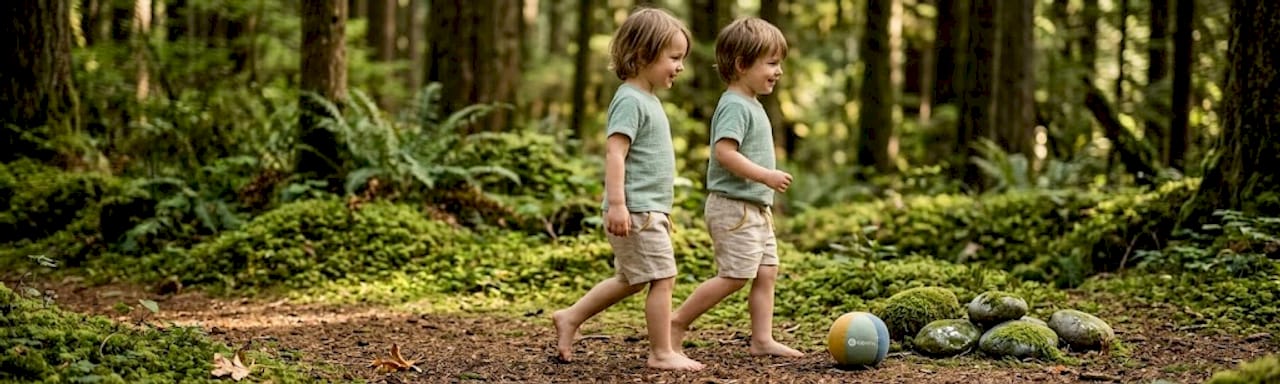
The surface is just as important as the shoe itself. Soft, natural surfaces like grass, forest floor, or sand offer ideal starting conditions, as they provide cushioning and simultaneously activate foot sensory perception. Hard concrete should be clearly avoided in the first few weeks.
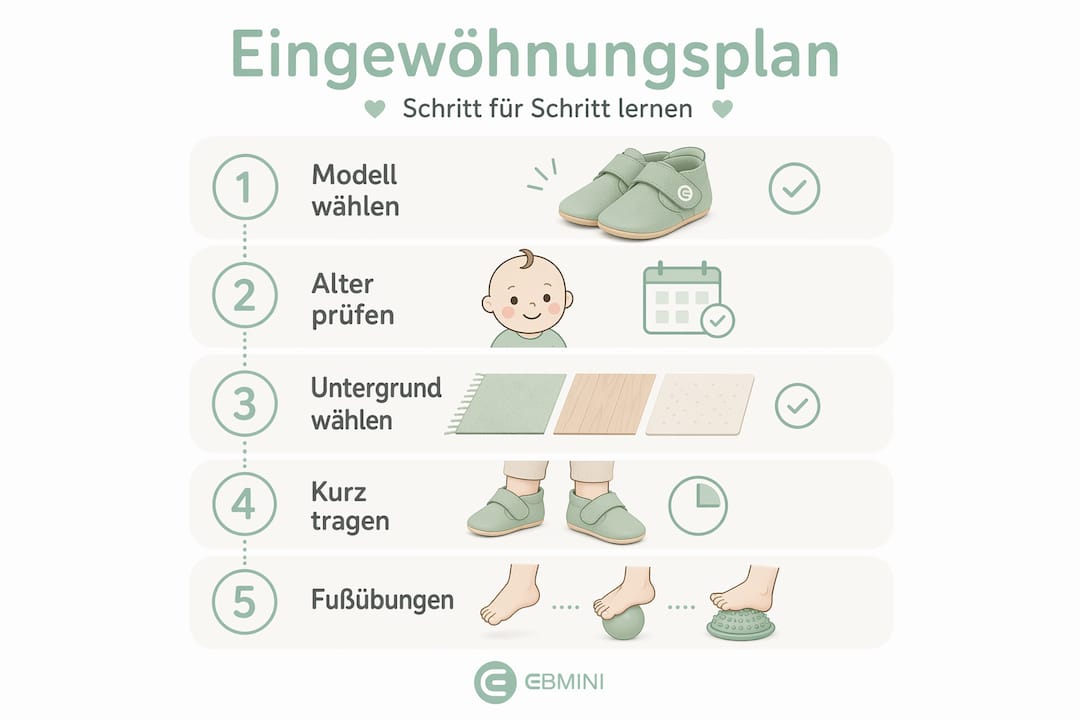
Pro Tip: First, let your child wear the new shoes at home on a carpet or indoors. This allows feet and muscles to get used to the feeling without immediately straining them on hard outdoor surfaces.
Clothing also deserves attention. At temperatures below 10 degrees Celsius, beginners should significantly reduce wearing time. Socks that are too thin or no socks at all in winter can overtax the blood circulation in children's feet. Breathable children's socks made of natural materials are the ideal companion to barefoot shoes, as they wick away moisture and still provide warmth.
The Acclimatization Plan: From the First Hour to Everyday Life
Introducing barefoot shoes step-by-step means, specifically: less is always more in the first few weeks. Here is a proven plan tailored to children's body signals.
Week 1 and 2: First Steps on Soft Ground
- Day 1 to 3: Only 15 to 20 minutes daily, exclusively at home or on grass. No long walks.
- Day 4 to 7: Increase to 25 to 30 minutes, still on soft surfaces. Observe how your child walks and if they complain of pain.
- From Day 8: Introduce short distances on slightly uneven terrain, for example, gravel paths in the park. Rule of thumb: a maximum of about 1 kilometer on solid ground for beginners.
Week 3 and 4: Building Up and Integrating into Daily Life
- Increase activities: Playing in the garden, short school commutes, or excursions to the park. Wearing time can increase to 45 to 60 minutes daily.
- Test different surfaces: Switch between grass, sand, and paved paths. Remember: not only wearing time but also changing surfaces must be done gradually to avoid overtaxing the soles of the feet.
- Consciously promote walking technique: Occasionally remind your child to land on the midfoot first instead of the heel. Midfoot striking instead of heel striking protects the joints and promotes natural posture.
Week 5 to 8: Complete Acclimatization
- Extend wearing time to all-day: If no discomfort occurs, the shoes can now be worn all day.
- Regular foot exercises: Toe spreading, toe stands, and single-leg stands for five minutes daily further activate foot muscles and accelerate acclimatization.
Pro Tip: Turn foot exercises into a game. “Who can stand on one leg the longest?” or “Can you pick up a pen with your toes?” motivates children much more than serious instructions.
Here is a guideline table for the acclimatization period:
| Week | Daily wearing time | Surface | Activity |
|---|---|---|---|
| 1 to 2 | 15 to 30 minutes | Carpet, grass, sand | Playing at home, short walks |
| 3 to 4 | 30 to 60 minutes | Grass, slightly uneven, park | Excursions, schoolyard, playground |
| 5 to 6 | 1 to 3 hours | Various surfaces | Everyday life, sports, school |
| 7 to 8 | All day possible | All surfaces | Normal everyday life without restriction |
Balance and coordination exercises are not a nice extra, but an integral part of acclimatization. They promote children's proprioceptive abilities, i.e., the perception of their own body movement, and strengthen their feet in a way that mere walking alone cannot achieve. Think of balancing on a stone, trying a slackline, or simply romping barefoot in the meadow as meaningful additions.
Common Acclimatization Mistakes
Many parents make similar mistakes when introducing barefoot shoes. The good news: all of them can be avoided if you know what to look out for.
“Increasing too quickly, wrong shoe choice, and ignoring body signals are the most common causes of overuse when starting with barefoot shoes.” (Source: Feelgrounds Acclimatization Guide)
Here are the typical pitfalls parents should be aware of:
- Increasing wearing time too quickly: This is by far the most common mistake. A child who walked for three hours in barefoot shoes on the first day is likely to have sore arch muscles the next morning. This is demotivating and detrimental to long-term progress.
- Ignoring pain: Barefoot shoes should feel like freedom, not pain. If your child complains of pain in the heel, ball of the foot, or arch, it's a clear signal for a break of at least one to two days.
- Starting immediately on hard asphalt: Concrete and asphalt are the most demanding surfaces. Starting there overtaxes both the soles of the feet and the muscles simultaneously.
- Skipping foot exercises: Barefoot shoes alone are not enough. Skipping the accompanying exercises leaves valuable potential untapped and risks slower acclimatization.
- Wrong socks or no socks at all: Synthetic socks prevent moisture from wicking away and can lead to blisters. Thick winter socks in barefoot shoes partially negate the barefoot effect. Thin and breathable is the motto.
- Underestimating the weather: In cold weather, muscles and tendons shorten more quickly. Special caution below 10 degrees Celsius is especially important for children whose blood circulation regulation is not yet fully developed.
Another, often overlooked, mistake is shoe size. A barefoot shoe that is too tight negates all the advantages of the wide toe box. The thumb test applies here: there should be about half a centimeter of space between the longest toe and the tip of the shoe. Those unsure about shoe selection for children can find specific measurement instructions in good guides.
What Changes After Acclimatization
The good news: the effort is measurably worthwhile. Those who consistently follow the acclimatization process will observe significant changes in children, often within four to six weeks.
- Stronger foot muscles: Barefoot shoes act like a gym for the feet. The musculature, which hardly worked in padded shoes, is actively trained. The result is a significantly more stable arch.
- More natural gait: Children who grow up in barefoot shoes develop a natural gait with midfoot strike, upright posture, and shorter, more efficient strides.
- Improved balance and body awareness: Through the thin sole, the feet receive significantly more information about the ground. This trains proprioception and noticeably improves coordination.
- Fewer long-term foot problems: Barefoot shoes are especially helpful for children because they promote the natural development of foot muscles and sensory perception, thus preventing deformities that can arise from tight, stiff shoes.
- More joy in movement: Many parents report that their children become more active and enjoy movement more after the acclimatization phase. This is because barefoot shoes enrich the tactile experience of surfaces and simply make walking more fun.
The long-term contribution to foot health should not be underestimated. Foot deformities such as flat feet or splayfoot often result from years of wearing unsuitable shoes. Those who switch to barefoot shoes early and correctly invest in healthy foot development that lasts into adulthood.
My Experience with Children's Acclimatization
Over the years, I have supported many parents who enthusiastically bought barefoot shoes, only to give up after two weeks because the child complained or limped. What I learned from this is that the problem was never with the shoe. It was almost always due to acclimatization being rushed and not approached playfully enough.
What strikes me is that many parents treat acclimatization like changing winter tires. New shoes in, all good. But children's feet that have been in cushioned shoes for years need real time. This is not a weakness, but biology.
My most sincere tip, which not everyone gives: For starters, don't buy the most minimalist barefoot shoe you can find. A child-friendly barefoot shoe with a bit more sole and still a wide toe box is a smarter entry point for beginners. Purism before the first step is not a virtue.
Patience is not a passive attitude. It means actively observing, reacting appropriately, and motivating the child with small successes. Children who experience barefoot shoes as freedom shoes rather than a chore will wear them voluntarily. And that is exactly the goal.
— Ebmini
The Right Shoes for a Successful Start
The right companion makes all the difference between a bumpy and a successful acclimatization. Ebmini's collection includes healthy barefoot shoes for children for every age group, from their first steps as toddlers to sturdy models for active school children. All models are ultralight, flexible, and feature a wide toe box, exactly what beginners need for gentle acclimatization.
For summer, the lightweight barefoot sandals for children are ideal, especially for first steps on grass and sand. And for those looking for matching socks, Ebmini also offers breathable children's socks that are perfectly coordinated with the barefoot shoes. The entire ordering process is straightforward online, with personal customer service and sizing advice.
FAQ
How long does it take to get used to barefoot shoes?
The acclimatization period typically ranges from four to eight weeks, depending on how long the child has previously worn conventional shoes and how systematically the progression occurs.
Which surfaces are best for starting?
Soft surfaces like grass, sand, or forest floor are ideal for starting, as they provide cushioning and gently activate foot sensory perception. Introduce hard asphalt only after several weeks.
What to do if the child complains of pain?
Pain is a clear sign of overuse. Take a break of one to two days, then reduce wearing time and progress slower than before.
Do children really need foot exercises during acclimatization?
Yes. Toe spreading and balance exercises significantly accelerate the strengthening of foot muscles and reduce the risk of overuse pain.
At what age are barefoot shoes suitable for children?
Barefoot shoes are suitable from the moment a child starts walking independently, which is typically around 12 to 18 months. There are suitable models for every age group, tailored to their specific developmental stage.


