

Barefoot Shoes for Developmental Promotion Explained: Natural Foot Health
Barefoot shoes are everywhere right now: in children's stores, parent forums, and playgrounds. But when it comes to barefoot shoes promoting development, it quickly becomes clear that the scientific evidence is more nuanced than many advertising claims suggest. Some studies show clear benefits for foot muscles and balance, while others warn of overuse and inappropriate use. As a parent, you want the best for your child, and in this case, that means not blindly following trends, but understanding what barefoot shoes really do, when they make sense, and how to introduce them correctly.
Table of Contents
- What Barefoot Shoes Are and How They Promote Natural Foot Development
- Scientific Findings on Developmental Promotion Through Barefoot Shoes
- In Comparison: Barefoot Shoes Versus Traditional Children's Shoes
- How Parents Can Effectively Use Barefoot Shoes for Their Children's Foot Development
- Important Tips and Myths About Barefoot Shoes for Children
- Perspective: Why Barefoot Shoes Are More Than a Trend
- Healthy Barefoot Shoes for Children from Ebmini – Sustainable Selection for Every Season
- Frequently Asked Questions About Barefoot Shoes and Developmental Promotion
Key Findings
| Point | Details |
|---|---|
| Natural Foot Development | Barefoot shoes promote the natural development of children's feet through flexible design and foot muscle training. |
| Gradual Introduction | It's important to introduce barefoot shoes gradually to prevent problems from muscle overuse. |
| Importance of Adaptation | Children should alternate between barefoot shoes and conventional shoes to adapt well to the new strain. |
| Weather-Adapted Models | Depending on the season, specific barefoot shoe models help keep feet warm and dry. |
| Medical Consultation for Complaints | For foot deformities or conditions, professional advice is needed before wearing barefoot shoes. |
What Barefoot Shoes Are and How They Promote Natural Foot Development
Before we discuss their effect, we need to talk about their construction. The term "barefoot shoe" is used for very different products. What truly defines it is a combination of four features. Barefoot shoes are minimalist shoes with a thin, flexible sole, a wide toe box, and no heel drop, simulating the feeling of walking barefoot.
The four core features of a true barefoot shoe:
- Flexible, thin sole: Often only 3 to 6 mm thick. The foot feels the ground and actively responds to it.
- Wide toe box: Toes can splay naturally instead of being compressed. This is a massive difference from many traditional children's shoes.
- Zero Drop: No height difference between the heel and forefoot. This promotes an upright, natural posture.
- No supportive corset: No reinforcements on the sides or heel that would "take over" and thus weaken the foot muscles.
This construction has a specific biomechanical consequence: the foot moves differently. Instead of landing on the heel, which is typical for cushioned shoes, the forefoot lands first. This is closer to the movement the human foot makes without a shoe. For children whose arch and muscles are still developing, this can make a real difference.
Children's barefoot shoes also differ in fit: children's feet are wider and rounder than adult feet, which places special demands on the toe box.
Pro Tip: Test the sole flexibility at home with the roll test. If you can easily roll up the shoe's sole, it's truly flexible enough. Many shoes marketed as "soft" don't pass this test.
The crucial difference between barefoot shoes and simply walking barefoot lies in protection. Children can walk barefoot on natural surfaces once they can walk. On asphalt, gravel, or in the cold, they need protection without losing the sensory and muscular benefits. This is precisely the real purpose of barefoot shoes.
Scientific Findings on Developmental Promotion Through Barefoot Shoes
This is where it gets interesting, because the research is clearer than some skeptics think, but also more honest than many proponents admit.
Positive effects on foot muscle strengthening often appear after four to six weeks of wearing, if the transition is gradual. This sounds simple, but there's a catch: "Gradual" really means slow. Putting your child in barefoot shoes every day right away risks muscle overuse.
"Walking barefoot strengthens foot and calf muscles, improves coordination, and prevents deformities." Dr. Thomas Schneider, Gala.de 2026
What science specifically proves:
- Foot Muscle Strength: Short foot muscles that stabilize the longitudinal arch are more actively engaged by barefoot shoes than by cushioned shoes. This has been repeatedly measured in biomechanical studies.
- Proprioception: This is the sensory system through which the foot perceives the ground, angles, and pressure. With a thin sole, this perception significantly improves. Better proprioception means better balance, which is especially important for toddlers when climbing, jumping, and running.
- Coordination and Posture: Barefoot shoes demonstrably train foot muscles in children between one and ten years old, provided the transition is done carefully. This translates to long-term improvements in body posture and gait.
At the same time, there are clear limitations:
- Risk of Spraining: Without lateral stabilization, children are more prone to spraining an ankle on uneven terrain. This is particularly relevant in the first month.
- Muscle Fatigue: The foot works harder. This is good, but if worn for too long, it can lead to calf pain and overuse reactions.
- Not for Everyone: Children with neurological conditions or certain foot deformities require specific medical advice before barefoot shoes can be considered.
You can find the detailed children's barefoot shoes guide at Ebmini if you want to delve deeper into the topic.
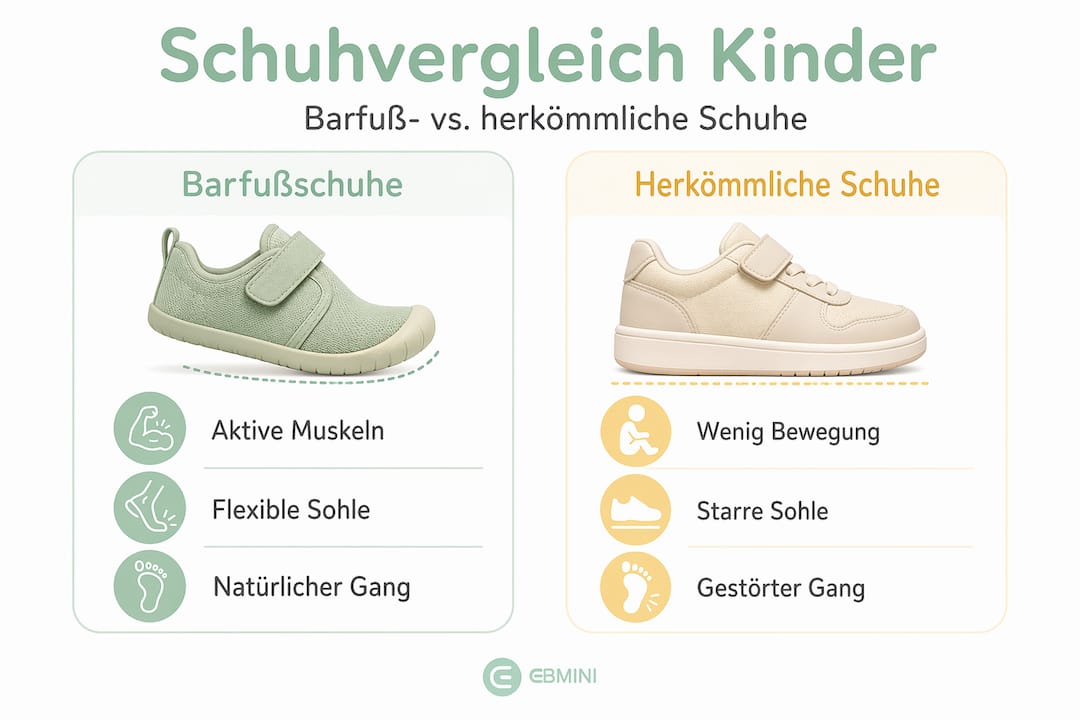
In Comparison: Barefoot Shoes Versus Traditional Children's Shoes
The decision isn't a matter of "right or wrong," but of context and developmental stage.
| Feature | Barefoot Shoes | Traditional Children's Shoes |
|---|---|---|
| Foot Muscle Activation | High | Low to medium |
| Sensory Perception | Very high | Cushioned |
| Break-in Period | 4 to 6 weeks | Immediately wearable |
| Protection from cold and wet | Model-dependent | Usually good |
| Stability Support | Low | Medium to high |
| Risk of Spraining | Increased | Reduced |
| Suitable for Foot Deformities | Only with medical advice | Often better suited |
| Natural Toe Position | Very good | Often restricted |
Barefoot shoes offer less stability than traditional shoes, which is why they are not ideal for children with weak muscles. This is not an argument against barefoot shoes in general, but an argument for a thoughtful introduction.
How to introduce barefoot shoes effectively:
- Check the starting position: Does your child have healthy feet without diagnosed deformities? Then the introduction is uncomplicated.
- Choose the model consciously: Wide toe box, flexible sole, no heel drop, non-slip outsole. These are the minimum requirements.
- Start with short wearing times: The first week, a maximum of 20 to 30 minutes daily, then gradually increase.
- Prefer soft ground: Grass, forest floor, or sandy paths are ideal for getting used to them. Asphalt demands significantly more from the muscles.
- Observe reactions: If your child complains of calf pain, pressure points, or seems unsteady, slow down the pace.
Whether interchangeable insoles in children's shoes are necessary is a frequently asked question when transitioning to barefoot shoes, especially in colder seasons.
How Parents Can Effectively Use Barefoot Shoes for Their Children's Foot Development
Theory is good. Practice is better. Here are concrete steps that really work.
The right introduction step-by-step:
- Week 1 to 2: Barefoot shoes only for short activities: playing in the garden, a walk in the park, a maximum of 30 minutes. Start with 15 to 30 minutes daily and gradually increase wearing time on soft surfaces.
- Week 3 to 4: Increase duration to 45 to 60 minutes if no discomfort occurs. First excursions on pavement are possible.
- From Week 5: Barefoot shoes can be worn for most of the day. Nevertheless, it's important to alternate between barefoot shoes and traditional shoes, and watch for pain or instability.
Pro Tip: Let your child choose. Children have a good sense of their bodies. If a child wants to take off their barefoot shoe after a short time, that's a clear signal, not bad will.
Which surfaces are suitable when?
- Ideal for getting used to: Grass, forest floor, sandpit, indoor floors
- Suitable after getting used to: Cobblestones, gravel, slightly uneven paths
- With caution: Long walks on asphalt, very uneven terrain in the early stage
Seasonal selection:
For winter, you need models with warming insoles and water-repellent materials, without the sole suddenly becoming thicker and stiffer. Models with vegan, thin soles and weatherproof materials are well-suited for different seasons. The winter barefoot shoes at Ebmini combine both.
Warning signs you should take seriously:
- Complaints of pain in the calf, Achilles tendon, or ball of the foot
- Visible limping or altered gait
- Blisters or pressure points beyond normal adaptation
- Unstable walking on uneven terrain after several weeks
You can learn more about fit and comfort in barefoot shoes in the detailed guide.
Important Tips and Myths About Barefoot Shoes for Children
There are persistent misunderstandings that either instill too much expectation or unnecessary skepticism in parents.
What barefoot shoes can do:
- Strengthen and activate foot muscles
- Support natural toe alignment
- Train sensorimotor skills and balance
- Promote joy of movement and body awareness in children
What barefoot shoes cannot do:
- Barefoot shoes are not a substitute for therapeutic insoles and are not suitable for certain conditions like polyneuropathy. This is not a product limitation, but a medical fact that parents should know.
- "Heal" existing flat feet or other orthopedic problems
- Protect joints on hard asphalt long-term like cushioned shoes do
Myth 1: Barefoot shoes always look strange. Not anymore. Visually appealing models specifically for children are on the market, hardly distinguishable from regular sneakers. Children are more willing to wear them if they also like them.
Myth 2: Everyone can switch to barefoot shoes immediately. This is the most common mistake. The foot needs to adapt. Muscles, tendons, and joints that have worked for years in cushioned shoes need time. This also applies to young children, whose bodies are more adaptable, but still deserve respect for the process.
Myth 3: Barefoot shoes are dangerous for infants and toddlers. False. As soon as a child takes their first steps, from about one year old, barefoot shoes can be the ideal first shoe choice because they restrict little and actively support the development of the arch.
Myth 4: More expensive automatically means better. The cost of barefoot shoes varies widely. Quality features like sole flexibility, toe box width, and breathable materials are more important than the price. Always prioritize function over brand. Ebmini's detailed buying and usage tips explain what specifically matters for children's shoes.
Perspective: Why Barefoot Shoes Are More Than a Trend
The honest observation after years of dealing with children's foot health is this: barefoot shoes are not a miracle cure, but they are also not a hype without substance. The truth is more concrete.
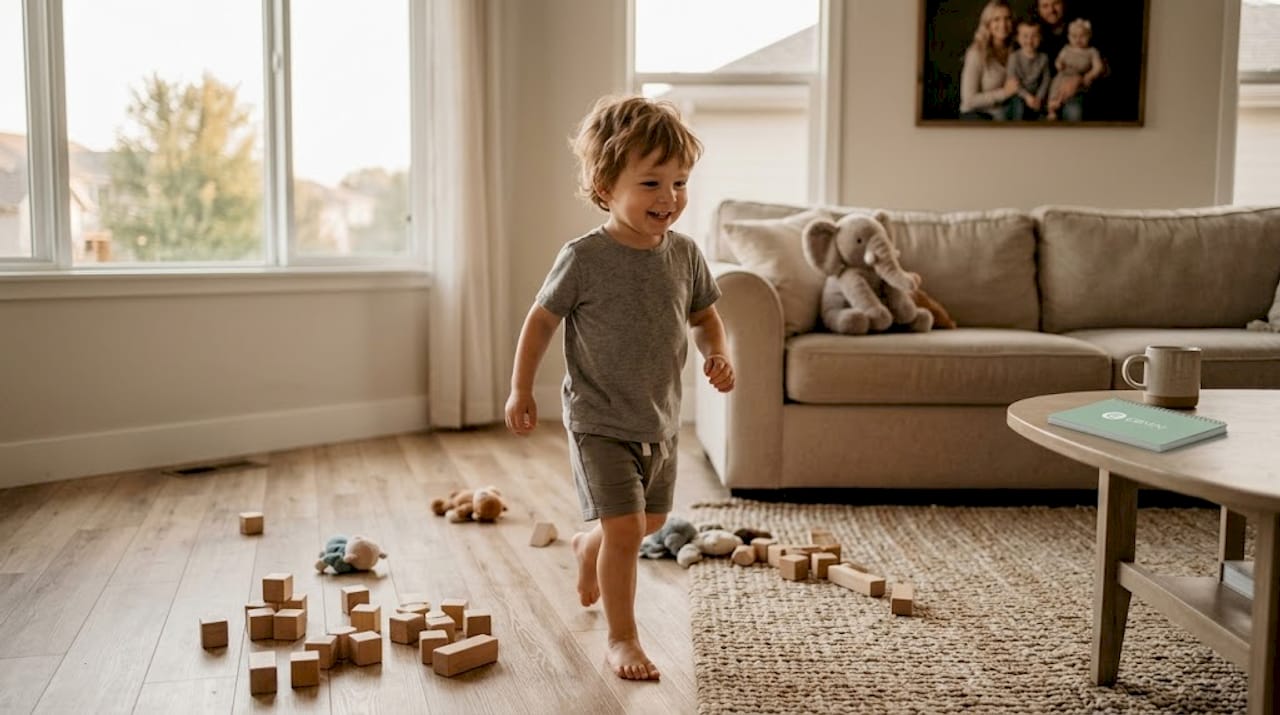
Children are naturally barefoot walkers. Observe a toddler let loose at home. They immediately walk barefoot. They seek ground contact. They climb, feel, sense. Barefoot shoes respect this instinct, while traditional shoes often systematically suppress it.
What is often overlooked: the emotional component is at least as important as the biomechanical one. Children in barefoot shoes move more. They want to run, climb, and be outside more. This is no coincidence, but the result of a better body feeling. More movement means more development, not just of the feet, but of the entire musculoskeletal system and coordination.
A second often neglected point is the seasonal strategy. Many parents buy barefoot shoes in summer and don't think about them again in winter. Consistent use across all seasons is key to lasting effects. A soaking wet, cold foot in the wrong winter shoe not only hinders the urge to move but also sensory development.
What we repeatedly notice in practice is that parents who transition too slowly often give up frustrated. And parents who increase too quickly report pain and skepticism. The middle ground, meaning practical tips for use combined with genuinely observing your own child, reliably leads to positive results.
Switching between barefoot shoes and well-fitting conventional shoes is not a weakness. It is the smartest strategy. No orthopedist in the world recommends only barefoot shoes for every child in every situation. But almost all agree that more barefoot contact in children's daily lives benefits foot development when dosed appropriately.
Healthy Barefoot Shoes for Children from Ebmini – Sustainable Choice for Every Season
You now know what matters for developmental support through barefoot shoes. Now the practical question arises: Which shoe actually meets all requirements, i.e., a flexible sole, wide toe box, zero drop, and suitability for everyday use across all seasons?
At Ebmini Children's Barefoot Shoes, you'll find a collection specifically developed for these requirements. Ultralight, non-slip, and water-repellent models that combine foot health and freedom of movement. For spring, there are spring barefoot shoes for children, breathable and light. In winter, winter barefoot shoes protect with warming materials without a stiff sole. And for hot summer days, summer barefoot sandals are the ideal choice. Your child can safely and naturally explore their world, season after season.
Frequently Asked Questions about Barefoot Shoes and Developmental Support
At what age are barefoot shoes suitable for children?
Barefoot shoes measurably train foot muscles in children between one and ten years old if the transition is done carefully. From about one year old, as soon as your child takes their first steps, use can begin with short wearing times.
How long does it take for barefoot shoes to show positive effects?
Positive effects on foot musculature usually appear after four to six weeks if your child wears the shoes regularly and in moderation. Forcing faster results by wearing them longer usually leads to muscle fatigue instead of progress.
Are barefoot shoes suitable for children with foot deformities?
Barefoot shoes are not a substitute for therapeutic insoles, which is why you should always consult a doctor or orthopedist first for foot deformities before making a switch.
How do I choose the right barefoot shoes for different seasons?
Models with vegan soles and weather-resistant materials are well suited for all seasons. In summer, breathable sandals are ideal; in winter, warming and water-repellent models with thin, flexible soles.
Can I use barefoot shoes every day for my child?
Alternating between barefoot shoes and regular shoes is important for a gentle transition and prevents overuse. Daily use is possible, but only once the adjustment period is complete and no discomfort occurs.


