

Preventing Insoles in Children: Reasons and Better Alternatives
No, routine insoles are usually not necessary for healthy, pain-free children's feet. The AWMF S2k guideline and the German Society for Orthopaedics and Trauma Surgery (DGOU) support this assessment with clear figures.
- Developmental norm instead of malformation: Most children show a flatfoot at around 19 months of age, but less than 2% actually develop symptoms later.
- Guidelines advise against precautionary intervention: The S2k guideline recommends no specific therapy for a painless, flexible foot, especially not before the age of 6.
- Exception: Pain, a stiff foot, or neuromuscular causes are different cases. Here, a specialist medical clarification is advisable, and insoles can be part of the treatment.
Key Takeaways
Healthy, pain-free children's feet usually do not need insoles, according to the AWMF guideline and DGOU, but rather movement, barefoot time, and appropriate shoes.
| Topic | Details |
|---|---|
| Flatfoot is normal | Most children show a flatfoot at around 19 months, usually without pathological significance. |
| Insoles only for clear indications | Pain, stiff foot, subluxation, or neuromuscular causes justify a specialist prescription. |
| Movement instead of support | Barefoot time, toe exercises, and varied surfaces train the foot muscles more effectively than passive insoles. |
| Shoe check every three months | Flexible sole, wide toe box, and loose heel counter should be checked regularly. |
| Ebmini as a supportive choice | Ebmini builds barefoot shoes with flexible soles and a wide toe box that support healthy foot development without replacing medical clarification. |
Table of Contents
- Why insoles often do more harm than good for children
- When insoles can be medically useful
- What you can do instead of insoles: exercises, barefoot time, and the right shoe choice
- Red Flags: When to consult a specialist promptly
- Overview: What guidelines and studies actually say
- Daily Checklist for Parents
- Our stance on insoles and natural foot development
- Why a barefoot-like sole is better than a precautionary insole
- Sources
- FAQ
Why insoles often do more harm than good for children
A child's foot learns through stress. Every step on uneven ground, every toe grip on a pebble trains the muscles, tendons, and sensory system that later support the arch of the foot. If this stimulus is replaced by a fixed shell before it is necessary, precisely the training that makes the foot stable is missing.
Pediatric orthopaedic specialists such as Dr. Eva Scheerer-Harbauer and Dr. Matthias Rogalski describe the flexible flatfoot as a transitional phase, not a disorder. Prof. Dr. Anna-Kathrin Hell, coordinator of the AWMF guideline, sums it up perfectly:
"As much freedom as possible, as much protection as necessary." Barefoot walking is considered the gold standard for foot development, not early external support.
Early support can lead to muscles and tendons not adapting to the extent they would without aids. In the long term, this makes the foot shape more unstable, not more stable. And a child who has become accustomed to an insole rarely unlearns dependence on it.
Pro Tip: Observe toe standing: If your child can stand on their toes and the arch of the foot lifts, this is almost always a good sign of a healthy, flexible foot.
When insoles can be medically useful
A prescription is not a mistake of nature, but sometimes the right response to a real problem. The guideline mentions specific indications where insoles make sense:
- A painful foot, regardless of the child's age.
- A stiff, inflexible foot instead of the typical mobile flatfoot.
- Subluxation in the tarsal area or lack of arch formation during toe standing.
- Neuromuscular diseases where high-walled insoles or DAFO are used as part of multimodal therapy.
Under 6 years of age: Without pain and without these abnormalities, a flexible flatfoot does not require routine care. A custom-made insole should always be prescribed only after a specialist medical examination, not on suspicion or out of pure caution.
What you can do instead of insoles: exercises, barefoot time, and the right shoe choice
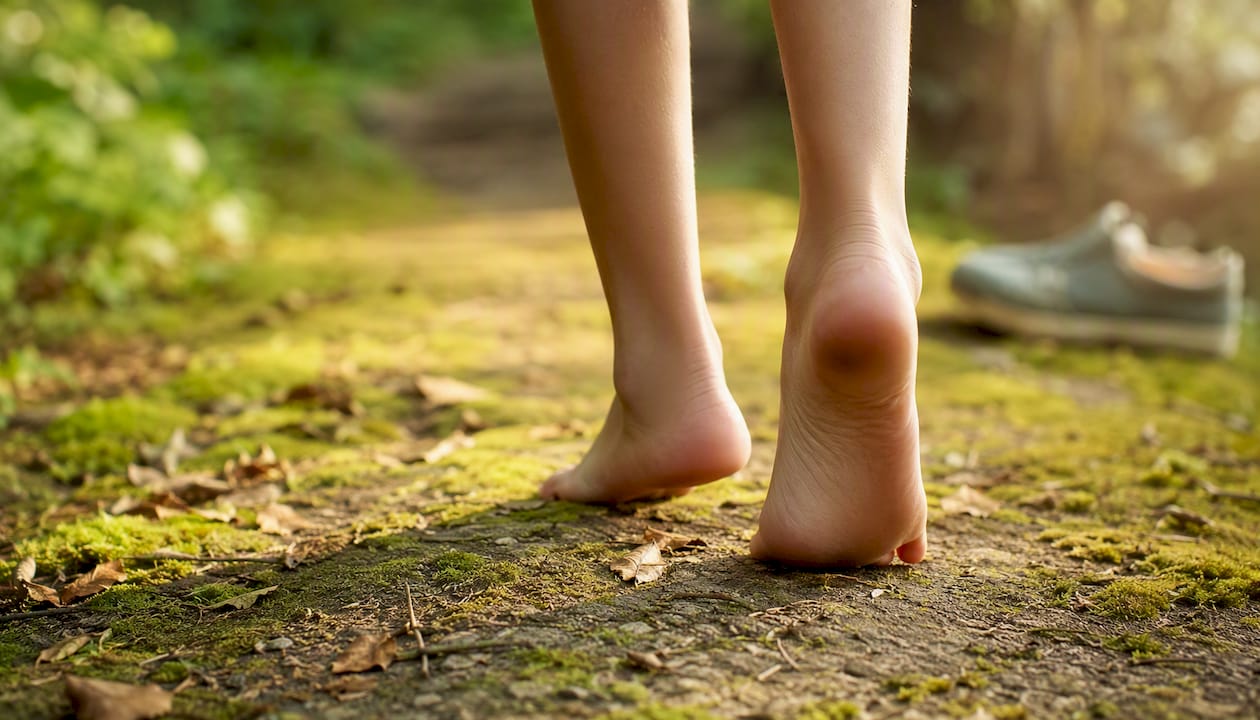
Movement beats support material. Barefoot walking on safe surfaces, in the garden, on the beach, or on forest ground, challenges the foot muscles in a way that no aid can replace. The DGOU points out that varied surfaces and plenty of movement are the central measures for healthy children's feet, not orthopedic accessories.
These four exercises can be playfully integrated into daily life:
- Grab small objects (marbles, cotton balls) with your toes and place them in a bowl.
- Walk a few steps on tiptoes and then on your heels.
- Balance along a rope or line on the floor.
- Walk barefoot over different surfaces, grass, sand, gravel, to challenge sensory perception.
When shoes are necessary, the design determines the benefit. Four points are sufficient for a check:
- The sole can be easily twisted and bent by hand.
- There is space for the toes in front, at least a thumb's width of reserve.
- The heel sits loosely, without a hard support shell.
- Check the fit every three months; children's feet grow faster than many think.
Pro Tip: Supportive shoes can weaken muscles rather than strengthen them in young children. The more flexible the sole, the more training stimulus the foot receives with every step.
Red Flags: When to consult a specialist promptly
Some signs should not be ignored. These include:
- Persistent pain in the foot or leg.
- Your child refuses to walk or limps.
- A unilateral deformity, only one foot affected.
- A stiff foot that does not straighten when standing on tiptoes.
- Frequent ankle sprains or an unusual gait.
At the specialist appointment, a physical examination usually follows, and imaging if necessary, to rule out differential diagnoses such as tarsal coalition or neuromuscular causes. Take a moment before the appointment: note down how long the abnormality has existed, make a video of the gait, and bring a well-worn pair of shoes; the wear on the heel often shows how your child steps.
Overview: What guidelines and studies actually say
The core statement of the AWMF guideline is clear: the flexible, pain-free flatfoot does not require specific therapy, and insoles are not routinely necessary.
A Cochrane review (Evans et al., 2022) classifies the quality of evidence for the benefit of sensorimotor insoles in healthy, asymptomatic children as low to very low.
In practice, this means:
- The guideline's recommendation against routine insoles in pain-free cases is strongly supported by experts.
- Active measures such as exercise and foot gymnastics are considered more effective than passive support.
- Sensorimotor insoles are often marketed as an "active" solution but do not replace muscle training through real stress.
Daily Checklist for Parents
These points can be easily incorporated into your weekly routine:
- Spend some time barefoot every day, indoors and outdoors.
- Include one to two short foot exercises per week.
- Check shoes for sole flexibility, toe room, and heel fit.
- Keep an eye on weight and general activity level.
Pro Tip: Place the old insole of the shoe on the floor and have your child stand on it. If the toes extend significantly beyond the edge, the shoe is too small – a simple trick for size control every three months.
Our stance on insoles and natural foot development
At Ebmini, we build children's shoes precisely according to the principle recommended by guidelines and specialists: as much freedom of movement as possible, as little artificial support as necessary. This does not replace a medical evaluation. In case of pain or a stiff foot, the first step should be to a specialist, not to the shoe shelf.
Our shoes are intended as a supplement, as an environment that does not hinder the foot in its own training. This also includes honest size advice so that parents do not have to guess whether a model still fits.
Why a barefoot-like sole is better than a precautionary insole
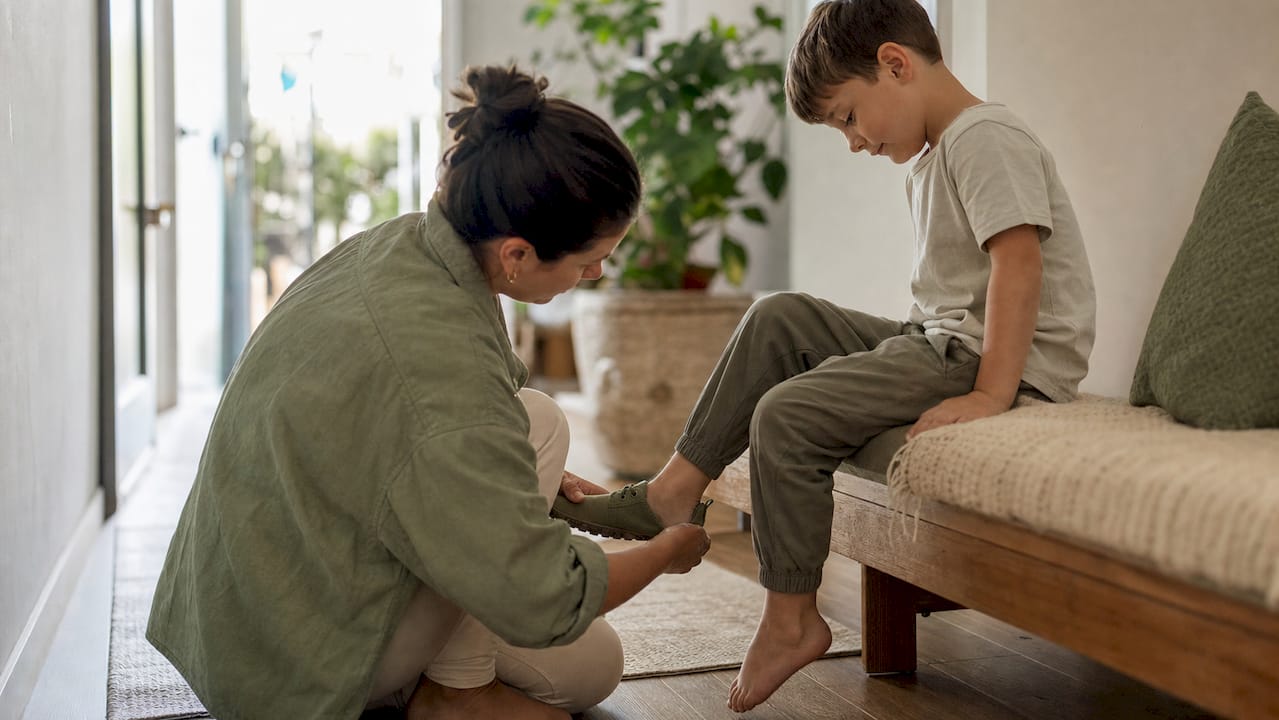
If your child's foot is healthy and pain-free, the right sole offers more than any precautionary support. Flexible soles support precisely the muscle work that guidelines recommend for natural development, instead of replacing it.

Ebmini's children's barefoot shoes are built with a wide toe box, zero drop, and a sole that twists like a towel instead of a board. For outdoors, puddles, and changing weather, the waterproof OTD model combines a barefoot feel with protection from wetness. The disclaimer remains important: these shoes support healthy, pain-free feet in their natural development; they do not treat ailments. If your child experiences pain or a noticeable deformity, the first step should be to a pediatric orthopedist. Afterward, you can calmly consider the right size and model for your child's daily life.
Sources
For in-depth questions, it is worth looking at the primary sources themselves.
- AWMF Guideline: Pediatric Flatfoot (Registry Entry)
- DGOU: Barefoot walking promotes healthy children's feet
In case of red flags, a local pediatric orthopedic consultation should always follow, not self-diagnosis. If you want to learn more about suitable shoes, you can find practical purchasing criteria in the Parent's Guide to Children's Shoes.
This article contains general information and does not replace consultation with a qualified physician. Consult a qualified medical professional regarding your personal situation before acting on the basis of this content.
FAQ
Should I give my child insoles as a precautionary measure?
No, for a healthy, pain-free foot, the AWMF guideline and DGOU advise against precautionary measures, especially under 6 years of age.
From what age is a flatfoot normal?
A flexible flatfoot is part of normal development up to about 6 years of age and often resolves spontaneously.
What symptoms require a doctor's visit?
Pain, a stiff foot, a unilateral deformity, or a child refusing to walk are reasons for prompt specialist medical evaluation.
Can barefoot shoes replace insoles?
Barefoot shoes like those from Ebmini do not replace medical treatment, but they support natural foot muscles in healthy, pain-free feet through flexible soles and plenty of freedom of movement.
How often should I check my child's shoe size?
Checking every three months is advisable, as children's feet often grow faster than the old shoe size would suggest.


