

Flexible Soles: Benefits for Children's Foot Development
Flexible soles are the most important feature of a child-friendly shoe, because they allow the foot to move completely with every step. Rigid soles take over this work and let the foot muscles atrophy. This is precisely the problem: the foot is not strengthened, but the shoe replaces its work. Barefoot-like shoes with thin, flexible soles, a wide toe box, and no heel drop follow a different principle. They let the foot work as it naturally would. This parent guide explains the benefits of flexible soles for the foot development of children between 1 and 10 years old, how to identify good shoes, and how to transition safely.
What advantages do flexible soles offer for children's foot development?
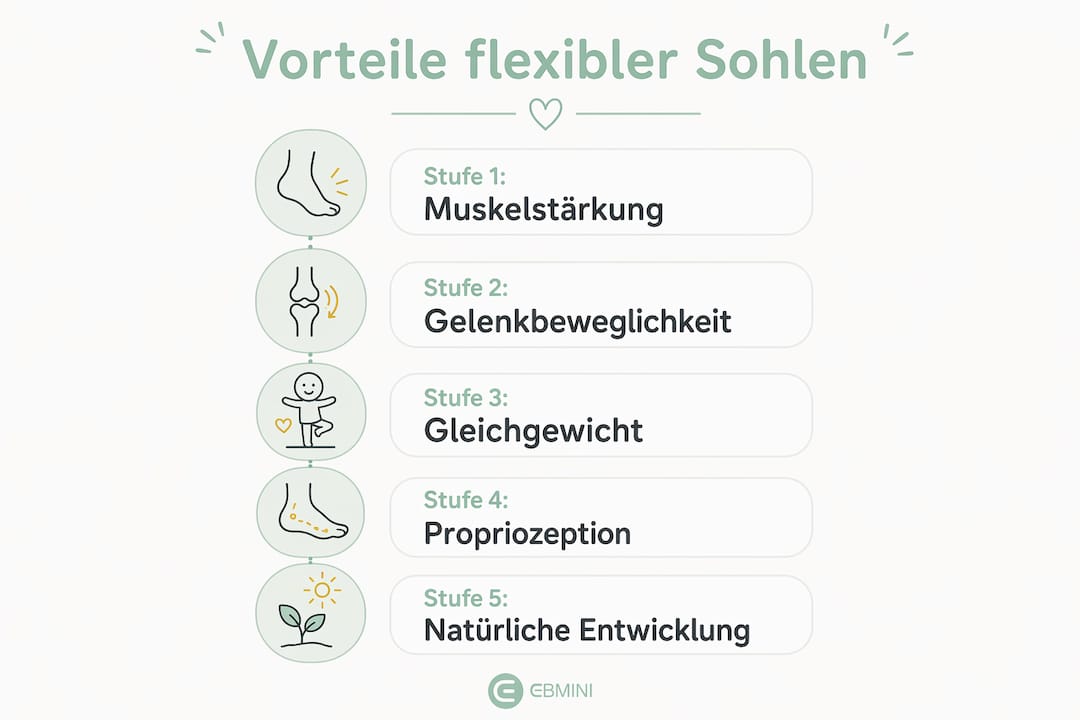
Flexible soles promote foot development because they allow muscles, tendons, and joints to work actively. A shoe with a flexible sole does not provide a rigid framework for the foot. The foot must stabilize itself, roll off, and maintain balance.
Especially important here is proprioception. This is the body's ability to sense its own position in space. Flexible soles significantly improve this body awareness because the sole of the foot receives more information from the ground. This improves balance, posture, and natural gait in growing children.
There is another effect: Children in rigid shoes show a longer ground contact time when walking. This indicates an unnatural gait. Flexible soles enable a fluid roll-off from the heel over the midfoot to the toe, as intended by the body.
The key advantages at a glance:
- Muscle strengthening: Small foot muscles, calves, and tendons are trained with every step.
- Improved balance: Sensory feedback from the ground actively trains balance.
- Natural roll-off: The foot moves without artificial guidance from the shoe.
- Joint mobility: Ankle and toe joints remain flexible and are not restricted.
- Avoid incorrect loading: Without a rigid sole, no unnatural pressure points arise.
Proprioceptive exercises such as toe gripping or standing on one leg further enhance this effect. So, if you let your child play barefoot on grass or sand, you give the foot even more training stimuli.
Pro tip: Observe your child walking without shoes. If they walk on their tiptoes or hardly put their heels down, this can be an indication of shortened calf muscles. Flexible soles and regular barefoot phases help to compensate for this.
How to recognize high-quality flexible soles for children's feet?
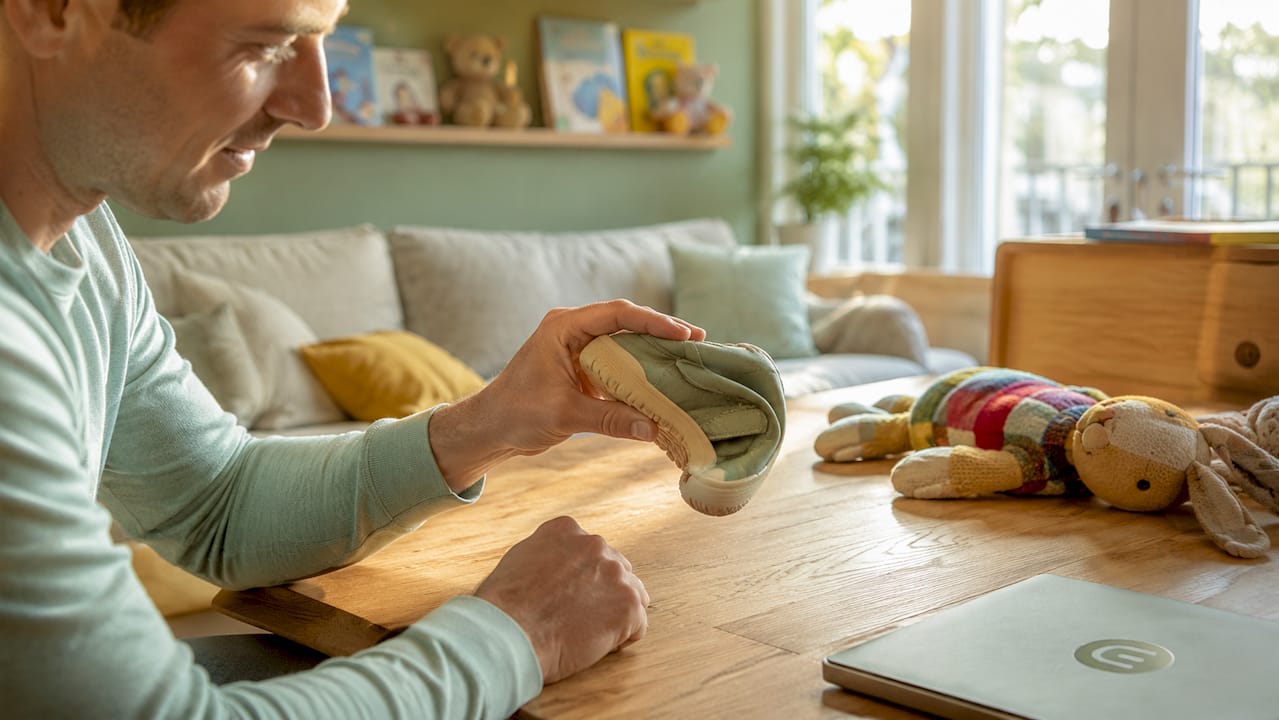
A good shoe with a flexible sole can be checked with two simple tests. The first is the bend test: Hold the shoe at the toe and heel and bend it. It should fold easily, without resistance. The second is the torsion test: Twist the front and back of the shoe against each other. Both the bend and torsion tests are established methods for checking the quality of children's shoes. If a shoe fails either of these tests, the sole is too stiff.
In addition to flexibility, there are other features parents should look for:
- Wide toe box: The toes must be able to spread without pressing against the material.
- Thin sole: The thinner, the more the foot feels the ground.
- No heel drop: The heel should not be higher than the toe. Experts call this “zero drop.”
- Lightweight: Heavy shoes tire children's feet quickly and change their gait.
- At least a thumb's width of toe freedom: Safety and toe freedom protect the growing foot from pressure points.
The sole flexibility should also match the child's age. The needs change with age: babies and toddlers need very soft, flexible soles. Older school children benefit from a little more stability, which still allows flexibility.
| Age Group | Sole Flexibility | Important Features |
|---|---|---|
| 1–2 Years | Very soft, maximally flexible | Hardly any sole, wide toe box, no heel |
| 3–5 Years | Soft to moderate | Thin sole, non-slip bottom, lightweight |
| 6–10 Years | Moderately flexible | Slightly more structure, but no rigid frame |
Pro tip: Never buy children's shoes in advance in a size that does not yet fit. A shoe that is too big changes the gait just as much as a shoe that is too stiff.
Ebmpini has compiled a detailed parent guide to shoe selection with orthopedic recommendations, if you want to delve deeper.
How to safely accustom children to flexible soles?
The transition to shoes with flexible soles takes time. Foot muscles and tendons that have previously worked little need to adapt first. Medical recommendations advise starting with 30-60 minutes daily to avoid overuse. This is especially true for children who have previously worn rigid shoes.
Typical adaptation reactions include calf muscle soreness and a pulling sensation in the sole of the foot. These discomforts are common when transitioning to barefoot shoes because muscles and tendons suddenly have to work more actively. This is not an alarm signal, but a sign that the foot is working.
Here's how to get started step by step:
- Week 1–2: Wear flexible shoes for 30–60 minutes daily, for example, when playing in the garden.
- Week 3–4: Extend wearing time to 2–3 hours if no discomfort occurs.
- From week 5: Use flexible shoes for longer outings and the way to school.
- In parallel: Incorporate regular barefoot phases at home on different surfaces.
- Observe: Regularly monitor the child's gait, posture, and well-being.
If your child complains of persistent pain after wearing flexible shoes or if their gait deteriorates, you should consult a pediatrician or orthopedist. Mild muscle soreness is normal. Joint or bone pain is not.
Barefoot phases at home complement the effect of the shoes. On grass, sand, or gravel, the foot receives the strongest training stimuli. Indoors, a smooth floor is sufficient to activate the toe muscles.
Pro tip: Make the transition playful. Let your child pick up marbles with their toes or stand on a balance cushion. This strengthens foot muscles and is fun.
Ebmini has compiled further concrete steps for safe acclimatization in a separate guide.
What mistakes should parents avoid when it comes to flexible soles?
The most common misconception is the belief that a supportive, rigid shoe provides more security for a child's foot. The opposite is true. Shoes that are too rigid weaken the foot muscles because they take over the work that the foot should actually be doing. Dr. Mellany Galla emphasizes that flexible shoes can train foot muscles, but do not possess universal healing properties. In case of existing complaints, medical advice is irreplaceable.
Other common mistakes parents make:
- Too quick a transition: Switching directly from a rigid shoe to a thin barefoot sole risks overuse.
- Ignoring age differences: A shoe that fits a school child is too inflexible for a toddler. And vice versa.
- Too narrow a toe box: If the toes don't have room, the flexible sole loses its benefit. The foot cannot spread naturally.
- Underestimating the heel: Even a small heel changes posture and stresses the knees and hips.
- Buying shoes that are too big: Parents often buy in advance. A shoe that is too big drags and changes the gait.
Pro tip: Check your child's shoe for fit every 6–8 weeks. Children's feet grow quickly. A shoe that is too tight causes more harm than no shoe at all.
Those who strive for natural foot health for their child should know and actively avoid these mistakes. The good news is that most can be easily avoided with a little attention.
Important Findings
Flexible soles promote the natural foot development of children because they actively train muscles, balance, and body awareness, while rigid soles take over this work and hinder development.
| Topic | Details |
|---|---|
| Key benefit of flexible soles | Foot muscles, tendons, and sense of balance are actively trained with every step. |
| Quality check | Bend and torsion tests by hand show whether a sole is truly flexible enough. |
| Age-appropriate selection | Babies need maximum flexibility, school children benefit from moderate stability with freedom of movement. |
| Safe transition | Start with 30–60 minutes daily and gradually increase wearing time over several weeks. |
| Most common mistake | Rigid, supportive soles weaken foot muscles and hinder natural development. |
What I've learned after years with children's shoes
At Ebmini, we often hear the question: "Isn't my child too young for barefoot shoes?" The answer is almost always no. Toddlers who are just learning to walk benefit most from a thin, flexible sole because their feet are still in their strongest growth phase.
What truly surprised me after many years with parents and children's feet: most problems arise not from too little support, but from too much. A foot that never has to work itself never learns to. That sounds harsh, but it's biomechanically clear.
I recommend parents see the shoe as a tool, not as a protective shield. A good shoe protects against sharp stones and cold. But it should interfere with the foot as little as possible. Wide toe box, thin sole, no heel drop. These are not compromises; they are the goal.
And one more thing: children give very clear signals. If a child constantly takes off their shoe, it's not defiance. It's feedback. Listen.
— Ebmini
Ebmini® barefoot shoes for healthy foot development
Ebmini specializes in barefoot-like children's shoes that implement exactly what foot researchers and orthopedists recommend: thin, flexible soles, wide toe box, zero drop, and lightweight. The range covers all age groups from 1 to 10 years and includes models for every season, from waterproof all-weather shoes to airy sandals.

All models are designed to protect the foot without restricting its freedom of movement. Parents can also find detailed sizing advice and customer reviews at Ebmini to help them choose. Check out the flexible children's shoes in the Ebmini shop and find the right model for your child.
FAQ
What are flexible soles in children's shoes?
Flexible soles are thin, pliable shoe soles that allow the foot to move fully with every step. They are the central feature of barefoot-like shoes and promote muscle strengthening and natural foot roll-off.
At what age are flexible soles suitable for children?
Flexible soles are beneficial from the first step. Toddlers need maximum flexibility, while school-aged children benefit from moderate flexibility with light stability.
How long does it take to get used to flexible soles?
The transition is best started with 30–60 minutes daily, gradually increasing the wearing time over several weeks. Mild calf muscle soreness is normal and no cause for concern.
Can flexible soles prevent flat feet in children?
Flexible soles support the natural development of the foot arch because they actively train the foot muscles. However, they do not replace medical treatment for existing deformities.
How do I check if a child's shoe is truly flexible?
Bend the shoe at the toe and heel: it should fold easily. For the torsion test, twist the front and back of the shoe against each other. If the shoe barely yields, the sole is too stiff for children's feet.


