

Children's Footbed Sandals: Flat or Shaped?
Flat footbed sandals promote the healthy development of children's feet better than strongly molded footbeds. This is not an opinion, but a clear recommendation from pediatric orthopedics: Passively supportive footbeds can hinder muscle development because the foot no longer has to do any work itself. When it comes to flat versus molded children's footbed sandals, it's not about taste, but about physiology. Parents who buy their child a sandal with a strongly molded footbed mean well, but often do their foot no favors.
What are the effects of flat and molded footbeds on children's foot development?
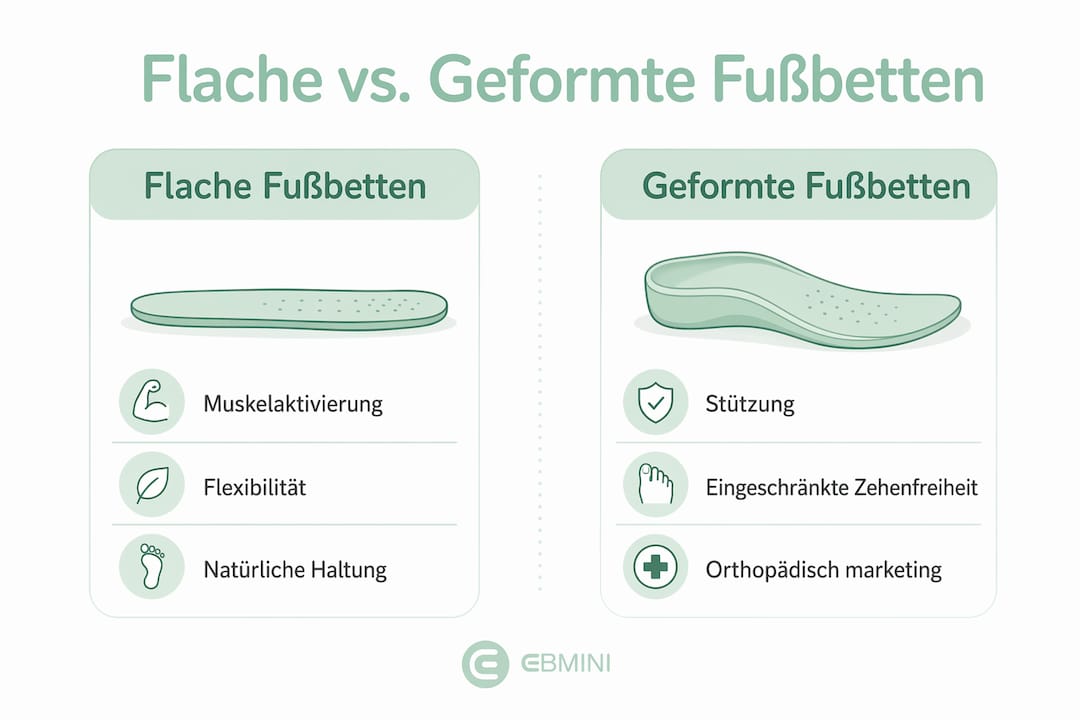
Flat footbeds activate the foot muscles, while molded footbeds replace them. That is the crucial difference. A child's foot is not an adult's foot with growth potential. It is an active organ that learns to stabilize itself through movement, pressure, and strain.
Barefoot sandals strengthen the foot muscles and promote balance when walking through a natural sole shape. Children who regularly walk in flexible, flat sandals develop better body stability than children in stiffly molded models. This is because every unevenness of the ground acts as a small training stimulus for the foot muscles.
The zero-drop principle describes a sole where the heel and forefoot are at the same height. Molded footbeds, on the other hand, often have a heel lift and a so-called drop. This construction changes natural posture and puts long-term unfavorable strain on knee joints and the spine.
Then there's the toe box. Tight molded footbeds restrict toe splay, which creates pressure points and prevents the natural power development during push-off. A wide toe box gives the toes room to splay and actively participate in walking.
Pro-Tip: Let your child walk barefoot for a short time and observe how they splay their toes when pushing off. This is exactly the movement a good sandal needs.
The most important features of flat sandals at a glance:
- Flat sole without heel elevation (zero drop)
- Wide toe box for free toe movement
- Flexible sole that adapts to the foot
- No molded arch support
- Lightweight, so it doesn't burden the foot
How do I recognize a well-fitting sandal for my child?
Fit is the most important purchasing criterion for children's sandals. Not the price, not the design. A poorly fitting sandal harms the foot, no matter how well the footbed is constructed.
The first guideline: children's sandals should offer 10–12 mm of space in front of the longest toe. This distance allows for natural rolling and gives the foot room to grow. Less space compresses the toes, more space causes the foot to slide in the shoe.
A common mistake when buying: parents only measure foot length. Shoe width is a three-dimensional measurement that also takes into account instep height and foot volume. A child with a wide, high foot needs a different sandal than a child with a narrow, flat foot, even if both have the same length.
How to measure correctly:
- Measure in the afternoon: Feet swell during the day. Measuring foot length in the afternoon gives the most realistic value for everyday use.
- Take the larger foot: No two feet are exactly alike. The larger foot determines the shoe size.
- Measure foot length on paper: Have the child stand on a piece of paper, mark the heel and longest toe, measure the distance.
- Check width: Press thumb and forefinger on the side of the shoe. The foot should not bulge out sideways.
- Perform a bend test: Bend the sole in the forefoot area with two fingers. The sole should be easily bendable at the front, but not buckle in the middle.
Pro-Tip: Let your child walk a few steps in the new sandal before you buy it. If they trip or hold their foot awkwardly, the sandal doesn't fit, no matter what the size chart says.
Closure systems also play a role. Velcro fasteners can be quickly adjusted and hold the foot securely in the sandal. Straps that can be individually adjusted are particularly helpful for children with unusual foot shapes. It is important that the foot neither slips nor is pinched.
Advantages and disadvantages of flat and molded footbed sandals in everyday life
Both types of sandals have their justification. But they don't suit the same situations or the same children.
Flat sandals with flexible soles are the first choice for healthy children's feet in everyday life. They allow natural rolling movements, activate the foot muscles, and let the foot work as it should. Children who walk, climb, and play a lot benefit directly from this. The only disadvantage: on very uneven or sharp-edged surfaces, thin, flat soles offer less protection than thicker models.
Molded sandals with an integrated arch support and heel elevation are often marketed as "orthopedic". This sounds good, but it is generally not useful for healthy children's feet. Passively supportive footbeds can inhibit muscle development because the foot no longer has to do the supporting work itself. For children with a diagnosed foot deformity, a molded footbed may be useful after medical recommendation. For everyone else, it is usually superfluous.
| Feature | Flat Sandals | Molded Sandals |
|---|---|---|
| Muscle Activation | High, foot works actively | Low, support does the work |
| Toe Freedom | Great, wide toe box possible | Often restricted by shape |
| Posture | Natural due to zero drop | Changed by heel elevation |
| Area of Use | Everyday, playing, sports | Only with medical recommendation |
| Price | From approx. €20, solid models €40–70 | Often more expensive due to molded construction |
Regarding price: children's sandals start at approx. €20, solid models are between €40 and €70, premium models over €80. Cheaper models often show weaknesses in material quality and fit. This does not mean that expensive automatically means healthy. But below €30, the probability is high that sole flexibility and toe box are not correct.
For healthy foot development, sole flexibility is more important than any footbed shape. A stiff sole, whether flat or molded, blocks natural rolling motion. This is the mistake many parents overlook when buying.
Which materials and features promote foot health?
The material of a child's sandal not only affects comfort but also the foot's health. Synthetic materials can cause excessive sweating in warm conditions, which promotes fungal infections and significantly reduces wearing comfort.
Chrome-free tanned leather, breathable fabrics, and non-slip outsoles are the most important quality features for children's sandals. Leather adapts to the foot, regulates moisture, and is durable. Breathable textiles are lighter and dry faster, which is particularly practical in summer and when playing in water.
What to look for in terms of material:
- Leather or textile: Both materials are breathable and skin-friendly if they are of high quality.
- Non-slip outsole: Especially crucial for safety on smooth floors, tiles, or wet surfaces.
- Soft inner finish: No sharp seams or hard edges that cause pressure points.
- Adjustable straps: Allow for individual adaptation to different foot shapes and widths.
The wide toe box is not a luxury feature, but a basic prerequisite for healthy sandals. It gives the toes room to splay when walking and actively contribute to stabilization. Sandals with pointed or narrow toe boxes force the toes into an unnatural position, which promotes long-term deformities.
Closure systems should be child-friendly. Velcro fasteners are practical and can be operated by children themselves. Buckles offer more adjustment options but require more patience when putting them on. It is important that the closure holds the foot securely without constricting it. Sandals that clatter or slip when walking simply do not fit well enough.
For families who also pay attention to clothing quality: High-quality children's clothing such as breathable swimwear follows the same principles as good children's shoes. Material quality and fit determine comfort and durability.
Key Takeaways
Flat, flexible sandals with a wide toe box and zero-drop sole are the superior choice for healthy children's feet compared to molded footbeds with heel elevation.
| Topic | Details |
|---|---|
| Footbed type for healthy feet | Flat, flexible sole without heel elevation actively engages the foot muscles. |
| Correctly check fit | 10–12 mm space in front of the longest toe, foot measurement in the afternoon, take the larger foot. |
| Flexibility test as a quality feature | Sole in the forefoot area should be slightly bendable, not buckling in the middle. |
| Material selection | Chrome-free tanned leather or breathable textiles prevent sweating and pressure points. |
| Molded footbeds | Only useful for medically diagnosed foot deformities, not for healthy children's feet. |
What we've learned at Ebmini from practice
Many parents come to us with the conviction that a "good" footbed must be molded. This is understandable. The idea of giving the foot support sounds caring. But it's simply wrong for healthy children's feet.
What we repeatedly observe: Children who run in flexible, flat sandals from the beginning have better posture and stumble less often. This is because their foot has learned to work independently. This is not a coincidence; it is physiology.
The uncomfortable truth is that many expensive sandals with elaborately molded footbeds do less for the foot than a simple, well-fitting model with a flat sole and wide toe box. Parents often pay for a construction that offers no benefit to the child, and sometimes even harms them.
Our advice from daily experience: Trust your child's foot. It knows what it needs. Your task is to provide shoes that do not hinder it. A sandal with a barefoot feel is not a compromise between protection and freedom. It is both at the same time.
— Ebmini
Barefoot Sandals for Children at Ebmini
Ebmini has developed sandals that consistently feature flat soles, wide toe boxes, and zero drop. The range includes ultra-light, flexible models for children aged 1 to 10, which work equally well for everyday wear, outdoor play, and summer activities.
All models are made from breathable, skin-friendly materials and feature non-slip outsoles. The size guide on the website helps you find the right size, including information on width and foot volume. If you are looking for healthy children's sandals, Ebmini offers models that actively support natural foot development. For the youngest, there are also barefoot shoes for first steps, specifically designed to meet the needs of babies and toddlers.
FAQ
What is the difference between a flat and a molded footbed?
A flat footbed allows the foot to work freely and activates the muscles. A molded footbed passively supports the foot, which can inhibit natural muscle development in healthy children's feet.
At what age should children wear sandals with footbeds?
Children of all ages benefit from flat, flexible sandals. Molded footbeds are only useful for a medically diagnosed foot deformity, not as a general preventative measure.
How much space does a child's foot need in a sandal?
Children's sandals should provide 10–12 mm of space in front of the longest toe. This allows for natural rolling and gives the foot room to grow.
When should I measure my child's foot for shoe shopping?
Foot length should be measured in the afternoon, as feet swell throughout the day. The larger foot determines the shoe size.
Are expensive children's sandals automatically healthier?
No. Sole flexibility, toe box width, and fit are crucial, not the price. Solid models are available from approx. €40–70, but cheaper sandals can also meet these criteria.


