Detecting Foot Malposition on Shoes: A Guide for Those Affected
Look at the soles of your most-worn shoes. If the heel is significantly more worn down on one side than the other, or if the inner edge at the front looks truly scuffed through, then your shoe is telling you something important about your foot. Foot misalignments can be reliably detected by wear patterns on shoe soles long before pain occurs.
Typical warning signs at a glance:
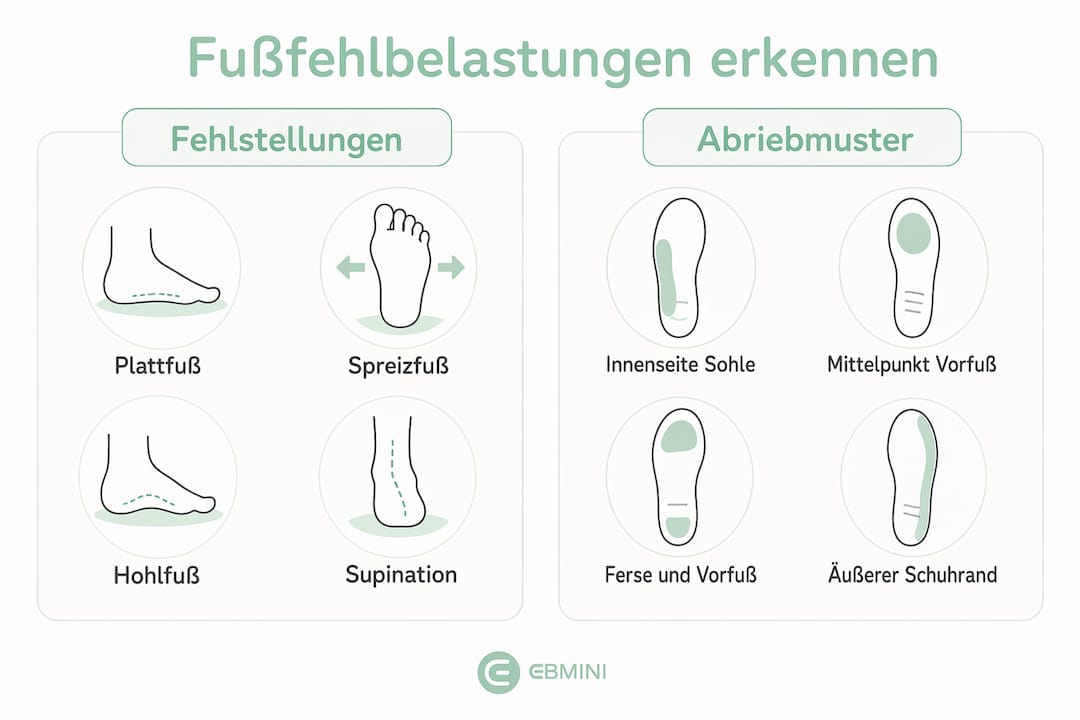
- Heavy wear on the inner edge of the shoe indicates overpronation (foot rolls too far inward).
- Wear on the outer edge points to supination or bow-leggedness.
- Localized wear under the mid-forefoot is a sign of splayfoot.
- Even wear only on the heel and inner forefoot is considered normal.
- Calluses in the same spots, pressure points, or altered toenails are early body signals.
- Pain with the first step in the morning or after prolonged sitting is among the early signs of misalignment.
- Altered gait, compensatory posture, or frequent ankle sprains are warning signs that should be taken seriously.
What foot deformities can be read from shoes?
Over 60% of the German population is affected by foot deformities, often due to ill-fitting footwear and weak foot muscles. The four most common deformities each leave a characteristic pattern on the shoe sole.
Flatfoot and Pes Valgus: The longitudinal arch is collapsed or completely fallen. The shoe wears down evenly on the inside from heel to forefoot, often so severely that it tilts slightly inward when removed. Affected individuals often report pain in the inner ankle and calf.
Splayfoot: The transverse arch in the forefoot is flattened. The wear is concentrated locally under the midpoint of the forefoot, not spread out. The insole also shows a characteristic bulge there. Calluses and pressure points under the middle metatarsophalangeal joints are typical.
Pes Cavus (High Arch Foot): The longitudinal arch is excessively high. The heel and forefoot are excessively loaded, while the midfoot area is barely used. On the shoe, this appears as two clearly separated wear zones, front and back, with little wear in the middle. Claw toes can occur as a concomitant symptom.
Supination: The foot rolls too far outward. The entire outer edge of the shoe is worn down, not just the rear area as with a normal gait.
| Deformity | Typical Shoe Sole Wear | Common Symptoms |
|---|---|---|
| Flatfoot / Pes Valgus | Inner side continuous, shoe tilts inward | Inner ankle pain, calf tension |
| Splayfoot | Localized under mid-forefoot, insole bulging | Calluses, pressure points under ball of foot |
| Pes Cavus | Two separate zones: heel and forefoot | Claw toes, heel spur |
| Overpronation | Heavy inner edge wear, shoe deformed | Knee pain, shin problems |
| Supination | Entire outer edge worn down | Ankle sprains, outer ankle pain |
Why do misalignments occur, and what are their consequences?
Ill-fitting footwear is one of the most common causes; other factors include muscle weakness, obesity, unilateral stress during sports, and predisposing conditions such as osteoarthritis or rheumatism. Injuries that have never fully healed can also permanently alter gait.
The consequences extend far beyond the foot. Foot misalignments trigger an ascending chain of cause and effect that can reach the knee, hip, and spine. For example, a misalignment of the heel can cause internal rotation of the lower leg and lordosis.
Ignoring misalignments risks chronic complaints:
- Pain in the knee, hip, and back due to altered body statics
- Plantar fasciopathy (heel spur) due to chronic overuse of the sole of the foot
- Tendon irritation at the inner or outer ankle
- Increasing calluses and pressure sores as a protective mechanism of the body
- Gait changes that become entrenched over time and are harder to correct
Pro Tip: Thickened calluses are not a cosmetic problem but a warning sign. Aggressively removing them without addressing the cause does more harm than good, as the body immediately rebuilds them.
How can misalignments be avoided, and when is professional help needed?
The right shoe choice is the most effective lever. Shoes should be bought in the late afternoon, when the feet are slightly swollen from the day. There should be exactly one thumb's width of space in the toe area, no more and no less. If you want to be sure, take out the insole and place your foot on it: if your big toe touches the edge, the shoe is too small.
Running shoes lose their cushioning after 500–800 km, even if the outsole still looks good. Wearing them longer means stressing your foot with a shoe that no longer performs its job.
Foot exercises strengthen the muscles that actively support the arch of the foot: toe-grasping exercises, rolling your feet on a spiky ball, or picking up small objects with your toes are simple but effective methods. Custom-made insoles can correct misalignments and improve the rolling motion.
Professional help from an orthopedist or podiatrist is necessary when:
- Pain persists for longer than 6–8 weeks despite appropriate footwear.
- Swelling, overheating, or pain at rest occurs.
- Gait has visibly changed.
- Children still show pronounced pes valgus after the age of six.
Pro Tip: Alternating several pairs of shoes relieves pressure on your feet and soles more evenly. Rotating two to three models with different sole characteristics is a simple measure with noticeable effects.
What experts and research data say about foot misalignment
The fact that more than 60% of Germans are affected makes it clear: foot deformities are not a fringe phenomenon. Many remain undetected for a long time because the symptoms initially appear elsewhere, in the knee, hip, or back.
A common misconception when buying shoes is the belief that tight shoes will stretch over time. They don't. Wearing shoes that are too small permanently changes your rolling pattern without you noticing. Podiatrists therefore emphasize that thickened calluses always require a cause analysis, not self-treatment.
Shoe sole analysis is a useful diagnostic tool but not a substitute for a clinical examination. Asymmetrical wear can indicate a deformity, but it is not necessarily conclusive. If you are unsure, you should bring your shoes to your doctor's appointment.
How can shoe wear be analyzed precisely?
For an initial assessment, a glance at the heel from behind is sufficient: if you place the shoe on a flat surface, a shoe that is tilted inward or outward already shows clear deformation due to misalignment. Photos of the sole, taken in even light, reveal wear patterns that might be overlooked at a casual glance.
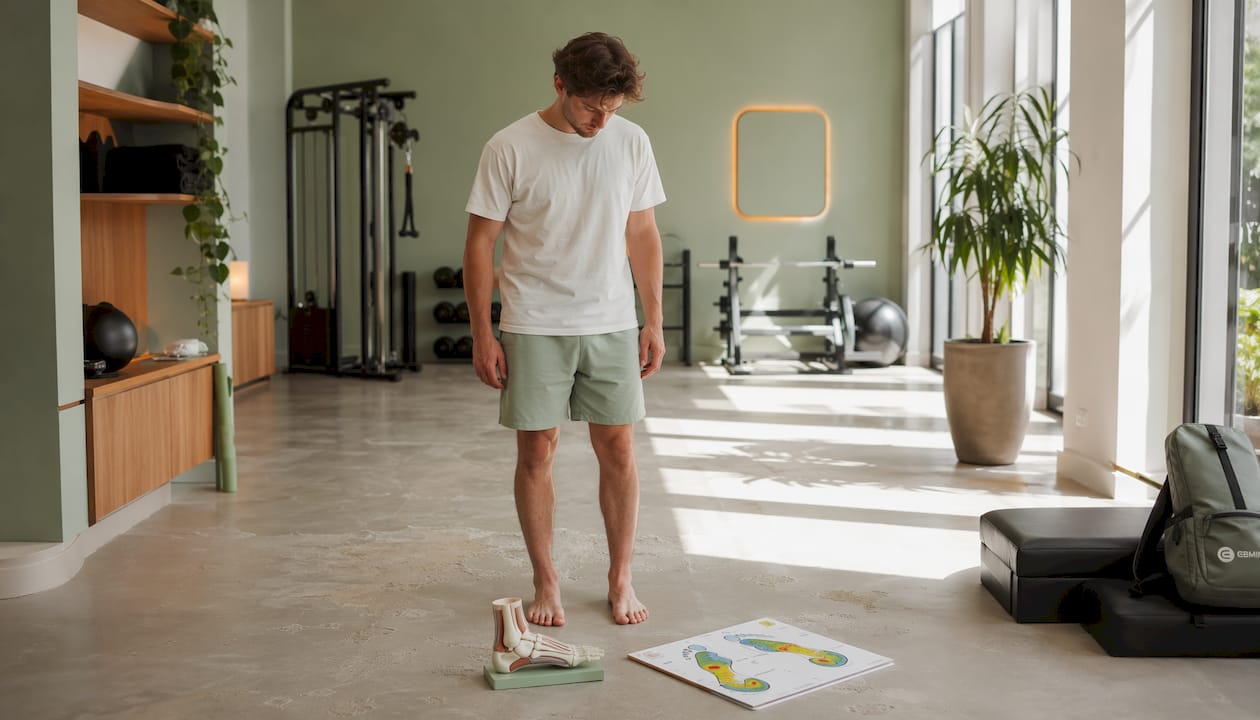
If you want to know more precisely, you can create a barefoot imprint: lightly moisten the sole of your foot and stand on dark paper. The imprint shows how much area actually makes ground contact. A completely continuous imprint without an inward indentation indicates a flatfoot, a very narrow imprint with little connection between the heel and forefoot indicates a high arch foot.
In orthopedic practices and with orthopedic shoemakers, pressure measuring insoles (podometry) and video gait analyses are used. These methods measure exactly where the foot builds up pressure when walking and provide objective data for insole provision. The shoe flexibility test additionally shows whether the sole still provides sufficient stability or has already become too soft.
Normal wear or misalignment: How can this be distinguished?
A normal shoe wears down on the outer back edge of the heel and in the forefoot area, with a slight emphasis on the inner forefoot, because rolling over the big toe is physiological. This wear is evenly distributed between both shoes.
Misalignment is indicated by three characteristics: the wear is asymmetrical (one shoe more than the other), it occurs in unusual places (only inner edge, only outer edge, only mid-forefoot), or it is so severe that the shoe has permanently deformed. A shoe that doesn't stand straight on a table has served its purpose.
Important: Even an evenly worn shoe can contribute to misalignments if the cushioning is exhausted. The sole may look acceptable from the outside, but it offers little resistance when pressed with a thumb.
Checking and storing shoes correctly
Regularly inspecting your shoes allows you to detect changes early. A quick glance at the soles once a month is worthwhile, preferably in good light and on a flat surface. Photos of the soles taken several months apart make gradual changes visible that might otherwise go unnoticed. Checking the shoe fit is just as important as looking at the wear.

Shoes should be aired out after wearing and not stored stacked on top of each other to maintain their shape. Wooden shoe trees help keep the upper material in shape and make deformations due to misalignment more visible. Rotating several pairs slows down wear and tear and simultaneously provides a better comparison of which model shows which wear pattern.
Key findings
Foot misalignments can be reliably detected by regularly checking shoe soles for asymmetrical wear and taking body signals such as calluses or pain seriously.
| Topic | Details |
|---|---|
| Interpreting wear patterns | Asymmetrical or localized wear indicates misalignment; normal wear is on the outer heel and inner forefoot. |
| Timing shoe purchases correctly | Buy shoes in the late afternoon and ensure one thumb's width of space in the toe area. |
| Replacing running shoes in time | After 500–800 km, cushioning is exhausted, even if the sole still looks good externally. |
| Do not underestimate consequences | Untreated misalignments can strain the knees, hips, and back. |
| When to see a doctor | An orthopedic diagnosis is necessary for pain lasting over 6–8 weeks, swelling, or altered gait. |
Healthy foot development begins early. For children whose feet are still growing, shoe choice is particularly important. Ebmiini barefoot shoes are designed with a wide toe box, flexible sole, and zero-drop construction so that children's feet can move and develop naturally without being forced into an improper posture by the shoe.