

Strengthening Foot Muscles in Toddlers: The Parent Guide
Barefoot-like children's shoes strengthen foot muscles if they combine three features: a flexible sole, a wide toe box, and no heel drop (zero-drop). The DGOU explicitly recommends letting children walk barefoot as often as possible and, if necessary, opting for flexible shoes with thin soles and ample space. Barefoot-like shoes, also known as minimalist shoes, are the next best option when going barefoot isn't possible.
Pro Tip: Let your child walk barefoot at home as often as possible. On safe surfaces like carpet, parquet, or grass, no shoes are needed at all. Minimalist shoes are then used when protection is necessary.
Table of Contents
- How Barefoot-Like Shoes Support Foot Muscles
- When Are Barefoot-Like Shoes Suitable for Toddlers?
- How to Choose Barefoot-Like Children's Shoes
- Practical Transition Plan for Barefoot-Like Shoes
- When Should You Consult a Pediatrician?
- Care, Sizing, and Practical Tips for Parents
- Ebmini Offers Barefoot-Like Shoes That Really Fit
- Key Takeaways
- Why Foot Health is More Than a Sales Argument at Ebmini
- Useful Sources and Further Information
How Barefoot-Like Shoes Support Foot Muscles
The effect of these shoes can be traced back to a simple mechanism: the more directly the sole of the foot feels the ground, the more actively the small muscles in the foot work.
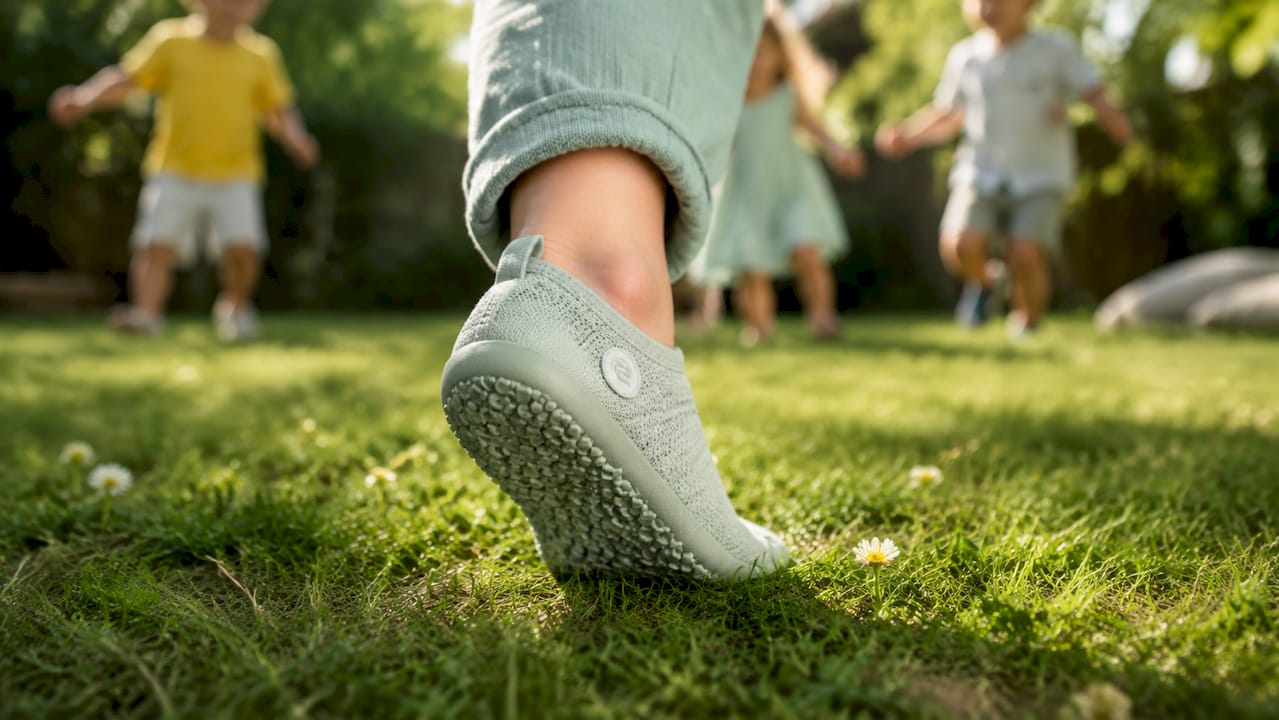
Conventional children's shoes with thick cushioning and stiff soles take over some of this work. The foot is, so to speak, "carried" instead of working itself. Barefoot-like shoes do the opposite.
The crucial design features:
- Flexible Sole: If the shoe can be easily bent in the forefoot, the foot can naturally participate in the rolling motion. Stiff soles block precisely this movement.
- Wide Toe Box: The toes can splay out and actively contribute to balance. In tight shoes, they are compressed and lose this function.
- Zero-Drop (flat sole): No elevated heel area means the child walks upright with a natural gait, without being tilted forward.
- Minimal Cushioning: More sensory feedback on the sole of the foot activates nerves and muscles more strongly.
A study by the University of Hamburg with several hundred children from different regions showed that children who grew up barefoot had significantly higher foot arches and better results in motor skills tests than children who predominantly wore firm shoes. Minimalist shoes are considered a sensible alternative when going barefoot is not possible.
“Barefoot shoes train the sensory feedback of the sole of the foot and thus improve balance and coordination. Orthopedic surgeon Matthias Manke and researcher Mathilda Meyer from the University of Hamburg see this as a clear advantage over conventional footwear.”
Source: ZDFheute
Important: Pediatric orthopedists emphasize that barefoot shoes are not a therapeutic device. Muscle strengthening results from the foot's own active strain, not from a special active ingredient formula in the shoe.
When Are Barefoot-Like Shoes Suitable for Toddlers?
Not every situation calls for shoes. And not every situation is suitable for minimalist shoes.
As soon as a child can walk steadily on their own, usually from about 12–18 months, they can be gradually introduced to barefoot-like shoes. Before that, they don't need any shoes indoors. On soft, safe surfaces like grass, sand, or carpet, going barefoot is always the first choice.
Pediatric orthopedists recommend a mix: as much barefoot walking as possible on safe surfaces, and barefoot-like shoes when needed. Stiff, heavily cushioned shoes are viewed critically.
Source: Orthopedic Practice Beckum
For longer distances on asphalt, in cold weather, or on sharp surfaces, more stable shoes may sometimes be the better choice. Barefoot-like shoes offer less protection there. However, they are ideal for everyday use, the playground, and short excursions. You can find more about the transition strategy for parents in the Ebmini blog.
How to Choose Barefoot-Like Children's Shoes
| Criterion | What you check | Why it's important |
|---|---|---|
| Sole flexibility | Easily bend and twist forefoot | Allows natural foot roll |
| Toe box | Sufficient width for splayed forefoot | Toes can move actively |
| Zero-Drop | No heel elevation, flat sole | Natural gait, no forward tilt |
| Grip / Tread | Non-slip outsole | Safety on wet and uneven surfaces |
| Waterproofness | Membrane or water-repellent material | Protection from rain and puddles |
| Size / Toe space | Approx. 1 cm space in front of big toe | Freedom of movement without pressure points |
Three practical tests before buying:
- Bend test: Lightly bend the sole in the forefoot area. A good barefoot shoe should yield without resistance.
- Twist test: Lightly twist the shoe at both ends. It should be able to twist, but not fold up like a wet rag.
- Heel cap test: Press your thumb on the inside and outside of the heel cap. It should not completely sink in, but also not be as hard as plastic.
For sizing: Toddlers grow quickly and often don't show clear pain signals if shoes become too tight. Therefore, it's important to regularly check shoe size at short intervals. High-quality barefoot-like children's shoes in Germany usually cost between €40 and €80. Warranty and return policies vary by provider; for online purchases in Germany, the statutory 14-day right of withdrawal applies.
Pro Tip: When buying online in Germany, always order half a size larger than measured. Toddlers grow quickly, and a little extra room is better than a shoe that's too tight.
Practical Transition Plan for Barefoot-Like Shoes
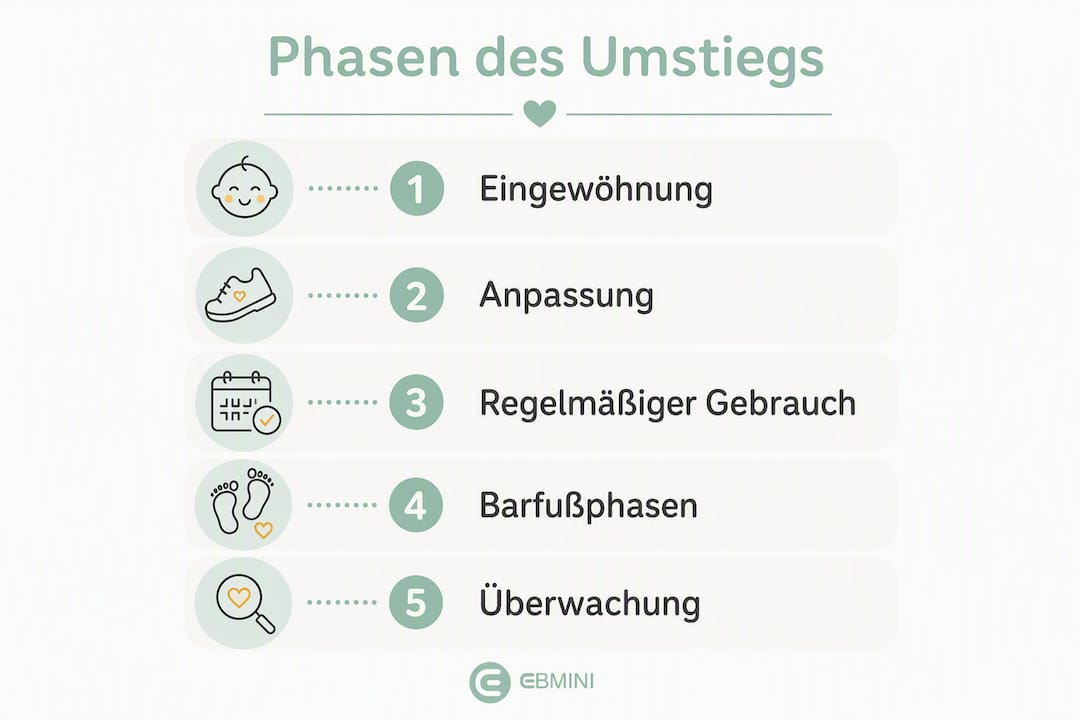
When switching from conventional shoes to minimalist shoes, do so gradually. Feet and muscles need time to adapt.
| Phase | Period | Recommendation |
|---|---|---|
| Acclimatization | — | Short periods daily, on soft indoor surfaces |
| Build-up | — | Slightly longer wear times, short outdoor uses |
| Integration | Later in the adaptation process | Normal daily use, continue to plan barefoot phases |
Barefoot phases at home remain important even after acclimatization. The shoe doesn't replace barefoot walking; it complements it.
If your child shows redness after walking, complains of pain, or changes their gait, it's a sign of overuse. In that case, simply slow down and plan more barefoot phases. A detailed step-by-step guide to getting used to barefoot shoes is available on the Ebmini blog.
When Should You Consult a Pediatrician?
Most toddlers initially have flat feet. This is normal and no cause for concern. The infantile pes planovalgus (flexible flatfoot) resolves itself in most children by school age.
However, the following signs should be medically evaluated:
- Persistent pain when walking that lasts longer than two to three days
- Significantly uneven gait, where one foot turns strongly inward or outward
- Discoloration, swelling, or pressure points on the feet
- Severely restricted mobility in the ankle joint
- Child's refusal to walk without any other obvious reason
According to the DGOU guideline, only a small percentage of children with pes planovalgus actually develop symptoms. Orthotics are rarely the standard approach.
When in doubt, it's better to consult a pediatric orthopedist once too often than to wait too long. This article does not replace medical advice.
Care, Sizing, and Practical Tips for Parents
How to measure correctly: Place foot on a piece of paper, trace length and width, then compare with the manufacturer's size chart. Always measure both feet, as they are often slightly different sizes. Use the larger foot as the benchmark.
| Age | Measurement Interval | Note |
|---|---|---|
| Preschool age | Regularly and at short intervals | Very rapid growth |
| Toddler years | At regular intervals | Growth slows slightly |
| From preschool age | Regularly after a few months | Regular checks remain important |
For care: Most barefoot-like children's shoes can be cleaned with a damp cloth. Waterproof models do not need additional impregnation as long as the membrane is intact. Always let shoes air dry, never on a heater. This preserves the material structure and sole flexibility.
Pro Tip: When buying online in Germany, always purchase half a size larger than measured. Toddlers grow quickly, and a little extra room is better than a shoe that's too tight.
Ebmini Offers Barefoot-Like Shoes That Really Fit
If you're looking for barefoot-like children's shoes that meet all the criteria mentioned, Ebmini provides a clear solution. All models have been developed in collaboration with orthopedists and combine a flexible sole, a wide toe box, and a zero-drop design.
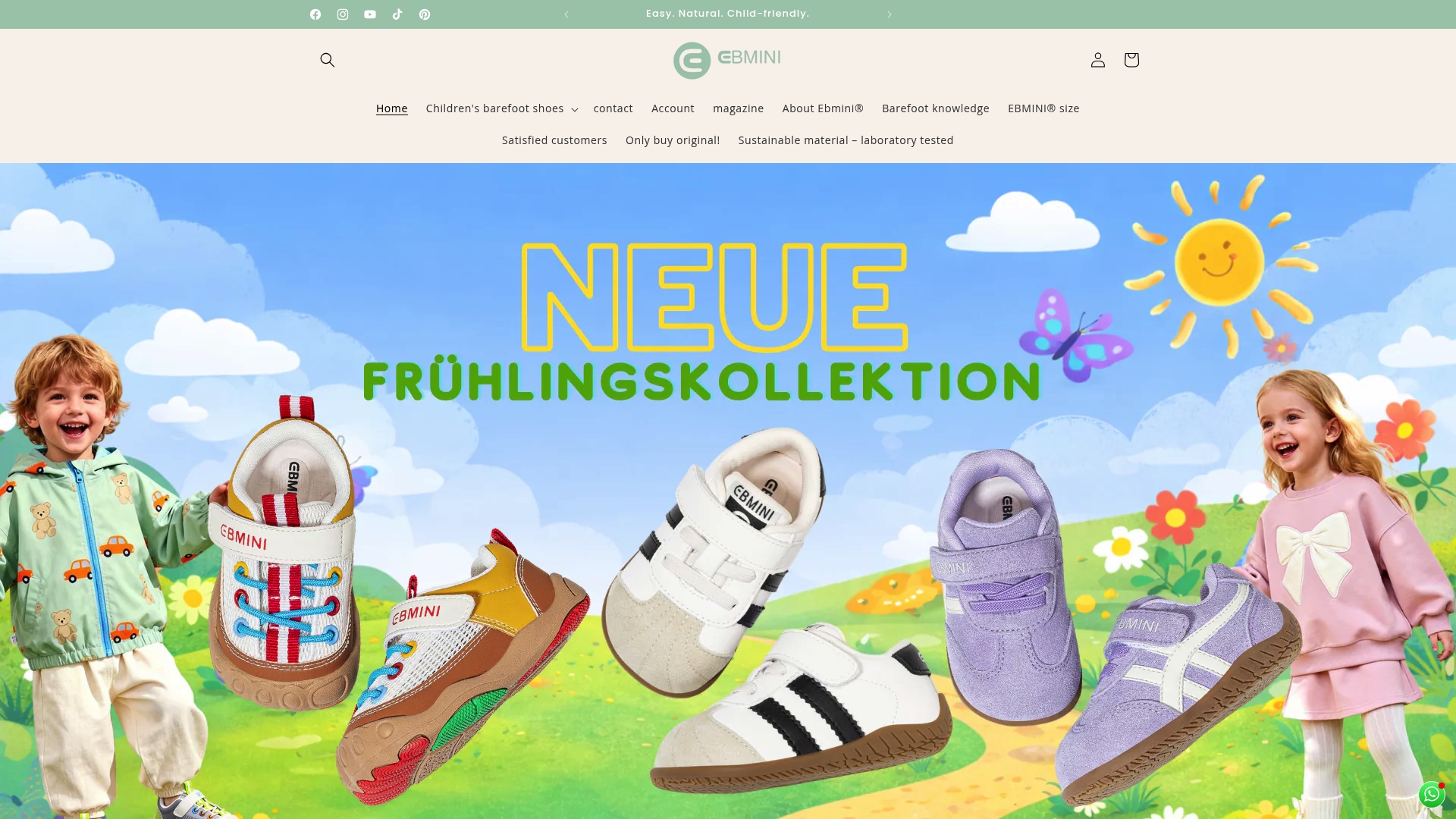
The EBMINI® TOB is an ultralight barefoot sandal, ideal for warm months, the playground, and short outings. Lightweight, breathable, and with a non-slip sole. The EBMINI® OTD is the waterproof trekking barefoot shoe for rain, mud, and cooler days. It protects the foot without restricting natural movement. Both models are available for children aged 1 to 10 years.
Ebmini offers detailed sizing advice directly in the shop, a guarantee on all products, and uncomplicated returns for orders from Germany. Check out the Ebmini collection for children and find the right model for your child.
Key Takeaways
Barefoot-like children's shoes only strengthen foot muscles if they combine flexible soles, a wide toe box, and a zero-drop design.
| Topic | Details |
|---|---|
| Core feature of effective shoes | Flexible sole, wide toe box, and zero-drop are the three crucial criteria. |
| Scientific basis | The University of Hamburg has shown that children raised barefoot have stronger foot arches and better motor skills. |
| Gradual transition | Initially, wear for short periods daily; maintain barefoot phases at home. |
| Size control | Toddlers often don't show pain signals; check shoe size regularly. |
| Ebmini recommendation | EBMINI® TOB (summer) and EBMINI® OTD (all-weather) meet all criteria and are orthopedically developed. |
Why Foot Health is More Than a Sales Argument at Ebmini
Many parents come to us because they want to do the right thing for their children but are confused by conflicting advice. Some hear that barefoot is always better. Others are told that children need supportive shoes. The truth lies somewhere in between, and it's actually simple: feet need freedom of movement, sensory feedback, and room to grow.
What drives us at Ebmini is not the conviction that every child must wear our shoes. It is the conviction that shoes, if worn at all, should not hinder natural development. That's why we developed our models with orthopedists, why we offer honest sizing advice, and why we stand for uncomplicated returns. Parents should feel secure, not pressured.
If you are unsure which model fits or how to measure the size, please contact us. We are happy to help.
Useful Sources and Further Information
For those who want to delve deeper, here are the most important sources:
- DGOU: Barefoot walking promotes healthy children's feet — Official recommendation from the German Society for Orthopaedics and Trauma Surgery on barefoot walking and flexible children's shoes.
- ZDFheute: Barefoot shoes and foot health — Expert opinions from orthopedist Matthias Manke and researcher Mathilda Meyer on the sensory effect of barefoot shoes.
- University of Hamburg: Barefoot walking and motor skills in children — Comparative study with several hundred children on foot arch and motor skills.
- Orthopedic Practice Beckum: Children's shoes and barefoot shoes — Practical recommendations from pediatric orthopedists on shoe selection and limitations of minimalist shoes.
- Ebmini Blog: Integrating barefoot shoes into daily life — Practical tips for daily use for parents in Germany.
- Ebmini Blog: Children's shoes for natural movement — Further guide on selection criteria and movement development.
In case of persistent complaints or uncertainties about your child's foot development, the DGOU recommends clarification by a pediatric orthopedist. This article provides general information and does not replace medical advice.


