

All-Season Shoes for Children: Overview of Features
All-season shoes for children are defined by flexible soles, breathable materials, and a precise fit. These characteristics of all-season children's shoes ensure healthy foot development and comfort throughout the year. Parents who want to buy the right all-weather shoes for children between 1 and 10 years old should know exactly what to look for. Sole flexibility, weather protection, and toe room are not minor details. They determine whether your child can move freely or if the shoe hinders natural foot development.
1. Flexible Soles as a Decisive Feature in All-Season Shoes
Sole flexibility is the most important quality feature of all-season shoes for children. A good children's shoe should be able to bend by at least 90 degrees in the toe area. This means: If you hold the shoe in your hand and push the tip upwards, it should bend far without resistance. If it doesn't, the sole blocks the natural rolling motion of the foot.
Children's feet are not small adult feet. The bones are still soft and actively form through movement. A sole that is too stiff forces the foot into an unnatural rolling motion and weakens the foot muscles in the long term. At the same time, the sole must not be too soft. Sufficient support at the heel and sides remains necessary to prevent the foot from twisting. The balance between flexibility and stability is a point that many parents underestimate when buying shoes.
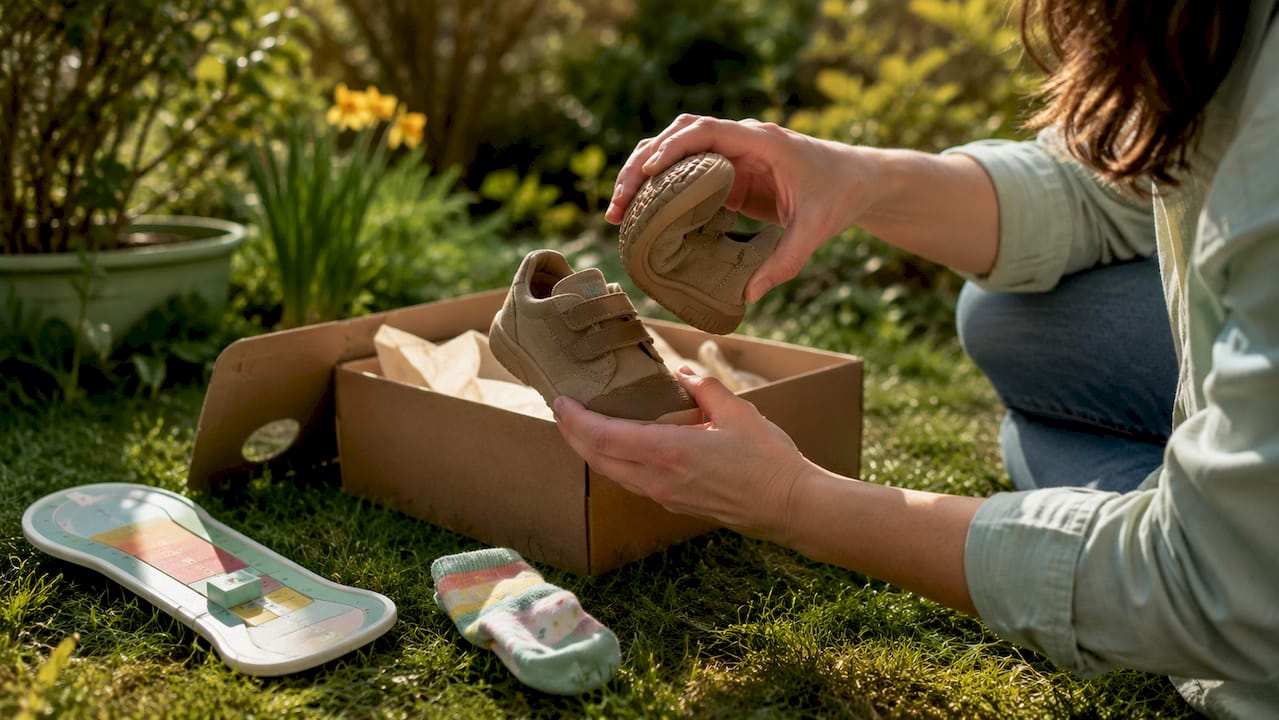
Concepts like zero drop and barefoot shoes consistently implement this principle. Zero-drop barefoot shoes with a wide toe box and thin, flexible sole promote natural foot movement and strengthen muscles. They offer protection without restricting freedom of movement. For everyday use with children between 1 and 10 years old, this is a clear advantage over conventional models with thick, hard soles.
What to look for when testing the sole:
- Toe area can be bent by at least 90 degrees
- Heel remains stable and does not give way sideways
- Sole is light but not paper-thin
- No twisting of the sole around its own axis possible
- Tread is visible and evenly distributed
Pro Tip: In the shoe store or when buying online, press the toe of the shoe against a firm surface. If it bends easily and evenly, the sole is suitable for children. If it remains stiff, leave it.
More on the practical application of flexible soles can be found in Ebmini's Parent Guide to Soles.
2. Breathable and Weatherproof Materials for the Whole Year
The material of an all-season shoe determines whether your child's foot stays dry, warm, and healthy. Breathable materials like leather and special textiles ensure a pleasant foot climate and reduce sweat production. This is not just a matter of comfort. Damp feet in poorly ventilated shoes promote fungal infections and skin irritations, especially in children who walk and play a lot.
For year-round use in changing weather, weatherproof properties are also required. Gore-Tex membranes make shoes waterproof and breathable at the same time. This means: moisture from outside stays out, sweat from inside can escape. This principle is particularly valuable for children who play outside in rain, snow, and mud.
In winter, further demands are added. Insulating materials keep the foot warm without constricting it. Here, it is also worth looking at suitable rainwear for children, which complements the overall protection concept in wet weather. In summer and spring, however, the air permeability of the upper material is particularly important.
Overview of the most important material properties:
- Leather or high-quality textiles for breathability
- Gore-Tex or comparable membranes for waterproofing
- Insulating lining for winter models
- Pollutant-free processing without plasticizers or heavy metals
- Washable or removable insoles for hygiene
A detailed look at vapor permeability and material selection in winter is offered in Ebmini's Guide to Children's Shoes in Winter.
3. The Right Fit: Room, Heel Fit, and Control
Fit is the feature that parents most often misjudge. Children often don't feel tight spots and get used to them. This makes regular measuring a duty, not an option. There should be exactly 12 to 17 mm of space between the longest toe and the tip of the shoe. Less leads to pressure points and deformities. More causes the foot to slip in the shoe and loses warmth in winter.
How to measure the space at home:
- Have your child stand on a piece of paper and trace their foot.
- Measure the length from the heel to the tip of the longest toe.
- Add 12 to 17 mm for the recommended room.
- Compare the result with the inner length of the shoe, not with the shoe size on the packaging.
- Repeat this step every three to four months, as children's feet grow quickly.
Pro Tip: It's best to buy children's shoes in the afternoon. Feet swell slightly during the day. A shoe that fits in the morning may be too tight in the afternoon.
In addition to length, heel fit is also important. The shoe must enclose the heel firmly without pressing. A loose heel fit causes the foot to slide forward and presses the toes against the toe of the shoe. Shoes that are too big also lead to heat loss in winter because the foot swims in them and cannot store body heat. The thumb test is a simple everyday check: Press your thumb behind the heel of the standing child. If exactly one thumb fits, the space is correct.
A detailed fit checklist for children's shoes will help you systematically check the correct fit.
4. Safety Features: Slip Resistance, Workmanship, and Fasteners
Safety in all-season shoes for children means more than just sturdy upper material. Non-slip soles with a good tread are indispensable on various surfaces. Leaves in autumn, wet pavement in spring, snow and ice in winter. Each surface places different demands on grip. A tread that only works on dry ground is unsuitable for all-weather shoes.
| Feature | All-season shoe | Seasonal shoe |
|---|---|---|
| Sole tread | Universal for all surfaces | Specialized (e.g., cleats for snow) |
| Waterproofing | Membrane or weatherproof material | Often designed for only one season |
| Breathability | Year-round regulation | Seasonally optimized |
| Flexibility | Consistently high | Varies depending on the model |
| Area of use | Everyday, rain, snow, sun | Limited to one season |
In addition to the tread, the workmanship of the shoe is important. Sharp seams on the inside rub against sensitive children's skin. Pollutant-free materials without plasticizers, formaldehyde, or heavy metals are not an option but a requirement for children's shoes. Removable or washable insoles significantly improve hygiene, especially if your child is active daily.
The fastener affects how securely the shoe fits. Velcro fasteners are ideal for children up to about 6 years old because they are quick to close and hold the shoe firmly on the foot. Laces offer more adjustability from school age onwards but require practice. Elastic laces combine both advantages. It is important that the fastener secures the shoe evenly on the foot without pressing on individual spots.
A specific guide to non-slip soles in winter can be found at Ebmini.
5. All-Season Shoes vs. Seasonal Shoes: When Which Model Makes Sense
All-season shoes and seasonal shoes pursue different goals. Seasonal shoes are optimized for extreme conditions. A winter boot with thick insulation keeps warm at minus 15 degrees, but is too heavy and warm in spring. A light summer shoe made of mesh offers no weather protection. All-season models, on the other hand, cover everyday life throughout all seasons, without being perfect for every weather condition.
| Criterion | All-season shoe | Seasonal shoe |
|---|---|---|
| Versatility | High, suitable for all seasons | Low, limited to one season |
| Specialized protection | Medium | High (e.g., winter boots in extreme cold) |
| Cost per year | Lower due to fewer models | Higher due to multiple pairs |
| Foot health | Consistent due to consistent fit | Change requires new adjustment |
| Everyday suitability | Very high | Limited to season |
For children between 1 and 5 years, an all-season model is recommended as a basic shoe, supplemented by a real winter boot for severe frost. From school age, children can better switch between models and communicate if a shoe pinches or is too cold. The all-season model remains the everyday shoe that covers most of the wearing time.
A good children's shoe concept views the shoe as a functional system in which sole, material, and fit work together. This approach clearly favors all-season models for everyday use because they permanently coordinate all three elements. Seasonal shoes interrupt this system and require the foot to re-acclimate each time.
For families who value foot health, the combination of a high-quality all-season shoe and a specialized winter model for extreme cold is the most sensible solution. This reduces shoe shopping to the essentials and ensures that your child always wears a well-fitting, healthy shoe.
6. Wide Toe Box and Zero Drop: What These Concepts Mean for Children's Feet
The wide toe box is a feature often underestimated in discussions about all-season children's shoe characteristics. Children's feet are wider in the toe area than adult feet and naturally splay when walking. A shoe that compresses the toes prevents this movement and can lead to deformities in the long term. A wide toe box gives the toes the space they need for healthy development.
Zero drop means that the heel and forefoot are at the same height. Conventional shoes often have a heel drop of 8 to 12 mm, which shifts body weight forward and permanently shortens the calf muscles. For children whose muscles and skeleton are still developing, this effect is particularly relevant. Zero-drop models promote an upright posture and natural gait development.
Barefoot and minimalist shoes for children must be carefully matched to protection and grip, not just flexibility. A thin sole without sufficient tread does not provide enough protection on uneven terrain or in cold weather. Parents should check when buying whether the model offers enough protection for the intended area of use. A barefoot shoe for the playground has different requirements than a model for winter hikes.
7. Regular Checks: Why Shoe Size Should Be Checked Every 3 to 4 Months
Children's feet grow quickly and irregularly. You should check your child's shoe size every three to four months. This sounds frequent, but it's necessary. Children often don't consciously feel the pressure of shoes that are too small and get used to it. The consequences are pressure points, ingrown toenails, and in the worst case, permanent deformities.
The check takes less than five minutes. Have your child stand in the shoe and press your thumb behind the heel. If no thumb fits, the shoe is too small. If more than one thumb fits, it's too big. Supplement this test by tracing the foot on paper and comparing it with the shoe's inner length.
Thermal protection and fit are just as important in all-season models as flexibility. Ill-fitting shoes lead to poor posture and increase the risk of colds in winter because a poorly fitting shoe does not retain body heat. Never buy in advance with too much room. More than 17 mm in front of the toes is just as harmful as too little.
Key Takeaways
All-season shoes for children only promote health if sole flexibility, fit, and material quality are all correct.
| Point | Details |
|---|---|
| Sole Flexibility | The shoe must be able to bend at least 90 degrees in the toe area. |
| Toe Room | 12 to 17 mm space between the longest toe and the shoe tip is optimal. |
| Material Choice | Breathable materials and Gore-Tex membranes protect and regulate year-round. |
| Regular Checks | Check shoe size every three to four months, as children do not report tight spots. |
| Slip Resistance | A universal sole profile for leaves, rain, snow, and mud is indispensable. |
What I've Learned After Years with Children's Shoes
I often hear that parents buy the most expensive shoe and consider the matter settled. That's a mistake. Price says little about the fit, and the fit is the only thing that truly matters. A cheaper shoe with the right sole flexibility and correct room is better than an expensive model that pinches in the wrong place.
What truly surprised me after many years with all-season shoes for children: most parents buy shoes too infrequently. They wait until the shoe is visibly too small. But children don't show it. They just keep walking because they don't know any different. Regular measurement every three to four months is therefore not a recommendation, but a necessity.
I consider minimalist models with zero drop and a wide toe box to be the healthiest choice for everyday use. But I also clearly state: they are not suitable for every situation. In severe frost below minus 10 degrees, a child needs an insulated boot. A barefoot shoe, however good it may be, does not replace that. The combination of a good all-season model and a real winter boot for extreme conditions is the most honest recommendation I can give.
What I've also learned: parents underestimate the importance of the toe box. A shoe can fit in length and still compress the toes because it is too narrow in the forefoot area. Look at the shoe shape from above. If the tip tapers significantly, it does not suit a child's foot.
— Ebmini
Discover Healthy All-Season Shoes for Children at Ebmini
Ebmini develops children's shoes that consistently implement all the features described in the article. Flexible soles, wide toe boxes, zero drop, and breathable materials are not extras but standard in every model.
In the Ebmini range for children, you'll find lightweight barefoot shoes for everyday wear, as well as weather-resistant models for autumn and winter. All shoes are tested for harmful substances, ultra-light, and designed for children between 1 and 10 years old. If you're specifically looking for protection against cold and wet conditions, you'll find waterproof and insulated barefoot shoes in the winter models for children section. The sizing guide on the website helps you find the right fit for your child.
FAQ
What are the key features of all-season shoes for children?
All-season shoes for children are characterized by a flexible sole with at least 90 degrees of bendability in the toe area, breathable and weather-resistant materials, and 12 to 17 mm of space in front of the toes. Non-slip soles with a universal tread and pollutant-free manufacturing are also among the basic requirements.
How often should I measure my child's shoe size?
Shoe size should be checked every three to four months, as children often don't perceive constrictions and don't report pressure from shoes that are too small. The thumb test behind the heel is a simple everyday check.
Are all-season shoes also suitable for winter?
All-season shoes with a Gore-Tex membrane and insulating lining are suitable for moderate winter conditions. For extreme cold below minus 10 degrees, a specialized winter boot with stronger insulation is recommended as an addition.
What does "Zero Drop" mean in children's shoes?
Zero Drop means that the heel and forefoot are at the same height, without an elevated heel. This concept promotes a natural posture and supports healthy gait development in children.
Why is a wide toe box important in children's shoes?
Children's feet naturally splay their toes when walking. A wide toe box gives the toes the necessary space and prevents deformities that can arise from shoes with narrow toe tips.


