

Child Supination and Pronation Explained: What Parents Need to Know
Pronation and supination are normal foot movements when walking. In most children, they are developmental and usually do not require treatment. The foot turns slightly inward (pronation) when striking the ground to absorb shock, and then straightens up again (supination) as it pushes off. This is a natural function.
Professional societies such as the DGOT and the BVO generally classify pediatric flatfoot as physiological, meaning it is part of normal development. And the numbers support this relaxed approach: fewer than 5% of children retain a deformity requiring treatment into adolescence.
Nevertheless, there are situations where you should take a closer look:
- Your child complains of pain when walking or standing
- You see pressure points or skin irritations on certain parts of the foot
- The foot does not visibly correct itself when standing on tiptoes
Important: A unilateral, painful, or rigid foot always requires medical attention. A bilateral, flexible, painless flatfoot in a three-year-old, however, usually does not.
Key Takeaways
Pronation and supination are normal foot movements that self-regulate in most children without treatment; the distinction between flexible and rigid deformity is crucial.
| Topic | Details |
|---|---|
| Mostly physiological | Pronation and supination are part of normal foot movement and do not require therapy in most children. |
| Good prognosis | Fewer than 5% of children retain a deformity requiring treatment into adolescence. |
| Take warning signs seriously | Pain, pressure points, or a rigid foot when standing on tiptoes require prompt medical clarification. |
| Tiptoe test at home | If the heel lifts when standing on tiptoes, this indicates a flexible, developmentally appropriate foot shape. |
| Appropriate shoes support | Flexible sole, wide toe box, and zero drop, as with Ebmini shoes, promote independent muscle development. |
Table of Contents
- Children's Supination and Pronation Explained: The Basics
- How the Child's Foot Develops: Age, Frequency, Prognosis
- Warning Signs When You Should See a Pediatrician
- Simple Tests at Home: How to Check Pronation and Supination Yourself
- What Really Helps in Everyday Life: Exercises and Physiotherapy
- When Insoles or Surgery Are Really Necessary
- Choosing the Right Shoes: What Really Matters
- Shoes That Support Natural Foot Development
- Sources
- FAQ
Children's Supination and Pronation Explained: The Basics
Imagine the foot as both a shock absorber and a lever. During pronation, the foot turns slightly inward when striking the ground, the arch lowers a bit, and the impact is cushioned. During supination, the opposite happens: the foot straightens up, becoming firm and stable so you can powerfully push off the ground.
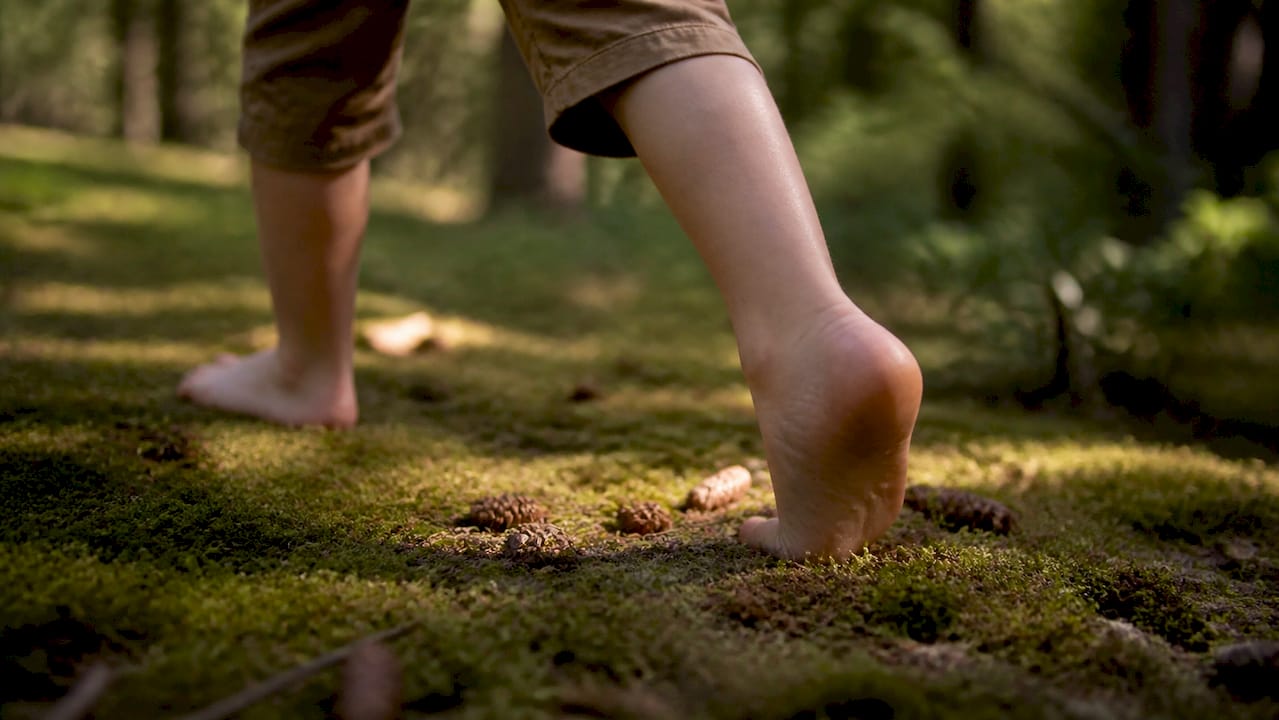
A healthy foot does both, in every single step. Pronation serves for damping, supination for stabilization during the push-off phase — both movements interlock like a gearbox and clutch. Problems only arise when one of the movements is constantly overactive: a persistent, strong inward bending without counter-movement, for example, or a foot that can no longer straighten up at all.
In young children, this often looks more dramatic from the outside than it is:
- An inward-turning foot when standing can be purely optically deceptive
- The child's foot arch is barely visible at two years old
- A "wobbly foot" when learning to walk is usually muscular immaturity, not a defect
A simple sketch is often more helpful than any explanation: A view of the foot from behind shows the axis of the heel, from the side you can see the arch. Once you've consciously looked at both, you'll find it much easier to spot deviations later on.
How the Child's Foot Develops: Age, Frequency, Prognosis
A child's foot is not a miniature version of an adult's foot. It undergoes its own maturation, which takes longer than many parents realize.
In infancy and toddlerhood, almost every foot appears flat. This is due to a fat pad under the sole of the foot, which optically obscures the arch; a visible "flatness" in toddlers is often anatomically determined and not a deformity. The arch itself only develops over years, usually in parallel with muscle strength and experience in barefoot walking.
Here's the typical timeline:
- Crawling age (0 to 1 year): Foot is soft, muscles hardly developed, no conclusion about later shape possible
- Beginning to walk (1 to 3 years): Wide-legged gait, visible "flatfoot" due to fat pad, usually unremarkable
- Preschool age (3 to 6 years): Foot arch begins to form, muscles strengthen through movement
- School age (6 to 10 years): Foot shape stabilizes increasingly, persistent irregularities become clearer now
The good news remains the same across all age groups: in the vast majority of children, the foot shape normalizes spontaneously, and fewer than 5% carry a deformity requiring treatment into adolescence. Patience is indeed the most effective measure here.
Warning Signs When You Should See a Pediatrician
Some signs do not warrant a wait-and-see approach. Here are the red flags you should really watch out for:
- Pain when walking, standing, or after sports
- Pressure points, redness, or skin damage in unusual areas
- A clearly unilateral, asymmetrical deformity
- A foot that does not straighten when standing on tiptoes
- Visible stiffness, where the foot can hardly be moved
The crucial difference lies between flexible and rigid. A flexible flatfoot can be passively returned to a normal position, and the hindfoot is mobile. A rigid foot, however, remains stiff, no matter how you move it. Only the rigid, contracted flatfoot requires prompt pediatric orthopedic evaluation, while the flexible type can usually be observed.
Here's how to proceed if you notice something:
- Observe for one to two weeks whether the abnormality remains constant or changes
- Perform the tiptoe test (see next section) and note the result
- Make an appointment with the pediatrician and precisely describe any pain, when it occurs, and on which side
- The doctor will usually first conduct a clinical examination; imaging procedures are only used if there is concrete suspicion
Simple Tests at Home: How to Check Pronation and Supination Yourself
You don't need a clinic to get a first impression. Three simple observations are usually enough.
- Toe stand test: Have your child stand barefoot on their tiptoes. If the heel lifts and an arch becomes visible, this indicates a flexible, developmentally appropriate foot shape that is likely to continue developing on its own.
- View from behind and wet footprint: Stand behind your child while they are standing and look at their heel. A wet footprint on a dark floor will also show you how much of the inner foot actually makes ground contact.
- Check sole wear: Look at the sole of old shoes. Uneven wear on the inside can be an indication of increased pronation.
Pro-Tip: Take a few photos from the front, back, and during the tiptoe stand, and note exactly when pain occurs, if any. These notes are often more helpful for the pediatrician than a long verbal description.
What Really Helps in Everyday Life: Exercises and Physiotherapy
The most effective measures are unspectacular, but they require repetition. Barefoot walking on different surfaces automatically trains the small foot muscles, without any need for a training plan.
These exercises can be easily integrated into daily life:
- Heel stretch: Gentle stretching of the calf muscles and Achilles tendon, such as child-friendly wall push-ups, helps with shortened structures
- Toe gripping: Picking up a cloth or small objects with the toes specifically strengthens the foot muscles
- Barefoot games: Walking on grass, sand, or gravel challenges the foot muscles more than any flat surface
For exercises, a simple rule applies: stop immediately if pain occurs. Strengthening should never hurt.
Physiotherapy is worthwhile if the deformity is accompanied by noticeable muscle weakness or if your child appears noticeably unsteady during sports. A physiotherapist can demonstrate targeted exercises and monitor progress over several weeks.
Pro-Tip: Shoes with flexible soles support this training effect precisely because the foot can move almost like barefoot in them. Our parent's guide to suitable children's shoes provides more details on selection.
When Insoles or Surgery Are Really Necessary
Insoles are the exception, not the rule. They may be considered for:
- Pain when walking or standing
- Pressure points or skin damage due to faulty weight distribution
- Bone overload reactions, i.e., bone complaints due to persistent deformity
For a symptom-free child, insoles are usually not necessary. Conservative measures such as barefoot walking, stretching, and strengthening are often sufficient for asymptomatic children; insoles rarely provide additional benefit here.
Surgeries are reserved for rare cases, usually in older children or adolescents with rigid, congenital deformities that can no longer be influenced conservatively.
The current S2k guideline emphasizes that the distinction between flexible and rigid flatfoot determines the therapy decision, not the external appearance alone.
Choosing the Right Shoes: What Really Matters
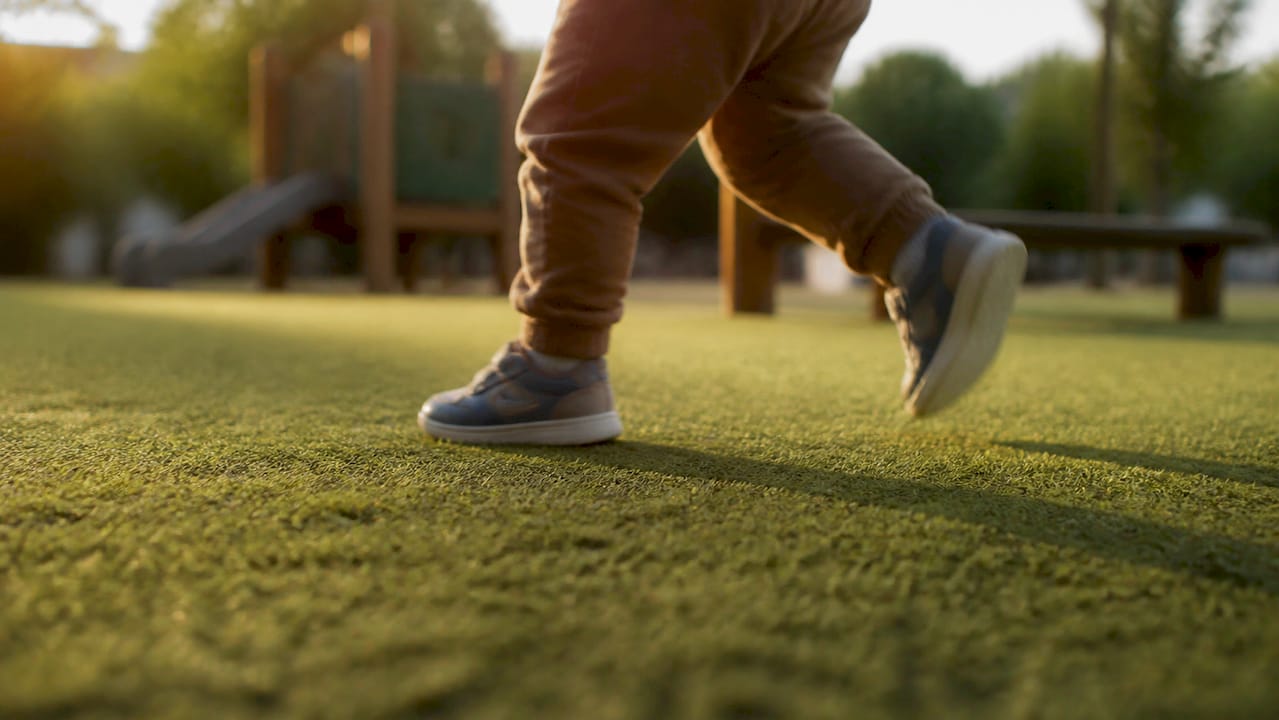
The right shoe can actively support or hinder foot development. Four characteristics are crucial: a thin, flexible sole, a wide toe box, zero drop (i.e., no elevation of the heel compared to the forefoot), and a non-slip tread. This combination gives the foot muscles the freedom they need to strengthen, instead of forcing them into a rigid shape.
For size, precision matters: measure the foot regularly, allow about 12 mm of space in front of the toes, and check the fit for toddlers every three months, as feet grow surprisingly fast at this age.
A few everyday habits also make a difference:
- Incorporate barefoot phases at home and in the garden as often as possible
- Choose thin, well-fitting socks instead of thick, restrictive models
- Keep an eye on sole wear; it reveals a lot about the rolling behavior of the foot
Pro-Tip: As a test, try to scrunch up the sole in the middle of the shoe. If it folds easily like paper, it's flexible enough for foot development. More details on fit and material can be found in our article on flexible soles and their effect on foot development.
Brief Perspective
Most uncertainty arises because parents measure a child's foot against an adult's foot, but it follows its own timeline. Observation, providing freedom of movement, and acting consistently when red flags appear is more effective than any premature correction. Ebmini supports this path editorially with further guides on foot health.
Shoes That Support Natural Foot Development
Ebmini designs children's shoes precisely according to the criteria discussed in this article: a thin, flexible sole, a wide toe box, zero drop, and a non-slip tread, along with waterproof all-weather models for mud, rain, and snow, without sacrificing the barefoot feel.

Many parents buy children's shoes based on appearance or brand, but the fit determines foot health. Ebmini offers size advice so you don't have to guess if the 12 mm toe clearance is actually correct, plus a return guarantee if the choice doesn't fit after all. Check out the barefoot shoes for children and find the right size for your child's next growth spurt.
Sources
The statements in this article are based on recognized pediatric orthopedic guidelines and specialized practices that focus intensively on foot development in children.
- Flatfoot in Children — OP Beckum
- Child's Foot and Flatfoot: What needs to be treated and where can one wait? — Children's Orthopaedics Insel
This article contains general information and does not replace consultation with a qualified physician. Consult a qualified medical professional for your personal situation before acting on the basis of this content.
FAQ
Are pronation and supination normal in children?
Yes, both movements are part of a normal gait and occur with every step. Only a persistent, overactive manifestation with pain or rigidity is considered to require treatment.
How do I recognize supination in my child?
Look for a foot that tips sharply outwards when standing, combined with uneven sole wear on the outside. If there is pain or instability in the gait, you should have it medically evaluated.
At what age should the arch of the foot be visible?
A visible arch usually develops by preschool age, often only between the ages of four and six. Before that, almost every child's foot appears flat due to the fat pad on the sole.
Does my child need insoles for pronation?
Insoles are only useful for pain, pressure points, or bone overload. For a child without symptoms, barefoot walking, targeted exercises, and appropriate footwear are usually sufficient.
Which shoes best support foot development?
Shoes with thin, flexible soles, a wide toe box, zero drop, and a non-slip tread give the foot muscles room for their own development. Ebmini focuses precisely on these criteria for its barefoot shoes for children.


