

Children's Shoes Dual Sole Winter: Explanation for Parents
When you buy winter shoes for your child, you inevitably stumble upon the term "double sole." Many parents think: more layers equal more warmth. This explanation of winter children's shoes with double soles shows why that's not true and what really matters. A poorly fitting double sole can actually leave your child's feet colder than a well-designed single sole. With the right information, you'll make a decision that truly benefits your child's foot development the next time you buy shoes.
Table of Contents
- Key Takeaways
- Double Soles in Winter Children's Shoes Explained
- Advantages for Children's Feet in Winter
- Criteria for Choosing Winter Children's Shoes
- Care and Everyday Tips for Winter Shoes
- Double Sole vs. Other Shoe Models
- My Experience with Double-Soled Shoes in Winter
- Discover Ebmini Winter Shoes with Double Soles
- FAQ
Key Takeaways
| Point | Details |
|---|---|
| Double sole protects with air cushion | The warming effect comes from the space within the sole, not thickness alone. |
| Fit determines warmth | At least 10 to 15 mm of space in the shoe is needed for the air cushion to work. |
| Flexible sole protects foot development | Child-friendly winter boots must remain flexible in the ball and toe area to allow for the rolling motion of the foot. |
| Too thick socks are counterproductive | Wearing too many socks destroys the air cushion and risks colder feet instead of warmer ones. |
| Regular size checks are essential | Children often don't feel pain from shoes that are too small, so parents must actively measure. |
Double Soles in Winter Children's Shoes Explained
A double sole consists of two clearly separate layers: the outsole, which has direct contact with the ground, and the midsole, which sits between the outsole and the foot. This exact construction makes all the difference. The midsole creates a gap between the cold ground and the child's foot, and this gap is the actual heat reservoir.
Materials and Their Functions
The outsole is usually made of rubber, which is non-slip, water-resistant, and durable. It protects against moisture, splinters, and unevenness. The midsole can be made of foamed EVA material, wool, or an aluminum combination. Insoles with aluminum and virgin wool keep children's feet particularly warm because the aluminum layer reflects body heat and the wool simultaneously absorbs moisture.
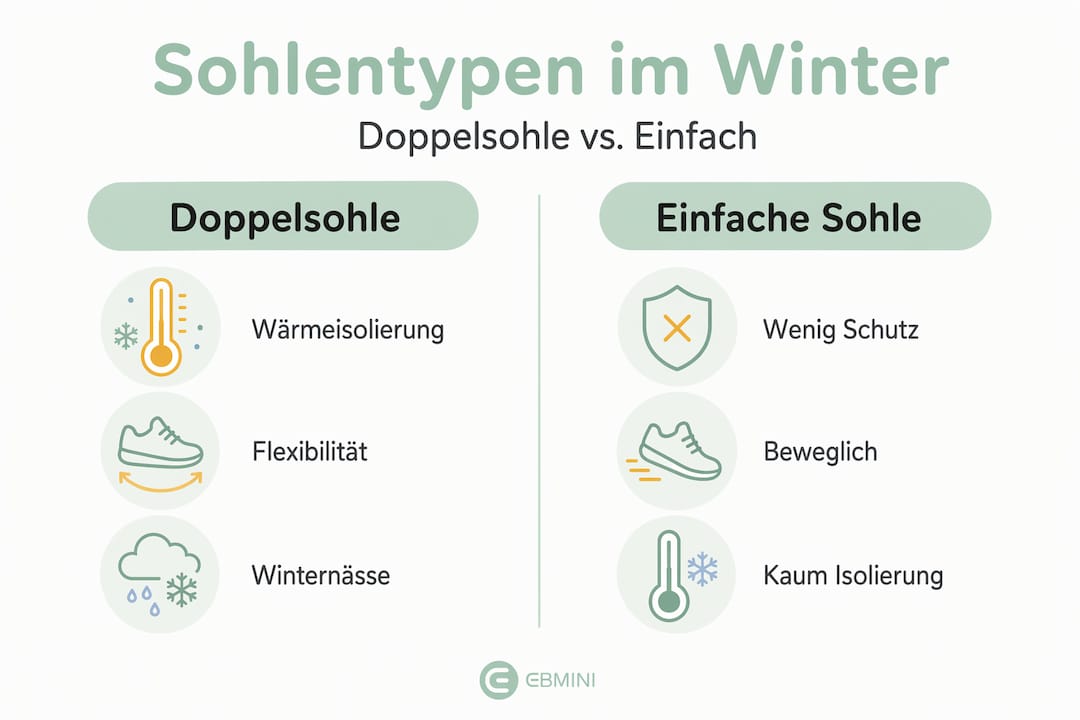
The main difference from a single sole lies in the insulation performance. A classic single sole offers no separating layer and directly conducts cold from the ground to the foot. The double sole interrupts this cold transfer. The principle is similar to a thermos flask: it's not the material itself that keeps warm, but the space in between.
| Sole Type | Insulation | Flexibility | Suitable for |
|---|---|---|---|
| Simple rubber sole | Low | High | Spring, autumn |
| Double sole (EVA + rubber) | Medium to high | Medium | Cold days, light snow |
| Double sole with aluminum insert | High | Medium | Frost, wet conditions |
| Thick hard rubber sole | Medium | Low | Not recommended for children |
Pro Tip: Before buying, press the sole together from below with two fingers. If it bends easily in the ball area, it is child-friendly. If it barely gives way, it restricts the natural rolling motion of the foot.
Advantages for Children's Feet in Winter
Double-soled shoes for children offer significantly more than just thermal protection in winter. They actively support healthy foot development if chosen correctly.
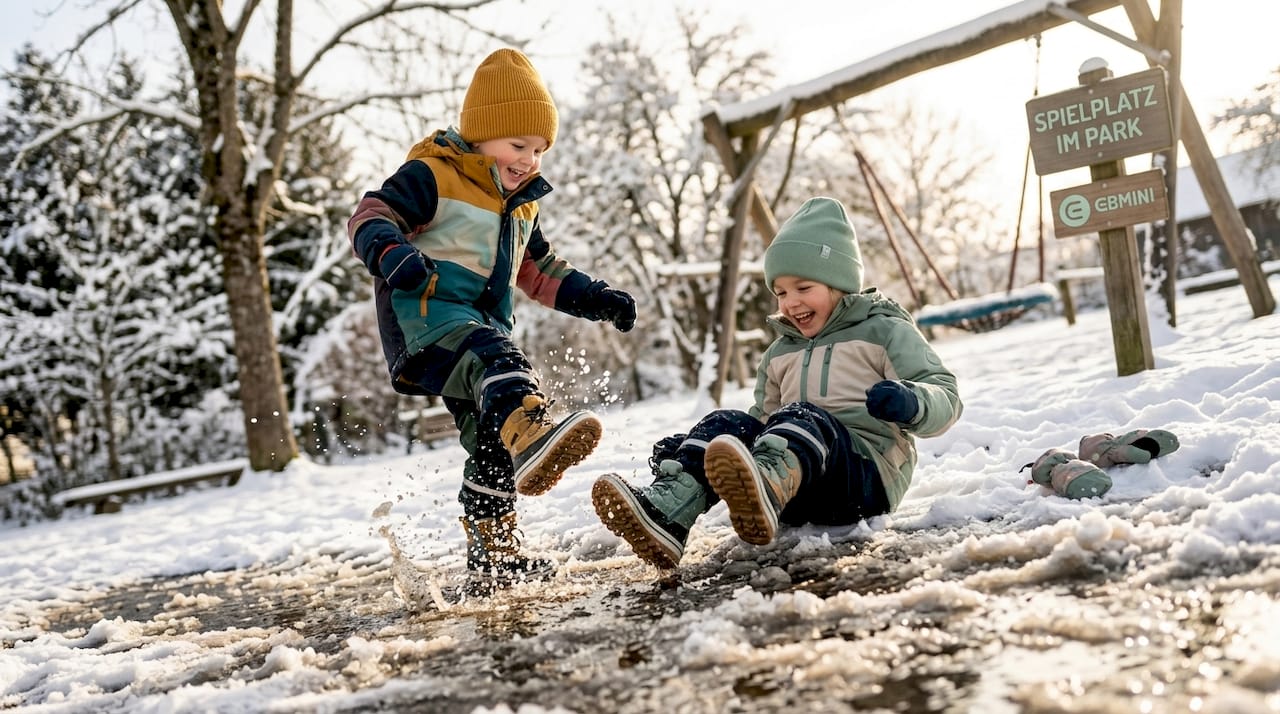
The biggest advantage is thermal protection from below. Children walk, jump, and stand on snowy surfaces, i.e., on ground that directly radiates cold. Without an insulating midsole, feet quickly cool down, even if the upper material feels warm.
Another advantage is the natural air cushion created by the double sole. This cushion acts like passive heating: the child's body heat warms the trapped air, which then remains between the sole and the foot. The natural air cushion in the double sole is crucial for insulation. This is precisely why a shoe that is too tight completely negates this effect.
Further concrete advantages at a glance:
- Flexibility is maintained: Good double-soled models are soft enough in the front area to allow children to roll their feet and actively use their toes when walking.
- Protection against moisture: The outsole seals against slush and puddles, while the midsole acts as a buffer against rising cold.
- Stability without stiffness: Children need support, but not a boot that encases their foot in concrete. Well-designed, child-friendly winter boots offer both.
- Natural foot development: Barefoot shoes with flexible double soles promote mobility and a sense of balance even in winter because the foot muscles remain active.
Pro Tip: If your child complains about cold feet after a short time outdoors, even though the shoe looks "thick," first check the fit. Usually, the shoe is too tight, not too thin.
Criteria for Choosing Winter Children's Shoes
Parents face many options when buying shoes for cold days. These selection criteria help to find models that truly fit the child's foot and are healthy.
-
Sufficient length allowance: Winter shoes should be 10 to 15 mm longer than the measured child's foot. This thumb's width creates space for the air cushion and allows for movement when walking.
-
Wide toe box: The toes must be able to spread out in the shoe. A toe box that is too narrow compresses the foot muscles and disrupts balance.
-
Breathable materials: Cotton retains moisture, while leather and wool regulate moisture. Inside, the shoe should be made of virgin wool or a breathable synthetic fiber fabric, not pure synthetic leather.
-
Appropriate insole: An aluminum-wool combination as an insole can effectively block cold from below. Make sure that the insole is not so thick that it changes the fit of the shoe.
-
Non-slip and flexible outsole: Good winter children's shoes are flexible and non-slip without hindering the foot. Test the slip resistance by letting the sole slide on a wet tile.
-
Closure system: Velcro fasteners or easily adjustable laces allow the shoe to be closed tightly enough without impairing circulation. Very tight lacing over the instep can constrict blood flow.
| Feature | Recommendation | Why it's important |
|---|---|---|
| Length allowance | 10 to 15 mm | Air cushion and growth |
| Sole material | Rubber outside, EVA or wool inside | Insulation and cushioning |
| Upper material | Leather or textile with membrane | Breathability and water protection |
| Closure | Velcro or laces | Easy to put on and take off, no pressure points |
| Toe box | Wide and round | Natural toe position |
Children often curl their toes when trying on shoes, which falsifies the measurement. Ask your child to consciously stand up and place their feet flat on the floor before you check the allowance.
Care and Everyday Tips for Winter Shoes
Double-soled shoes for children last longer and perform better if parents follow a few simple rules. Most problems arise not from bad shoes, but from incorrect use.
- Check size regularly: Children often don't feel pain from shoes that are too small, so the fit should be checked every four to six weeks. Use a foot measuring template or device.
- Adjust lacing correctly: Loose lacing in the upper shaft area promotes blood circulation and prevents cold feet. In the lower area, it can be a little tighter so that the foot doesn't slip. After 15 to 20 minutes of wear, it's worth readjusting the lacing.
- Dry shoes properly: Let winter shoes air dry after each use, never directly on the radiator. Too much heat damages the upper material and stiffens the sole.
- Choose socks wisely: Thinner wool socks are better than thick cotton socks. Wool regulates moisture and retains warmth, cotton does not. In addition, the air cushion in the shoe is maintained if the sock does not take up too much volume.
- Use insoles correctly: If you use a thermal insole, you should first check whether the shoe still offers sufficient space. Read whether removable insoles are useful in winter children's shoes.
Pro Tip: The most common mistake: parents put three pairs of socks on the child, the shoe becomes too tight, the air cushion disappears, and the feet get cold. A medium-thick wool sock in a well-fitting shoe does more than five thin cotton socks.
Double Sole vs. Other Shoe Models
A classic double-soled shoe is not the best choice for every situation. An honest comparison is worthwhile here.
| Shoe Type | Thermal Insulation | Flexibility | Suitable for |
|---|---|---|---|
| Barefoot shoe without insulation | Very low | Very high | Autumn, dry cold up to approx. 5°C |
| Barefoot shoe with double sole | Medium to high | High | Snow, frost down to approx. minus 10°C |
| Classic winter boot with rigid sole | High | Low | Extreme cold, but foot development suffers |
| Lined shoe without double sole | Medium | Medium | Light winter, temperatures around 0°C |
A classic lined winter boot with a rigid sole protects against cold, but completely blocks the natural rolling motion of the foot. Children who regularly wear very stiff shoes develop weaker foot muscles. This is not a theoretical risk, but an observable pattern.
A barefoot shoe with a flexible double sole combines both worlds. It allows free toe movement and rolling motion, while protecting against ground temperatures. For temperatures below minus 10°C, however, additional insulation is needed, for example, a wool-aluminum insole. The size and fit checklist can help identify the right shoe.
My Experience with Double-Soled Shoes in Winter
Over the past years, I've observed many children in our Ebmini shoes and consistently seen the same mistake. Parents choose the thickest, stiffest shoe they can find, and then wonder why the child's feet still get cold.
What I've learned: The fit determines everything. A well-fitting shoe with a sensible double sole and an air cushion beats any thick boot that negates the air cushion with a tight fit.
What always surprises me: Children in flexible double-soled shoes are more active in winter. They walk more, jump more, stay in motion. And movement is the most effective heater for cold feet. A rigid shoe encourages slow shuffling.
I often tell parents: trust the space in the shoe more than the shoe itself. Three millimeters too tight, and all the double sole's technology is useless. Three more millimeters, and the child walks through the snow with warm feet.
Of course, there are limitations: in extreme cold below minus 15°C, even the best flexible double sole is not enough without additional insulation. Then a thermal insole or a more heavily insulated model is needed. But for the German winter, with what you actually experience, a barefoot-like shoe with a double sole is by far the better choice than a child who barely walks in stiff shoes.
— Ebmini
Discover Ebmini Winter Shoes with Double Soles
If you're looking for winter shoes that combine all these principles, check out the Ebmini Winter Barefoot Shoes. The collection combines flexible double soles with waterproof uppers, a wide toe box, and a zero-drop construction.
Each model is designed so that the air cushion in the shoe is maintained and the natural rolling motion of the child's foot is not restricted. The warmly lined winter models offer enough space for a thin wool sock without making the shoe too tight. In addition, Ebmini provides a detailed size checklist for children's shoes to help you with accurate measurement. Healthy feet in winter start with the right choice.
FAQ
What is a double sole in children's shoes?
A double sole consists of an outsole and a midsole, which together create an insulating air cushion between the ground and the child's foot. This construction protects against ground cold and moisture.
How much space does a winter shoe need for children?
Winter shoes should be at least 10 to 15 mm longer than the child's foot. This space corresponds to a thumb's width and is necessary for the air cushion in the double sole to develop its warming effect.
Why do my child's feet get cold despite thick shoes?
The most common reason is a shoe that is too tight, which destroys the air cushion. Socks that are too thick or laces that are too tight exacerbate this problem. A well-fitting shoe with a thin wool sock performs better than a tight shoe with several socks.
Are barefoot shoes with a double sole suitable for winter?
Yes, if they are correctly constructed. Flexible double-soled barefoot-style shoes for children allow natural foot movement while providing protection against cold and wet conditions. For temperatures below minus 10°C, an additional thermal insole is recommended.
How often should I check my child's shoe size in winter?
Every four to six weeks, as children's feet grow quickly and children often don't feel pain with shoes that are too small. Use a measuring template or have their foot measured at a shoe store.


