

How Children's Shoes Affect Gait: Guidelines for Parents
Yes, children's shoes measurably alter gait. When children wear stiff, too-small, or overly cushioned shoes, it affects pressure distribution, joint angles, and foot roll-off with every step. There are three things you should check today:
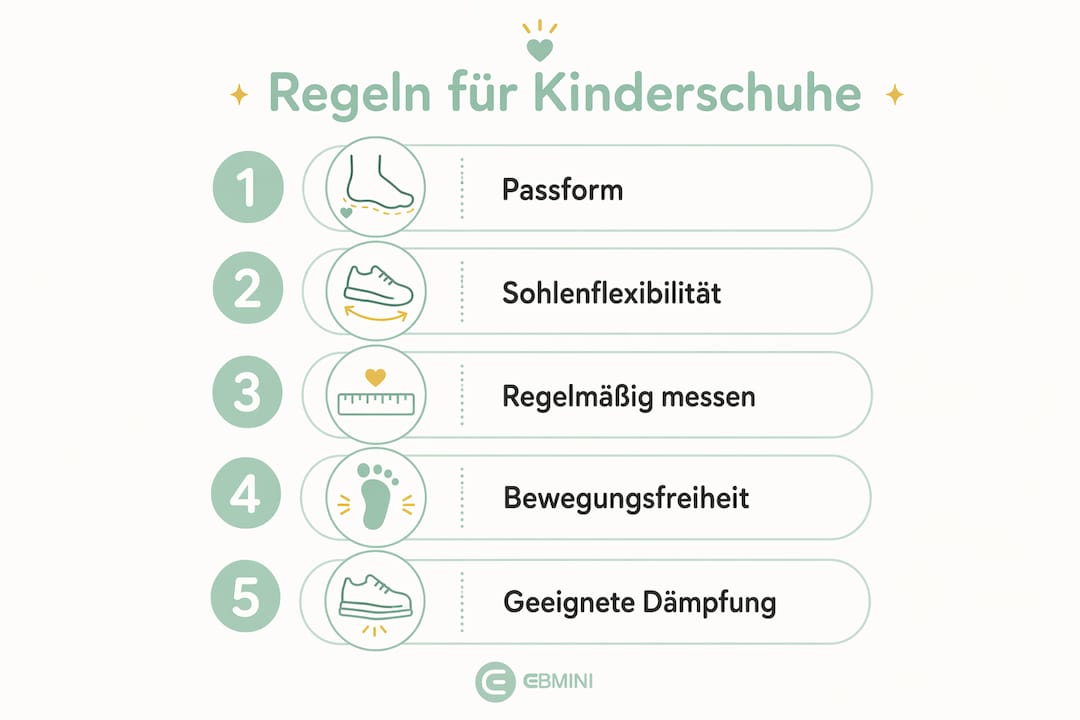
- Fit: There should be a little space between the longest toe and the tip of the shoe. Children often don't notice tightness themselves.
- Sole flexibility: Can the sole be easily bent in the middle with two fingers? If not, it restricts the natural rolling motion of the foot.
- Barefoot time: Let your child walk without shoes as often as possible indoors and on safe surfaces.
A gait analysis by a pediatric physiotherapist or pediatric orthopedist is advisable if your child consistently walks on tiptoes after their third birthday, if a clear asymmetry is noticeable, or if they complain of pain.
Table of Contents
- How Shoes Alter Gait Biomechanics
- Which Gait Abnormalities are Normal in Children and When You Should Act
- When is Gait Analysis Useful and What Does it Measure?
- Which Shoes Promote Gait: Criteria by Age and Activity
- What Physiotherapy, Insoles, and Exercises Really Achieve
- Warning Signs: When You Should Definitely See a Doctor
- How Ebmini Implements the Recommended Criteria in Everyday Life
- Key Takeaways
- What Parents Really Underestimate When Choosing Shoes
- Ebmini OTD: Barefoot-like All-Weather Children's Shoes for Every Day
- Further Reading for Deeper Understanding
How Shoes Alter Gait Biomechanics
Shoes are not neutral accessories. They actively intervene in the mechanics of walking, and this can be measured. A study with many analyzed gait cycles shows significant changes in pressure distribution and joint angles due to shoes: the maximum load shifts from the rearfoot to the midfoot, heel strike is cushioned, and the duration of loading increases.
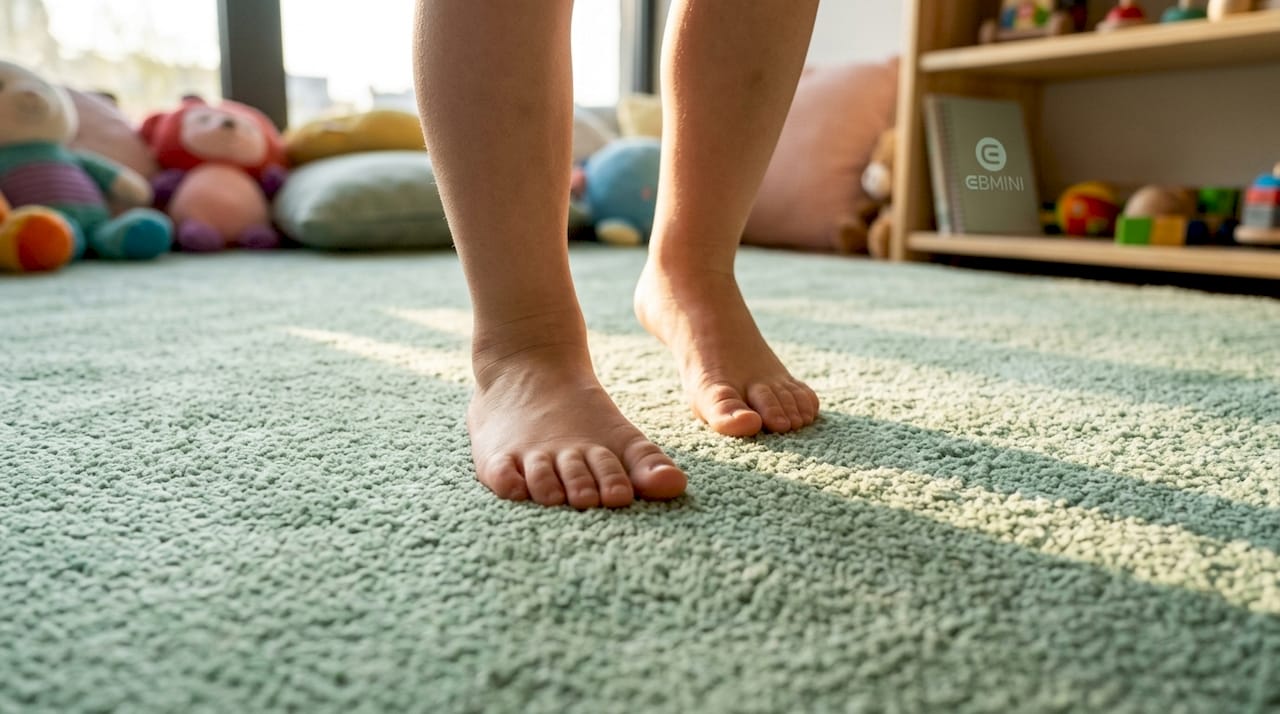
Specifically, this primarily affects the ankle and knee. Shod walking increases the range of motion in these joints, while barefoot walking produces smaller joint angles. This is not inherently bad, but it means that every shoe shapes the movement pattern.
Excessive cushioning is particularly critical. Soft soles yield asymmetrically under load, creating an uneven surface under the foot. The foot tilts slightly outward, and the muscles have to compensate for this with every step. In children whose movement patterns are still developing, such compensatory movements can become habitual.
Supportive shoes with high collars or rigid soles also restrict foot muscle development. What the shoe supports, the muscle no longer has to do. This is a problem for children who are just learning to walk.
Pro Tip: In the store, place the shoe on a flat surface and press the middle of the sole from above with your thumb and forefinger. Does it yield? Good. Does it remain as stiff as a board? Stay away.
Which Gait Abnormalities are Normal in Children and When You Should Act
Not every abnormality is a problem. Many gait patterns that concern parents are simply developmental phases.
A healthy gait is even, fluid, and without significant asymmetries. Deviations from this must always be considered in the context of age, not evaluated in isolation.
Common patterns and their typical age windows:
- In-Toeing: Feet point inward when walking. Often physiological until school age, frequently caused by thigh rotation. Usually corrects itself by the age of seven.
- Toe Walking: Many toddlers walk on their tiptoes in the first months after learning to walk. If this persists after the third birthday, clarification is advisable.
- Flatfoot (Pes Planovalgus): Often physiological and usually does not require treatment until about ten years of age. The arch of the foot develops during childhood. Only intervene if there is pain or noticeable findings.
- Knock-knees (Genu valgum): Developmentally normal between two and six years of age. After that, the distance between the ankles when the knees are together should significantly decrease.
Red flags that you should not wait for:
- Pain when walking or after exercise
- Significant asymmetry: one foot turns sharply inward, the other does not
- Frequent stumbling or falling without an apparent reason
- Toe walking that remains constant after the third birthday
- Flatfoot with pain after the eighth year of life
When is Gait Analysis Useful and What Does it Measure?
Gait analysis is not a routine appointment, but a targeted diagnostic tool. Specialized practices use it when abnormal findings are present and therapeutic decisions depend on it. The goal is not to name a pattern, but to understand what is behind it.
Specific indications:
- Persistent toe walking after the third year of life
- Severe in-toeing that does not improve
- Pain in the foot, knee, or hip
- Significant asymmetry in gait
- Parents or educators report frequent stumbling
What is measured in a gait analysis:
- Stance analysis: Leg axes, foot position, body posture while standing
- Roll-off motion: Video recordings from the front, back, and side while walking
- Plantar pressure measurement: How and where the foot bears weight on the ground
- Strength and coordination: Simple tests of balance and muscle strength
- Movement analysis: Ankle, knee, and hip angles during the gait cycle
The results determine whether physical therapy, sensorimotor insoles, or an exercise program are appropriate. Gait analysis in children is particularly valuable because it justifies active measures instead of reflexively prescribing passive aids.
Which Shoes Promote Gait: Criteria by Age and Activity
Buying checklist for every shoe:
- Toe space: At least a small amount of space between the longest toe and the tip of the shoe
- Sole flexibility: Shoe can be easily bent in the middle
- No high heel: No height difference between heel and forefoot (no heel-to-toe drop)
- Wide toe box: Toes can spread out, not be compressed
- Weight: The lighter, the better for small feet
- Non-slip sole: Especially for outdoor use
Age-related advice:
| Age Group | Recommendation |
|---|---|
| Up to 12 months | Barefoot or non-slip socks; no shoes needed |
| 1–2 years (first steps) | First shoes only when the child regularly walks outdoors; lightweight, flexible, flat |
| 2 to 5 years | Flexible sole, wide toe box, regularly check size |
| From school age | Sports shoes depending on activity; continue to prefer flexible soles |
Barefoot is the best school for feet; you can learn more about this in our minimalist household management: live less, live better – NORDVIVE. Research from the University of Hamburg shows that children who spend a lot of time barefoot develop higher arches and better balance and jumping skills. If going barefoot is not possible, minimalist shoes are the next best option. The transition should be gradual, especially if the child is used to more cushioned shoes. Practical tips on this can be found in the guide to transitioning to barefoot shoes.
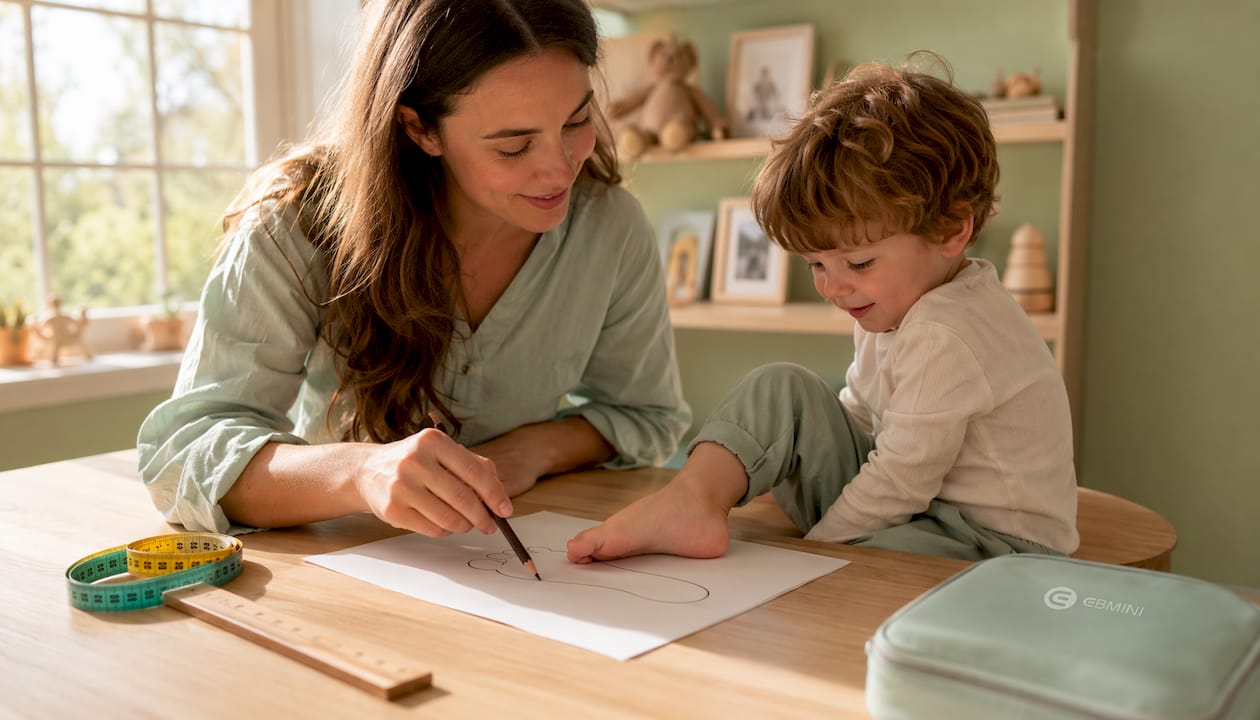
Children's feet grow noticeably in early childhood and should therefore be measured regularly. As a result, too-small shoes are not uncommon. A study by the Medical University of Vienna found that children often wear shoes that are too short.
Pro Tip: Place the child's barefoot on a piece of cardboard, trace the outline of the foot, and add 12 mm to the longest toe. Take this template to the store and measure the inner length of the shoe with it. It's almost impossible to be faster and more reliable.
What Physiotherapy, Insoles, and Exercises Really Achieve
Conservative measures are effective, but only if they match the cause.
Physiotherapy is the first choice for muscular imbalances, coordination weakness, or an abnormal gait pattern without a structural cause. A good pediatric physiotherapist works playfully, with balance exercises, strengthening of the foot muscles, and gait training. Effects usually appear after six to twelve weeks of regular therapy.
Sensorimotor insoles stimulate the sole of the foot, thus activating deep perception. They are not a passive support but a stimulus. They are useful as a supplement to physiotherapy, not as a substitute. Anyone who is prescribed an insole should also ask what exercises the child can do at home.
Orthopedic aids such as night splints or lower leg orthoses are only used for pronounced structural findings and are prescribed by a pediatric orthopedist.
Key points at a glance:
- Insoles do not replace active therapy, they complement it
- Effects of conservative measures should be reassessed after three months
- Home exercise programs are part of the therapy plan
- If no progress after six months, a new gait analysis is advisable
- Proprioceptive stimuli through barefoot-like shoes can support therapy in everyday life
| Measure | When useful | Expectation |
|---|---|---|
| Physiotherapy | Muscular cause, coordination weakness | Improvement after several weeks |
| Sensorimotor insoles | Complementary, for deep perception problems | Supportive, not a sole remedy |
| Orthopedic aids | Structural findings, after specialist judgment | Long-term, regular control |
Warning Signs: When You Should Definitely See a Doctor
Some abnormalities take time. Others require an appointment.
Red flags that you should not ignore:
- Pain during or after walking that occurs regularly
- Toe walking that remains constant after the third birthday
- Flatfoot with pain after the age of eight to ten years
- Pronounced asymmetry: one leg rotates significantly differently than the other
- Frequent stumbling without an apparent reason, especially if it increases
- Visible change in leg axes after the sixth year of life
Who first?
- Pediatrician: First point of contact for uncertainty; can classify and refer
- Pediatric orthopedist: For structural findings, pain, or pronounced deformities
- Pediatric physiotherapist: For functional abnormalities, coordination weakness, for gait analysis and therapy planning
A gait analysis by a pediatric physiotherapist is often the quickest way to get a clear assessment of whether action is needed. It is not a routine appointment, but for persistent abnormalities, it is a sensible first step before seeing an orthopedist.
How Ebmini Implements the Recommended Criteria in Everyday Life
Barefoot-like children's shoes are not a trend, but a direct answer to what pediatric orthopedists and movement scientists recommend. Ebmini implements these criteria specifically:
- Wide toe box: Toes can spread naturally, no lateral pressure
- Zero-drop sole: No height difference between heel and forefoot, the foot is flat like barefoot
- Flexible sole: Allows natural rolling motion, does not restrict foot muscles
- Non-slip outsole: Safe on various surfaces, even wet
- Waterproof models: All-weather suitable for daycare, playground, and outdoors
Barefoot-like shoes are most useful when they provide protection without hindering natural foot movement. The sole protects, the foot works.
For online purchases, Ebmini recommends tracing the child's foot on paper and measuring the length. Then add 12 mm for extra space. Ebmini offers size advice to guide this step. If unsure, you can ask customer service before placing an order.
The models are suitable for everyday daycare, outdoor play, and winter conditions. Parents planning to switch from conventional shoes should do so gradually: first for short everyday distances, then for longer ones. More on this is explained in the guide to minimalist children's shoes.
Pro Tip: Have the child wear the new shoes for only one hour a day for the first week. Foot muscles that have been underworked need time to adapt.
Key Takeaways
Shoe choice measurably influences children's gait: fit, sole flexibility, and regular size checks are the three most effective levers that parents themselves have at hand.
| Topic | Details |
|---|---|
| Check fit | Measure regularly; allow a small space at the longest toe |
| Sole flexibility | Sole must bend in the middle; stiff soles restrict the rolling motion |
| Barefoot time | Regular barefoot walking demonstrably strengthens foot muscles and improves balance |
| Recognize warning signs | Pain, toe walking after 3rd birthday, or significant asymmetry: consult a pediatrician |
| Ebmini in everyday life | Wide toe box, zero-drop, and flexible sole directly implement expert recommendations |
What Parents Really Underestimate When Choosing Shoes
The debate about children's shoes usually revolves around the obvious: size, brand, price. What often gets overlooked is the question of sole stiffness. Parents in stores often opt for shoes that seem stable and high-quality because they feel firm. But that's precisely often the problem. A shoe that doesn't bend forces the foot into a rigid rolling pattern and takes over the work that the foot muscles should do themselves.
Another blind spot is that many parents buy shoes that just fit, instead of those that account for growth. Children's feet grow quickly, and children don't complain when things get tight. The Vienna study, which shows that the majority of children wear shoes that are too short, is not an anomaly. It describes everyday life.
Ebmini has specialized in precisely this point: shoes that protect without dominating. This is not a marketing promise, but a fundamental biomechanical decision. Anyone who takes foot development seriously chooses shoes that give the foot space. And if you are unsure about any abnormalities, you shouldn't wait, but consult a pediatric physiotherapist. Acting early is almost always better than waiting.
Ebmini OTD: Barefoot-like All-Weather Children's Shoes for Every Day
If you want to implement the recommendations from this article, you will find a direct equivalent in the Ebmini models. The Ebmini OTD barefoot shoes combine a wide toe box, zero-drop sole, and flexible outsole in a waterproof all-weather model that is equally suitable for daycare, playgrounds, and outdoor activities.
Ebmini offers size advice directly on the website as well as clear return conditions if the size doesn't fit. Measure your child's foot, add 12 mm, and compare with the Ebmini size chart. Customer service is happy to help with any questions. Check out the current models and find the right shoe for your child.
Further Resources for Deeper Understanding
For parents who want to delve deeper, or prepare for a professional appointment:
- Children's shoes often too small: What parents should look out for when buying — Spektrum der Wissenschaft: Study by the Medical University of Vienna on incorrect sizes and consequences; good for an introduction
- Gait analysis in children — Die Kinderphysio: Explains procedure, measurements, and indications; helpful before a physiotherapy appointment
- Tips for healthy children's feet — Kinderkrankenhaus: Pediatric orthopedic recommendations on shoe purchase and flat feet
- Gait pattern: Definition and disorders — Gelenk-Klinik Gundelfingen: Overview of typical gait abnormalities; useful for classifying your own observations
- Barefoot walking and foot development — University of Hamburg: Research project on barefoot times, foot arches, and motor performance
- Buying children's shoes: Tips for the right shoe — hkk Magazine: Practical buying guide with template method and width information
- Gait analysis: Indications and procedure — MHP Bonn: Practical description of examination modules; good before an orthopedic appointment
| Source | When helpful |
|---|---|
| Spektrum der Wissenschaft | Understanding why shoe size is so important |
| Die Kinderphysio | Before a gait analysis appointment |
| Kinderkrankenhaus | If unsure about flat feet or shoe purchase |
| Gelenk-Klinik Gundelfingen | Classifying gait abnormalities |
| Universität Hamburg | Understanding the evidence for barefoot time |
This article is for general information only and does not replace medical or therapeutic advice. For specific complaints or persistent abnormalities, please consult a pediatrician, pediatric orthopedist, or pediatric physiotherapist.


