

Children's Shoe Size Checklist: Ensuring Fit and Health
Many parents buy children's shoes based on feel, in advance, or simply by the external dimensions of the box. The result: shoes that pinch, rub, or block the natural rolling motion of the foot. Studies show that a significant proportion of children wear shoes that don't fit optimally, which can lead to long-term foot deformities. This can be prevented with a clear checklist. This article shows step-by-step how parents can reliably determine their children's shoe size, recognize typical mistakes, and choose healthy shoes.
Table of Contents
- Why the Right Size is Important for Children's Shoes
- The Step-by-Step Checklist for Determining Shoe Size
- Common Mistakes When Buying Children's Shoes and How to Avoid Them
- Children's Feet and Shoe Sizes Compared: Overview Table
- Our Experience: Why Diligence in Size Checking Really Pays Off
- Discover Healthy Barefoot Shoes Now
- Frequently Asked Questions About Children's Shoe Sizes
Key Takeaways
| Point | Details |
|---|---|
| Correct Size is a Must | Optimal shoe size prevents health problems and deformities. |
| Checklist Prevents Wrong Purchases | By measuring, adding allowance, and using a comparison chart, parents can reliably find the right shoe. |
| Identify Mistakes Early | Shoes that are too big or too small can be avoided with systematic checks. |
| Regular Remeasurement | Children's feet change quickly – therefore, plan for size checks every few months. |
Why the Right Size is Important for Children's Shoes
Children's feet are not just small adult feet. The cartilage and bones are still soft and pliable, which on the one hand allows for natural development, but on the other hand means that ill-fitting shoes can cause real damage. A shoe that is too tight crowds the toes and promotes deformities such as hallux valgus (a painful bunion on the big toe) or hammer toes. A shoe that is too loose allows the foot to slide unstably, unnecessarily stressing tendons and muscles.
Toe freedom, meaning the space between the longest toe and the tip of the shoe, is particularly critical. If this space is missing, growth is literally restricted. At the same time, the width measurement, i.e., the width of the shoe in the ball area, plays a decisive role. A narrow shoe on a wide child's foot causes pressure points that children often cannot verbalize.
Size and fit significantly influence foot health during growth. Paying attention to correct fit early on lays the foundation for healthy feet in adulthood.
Barefoot shoes with a wide toe box and flexible sole particularly support natural development. They allow the foot to move as if it were uncovered when walking. This promotes good rolling motion and strengthens the small foot muscles. Those who consider the resale value of children's shoes will, in any case, choose quality models with a healthy construction.
Signs that a shoe does not fit:
- Redness or pressure marks after wearing
- Child frequently takes off shoes or complains of pain
- Toes are cramped or bent in the shoe
- Heel lifts out of the shoe when walking
- Shoe leaves marks on the skin
The Step-by-Step Checklist for Determining Shoe Size
Now for the practical part. This checklist can be followed before every shoe purchase, whether in a store or when ordering online.
1. Measure both feet Have your child stand barefoot on a white piece of paper. Trace the outline of both feet. Then measure the length from the heel point to the tip of the longest toe. Important: always measure while standing, as the foot lengthens slightly under body weight. Use the larger of the two values as the basis.
2. Calculate length allowance Add an allowance of 12 to 17 mm to the measured foot length. This allowance gives the foot room to move and accounts for growth. For barefoot shoes with a flexible sole, the lower end of the range is often sufficient, as the shoe moves with the foot.
3. Compare with manufacturer's chart Each manufacturer has slightly different measurements. Size charts vary significantly by manufacturer, which is why the measurement method always takes precedence over the printed size. Compare your determined inner length with the chart of the respective manufacturer.
4. Try on and check the shoe Have the child wear the shoe while standing. The classic thumb press test: press your thumb behind the tip of the shoe. There should be about a thumb's width of space between the toe and the end of the shoe. This corresponds to approximately 10 to 15 mm.
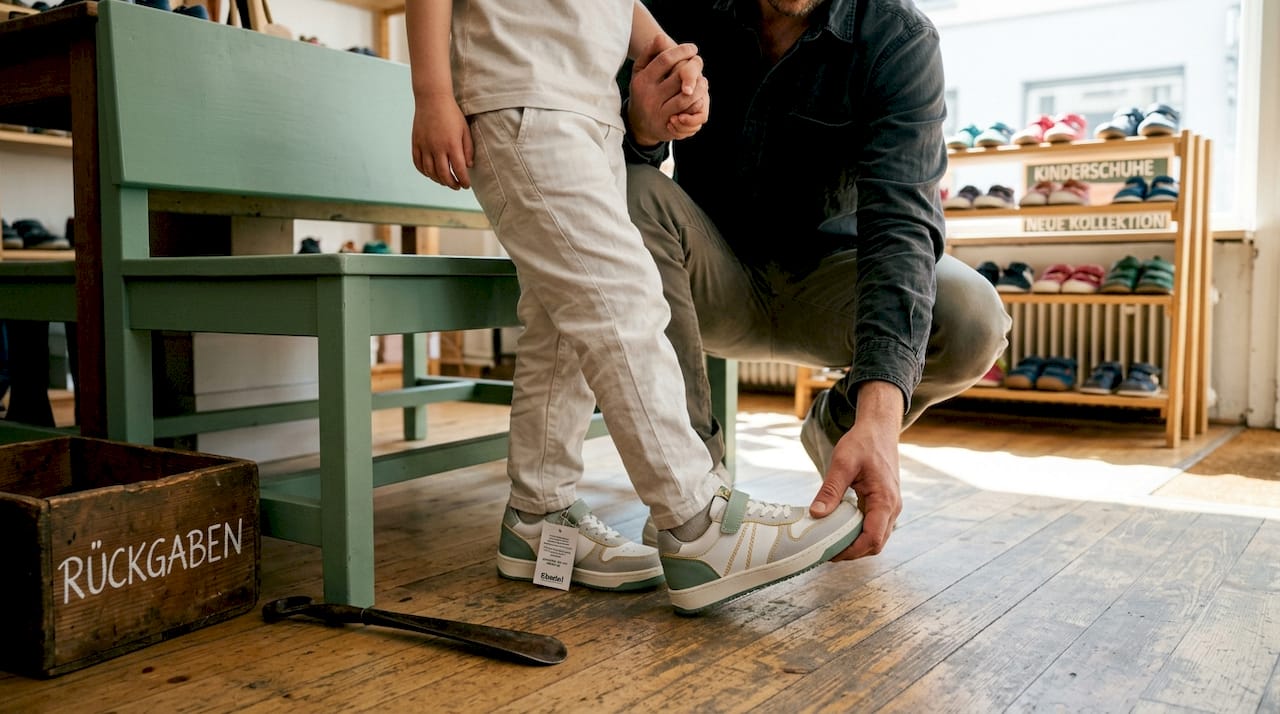
5. Perform a movement test Have the child walk a few steps, run, and squat. Does the heel lift? Does the foot slip sideways? Does the ankle buckle? If so, either the length, width, or instep is incorrect.
Pro tip: Take out the insole of the shoe and have your child stand on it. This way you can immediately see if the length and width really fit before the child even puts on the shoe. This method works particularly well when buying online.
For first steps and baby shoes: toddlers need softer soles and more toe freedom. For warmer months, barefoot sandals are a good alternative, as they allow for a lot of freedom of movement.
Overview: Shoe Sizes by Foot Length and Age Group
| Age | Foot Length (cm) | EU Size | UK Size |
|---|---|---|---|
| 1 Year | 11.5 to 12.5 | 19 to 20 | 3 to 4 |
| 2 Years | 13.0 to 14.0 | 21 to 22 | 5 to 6 |
| 3 Years | 14.5 to 15.5 | 23 to 24 | 6 to 7 |
| 4 Years | 15.5 to 16.5 | 25 to 26 | 8 to 9 |
| 5 Years | 16.5 to 17.5 | 27 to 28 | 9 to 10 |
| 6 to 7 Years | 17.5 to 19.0 | 29 to 31 | 11 to 12 |
| 8 to 10 Years | 19.0 to 22.0 | 31 to 35 | 12 to 2 |
This table serves as a guide. Individual deviations of half to a full size are normal and common. Always use the actual foot length as a basis.
Common Mistakes When Buying Children's Shoes and How to Avoid Them
Even well-informed parents fall into the same traps. Here are the most common mistakes and how to specifically avoid them.
Buying for growth The thought is understandable: if the shoe is a bit bigger, it will last longer. But a shoe that is too big is just as harmful as one that is too small. The child has to frantically splay their toes to find support. This changes the rolling motion and incorrectly strains muscles and tendons. A maximum of one size larger is acceptable, no more.
Outer measurement instead of inner length Many parents read the shoe size from the sole or rely on the inscription on the box. This is a mistake. What matters is the inner length of the shoe, i.e., the actual available space inside. This can vary by up to 8 mm for the same EU size, depending on the manufacturer.
Depending on the material and model, the fit varies greatly. If you only buy by size indication, you risk a wrong purchase.
Ignoring individual foot shape Not every child has a standard foot. Wide feet need shoes with a wide toe box. A high instep requires more volume in the instep area. Some children have very narrow heels. A size guide helps, but trying them on remains irreplaceable.
Underestimating manufacturer differences An EU 27 from manufacturer A can correspond to a different inner length than an EU 27 from manufacturer B. Therefore, always use the size chart of the respective manufacturer and do not blindly trust the size number.
Pro tip: Photograph your child's foot outline and measurements on paper. This way, you always have the current values at hand when buying online and can quickly compare them with manufacturer charts.
Other typical mistakes at a glance:
- Buying shoes only in the afternoon, when the foot is slightly swollen from activity (this is actually the better time)
- Passing on sibling's shoes without remeasuring
- Relying on the child's judgment, as children often don't feel when a shoe is too tight
- Not checking worn soles, even though they provide clues about incorrect strain
For a wide selection of models with child-friendly measurements, take a look at barefoot sneakers and models with checked size specifications.
Children's Feet and Shoe Sizes Compared: Overview Table
With mistakes and buying tips in mind, a detailed comparison table helps with quick matching. Especially when shoes are ordered from different countries or international shops, the systems differ.
International sizes and foot measurements differ and must be correctly assigned. A British UK 8 does not correspond to a US 8, and a European EU 24 has different inner lengths in different countries.
| EU Size | Foot Length (cm) | UK Size | Note |
|---|---|---|---|
| 19 | 11.5 | 3 | First walking shoes |
| 21 | 13.0 | 4.5 | Toddler, active movement |
| 23 | 14.5 | 6 | Wide toe box important |
| 25 | 15.5 | 7.5 | Growth spurt often here |
| 27 | 17.0 | 9.5 | Active preschoolers |
| 29 | 18.0 | 11 | School start, lots of walking |
| 31 | 19.5 | 12.5 | Greater variance between manufacturers |
| 33 | 21.0 | 1 | Transition to junior sizes |
| 35 | 22.0 | 2.5 | Almost adult size |
Important notes on the table:
- All values are approximate. Always check the manufacturer's chart for the specific model.
- For children's winter shoes with thick socks, plan for half a size larger.
- Barefoot shoes often have a slightly different fit than conventional shoes, as the toe box is wider and the sole is flatter.
Especially for children's winter shoes, the allowance plays a larger role, as thick socks take up additional space. Plan for 15 to 20 mm allowance here, instead of the usual 12 to 17 mm.
Our Experience: Why Diligence in Size Checking Really Pays Off
We often find that parents view size checking as a tedious chore. Yet, it is one of the smartest investments one can make for health and finances.
Children's feet grow up to 2 cm per year in the first year of life, and still about 1 to 1.5 cm annually between the ages of three and six. This means that if you measure every two to three months, you won't buy shoes that are too big too early, or too small too late. This sounds like effort, but in practice, it takes less than five minutes.
A well-documented size progression has another advantage: when reselling or passing on shoes, you can precisely prove how long and in what size the shoe was worn. This significantly increases the resale value of children's shoes, especially for high-quality barefoot models.
Our experience also shows that children who grow up in well-fitting shoes from the start develop a better sense of body. They stumble less often, complain less about tired legs, and are generally more active. This is not a coincidence, but the direct result of healthy foot development.
Growth-friendly models with adjustable fasteners and a wide toe box are particularly practical. They adapt to the foot instead of shaping it. Sustainable materials like certified leather or recycled textiles last longer and are better suited for resale. Investing in quality once pays off in the long run.
Discover Healthy Barefoot Shoes Now
Now that you know how to determine the correct size and avoid typical mistakes, the next step is simple: finding the right shoes.
At ebmini.de, you'll find children's shoes in the right size for every season, from lightweight summer models to waterproof winter shoes. All models follow the principles of barefoot walking: wide toe box, zero drop (i.e., no heel), flexible sole, and tested materials. Practical filters help you quickly find the right model for the measured foot length. If you're unsure, you can comfortably try on the shoes at home and easily return them if they don't fit. For active children, especially the children's barefoot sneakers are recommended, which are impressive both in everyday life and during sports.
Frequently Asked Questions About Children's Shoe Sizes
How do I correctly measure my child's foot length?
Have your child stand barefoot on a piece of paper, mark the longest point, and measure the distance in cm. Foot length should be measured fully while standing, as the foot elongates slightly under weight.
How much allowance do I need for children's shoes?
An allowance of approximately 12 to 17 mm between the foot length and the inner dimension of the shoe is recommended. Recommended allowances are essential for every shoe and vary depending on sole flexibility and shoe type.
Are there differences in European, British, and US children's shoe sizes?
Yes, international systems often differ. Size differences should be compared using conversion charts, as an EU 27 does not automatically correspond to the same inner length as a UK 9.
How often do I need to check my child's shoe size?
Due to growth, remeasure and check shoes every 2 to 4 months. Especially during growth spurts, which often occur in spring and autumn, a foot can increase by half a size within a few weeks.


