

Children's shoes for the transitional period: Finding the best model
A single pair of shoes for the entire spring or autumn? While that sounds practical, it often means children end up with soaking wet socks in the rain or sweaty feet in overly thick boots on warm afternoons. The transitional period presents real challenges for parents: you put on a jacket in the morning, the sun shines in the afternoon, and another shower arrives in the evening. If you want to understand which shoe models are truly sensible when, and how to make the right choice without wasting money or risking your child's foot health, you'll find well-founded answers here.
Table of Contents
- Challenges of the Transitional Period: What Makes the Shoe Weather So Special?
- Recommended Models for the Transitional Period: Lightweight vs. Robust
- What Parents Should Look for in Fit and Quality
- Practical Everyday Tips for Daycare, School, and Leisure
- A Fresh Look at Children's Shoes for the Transitional Period: More Than Trend or Technology
- Discover Healthy and Comfortable Children's Shoes for the Transitional Period
- Frequently Asked Questions about Children's Shoes in the Transitional Period
Key Insights
| Point | Details |
|---|---|
| At least two models | With a lightweight and a weatherproof pair, children are optimally equipped for the transitional period. |
| Flexibility and Fit | Flexible soles, wide toe box, and correct width are more important than brand promises. |
| Regular Control | Parents should check shoe size and condition every few months and replace if necessary. |
| Practical Spare Pairs | A second pair at daycare or school helps to react spontaneously to unexpected weather. |
| Conscious Selection | An honest assessment of daily requirements leads to healthier, more sustainable decisions. |
Challenges of the Transitional Period: What Makes the Shoe Weather So Special?
Spring and autumn sound romantic, but weather-wise, they're real rollercoasters. Temperatures fluctuate between 5 and 18 degrees within a single day, and rain can come at any time. Those who start their school commute dry in the morning often find themselves in mud in the afternoon. This is precisely what makes choosing shoes for children so challenging during these months.
Children's feet are particularly sensitive to changing conditions. They sweat faster than adult feet, grow rapidly, and need room for natural movement. A shoe that fits in the morning when starting daycare can become a damp trap at noon if it suddenly gets warm. At the same time, it won't provide enough protection during an afternoon rain shower if it's not designed for it.
Most parents are familiar with the layering principle for clothing: functional underwear, fleece jacket, rain jacket. This very idea can be applied to shoes. Lightweight, flexible models for dry days and more robust, water-repellent versions for wet periods form a system that truly works.
Typical everyday problems during the transitional period manifest in these situations:
- Frost on the grass in the morning, spring sunshine in the afternoon: winter boots are too warm, summer shoes are too cold.
- Puddles and mud after rain: normal sneakers soak up moisture like a sponge.
- Rapidly changing activities: daycare indoors, playground, forest, supermarket all demand different requirements.
- Children's feet grow quickly: what fit in September is often already too tight in October.
The mistake many parents make is to rely on a single "all-rounder." It doesn't exist. What does exist are clever combinations of two carefully selected models that truly cover everyday needs.
Recommended Models for the Transitional Period: Lightweight vs. Robust
Now that it's clear why a single pair isn't enough, the practical question arises: which models are suitable for which situation? The answer depends on what the child's daily routine truly demands.
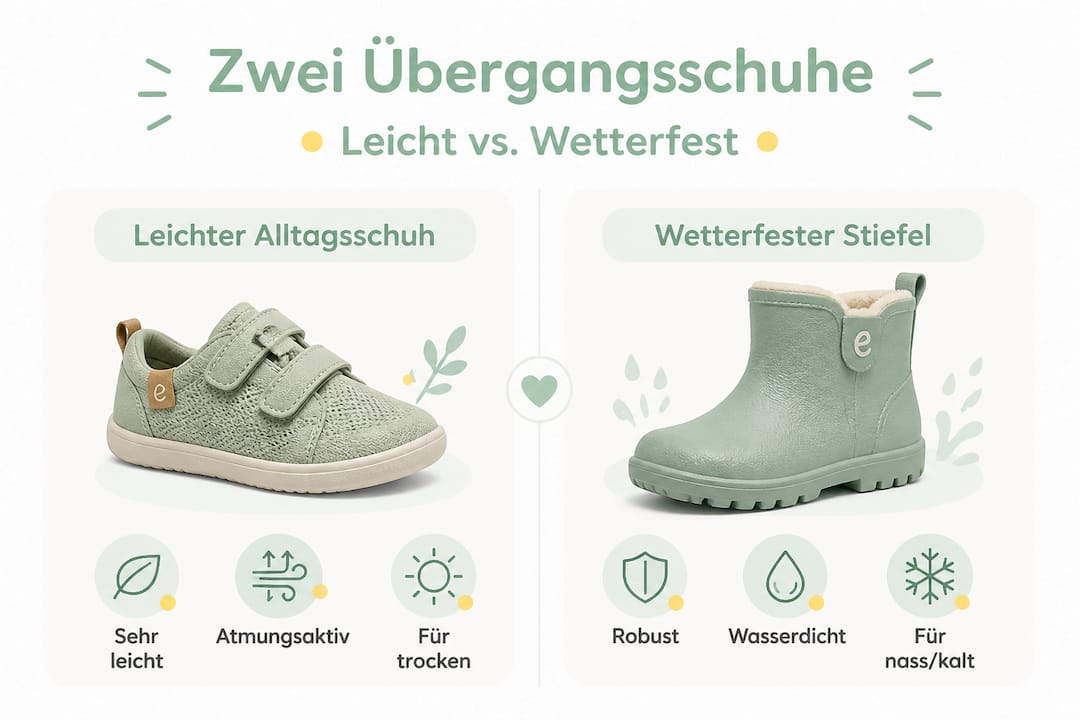
At least two transitional shoes are recommended: a lightweight, sporty model for warm and dry days, and a robust pair for bad weather. This basic rule sounds simple, but it has a big impact in practice.
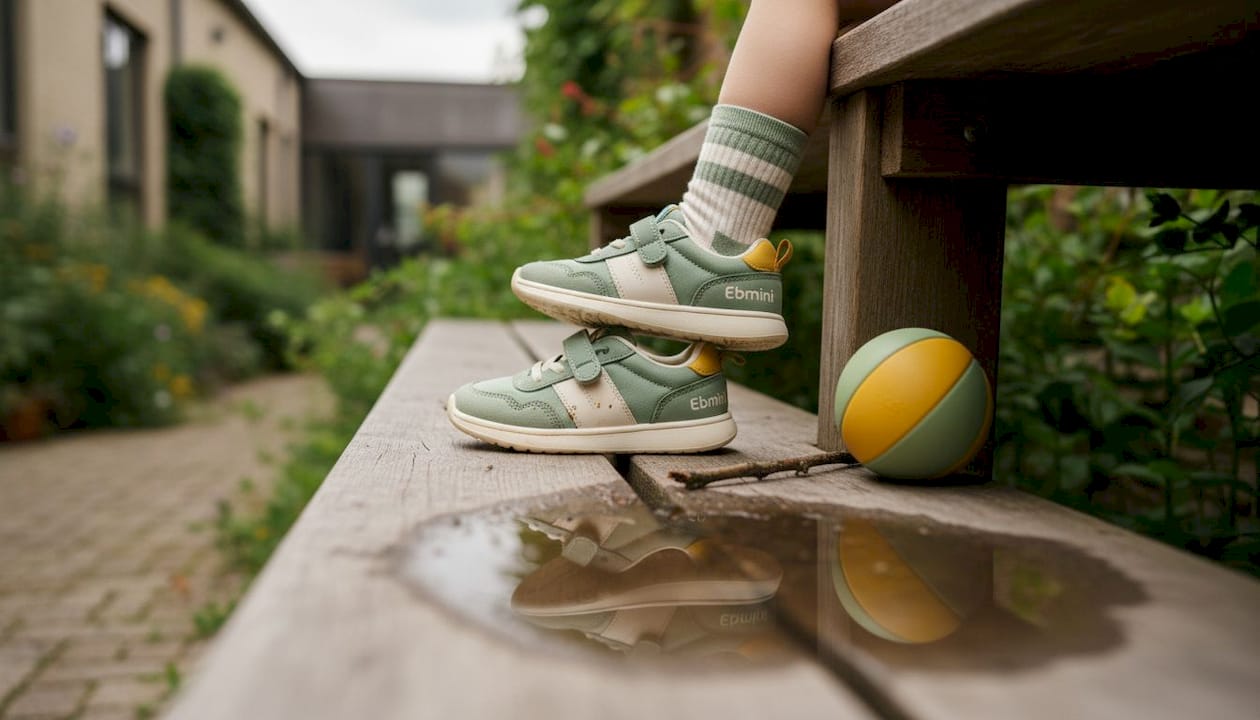
Type 1: The lightweight everyday shoe or barefoot sneaker
This type of shoe is ideal for mild, dry days. It weighs little, is easy to put on and take off, and gives the foot maximum freedom of movement. Barefoot shoes or minimal shoes have particular advantages here: a thin, flexible sole allows the child to feel the ground, promotes muscle development, and trains balance. The wide toe box prevents the toes from being squeezed, which often happens with normal lace-up shoes. Zero drop means that the heel and forefoot are at the same height, which supports natural posture.
Type 2: The weatherproof boot or high-cut shoe
This type is indispensable for rainy days, muddy periods, and colder stretches. It protects the ankle, keeps moisture out, and offers grippy soles for slippery surfaces. It is important that this shoe is also not too stiff. Many "robust" children's shoes on the market are so stiff that the child can barely roll their foot naturally. This puts long-term strain on muscles and joints.
| Feature | Lightweight Everyday Shoe | Weatherproof Boot |
|---|---|---|
| Weight | Very light (under 200 g) | Medium weight |
| Sole Thickness | Thin, very flexible | Slightly thicker, robust |
| Water Protection | Low to medium | High (water-repellent/proof) |
| Toe Box | Wide, naturally shaped | Ideally also wide |
| Use | Daycare, school commute (dry), playground | Rain, mud, cold periods |
| Zero Drop | Yes (for barefoot models) | Depending on manufacturer |
| Breathability | Very high | Medium (due to membrane) |
For everyday daycare, where children often put their shoes on and take them off themselves, a model with a simple Velcro fastener is recommended. For the school commute in changeable weather, water-repellent materials are useful. At the playground, sole grip is most important so children can climb and run safely.
Among the practical tips for buying shoes is that a change model should always be at hand. If you don't know in the morning whether it will rain in the afternoon, pack the lightweight pair in your bag.
Pro Tip: Always keep the spare pair in your backpack or daycare bag. A dry spare shoe will save your child from wet socks and you from annoying pick-up moments.
What Parents Should Look for in Fit and Quality
The best model choice is useless if the shoe doesn't fit. Fit is not a minor detail when it comes to children's shoes; it is the decisive factor for foot health and comfort. Children's feet are still growing, bones and ligaments are forming, and ill-fitting shoes can negatively affect this process.
Here are the most important steps for correct fit control:
- Measure foot length: Have the child stand on a piece of paper, trace the heel and longest toe, and measure the distance. Add 10 to 12 mm for growth reserve to the measured value.
- Check width: The shoe should not press anywhere. It should allow for slight widening across the ball of the foot. A too-narrow toe box can be identified by gently pressing from the outside.
- Bend the sole: Hold the shoe at the heel and toe and bend it. It should bend at the transition from the ball of the foot to the middle of the toes, not in the middle of the sole. A too-stiff shoe is not a good shoe.
- Check for zero drop: Place the shoe on a flat surface and look from the side. The heel and forefoot should be at the same height.
- Check material quality: The upper material should be breathable, the insole soft and removable (for better hygiene). Seams should not rub on the inside.
Pro Tip: Never buy shoes in advance in a size that is still "too big." Children walk differently in shoes that are too large, tip forward, and develop compensatory movements that can lead to long-term muscle problems.
For barefoot and minimal shoes, maximally flexible, thin soles and wide toe boxes are emphasized, but fit always takes precedence. A wide shoe that fits poorly is worse than a slightly narrower one that fits perfectly.
Especially during the transitional period, another factor comes into play: the material. Breathable textiles are ideal for spring shoes because children's feet sweat quickly. For autumn shoes, you need a material that keeps moisture out but wicks moisture away from the inside. This is a combination that only high-quality materials like leather or special functional membranes can achieve.
| Material Type | Breathability | Water Protection | Care | Suitable For |
|---|---|---|---|---|
| Textile / Knit | Very high | Low | Easy | Spring days |
| Leather (natural) | High | Medium | Medium | Spring/Autumn |
| Synthetic with Membrane | Medium | High | Easy | Rainy days |
| Rubber / Neoprene | Low | Very high | Very easy | Muddy paths |
The barefoot shoes for children at ebmini.de combine precisely these characteristics: flexible soles, natural fit, and everyday suitable materials for changing conditions. This is no coincidence, but the result of a clear development focus on child-friendly foot health.
Practical Everyday Tips for Daycare, School, and Leisure
Knowledge alone isn't enough when the morning is hectic and the child is already waiting at the door. That's why parents need clear strategies that can be integrated into everyday life without much planning. Theory is good, practice is better.
In everyday life, the layering principle is also useful for footwear: one model for dry days, one for wet days, alternating. If you implement this consistently, you'll always have a dry, clean pair at hand.
Concrete everyday strategies that really work:
- Deposit a spare pair at daycare: Many daycares allow a second pair to be left in the cubby. This saves panic if the child waded through puddles in the afternoon and the next appointment is imminent.
- Prefer quick-drying models: Shoes that are dry again within 30 to 60 minutes after rain or water splashing make everyday life much easier. Textile models or models with removable insoles dry faster.
- Weekly size check: Have the child slip into their shoes once a week and actively ask about pressure points. Children often don't spontaneously say anything because they are used to it. A simple test: gently press on the toe box from the outside. If you feel the toes, it's too tight.
- Plan regular cleaning: Dirty shoes dry slower, lose their water protection function faster, and smell unpleasant. Clean them once a week with a soft brush and, for textile shoes, remove lint from the Velcro fastener.
- Talk to the child: Don't just ask "Does the shoe fit?", but more specifically: "Where do you feel the shoe when you walk? Does it rub anywhere? Does your heel slip?" Children over three can give surprisingly precise information if you ask the right questions.
For the cool, rainy autumn weeks, warm transitional boots are a sensible addition to the shoe closet. They offer support, warmth, and are still flexible enough for active play. Anyone who lives in areas with frequent autumn rain will also be very happy with waterproof transitional shoes, as they keep feet dry without blocking natural foot movement.
An often overlooked point is cleaning after muddy adventures. Many parents simply place wet shoes next to the heater, which damages the material and stiffens the sole. Room temperature with good airflow, for example on a shoe rack in front of an open window, is better. This takes a little longer but keeps the shoe functional for much longer.
A Fresh Look at Children's Shoes for the Transitional Period: More Than Trend or Technology
After all the facts, recommendations, and practical tips, it's time for an honest look at everyday parenting. Because today, parents are confronted with an enormous flood of product promises: "barefoot certified," "high-tech membrane," "orthopedically recommended," "sustainably produced." Every label sounds important. But which information is truly helpful?
Our experience shows that many parents are more unsettled by these terms than made smarter by them. The "barefoot label," for example, says nothing about whether a shoe actually fits well. And a "high-tech membrane" boot with a narrow toe box harms the child more than a simple pair without a certificate that fits perfectly.
The honest truth is this: fit, flexibility, and everyday suitability are more important than any brand or material promise. A shoe that the child likes to wear, that doesn't rub, that is quick to put on in the morning, and doesn't stink after the playground, is the better shoe. Period.
We also see that parents often wait too long before discarding old shoes. The thought "they still fit somewhat" costs the child comfort and developmental potential. Children's feet grow quickly, sometimes half a size within six weeks. A shoe that "still works" actually no longer works.
The shoe-buying checklist is a useful tool, but no substitute for your own intuition and direct interaction with the child. Look closely, ask questions, observe how your child walks. These are the best diagnostic tools you have, and they cost nothing.
The counter-intuitive advice is therefore: Trust your observation more than the product promise. An expensive shoe from the trendy barefoot segment that fits poorly is worse than an inexpensive model with a well-thought-out fit. Invest your time in trying on shoes and communicating with your child, not just in product research.
Discover Healthy and Comfortable Children's Shoes for the Transitional Period
The knowledge about fit, model types, and everyday strategies is now available. The next practical step is to find shoes that meet these requirements exactly, without hours of research.
At ebmini.de, you'll find specially designed children's shoes that meet all key criteria for the transitional season: a wide toe box, zero drop, flexible soles, and weather-resistant materials. Whether it's waterproof boots for kids for rainy days or light transition boots for milder periods, you can compare models directly, use size advice, and benefit from genuine customer reviews. All products are designed to actively support natural foot development rather than hinder it. Take a look and find the model that suits your child's everyday needs.
Frequently Asked Questions about Children's Shoes for the Transitional Season
How many pairs of shoes do children need for the transitional season?
At least two pairs of transitional shoes are recommended: one light and one weather-resistant pair, so parents can react flexibly to changing conditions without sending their child out in the wrong shoes.
Are barefoot shoes suitable for wet weather?
There are barefoot shoes with water-repellent materials that are well-suited for the transitional season, provided that correct fit and sufficient sole thickness for colder temperatures are observed.
How do I know if a children's shoe fits well?
The shoe should not pinch anywhere, leave enough space at the front, and roll easily when walking; a wide toe box and flexible sole are the most important quality features.
How often should children's shoes be changed during the transitional season?
Regular size checks at least every two to three months are sensible, as children's feet grow quickly, and the changing demands of transitional weather put more strain on shoes than in stable seasons.


