

Children's Shoe Temperature Ranges: A Guide for Parents
The right children's shoe is defined by its temperature range: It protects the foot exactly when conditions require it. Parents are faced with the question of when a water-repellent shoe is sufficient and when a completely waterproof winter boot is necessary. The answer depends on three factors: outside temperature, activity level, and terrain. This children's shoe temperature range overview shows which types of shoes are suitable for which conditions, explains the function of insulation and breathability, and provides specific tips on fit and care.
1. Children's Shoes Temperature Ranges: Overview by Season
Children's shoes can be roughly divided into three temperature ranges. Each range places different demands on materials, construction, and sole.
| Temperature Range | Shoe Type | Main Feature |
|---|---|---|
| Above 15°C | Sandals, Sneakers | Breathability, lightweight material |
| 5°C to 15°C | Water-repellent everyday shoes | Splash protection, flexibility |
| Below 5°C to -30°C | Waterproof winter boots | Insulation, waterproofing, grip sole |
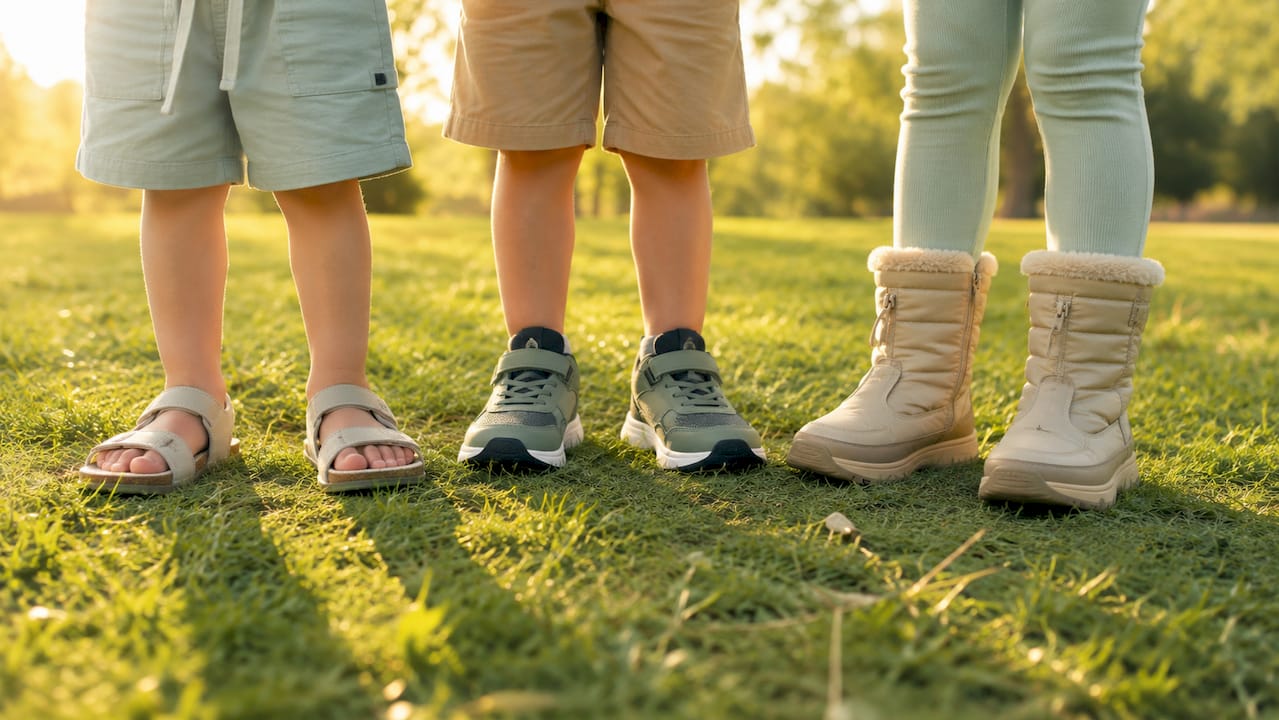
This classification is the starting point for every purchasing decision. Knowing the temperature range helps make the right choice faster.
2. Which Shoes Are Suitable for Mild Temperatures Above 5°C?
Water-repellent shoes are best for temperatures between 5°C and 15°C. They allow air to pass through the material but prevent light rain and splashes. This is the crucial difference to fully waterproof shoes, which completely keep out moisture but also allow less air to pass through.
For autumn and early spring, a child does not need heavy winter boots. A flexible shoe with a water-repellent coating is perfectly sufficient. It is important that the upper material breathes so that sweat does not accumulate.
Suitable materials for this range:
- Leather with water-repellent impregnation
- Synthetic membranes with limited waterproofing
- Textile shoes with DWR coating (Durable Water Repellency)
Pro-Tip: Re-impregnate water-repellent shoes every four to six weeks, especially after frequent rain. The protective effect diminishes over time but can be easily restored with an impregnating spray.
For weather protection in everyday life, the shoe and clothing should be coordinated. A water-repellent shoe loses its purpose if the child runs through puddles in shorts.
3. Winter Shoes and Snow Boots for Temperatures Below 5°C
As soon as temperatures consistently drop below 5°C, a child needs a shoe with real insulation and complete waterproofing. Temperature ratings down to -30°C on snow boots serve as a guide for insulation performance. They do not mean that the child should play outdoors at -30°C, but that the shoe will still retain enough warmth at this temperature.
The construction of a good winter boot consists of several layers:
- Outer material: Waterproof synthetic or leather with membrane
- Lining: Faux fur, wool, or fleece for warmth
- Sole: Profiled rubber sole for grip on ice and snow
- Shaft: High enough to prevent snow from entering
Winter shoes need a balanced ratio of insulation, breathability, and flexibility. Too much insulation without ventilation leads to sweaty feet, which actually worsens the warming effect.
Robust winter boots in the price range of 25–60 Euros offer sufficient protection for typical German winter conditions. More expensive models often score with better materials and longer durability but are not necessarily needed for most families.
Pro-Tip: Do not buy winter boots too big to "grow into." A shoe that is too wide loses warmth due to excessive air circulation and feels insecure when walking.
4. Fit, Socks, and Care at Different Temperatures
The fit determines whether a shoe actually delivers its thermal performance. A growth allowance of 12–17 mm is considered ideal for winter shoes. This allowance leaves room for thick socks and toe movement without the foot swimming in the shoe.
Winter shoes that are too tight compress the insulation material and reduce the warming effect. Shoes that are too large promote heat loss because the air in the shoe circulates without being heated. Both are common mistakes when buying shoes.
Regarding sock choice: Merino wool with fibers under 19 µm absorbs up to 30% of its own weight in moisture and still keeps children's feet warm and dry. Cotton socks absorb moisture but do not release it. The result: cold, wet feet after a short time.
Wool socks can be combined using the layering principle: a moisture-wicking base layer directly on the skin, an insulating mid-layer over it. For most children, a good merino sock is perfectly sufficient.
For shoe care:
- Always open wet shoes completely and let them dry at room temperature
- Never place them directly on the heater or in the sun
- Treat leather shoes with leather care after drying
- Clean synthetic shoes with a damp cloth
Proper drying protects the material and maintains insulation performance over several seasons. Direct heat destroys adhesives and deforms soles.
Pro-Tip: Newspaper in wet shoes speeds up drying without needing heat. The paper absorbs moisture and slowly releases it into the air.
5. Shoe Choice Based on Activity and Play Environment
A child's activity level influences shoe choice just as much as the temperature. Snow boots are suitable for prolonged standing in sub-zero temperatures, while lighter winter shoes are better for active children in everyday life. A child who walks 20 minutes to school needs a different shoe than one who plays in the snow for two hours.
For shoe selection by use, the following rule of thumb applies:
- School commute and everyday life: Lightweight winter shoe with water-repellent coating and flexible sole
- Playing in the snow: High snow boot with insulation and grip sole
- Sports and movement: Flexible shoe with good cushioning that allows freedom of movement
- Nature excursions: Waterproof hiking shoe with ankle support
Those looking for shoes for active children should pay attention to sole flexibility. A stiff sole restricts the natural rolling motion and tires the foot faster. This is particularly noticeable on long school commutes.
Children who run and climb a lot generate more body heat than children who stand still. An active child will quickly sweat in a shoe that is too warm, which cools the feet instead of warming them. In this case, a lighter winter shoe with good breathability is the better choice.
Rule of thumb for parents: If the child has sweaty feet after playing outside, the shoe is too warm or not breathable enough. If the feet are cold, there is a lack of insulation or the fit is incorrect.
6. When is Water-Repellent Enough, When Must it Be Waterproof?
The difference between water-repellent and waterproof is crucial for shoe selection. Water-repellent shoes repel short rain and splashes. With prolonged contact with water or stepping through puddles, moisture penetrates. Waterproof shoes with a membrane keep moisture out permanently but also allow less air to pass through.
For the comparison of both shoe types: Water-repellent is sufficient for dry winter days and short rain showers. Waterproof is necessary for snow, mud, and prolonged exposure to wetness.
A practical test: Hold your hand under running water and observe whether drops pearl off or soak in. The same principle applies to shoe surfaces. If drops pearl off, the water-repellent coating is still intact.
7. Breathability and Vapor Permeability in Winter
Breathability means that water vapor can escape from the shoe without water entering from the outside. This mechanism is particularly important in winter because children's feet sweat even in cold weather. If moisture accumulates in the shoe, the foot cools down faster.
Vapor permeability in winter depends on the membrane material. High-quality membranes allow water vapor to escape to the outside but block liquid water. Cheaper models without a membrane are often less breathable.
For parents, this means: A shoe with a good membrane keeps feet dry longer than a shoe with only a water-repellent coating. Especially for active children who sweat a lot, this difference is noticeable.
Key Takeaways
The right children's shoe for every temperature range protects children's feet through a combination of suitable insulation, breathability, and correct fit.
| Topic | Details |
|---|---|
| Temperature range as a basis | Choose shoes according to temperature range: above 5°C water-repellent, below 5°C waterproof and insulated. |
| Fit is crucial | A growth allowance of 12–17 mm is ideal for winter shoes with thick socks. |
| Merino wool instead of cotton | Merino wool absorbs up to 30% moisture and still keeps feet warm and dry. |
| Consider activity level | Active children need lighter, more breathable shoes than children who stand a lot. |
| Care maintains function | Let shoes dry at room temperature, never directly on the heater. |
Ebmini's Experience: What Parents Really Underestimate When Buying Shoes
At Ebmini, we consistently see the same pattern: parents buy winter shoes that are too big because they think the child will grow into them. However, a shoe that is too loose loses warmth and feels insecure. The child stumbles more often and complains about cold feet, even though the shoe is actually designed for low temperatures.
A second blind spot is the sock. Cotton socks are simply the wrong choice for winter. Fine merino wool is much better suited for sensitive children's feet because it stores warmth and wicks moisture away from the foot. Those who switch to merino socks will notice the difference after the first winter day.
What else we notice: Many parents buy a single shoe for all situations. This rarely works well. A snow boot for the school commute is too heavy and too warm. A light everyday shoe fails when sledding. Two shoes for two areas of use are not a luxury but a sensible investment in comfort and health.
And one more thing: The thermal performance of winter shoes cannot be solely judged by the price. A shoe for 40 Euros with a good fit and the right sock warms better than a shoe for 100 Euros that is too big or worn with cotton socks. The combination makes the difference.
— Ebmini
Ebmini® Barefoot Shoes: Healthy and Temperature-Adapted

Ebmini develops barefoot shoes for children that combine foot health and weather protection. The shoes follow the barefoot principle: wide toe box, zero drop, and flexible sole for natural foot development. At the same time, the models are designed for various temperature ranges, from breathable everyday shoes to waterproof winter models. Those also looking for suitable breathable children's socks will find skin-friendly models made from fine materials at Ebmini. All products are available directly in the Ebmini shop, with detailed size advice and customer reviews.
FAQ
What does the temperature range on children's shoes mean?
The temperature range on children's shoes indicates up to what outside temperature the shoe offers sufficient warmth. It is a guide for insulation performance, not an absolute limit.
When does a child need waterproof shoes?
Waterproof shoes are needed for consistent temperatures below 5°C or in snow and mud. Water-repellent models are sufficient for short rain and dry winter days.
Which socks are best suited for winter shoes?
Merino wool is the best choice for winter shoes because it absorbs up to 30% moisture and still keeps warm. Cotton socks soak up sweat and cool the foot.
How much space should a winter shoe have?
A growth allowance of 12–17 mm is ideal. This room allows for thick socks and toe movement without the shoe being too loose and losing warmth.
How do I properly dry wet children's shoes?
Open shoes completely and let them dry at room temperature. Direct heat, for example on the heater, destroys adhesives and deforms the sole.


