

Children's Shoes and Gait Analysis: Criteria for Parents
The crucial criteria for movement analysis of children's shoes are sufficient toe freedom, a flexible sole, and secure fixation. Experts refer to this as biomechanical shoe evaluation, meaning assessing how a shoe supports or hinders natural foot mechanics. The optimal allowance is 12–17 mm in front of the longest toes, measured in the afternoon when the foot is slightly swollen. This leeway allows for growth and natural rolling movements simultaneously. Knowing these children's shoe analysis criteria will lead to significantly better decisions for your child's foot health when purchasing shoes next time.
1. Toe Freedom: Why the Toe Box Is Everything
Toe freedom is the most important single criterion in shoe evaluation for children's movement. Wide toe boxes allow natural toe splay and prevent restrictions in muscle activity as well as deformities. This sounds technical, but it simply means: If the toes cannot spread, the foot muscles do not work properly.
Shoes that are too tight force the toes into an unnatural position. In the long term, this leads to weakness in the foot muscles, altered gait patterns, and in the worst case, deformities such as hallux valgus. Children often do not consciously feel this pressure because their cartilage tissue is still soft.
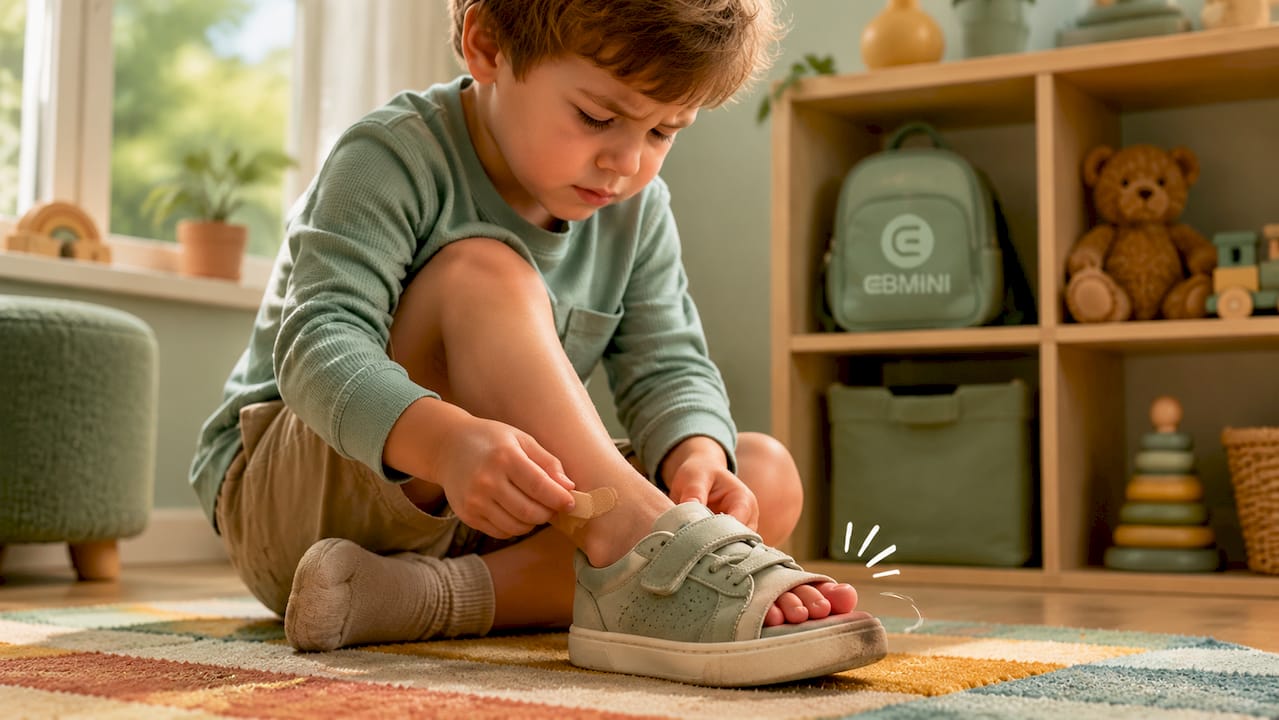
The ideal toe box is rounded at the front and follows the natural foot shape. A simple test: Place your child's foot on a piece of paper, trace the outline, and then place the shoe over it. If the shoe overlaps at the sides, it is too narrow.
What to look for in the toe box:
- The width of the shoe at its widest point should be at least as wide as the foot itself.
- The shoe should not taper to a point at the front, not even slightly.
- When standing, there should still be room for a finger between the longest toe and the tip of the shoe.
- When walking, no toe should hit the tip of the shoe.
Pro Tip: Always measure your child's foot in the afternoon. Feet swell slightly throughout the day. A shoe that fits in the morning may already be too tight in the afternoon.
EBMini explains more about the specific benefits of a wide toe box for children's feet in its own guide.
2. Flexible Sole: How Much Flexibility a Child's Shoe Needs
A flexible sole is not a luxury feature, but a basic prerequisite for healthy foot development. When walking, the foot rolls from the heel over the outer edge to the toes. A stiff sole blocks this movement and forces the foot to make compensatory movements.
The simplest practical test: Hold the shoe at the heel and toe and bend it. It should bend easily without force. If you need both hands, the sole is too stiff for a child's shoe.
At the same time, the sole needs a certain torsional ability for uneven ground. This means that the shoe should be able to twist slightly when twisted at both ends against each other. This property provides stability to the foot on uneven surfaces without restricting the rolling motion.
Pro Tip: Pay attention to the weight of the sole. Heavy soles tire children's leg muscles more quickly. A light, flexible sole is almost always the better choice.
How to check sole quality in three steps:
- Bend test: Bend the shoe at the heel and toe. It should bend easily with one hand.
- Torsion test: Twist the shoe at both ends against each other. A slight twist is good; strong stiffness is bad.
- Weight test: Pick up the shoe. A child's shoe should feel light, not heavy.
3. Heel Counter and Fixation: Support Without Restriction
A light, flexible heel counter provides secure support without restricting movement and supports healthy foot mechanics. It prevents the foot from tilting sideways in the shoe without blocking natural movement.
The closure mechanism plays an underestimated role. Velcro fasteners are practical for children under 6 because they are quick and secure to close. Laces allow for finer adjustment but require motor skills that many children only develop after school age. Combinations of Velcro and elastic elements often offer the best results for active children.
Important fixation criteria at a glance:
- The heel counter should give slightly when pressed, but not collapse.
- The closure must hold the foot firmly enough so that the shoe does not wobble when running.
- No gap should form between the heel and the heel counter when the child is standing.
- For sandals: At least one strap over the instep for adequate fixation.
For sports and longer asphalt paths, children need shoes with better cushioning and protection, without sacrificing freedom of movement. More cushioning means more comfort during intense activity, but not automatically more safety.
4. Shoe Weight: An Often Underestimated Factor
The weight of a child's shoe directly influences how much energy a child has to expend when walking and running. Heavy shoes tire leg muscles faster and alter gait patterns. Children often unconsciously compensate for the weight by placing their foot differently.
As a rule of thumb: A child's shoe should not weigh more than 10 percent of the child's body weight. For a 15-kilogram child, that would be a maximum of 150 grams per shoe. Many conventional children's shoes significantly exceed this value.
Barefoot shoes and minimalist models often weigh less than 200 grams per shoe. This is no coincidence, but a design principle. Lightweight shoes allow the foot to work more naturally and actively promote muscle development.
5. Movement Analysis Methods: What Experts Measure
Three-dimensional movement analysis enables precise quantification of functional disorders that often go undetected during a simple visual inspection. This is the decisive advantage over merely observing gait.
Two procedures dominate clinical practice: the PlugInGait model and the Oxford Foot Model. PlugInGait analyzes the entire body during walking, from the pelvis to the foot. The Oxford Foot Model goes deeper, differentiating between individual foot segments, i.e., hindfoot, midfoot, and toes. Both methods provide data that orthopedic surgeons and physiotherapists use for shoe recommendations.
| Analysis Method | What It Measures | Benefit for Parents |
|---|---|---|
| PlugInGait | Overall gait pattern, joint angles | Detects compensatory movements in the knee and hip |
| Oxford Foot Model | Individual foot segments | Shows incorrect loading in the foot itself |
| Foot pressure measurement | Pressure distribution under the foot | Helps with orthotic provision and shoe selection |
| Muscle activity measurement | Which muscles are active when | Shows muscular imbalances |
Foot pressure distribution measurement shows areas of higher stress and helps with orthotic provision. It is particularly relevant for parents because it makes visible whether a child distributes weight evenly or rolls off the foot unilaterally.
Modern movement analysis often reveals muscular imbalances in children that can be corrected with appropriate shoes. This means that the right shoe choice is not just comfort, but active prevention.
Pro Tip: A professional gait analysis by a pediatric orthopedist or physiotherapist is particularly worthwhile if your child frequently complains of foot pain, walks unusually, or tires quickly. Many health insurance companies cover the costs.
6. Zero Drop: What the Principle Means for Children's Feet
Zero drop describes the height difference between the heel and forefoot in the shoe. In classic sports shoes, the heel is often 8–12 mm higher than the forefoot. In zero drop shoes, this difference is zero, meaning the foot stands flat, as when walking barefoot.
For children, zero drop is particularly relevant because their feet are still developing. An elevated heel changes posture, tilts the pelvis forward, and stresses the spine in the long term. Zero drop shoes allow the foot to remain in its natural position and promote an upright posture.
The transition to zero drop shoes should be gradual, especially if a child has previously worn conventional shoes. The calf muscles and Achilles tendon need time to adapt. For children who have worn barefoot-like shoes from the start, this transition is not an issue.
7. Situational Shoe Selection: The Right Shoe for Every Situation
Barefoot shoes and stable models are not mutually exclusive. A situational mix is ideal because barefoot shoes promote muscle development and stable shoes offer protection. The choice depends on the activity level and the ground surface.
Parents should abandon the idea that there is one all-round shoe for all situations. Instead, it is worthwhile to choose several models depending on their use. This sounds complicated, but it is simply the reality of children's diverse movement.
| Situation | Recommended Shoe Type | Most Important Criterion |
|---|---|---|
| Playing in the garden, on grass | Barefoot shoe or minimalist | Maximum flexibility, thin sole |
| Kindergarten, school (indoors) | Light indoor shoe, flexible | Good fixation, light weight |
| Asphalt, longer walks | Shoe with more cushioning | Protection during exertion |
| Sports, football, gymnastics | Sports shoe with support | Heel counter, closure |
| Rain, mud | Waterproof barefoot shoe | Flexibility and protection combined |
Barefoot walking and barefoot shoes promote balance and foot muscles, but offer little protection on rough surfaces. This is not an argument against barefoot shoes, but an argument for situational thinking. Ebmini explains in detail what parents should pay attention to during the transition to barefoot-like shoes.
8. Materials and Breathability: What Matters Inside
The inner material of a child's shoe influences how warm and moist the foot becomes. Children sweat more than adults, especially on their feet. Poorly ventilated lining leads to moisture, which promotes fungal infections and causes the shoe to wear out faster.
Natural materials like leather or textile fabrics with a high cotton content breathe better than pure synthetic leather. For all-weather models, waterproof membranes like Gore-Tex are useful, provided they can also wick away moisture from the inside. A shoe that is waterproof on the outside but not breathable on the inside quickly becomes uncomfortable.
The insole should be removable. This makes cleaning easier and allows for the use of orthopedic insoles if a pediatrician recommends them. Many parents underestimate this point when buying.
9. Size Advice: Why Shoe Sizes Alone Are Not Enough
Shoe sizes are not enough. two shoes of size 28 can vary considerably in length, width, and internal volume. Therefore, measuring the foot in centimeters is the only reliable starting point.
Foot length is measured from the heel to the longest toe. To this, add the recommended allowance of 12–17 mm for growth and movement. If you remove an insole from the shoe and place the child's foot on it, you will immediately see if the length and width are suitable.
Children aged 1–3 years grow up to two shoe sizes per year. After school age, growth slows to about one size per year. This means checking shoes every 2–3 months, not just when the child complains.
Pro Tip: Never buy in advance if the shoe is more than 17 mm too large. A shoe that is too large is just as harmful as one that is too small, because the child will cramp their foot to keep the shoe on.
Key Takeaways
The most important criteria in the movement analysis of children's shoes are toe freedom, sole flexibility, heel counter, and situational shoe selection, because only their interaction ensures healthy foot mechanics.
| Topic | Details |
|---|---|
| Optimal allowance | 12–17 mm in front of the longest toe, measured in the afternoon, for growth and rolling motion. |
| Toe box | Wide and rounded, allowing toes to splay and muscles to work actively. |
| Sole flexibility | Shoe must be bendable with one hand and allow slight torsion. |
| Situational shoe choice | No all-round shoe: barefoot models for grass, more cushioning for asphalt and sports. |
| Movement analysis | Methods like PlugInGait and foot pressure measurement reveal imbalances that the eye overlooks. |
What I've Really Learned After Years of Consulting
Many parents come to us with a clear idea: they are looking for the one perfect shoe that fits everything. This is understandable, but unfortunately incorrect thinking. No single shoe can simultaneously offer maximum flexibility for the playground and sufficient cushioning for a long city walk.
What surprised me most after many conversations with parents: Most problems arise not from bad intentions, but from a lack of information. Parents buy shoes based on appearance or price because no one has explained to them what really matters. The shoe size is measured once in the store and then not checked again for months.
The second blind spot: Parents wait until the child complains. Children rarely complain about shoe pain because they have no comparison. They don't know what it feels like when the foot truly has space. Therefore, regular checks by parents are so important, not the child's feedback.
My honest advice: Buy two to three different types of shoes and switch them situationally. This is not a luxury, but the most sensible investment in your child's foot health. And measure their feet every two months, especially for children under 4 years old.
— Ebmini
EBMini: Barefoot Shoes That Meet All Criteria

EBMini has developed barefoot-like children's shoes that precisely meet the criteria that movement analyses identify as crucial: wide toe box, zero-drop sole, lightweight, and flexible construction. The shoes are available for children aged 1 to 10 and cover all seasons, from waterproof all-weather models to lightweight summer models. All models are designed to allow the foot to work naturally, without compromising on protection. Those who explore EBMini's children's shoe collection will find models for everyday wear, the playground, and active children. EBMini also offers detailed size advice to ensure the first shoe truly fits.
FAQ
What does motion analysis mean for children's shoes?
Motion analysis for children's shoes refers to the assessment of how a shoe influences natural foot mechanics during walking and running. Experts use methods such as the PlugInGait model or foot pressure measurement to identify misalignments.
How much space should a children's shoe have at the front?
The recommended allowance is 12–17 mm between the longest toe and the shoe tip, measured in the afternoon when the foot is slightly swollen. This leeway allows for growth and natural rolling movements.
How often should I measure my child's foot?
Children under 4 years old should be re-measured every 6–8 weeks, older children every 2–3 months. Shoes that still fit can become too tight within a few weeks.
Are barefoot shoes suitable for all situations?
Barefoot shoes promote muscle development and balance, but offer little protection on hard or rough surfaces. A situational mix of barefoot shoes and models with more cushioning is the best solution for active children.
How do I recognize good sole flexibility?
A shoe with good sole flexibility can be easily bent with one hand at the heel and toe. Additionally, it should be easy to twist, indicating sufficient torsional capability for uneven ground.


