

Choosing First Walking Shoes: The Parents' Guide
Few purchases feel as important, or as confusing, as your toddler's first pair of shoes. Soft or firm? Leather or textile? With or without a toe cap? The criteria for selecting first-walking shoes are crucial, because it is precisely between the ages of one and three that the arch of the foot, muscles, and sense of balance develop at a pace unmatched at any other stage of life. Barefoot-style first-walking shoes are considered the direct way to support this development without hindering it. This article provides you with the specific criteria, measurement methods, and material knowledge you need to make an informed decision.
Table of Contents
- Important Selection Criteria for Barefoot-Style First-Walking Shoes
- Materials and Workmanship: Focus on Health and Environment
- Fit and Sizing: How First-Walking Shoes Really Fit
- Flexible Soles and Stability: Balance Between Protection and Freedom of Movement
- Practical Tips: Shoe Care and Everyday Suitability for Toddlers
- Comparison Table: Barefoot-Style First-Walking Shoes at a Glance
- Why Stiff Shoes Weaken the Foot: A Change of Perspective for Parents
- Discover High-Quality Barefoot-Style First-Walking Shoes at EBMINI®
- Frequently Asked Questions About First-Walking Shoes and Selection Criteria
Key Takeaways
| Point | Details |
|---|---|
| Material quality matters | Chrome-free, natural materials protect health and promote wearing comfort. |
| Fit is crucial | Approximately 1 to 1.5 cm of toe space allows for natural growth and toe freedom. |
| Flexible soles promote development | Flexible soles support balance and strengthen foot muscles. |
| Heel support without constriction | A firm, well-fitting heel cup prevents slipping and supports natural foot roll. |
| Regular checks | Shoe care, proper fitting, and wear inspection ensure long-term healthy feet. |
Important Selection Criteria for Barefoot-Style First-Walking Shoes
To find the right first-walking shoes, it's essential to know the selection criteria in detail. This sounds self-evident, but in practice, it's often different: many parents focus on appearance, price, or brand name, and then end up with a shoe that simply doesn't fit the child's foot. This guide to buying first-walking shoes therefore starts with what really matters.
Material quality and absence of harmful substances are at the top of the list. Baby and children's skin reacts more sensitively to chemical residues than adult skin. When buying leather shoes, you should look for the NATURLEDER IVN ZERTIFIZIERT seal, which guarantees chrome-free tanning.
Soft, flexible soles come right after. A sole that can be easily bent at the ball of the foot allows for the natural rolling motion that a toddler's foot needs when walking. Stiff soles suppress this movement.
A wide toe box is not a luxury, but an anatomical necessity. Toddlers' feet are wider at the front than adult feet, and a toe box that is too narrow compresses the toes, which can lead to long-term deformities.
Heel support without restriction means: the shoe should sit at the back, but not be tight. A slight pressure when squeezing the heel cap is normal; strong stiffness is not.
Adjustable fastenings like Velcro closures or elastic inserts make everyday life noticeably easier. Toddlers rarely have patience when putting shoes on and taking them off.
- Toxin-free materials with certification
- Flexible, bendable sole at the ball of the foot
- Wide, anatomically shaped toe box
- Secure heel support without stiffness
- Velcro closure or elastic insert
Pro-tip: Before buying, check the Children's Shoe Size Checklist to ensure you have the correct starting size before evaluating other criteria.
Materials and Workmanship: Focus on Health and Environment
In addition to fit, material quality plays a central role in healthy wearing comfort. A shoe that fits well but is made of problematic materials is not a good shoe. This is one of the most frequently underestimated points in first-walking shoe buying advice.
ÖKO-TEST found in 2023 that many leather shoes contained problematic substances like chromate (Chromium VI) and recommended chrome-free tanned natural leather or organic materials. This is not a side note. Chromium VI is considered potentially carcinogenic and can cause contact allergies in sensitive children's feet.
What to look for when buying shoes regarding materials:
- Prefer chrome-free tanned leather or healthy materials in children's shoes with certification
- Classify IVN natural leather as a reliable quality feature
- Only choose synthetic materials if they are explicitly tested for harmful substances
- Inner lining made of natural textile protects against excessive sweating
- Check glues and dyes for harmful substances (look for OEKO-TEX certificate)
Breathable materials are particularly important for toddlers. Children's feet sweat significantly more than adult feet, and a moist foot climate promotes fungal infections and skin irritations.
Note: An inexpensive shoe without material certification can become more expensive in the long run, namely through doctor's visits, allergies, or deformities that develop from poor wearing comfort.
Sustainability plays a growing role. Parents who opt for vegan alternatives should specifically look for toxin-free synthetic leather or certified textile fabrics that are explicitly designated for children's shoes.
Fit and Sizing: How First-Walking Shoes Really Fit
In addition to material and workmanship, the fit largely determines comfort and healthy development. And here lies one of the biggest problems: children often don't feel when a shoe is too small, so precise measurement with about 12 mm of allowance is crucial.
This sounds like a detail. But it is a central safety feature. A shoe that is too tight, which the child wears without complaint, can cause pressure points, corns, or even a permanent toe deformity in just a few weeks.
How to correctly measure your child's foot:
- Have your child stand in socks on a white piece of paper
- Trace tightly around the contour of the foot with a pen, making sure the child stands straight
- Measure the length from the heel end to the longest toe (often the second toe, not necessarily the big one)
- Repeat with the other foot
- Always use the larger foot for shoe purchases
- Add 1 to 1.5 cm for growth and natural toe spread
Correct fit testing doesn't end with length. The width of the shoe at the ball of the foot is also crucial. Squeeze the shoe sideways; if there's no resistance, it's too wide. If it immediately resists firmly, it's too narrow.
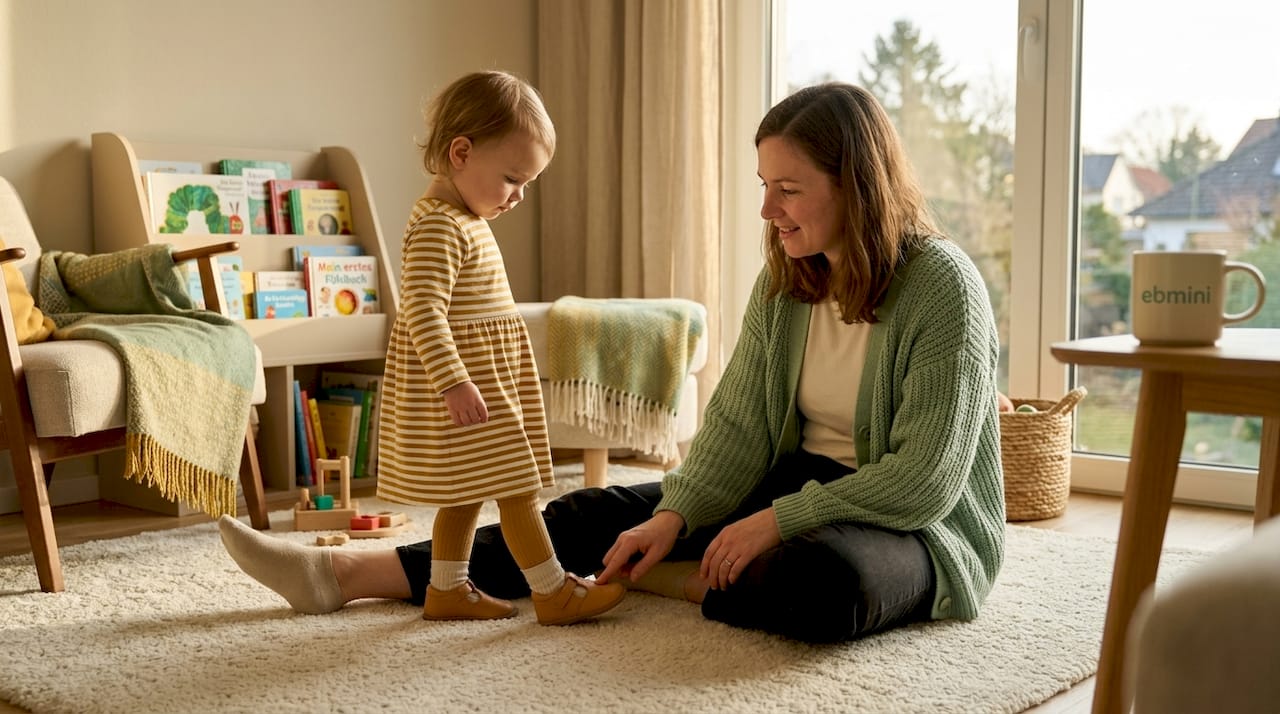
Check the heel support by sliding a finger between the heel and the shoe. Exactly one finger should fit. More indicates too much play, which encourages the child to curl their toes to keep the shoe on. This is an underestimated trigger for foot problems.
Flexible Soles and Stability: Balance Between Protection and Freedom of Movement
Just as important as fit is the optimal sole characteristic for natural foot function and stability. Here, two common misconceptions meet: too much stability harms, too little protection also harms.
A too stiff shaft can weaken the foot muscles, as true stability must come from the foot itself. This does not mean that first-walking shoes should be unstructured. It means that the shoe should support the foot's work, not take it over.
What makes a good sole in the best first-walking shoes for children:
- Bendable at the ball, but not foldable in the middle (indicates sufficient basic stability)
- Non-slip profile for secure grip on parquet, tiles, and forest floor
- Firm but not stiff heel cap for orientation and stability
- Low sole thickness for better ground feel (so-called zero drop is ideal)
- No excessive cushioning that dampens the proprioceptive feedback from the ground
Important for parents: Proprioception refers to the body's ability to sense its own position in space. Children's feet intensely train this ability through ground sensation. Thick cushioning soles reduce this training stimulus.
Pro-tip: Test the sole in the store by bending it upwards at the tip of the ball. With a good first-walking shoe, the sole should bend easily there but not snap back in the other direction. Read more about transitional models for first-walking shoes if you are switching between seasons.
Practical Tips: Shoe Care and Everyday Suitability for Toddlers
In addition to the selection criteria, it is important to know practical everyday tips for the optimal use of first-walking shoes. A good shoe lasts longer and provides better support if it is treated correctly.
Helpful tips for first-walking shoes in everyday life:
- Always try on shoes with the child in motion, i.e., while walking, hopping, and jumping, as feet widen under load
- Regularly check sole wear, especially on the outer edge of the heel, as uneven abrasion can indicate gait problems
- Regularly check Velcro fasteners for function and readjust or replace them if worn
- For leather shoes, apply nourishing leather wax monthly; for textile shoes, observe washing instructions
- Always air dry shoes after damp outings, never on a heater, as heat damages soles and glue
The gait pattern when walking reveals a lot. Observe whether your child turns outward or inward, limps, or stumbles noticeably. This can be an early sign of fit problems or sole wear before you see it with the naked eye.
Here's how to perform the everyday check in four steps:
- Take off the shoe and check the insole for pressure points or impressions
- Observe the child barefoot to see if they walk differently than with shoes
- Press the toes forward to check for toe room
- Check the sole profile for even wear
Pro-tip: Never buy in bulk for several months. Children's feet grow quickly and unevenly. Check shoe size every eight weeks at the latest. Read tips on shoe care and durability so your investment lasts longer.
Comparison Table: Barefoot-Style First-Walking Shoes at a Glance
Practical overview aids facilitate individual purchasing decisions. The following table evaluates five typical models based on the most important first-walking shoe test criteria. Use it as a guide, not as a final judgment, as individual foot shapes are crucial.
Superfit first-walking shoes offer soft leather workmanship with a flexible sole and practical Velcro fasteners, making them a well-known representative in the segment.
| Model Type | Material | Flexibility | Toe Box | Fastening | Toxin Test | For Outdoors |
|---|---|---|---|---|---|---|
| Leather barefoot shoe (chrome-free) | Natural leather IVN | Very flexible | Wide anatomical | Velcro fastener | High | Yes |
| Textile barefoot shoe | Organic cotton | Flexible | Medium-wide | Elastic | Medium | Conditional |
| Classic leather first-walking shoe | Smooth leather | Moderate | Narrow to medium | Velcro fastener | Variable | Yes |
| All-weather barefoot shoe | Synthetic waterproof | Flexible | Wide | Velcro fastener | High | Very good |
| House shoe with barefoot principle | Textile lining | Very flexible | Wide | Elastic | Medium | No |
For the Ebmini Barefoot Shoes Overview, you'll find models that meet several of these criteria simultaneously, especially in the areas of all-weather suitability and freedom from harmful substances.
What the table cannot show: the feel of the inner lining, the actual width of the toe box for your specific child, and how the shoe feels after twenty minutes on the playground. These factors are just as decisive as the specifications on the label.
Why Stiff Shoes Weaken the Foot: A Change of Perspective for Parents
Most parents buy their first pair of walking shoes with a silent belief in the back of their minds: a firm, stable shoe protects the little foot better. This thought is humanly understandable and completely wrong.
Stability must come from the foot muscles. Shoes that are too stiff prevent muscle development and can even cause harm. This is not an opinion from the barefoot running scene; it is orthopedic fundamental. A toddler walking in a stiff shoe literally leaves their foot muscles unemployed. The result: weak muscles, poor proprioception, potential development of flat feet (pes valgus).
I regularly encounter parents who feel uncomfortable with soft barefoot shoes because they feel they are not providing enough protection for the child. But the opposite is true. A soft, well-fitting shoe that allows the foot to work provides the child with more long-term protection than any rigid supportive shoe.
The contrasting idea worth considering: supportive shoes for toddlers are in most cases not necessary, but counterproductive. Orthopedists today only recommend them for diagnosed deformities that have a medical indication.
The parallel to adults is illuminating. Those who constantly wear supportive corsets lose back muscle strength. Those who constantly put toddlers in supportive shoes prevent the foot muscles from taking on this supportive task themselves.
Barefoot-like shoes solve this problem not by omitting structure, but by allowing natural movement. They protect against cold, sharp stones, and wet ground, but they let the foot do what it's supposed to do: feel, sense, balance. Read more about how stability and muscle building interact in transitional models.
Patience is the second element that is often forgotten. Feet develop not through shoe design, but through movement. Barefoot time indoors, on grass, on sand is just as valuable as the best shoe.
Discover high-quality barefoot-like first-walker shoes at EBMINI®
You now know what really matters: flexible soles, a wide toe box, pollutant-free materials, and adequate room for movement. The next step is to find shoes that actually deliver all of this, not just promise it on the label.
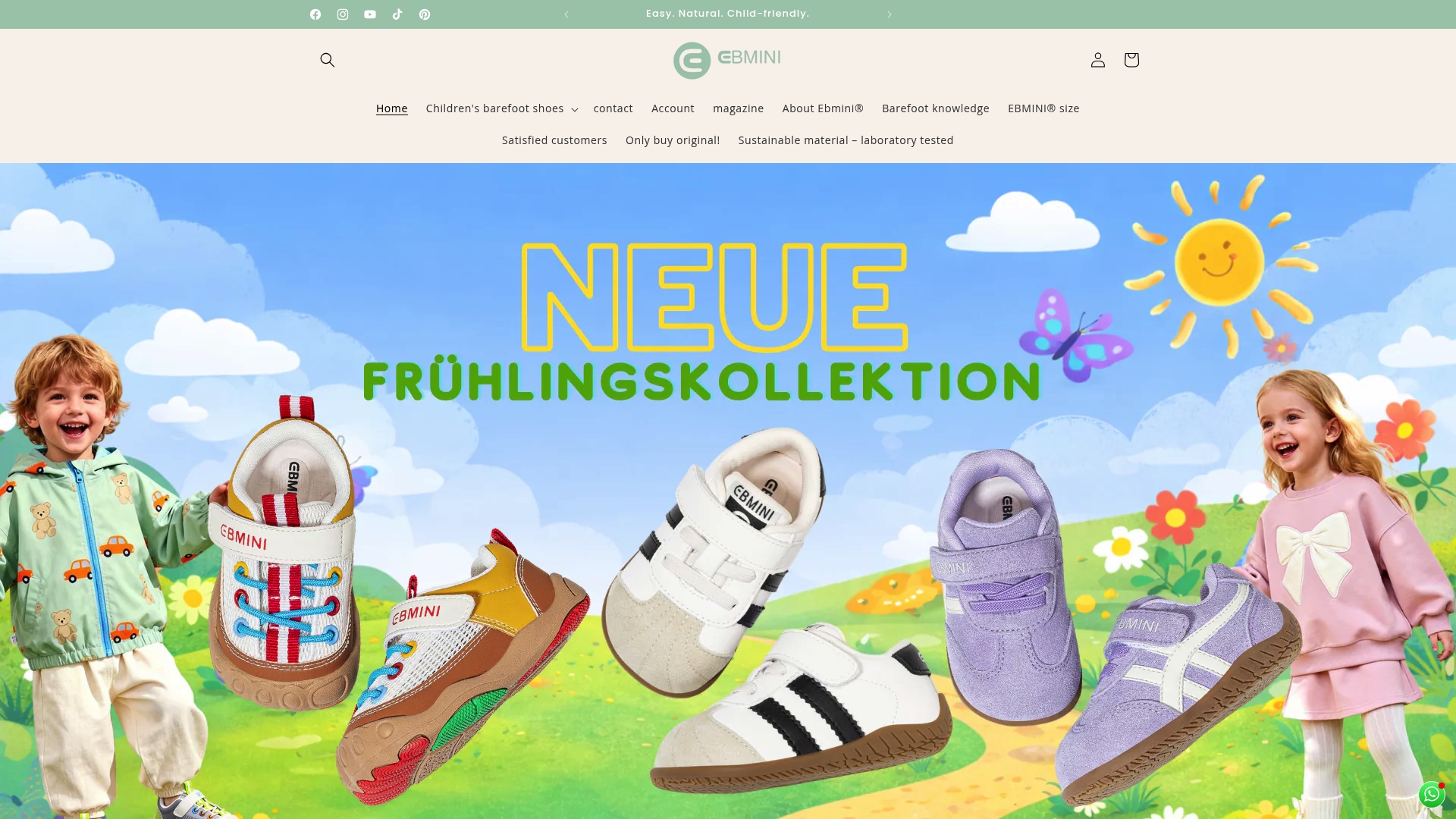
EBMINI® has developed a collection based precisely on these selection criteria. Ultra-light, flexible barefoot shoes with a wide toe box, zero-drop sole, and pollutant-free manufacturing. You'll find the right model for every occasion: EBMINI children's barefoot shoes are suitable for everyday wear and the playground, EBMINI baby barefoot shoes accompany the first steps, and EBMINI barefoot sandals for children ensure a healthy walking experience in summer. Velcro fasteners and elastic inserts make them easy to put on in everyday life. All models are designed for natural foot development, not just appearance.
Frequently asked questions about first-walker shoes and selection criteria
Why are barefoot-like first-walker shoes important for toddlers?
They promote natural foot development, strengthen foot muscles, and maintain full freedom of movement when walking. Barefoot-like shoes demonstrably reduce deformities and strengthen foot muscles in the long term.
How do I find the right shoe size for my child?
Measure both feet with socks, base your decision on the larger foot, and allow 1 to 1.5 cm of space in front of the longest toe. Accurate measurement with adequate space prevents deformities and ensures a comfortable fit even as they grow.
Which materials are recommended for first-walker shoes for health reasons?
Chrome-free tanned natural leather or certified organic materials are the first choice, as they are low in pollutants, breathable, and skin-friendly. ÖKO-TEST explicitly recommends chrome-free tanned natural leather for children's shoes due to its low pollutant levels.
Why should the soles of first-walker shoes be particularly flexible?
Flexible soles allow for natural rolling motion and actively train the foot muscles, while stiff soles hinder this development. Stiff shoes weaken the foot muscles, as true stability must always come from the foot itself.


