

Sustainability in the Textile Industry: Explained to Children
Sustainability in the textile industry means that clothes are manufactured in a way that protects people and the environment. For children, this can be explained as follows: A T-shirt takes a long journey, from the cotton field to the factory to the store, and a lot of good or a lot of bad can happen on this journey.
Three things children can do immediately:
- Care for a favorite garment instead of throwing it away when a button is missing.
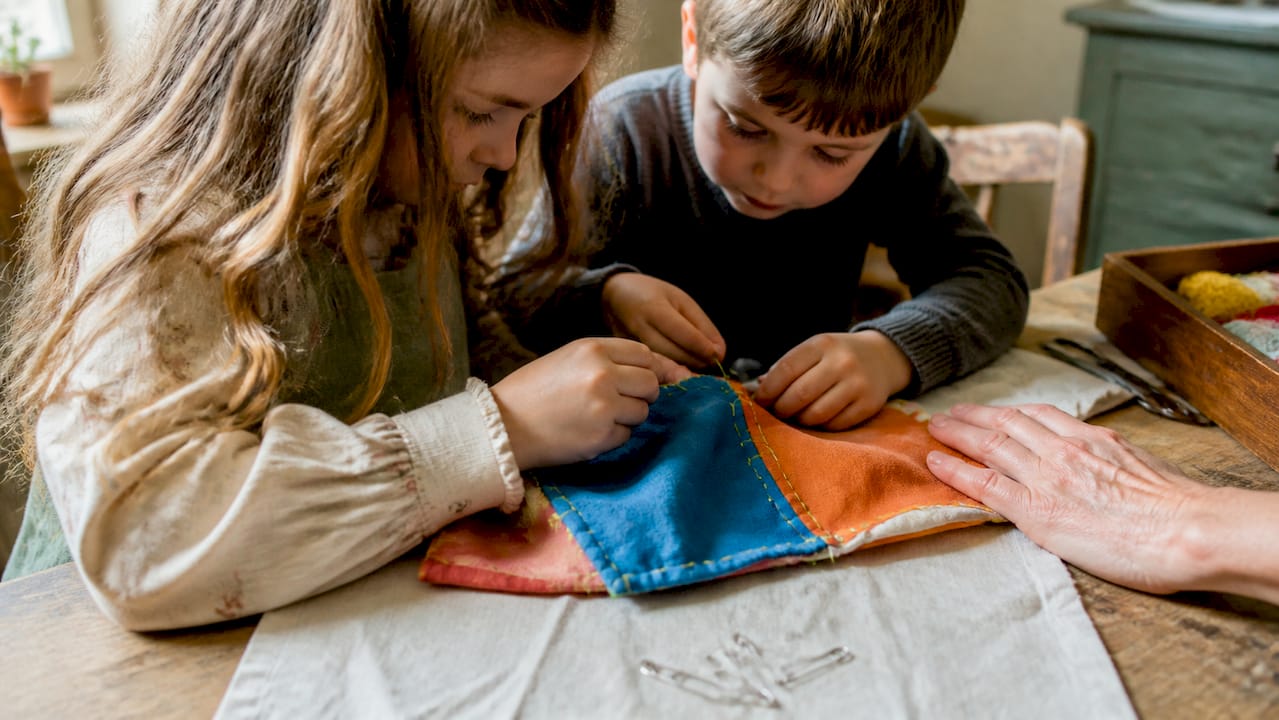
- Repair a torn shirt together, for example, with a colorful patch.
- When buying next, check the second-hand store first.
The BMZ children's book "A T-Shirt on a Journey" explains this journey to children and shows how to recognize fair clothing.
Key Takeaways
Sustainable textile industry explained for children means: buy less, use longer, look for certified labels, and actively involve children.
| Topic | Details |
|---|---|
| Child-friendly explanation | The journey of a T-shirt (field → factory → store → wardrobe) makes abstract problems tangible. |
| Reliable seals | Grüner Knopf (state-certified) and GOTS check environmental and social standards; mere "organic" labels are not enough. |
| Most effective family levers | According to WWF, fewer new purchases, second-hand, and repairs have the greatest effect. |
| Teaching and activities | Participatory formats such as clothes swaps and repair stations strengthen children's appreciation. |
| Free materials | BMZ children's book, Verbraucherzentrale RLP, and FEMNET offer verified, free teaching materials. |
Table of Contents
- What is "Fast Fashion"? A pictorial explanation for primary school children
- How does textile production harm the environment and people?
- How do you recognize sustainable clothing? Labels like Grüner Knopf and GOTS explained
- How do you design a lesson unit on sustainable fashion?
- 10 simple tips for families: buying, caring for, and passing on sustainably
- Which media and materials are suitable for teaching in Germany?
- Why this topic is more than just a school subject
- Sources
What is "Fast Fashion"? A pictorial explanation for primary school children
Fast fashion is like a toy from a surprise egg: cheap, colorful, but broken or boring after a short time. This is exactly how a large part of the fashion industry works today.
Fashion chains release new collections every week. The price is low because fabrics are bought cheaply and sewing is done in countries with very low wages. For children, this is tangible when they think of a T-shirt that becomes thin and grey after five washes. This is no coincidence, but intentional: those who quickly buy new goods generate more sales.
The only advantage for families is the low price. But the disadvantage is more significant: clothes end up in the trash faster, resources are wasted, and the people who sew often earn barely enough to live. The teaching material from Verbraucherzentrale RLP vividly describes these connections and is well suited as an introduction to lessons.
How does textile production harm the environment and people?
The short answer is: clothing consumes an enormous amount of water, releases chemicals, generates microplastics, and is often produced under poor conditions. The Federal Ministry for the Environment summarizes these ecological and social consequences as an official factual basis.
For children, images help: toxic wastewater from textile factories makes fish sick and colors rivers brightly, like an overturned paintbox in a stream. Microplastics from synthetic fabrics end up in the sea when washed and are eaten by small animals.
Memorandum: Approximately 15,000 liters of water are needed for one kilogram of raw cotton. This corresponds to about 100 full bathtubs.
| Topic | Number / Fact | Source |
|---|---|---|
| Water consumption cotton | approx. 15,000 liters per kg raw cotton | Verbraucherzentrale RLP |
| Employees worldwide | Textiles are one of the largest employers worldwide | Federal Ministry for the Environment |
| Chemical use | Hundreds of chemicals for dyeing and finishing | Bezirksjugendring Mittelfranken |
| Microplastics | Synthetic fibers release microplastics during washing | Federal Ministry for the Environment |
The educational material from Bezirksjugendring Mittelfranken documents the textile chain from cotton plant to disposal and provides child-friendly facts on chemicals and occupational safety.
How do you recognize sustainable clothing? Labels like Grüner Knopf and GOTS explained
Sustainable textiles are characterized by environmentally friendly materials, fair working conditions, long durability, and transparent production. Not every "organic" label meets all these criteria simultaneously.
Two labels are particularly reliable:
- Grüner Knopf (Green Button): A state label from the German government. It checks both environmental and social standards along the supply chain. The BMZ children's book names the Grüner Knopf as an easy identifier for children: "If you see this sign, the clothing was made more fairly."
- GOTS (Global Organic Textile Standard): Checks organic fibers and minimum social standards in production. Important: A pure "organic cotton" label without GOTS says nothing about working conditions. Many parents confuse this, as the Verbraucherzentrale RLP explicitly points out.
A brief warning about greenwashing: terms like "Eco," "Green," or "Nature" on labels are not protected. Only verified labels like Grüner Knopf or GOTS provide real security. An overview of relevant labels for children's shoes helps parents quickly distinguish when shopping.
Teaching idea: Print out label images and have children sort real from fake labels. This teaches critical thinking and makes greenwashing tangible.
How do you design a lesson unit on sustainable fashion?
FEMNET recommends participatory formats such as clothes swaps and repair stations, because children best understand the value of clothing through their own actions. A 30- to 45-minute unit can be structured as follows:
Learning objective: Children understand that every garment has a story and develop an appreciation for it.
Process:
- Introduction (5 minutes): Show a T-shirt and ask, "Where do you think this came from?" The children's book from the German government is suitable as a read-aloud introduction.
- Main part (20–25 minutes): Children draw or label the journey of a T-shirt: cotton field → spinning mill → sewing factory → ship → store → wardrobe → used clothing container. Group work: Each group takes over one station.
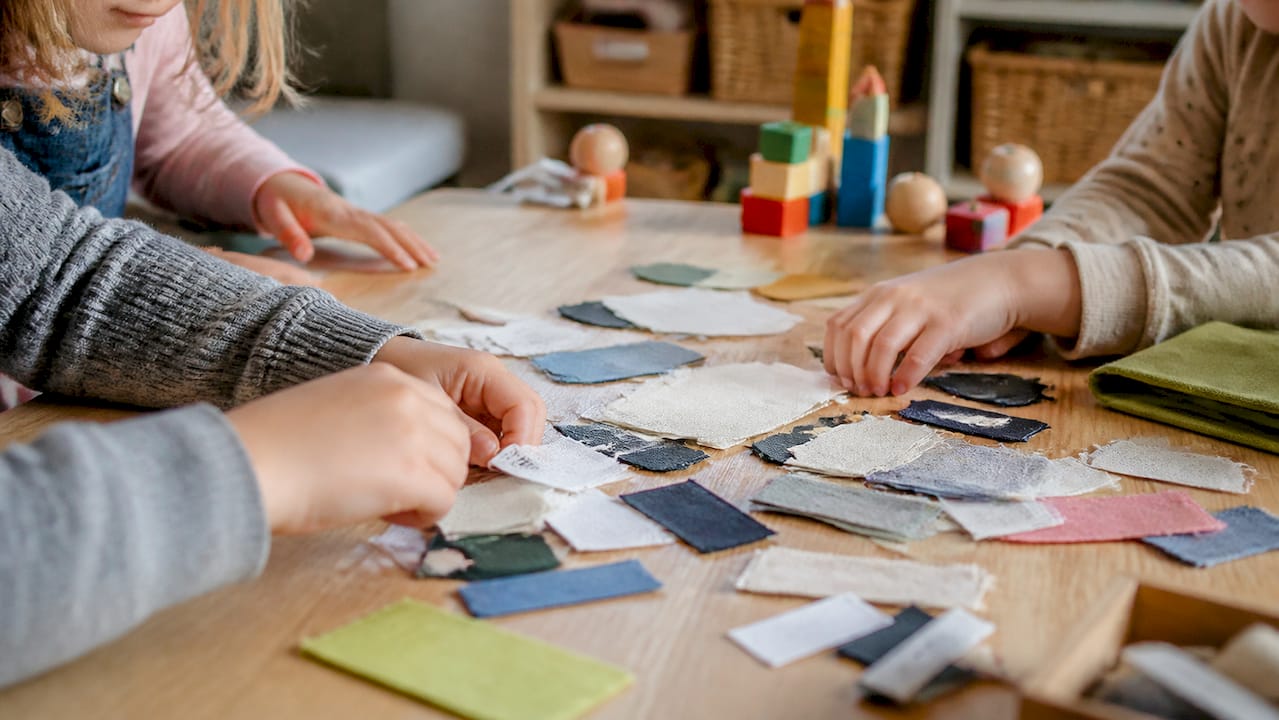
- Repair station (10 minutes, optional): Mend old socks or fabric scraps with colorful yarn. Sew on simple buttons.
- Conclusion (5 minutes): Each child writes or draws one thing they want to do differently. A joint class poster is created.
Material list: Paper, crayons, old clothes, sewing needles (blunt, suitable for children), colorful yarn, scissors.
Pro tip: When using the repair station, only use blunt children's needles and always have an adult directly supervising. Hygiene: Wash clothes beforehand. For younger children (grades 1–2), drawing the journey is sufficient; sewing is suitable from grade 3.
For shorter time slots of 20 minutes, the introduction plus the drawing task is sufficient. The repair station can be outsourced as homework or an afternoon activity for parents.
10 simple tips for families: buying, caring for, and passing on sustainably
Small steps add up. Those who don't change everything at once, but try one tip after another, will get further than someone who makes big plans and implements nothing. WWF Germany names fewer new purchases, second-hand, and repairs as the three most effective levers in family everyday life.
- Buy less: Before every purchase, ask: "Do we really need this, or is it just an impulse?"
- Second-hand first: Flea markets, clothing swaps, or local exchange groups often offer well-preserved children's clothing at a fraction of the new price.
- Organize a clothes swap party: Swap clothes with other families from the class. Children choose what they want to take themselves.
- Repair instead of throwing away: A missing button or a small hole is no reason to dispose of something. Repair cafés are available for free in many German cities.
- Pay attention to quality: A durable garment costs more but often lasts three times as long. That pays off.
- Wash correctly: Low temperatures (30°C) and full loads protect fibers and save energy.
- Plan sizes ahead: Buy clothes one size larger so they fit longer. Especially for children who grow quickly.
- Pay attention to labels: When buying new, look for Grüner Knopf or GOTS. An overview of sustainable brands for children's shoes helps to get started.
- Pass on old clothes meaningfully: Donate well-preserved items (Red Cross, Diakonie), sell them, or upcycle them. The EU Circular Economy Policy makes it clear that recycling is technically complex. Passing on is simpler and more effective.
- Involve children: Involving children in sorting out and swapping strengthens their awareness of the value of things.
Which media and materials are suitable for teaching in Germany?
For an introduction, particularly verified, free materials from Germany and Switzerland are suitable. Here is a selection:
Children's books and print materials
The BMZ children's book "A T-Shirt on a Journey" is available free as a PDF and explains the journey of a garment at primary school level. Ideal for a read-aloud session or for printing for the class. The German government also provides it as a free print version.
Videos
SRF Kids (Swiss Broadcasting Corporation) produces short, child-friendly explanatory videos on topics such as fast fashion and clothing production. The videos are in German, freely accessible, and well suited for an introduction to lessons because they visually explain abstract production chains in a few minutes.
Teaching materials
The teaching material from Verbraucherzentrale RLP contains worksheets, facts, and teaching suggestions for different age groups. FEMNET offers supplementary pedagogical materials with a focus on educational work and participatory formats.
The Bezirksjugendring Mittelfranken has created a regional PDF on the textile chain, which provides background facts on cotton, chemicals, and working conditions and is well suited as a teacher's handbook.
Why this topic is more than just a school subject
Explaining to children how a T-shirt is made gives them something that goes far beyond general studies: the ability to question things that seem obvious. A garment in the wardrobe isn't just there. Behind it are people, fields, factories, and decisions.
What particularly concerns me about this topic is the gap between knowledge and action. Many parents know that fast fashion is problematic. But everyday life with children is busy, and inexpensive clothing is convenient. That's why it doesn't need lecturing, but concrete small steps that fit into everyday life. A clothes swap party in class costs nothing and is fun for children. A jointly mended sweater remains in memory longer than any lesson about water consumption.
The topic of sustainability in the textile industry is also so well suited for primary school children because it is tangible. Everyone wears clothes. Every child can touch what they are wearing and ask: Who sewed this? Where did the fabric come from? This curiosity is the beginning of conscious consumption, and it can be awakened without moral pressure.
Sources
Official bodies such as the Federal Ministry for the Environment, the BMZ, and the consumer protection centers offer the most reliable basis for teaching and parent information.
- BMZ – Where do our clothes come from? (Children's book)
- Verbraucherzentrale RLP – Teaching material textiles
- Federal Ministry for the Environment – Fashion and textiles
- European Commission – Waste Framework Directive
- FEMNET – Educational offers and materials
- Federal Government – Where do our clothes come from? (Children's book)
- District Youth Council of Middle Franconia – Textile Chain (PDF)
All sources mentioned are freely accessible and suitable for school use or parent evenings.


