

Naturally Correct Pronation in Children: A Parent's Guide
First things first: for most children, pronounced pronation, or a pediatric flatfoot, can be well supported with natural daily measures. Invasive therapy is rarely necessary. Start today by increasing your child's barefoot time, choosing appropriate shoes, and incorporating age-appropriate movement stimuli into their daily routine.
Immediately beneficial:
- Significantly increase barefoot time, preferably on grass, sand, or forest floor
- Choose shoes that are flexible, light, and wide enough in the toe area
- Incorporate age-appropriate balance and strengthening exercises playfully
- For overweight children: weight management as a supportive measure.
When to see a doctor immediately:
- The child complains of pain in the foot, knee, or back
- The foot remains flat even when standing on tiptoes (no arch formation)
- The foot feels stiff and cannot be passively corrected
- Significant limitation in walking, jumping, or playing
Statistical classification: According to the German S2k guideline "Pediatric flatfoot", less than 2% of affected children actually experience pain. The vast majority of cases can be observed without active therapy being necessary.
The German Society for Orthopaedics and Trauma Surgery (DGOU) explicitly recommends that children walk barefoot as often as possible. This is not a lifestyle recommendation, but guideline-based medicine.
Pro Tip: Make a quick note on your phone: date, how much barefoot time your child had today, and if you observed any abnormalities. After four weeks, you'll have a real basis for your next doctor's appointment.
Table of Contents
- What exactly is a pediatric flatfoot?
- What causes and risk factors play a role?
- How do you recognize at home if medical clarification is necessary?
- Which everyday measures support natural foot development?
- What should children's shoes do to support foot development?
- When do physiotherapy and insoles really help?
- When does the arch of the foot normally develop?
- How can barefoot-like children's shoes like Ebmini be supportive?
- Important insights
- Why natural measures should come first
- Ebmini shoes: Barefoot feel with protection for everyday use
- Further resources for parents and professionals
What exactly is a pediatric flatfoot?
Flatfoot (medically: pes planovalgus) describes a foot position in which the longitudinal arch is flattened and the heel tilts outwards (valgus position). If you look at a child from behind, you can see how the Achilles tendon is slightly curved inwards. This sounds alarming, but it is often completely normal in toddlers and preschool children.
The crucial question is not whether the arch looks flat, but whether the foot is flexible or rigid. This distinction is clinically central and determines everything else.
Flexible Foot: the common, uncritical case
A flexible flatfoot straightens itself when standing on tiptoes. The arch appears, and the heel rotates into the neutral position. This is the most important sign that the foot is physiologically normally developed and the musculature is fundamentally functioning. The S2k guideline describes this tiptoe standing test as a central diagnostic criterion.
Rigid Foot: rare, but requires clarification
If the foot remains flat even when standing on tiptoes and cannot be passively brought into a neutral position, it is called a rigid (contracted) flatfoot. This can indicate bony anomalies, coalitions (fusions between foot bones), or neuromuscular causes. This case requires specialist clarification, not a wait-and-see strategy.
Pro Tip: Ask your child to stand on their tiptoes with their knees straight. If the arch becomes visible and the heel straightens, that's a good sign. If it doesn't work at all, make a note of it and show it to the pediatrician.
What causes and risk factors play a role?
Pronation deformities rarely arise from a single cause. Usually, several factors interact, some of which parents can directly influence.
- Lack of exercise and insufficient barefoot stimulation: — Children who spend a lot of time in sturdy shoes and rarely walk on natural surfaces hardly train their foot muscles. However, the longitudinal arch needs precisely these stimuli to develop. According to the DGOU, walking barefoot on various surfaces is the most effective training for a child's foot.
The good news: the most common risk factors, i.e., lack of exercise and incorrect footwear, can be directly addressed.
How do you recognize at home if medical clarification is necessary?
The tiptoe stand test
Ask your child to stand on their tiptoes barefoot, keeping their knees straight. Observe from behind:
- Does the longitudinal arch straighten? Good.
- Does the heel rotate into a more neutral position? Good.
- Does everything remain flat and the heel still heavily tilted outwards? This is an indication that should be clarified.
Children under three years often cannot reliably perform this test. From the age of four, it becomes more meaningful.
According to the S2k guideline, pain occurs in less than 2% of children with flexible flatfoot. This means that most parents reading this article have a child who needs to be observed but not treated.
Red flags not to wait on:
- Pain in the foot, knee, calf, or back during or after walking
- Foot cannot be passively brought into a neutral position (rigid form)
- No arch formation in tiptoe stand after the age of 6
- Noticeable gait pattern that does not improve (severe collapsing, stumbling)
- Early childhood developmental abnormalities indicating neuromuscular causes
After the age of 6, if the arch of the foot has not developed at all, a visit to a pediatric orthopedist is advisable. Not because all is lost, but because it should then be specifically examined whether structural causes are present. The Gelenk-Klinik describes this point in time as an important observation threshold.
Which everyday measures support natural foot development?
Walking barefoot is the most effective single measure parents can implement today. Not just once a day, but as often as possible. Grass, sand, gravel, forest floor, even slightly uneven surfaces in the garden: every surface trains different muscles and tendons and sends different signals to the brain.
- Structuring barefoot times: Indoors, always barefoot or in socks. Outdoors, barefoot as safely as possible, for example in the garden, on playgrounds with soft surfaces, or on the beach. For safe barefoot activities at home and on the balcony, there are practical safety tips for parents.
Pro Tip: Many German cities and nature parks have barefoot paths. A quick search for "barefoot path" plus your location is worthwhile. Children experience this as an adventure, not as therapy.
What should children's shoes do to support foot development?
When walking barefoot is not possible, shoe choice matters. And here there is a clear consensus among orthopedists: the more a shoe resembles the barefoot feeling, the better for natural foot development.
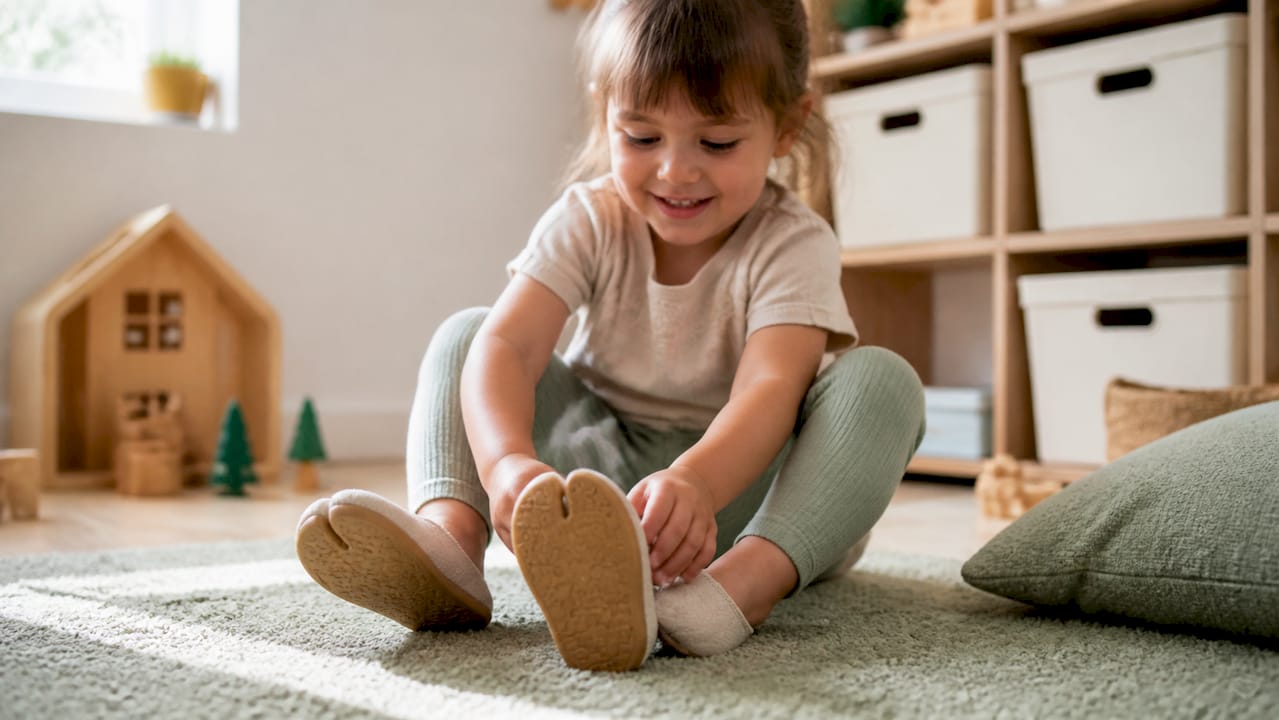
| Feature | Recommended | Better to avoid |
|---|---|---|
| Toe box | Wide, toes can spread | Narrow, toes are compressed |
| Sole | Flexible, thin, bendable | Hard, stiff, pre-formed |
| Drop | Zero or very low (Zero Drop) | High heel elevation |
| Weight | Ultra-light | Heavy, restricts movement |
| Shaft construction | Soft, yielding | Hard, excessively fixes the foot |
| Footbed | Flat, without pre-formed support | Strongly contoured footbed |
When trying on shoes: remove the insole, place the foot directly on it, and check if there is still about 12–17 mm of space at the front. According to AOK, afternoon is the best time to measure, as feet are slightly swollen then. Shoes that fit in the morning might be too tight in the afternoon.
Make the transition from normal shoes to barefoot-like models gradually: initially short wearing times, then slowly increase. More on this in the guide to transitioning to barefoot shoes.
Pro Tip: Never buy shoes "to grow into." Shoes that are too big are just as problematic as shoes that are too small, because the child cramps their toes to hold the shoe on. It's better to remeasure every 6–8 weeks.
When do physiotherapy and insoles really help?
Physiotherapy is not aimed at forcing the foot into a different shape. It trains strength, coordination, and sensorimotor skills, i.e., the nervous system's ability to precisely control muscles. Typical measures include gait training, balance exercises on unstable surfaces, targeted strengthening of the foot and lower leg muscles, and proprioceptive training. This makes sense for children who show no improvement despite everyday measures, or when a gait problem limits daily activities.
Insoles: what they can and cannot do:
- Insoles can temporarily relieve pain and reduce strain on the gait.
- According to Orthopedic Practice Beckum, there is no evidence that they fundamentally change the natural maturation process in pain-free, flexible flat feet.
- Insoles do not replace exercise or barefoot stimulation.
- When insoles are provided, check-ups are recommended approximately every 6 months, as children's feet grow quickly and the insole needs to be adjusted.
- Without insoles: an annual follow-up with the pediatrician or pediatric orthopedist is sufficient as long as there are no complaints.
The S2k guideline emphasizes: A therapy decision should always be made individually. Blanket corrections without symptoms can disrupt the natural maturation process instead of promoting it.
Further orthopedic technical measures, such as custom-made orthoses or special insoles, are indicated when functional complaints persist despite conservative therapy or when structural causes are present.
When does the arch of the foot normally develop?
Parents often worry unnecessarily early. The arch of the foot is not a state that is either present or not. It is a maturation process that takes years.
| Age | What is normal? | When to pay attention? |
|---|---|---|
| — | Flat footprint, fat pad covers arch | Hardly possible to assess |
| 2–4 years | Arch begins to show, flatfoot common | Only with pain or stiffness |
| 4–6 years | Significant developmental steps, tiptoe test more meaningful | No arch formation in tiptoe stand |
| 6–10 years | Arch should increasingly develop | Lack of development, pain, rigid foot |
| up to ~12 years | Arch of the foot can continue to strengthen | Persistent complaints, structural abnormalities |
Up to the age of 6, a wait-and-see approach is the right decision in most cases, combined with barefoot stimulation and exercise. After the age of 6, a pediatric orthopedist should be consulted if the arch has not shown any signs of development. This is also recommended by orthopedists in the Frankfurter Rundschau as an orientation guideline.
Routine check-ups with the pediatrician as part of the U-examinations are sufficient for most children. In case of specific abnormalities: directly to the pediatric orthopedist.
How can barefoot-like children's shoes like Ebmini be supportive?
Barefoot-like shoes bridge the gap between true barefoot walking and the protection children need outdoors. And that is precisely their benefit: no more, but no less either.
The features that orthopedists and the S2k guideline recommend for child-friendly footwear directly align with what Ebmini shoes offer: a wide toe box that allows toes to splay, a flexible and ultra-light sole that enables ground contact and natural rolling motion, zero drop without heel elevation, and non-slip soles for safe outdoor play. More about the benefits of a wide toe box for children's feet is explained in a separate guide.
Such shoes complement barefoot time, but do not replace it. If your child needs protection on the playground, in the forest, or in bad weather, a barefoot-like shoe is the next best option after true barefoot walking. No pre-formed footbed that takes over muscle work. No hard shaft that restricts foot movement.
Important: Shoes, even barefoot-like ones, do not replace medical clarification for red flags. If your child has pain or the tiptoe test is negative, the next step is the pediatric orthopedist, not buying shoes.
Pro Tip: When transitioning to barefoot-like shoes, start slowly. Initially 1–2 hours daily, then gradually increase. Muscles and tendons need time to adjust to the new freedom of movement. You can find a detailed barefoot shoe acclimatization plan in the Ebmini blog.
Important insights
The natural correction of pronation deformities in children is best achieved through consistent barefoot stimuli, targeted movement, and a well-considered choice of footwear, not through early insoles or restrictions.
| Topic | Details |
|---|---|
| Flexible vs. Rigid Form | The toe-tip stand test decides: arch elevation means flexible and usually uncritical. |
| Pain is rare | Less than 2% of affected children experience discomfort; most cases do not require active therapy. |
| Barefoot stimuli are the best training | According to the DGOU, walking barefoot on varied surfaces strengthens foot muscles and promotes arch development. |
| Insoles do not alter the course of maturation | In pain-free children, there is no evidence for a fundamental effect of insoles on maturation. |
| Ebmini as an everyday companion | Ebmini barefoot shoes with a wide toe box, zero drop, and flexible sole safely and guideline-conformingly complement barefoot time. |
Why Natural Measures Should Come First
What always concerns me about the discussion surrounding childhood pronation is that parents often receive either no information at all or are immediately confronted with insoles and shoe corrections before it's even clear whether any action is needed.
The German S2k guideline is actually quite clear. The flexible flatfoot is so common in young children that it is considered a developmental physiological variant, not a disease. And yet, insoles are prescribed, shoes with supportive functions are bought, and parents are unsettled. The opposite of what the guideline recommends.
What truly helps is movement. Barefoot, on real surfaces, with real stimuli. This is not romantic nature philosophy; it is biomechanics. A foot that is never challenged does not develop strength. A foot stuck in a rigid shoe does not learn to balance.
Of course, there are cases where more is needed. Rigid forms, neurological causes, persistent pain. For these children, specialist medical care is indispensable. But this is the minority. The majority needs no therapy, but more freedom of movement.
Parents who give their children more barefoot time today, buy better shoes, and incorporate playful exercises do more for foot health than any prophylactic insole. This is the message of the guideline, and this is the message parents deserve.
Ebmini Shoes: Barefoot Feeling with Everyday Protection
Walking barefoot is ideal, but not always possible. That's exactly what Ebmini is for.

Ebmini children's shoes are designed to mimic the barefoot feeling as closely as possible: a wide toe box for natural toe splay, a flexible and ultralight sole for real ground contact, zero drop with no heel elevation, and non-slip soles for safe play outdoors, even in rain and mud. Developed in collaboration with orthopedists, with the goal of supporting natural foot development, not hindering it.
Transition gradually: Start with 1–2 hours daily and increase wearing time over two to three weeks. Muscles and tendons need this adjustment period. On the Ebmini website, you'll find free sizing advice, customer reviews, and a guarantee that secures your purchase.
Check out the current models and get advice: Discover Ebmini now.
Further Resources for Parents and Professionals
All linked sources have been verified and are available in German. They serve for in-depth information and do not replace individual medical advice.
- S2k Guideline "Childhood Flatfoot" (AWMF Register): — The official German guideline with diagnostic criteria, therapy indications, and control recommendations. Essential reading for anyone wanting to delve deeper.
- DGOU: Barefoot Walking Promotes Healthy Children's Feet: — Recommendations from the German Society for Orthopaedics and Trauma Surgery on barefoot stimuli and shoe choice.
- Orthopaedic Practice Beckum: Flatfoot in Children: — Specific information on insoles, follow-up examinations, and conservative therapy.
- AOK: Healthy Feet in Children: — Practical shoe tips, measuring instructions, and fit advice for parents.
This article contains general information on childhood foot development and does not replace individual medical advice. For pain, abnormalities, or uncertainties, consult a pediatrician or pediatric orthopedist.


