

Sandals for Children's Feet: Ensuring Proper Toe Freedom
Toe freedom in children's sandals means that the toes can splay, stretch, and move freely without hitting the edge of the sandal. Pediatric orthopedists refer to this space as a growth buffer and recommend at least 10–12 mm between the longest toe and the front edge of the sandal. If this buffer is missing, pressure points occur, foot muscles develop poorly, and children unconsciously move less. By ensuring toe freedom when buying sandals for children's feet, parents lay the foundation for healthy foot development during the first ten years of life.
What features should sandals have to ensure toe freedom?
Good children's sandals are characterized by a wide toe box that does not constrict the forefoot. Pediatric foot experts emphasize that the natural spreading of the toes is fundamental for balance and muscular development. Only sufficiently wide sandals promote this spreading. A toe box that tapers towards the front like a pointed shoe presses the toes together and prevents exactly that.
The sole is the second crucial feature. An ideal sole bends only in the area of the ball of the foot, not in the middle of the foot. This promotes natural rolling when walking. Sandals with a flexible sole based on the zero-drop principle keep the heel at the same height as the forefoot. This mimics barefoot walking and actively strengthens the foot muscles.
Other features to look for when buying:
- Wide toe box: Toes must be able to move freely sideways without pressure from the sides.
- Flexible, thin sole: Bends easily by hand but does not fold in the middle of the foot.
- Zero-drop construction: Heel and forefoot are at the same height, no elevated heel.
- Adjustable fasteners: Velcro fasteners or buckles ensure a secure fit and adapt to the foot without creating pressure points.
- Non-slip sole: Protects on slippery floors, cobblestones, and wet surfaces.
- Lightweight materials: Soft, pliable materials prevent rubbing on sensitive children's skin and improve wearing comfort.
Pro Tip: Squeeze the sole of a new sandal in the middle once. If it gives way there, it will buckle in the wrong place when walking. A good sole remains stable in the middle and only bends at the front.
How do you find the right size for children's sandals?
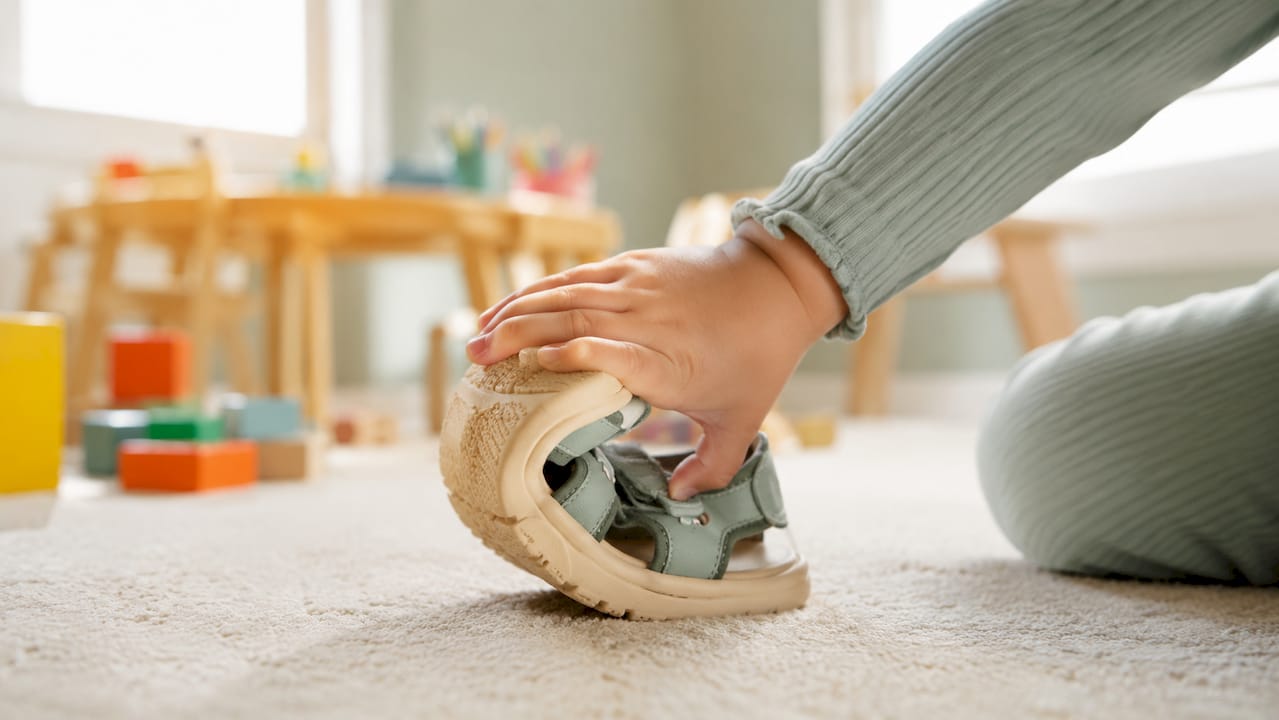
The right size is the most common mistake when buying sandals. Many parents buy them too small because the child just barely fits. The recommended growth buffer of 10–12 mm in front of the longest toe not only accommodates growth but also the natural swelling of the foot throughout the day. Feet swell in the afternoon. This is one reason it's best to try on sandals in the afternoon.
This is how you proceed with size selection:
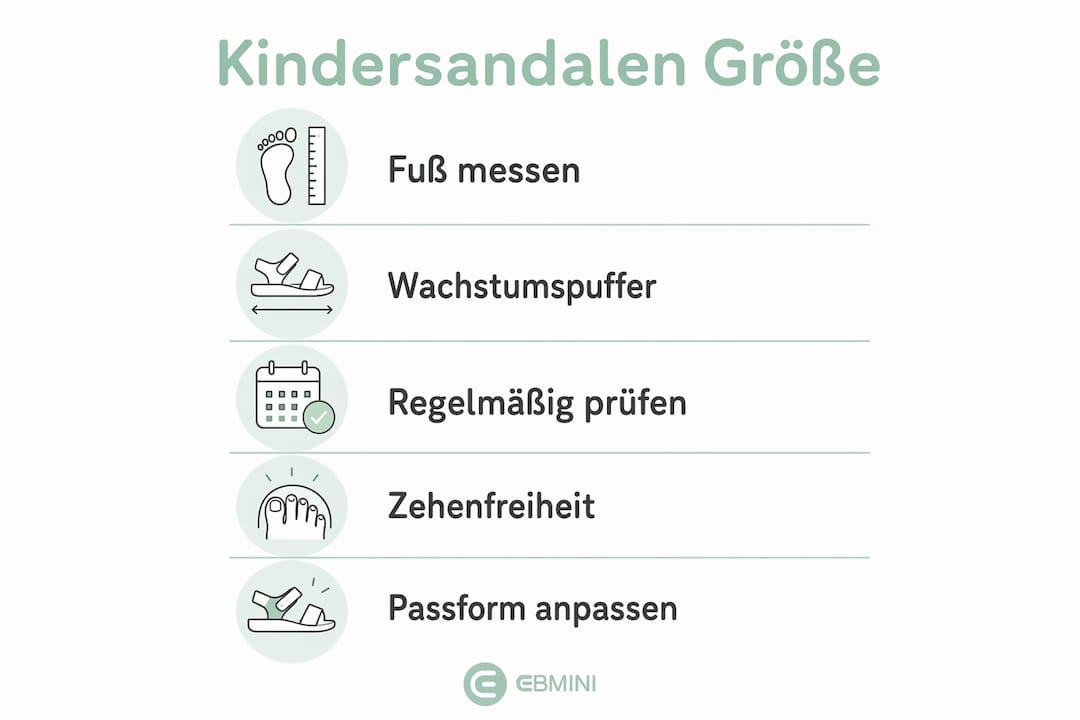
- Measure foot length: Place the child on a piece of paper and trace the outlines of both feet. Measure the length from the heel to the longest toe. Use the longer foot as the standard.
- Calculate buffer: Add 10–12 mm to the measured foot length. This gives the minimum inner length of the sandal.
- Have them tried on: Let the child stand and walk in the sandal. The foot should not slide forward.
- Check toe freedom: Place a finger between the toe and the edge of the sandal. If it fits loosely, the buffer is correct.
- Check heel: The heel should sit snugly in the heel strap, without rubbing or slipping.
- Observe walking and playing: See if the child walks normally or curls their toes. Curling is a sign that the sandal is too big or too loose.
Typical mistakes in size selection are models that are too small because the child is still "growing into them," or models that are too large, causing the foot to slip uncontrollably. Both are detrimental to foot development. Slipping sandals force children to curl their toes to find support. This creates muscle tension and inhibits natural foot movement.
Pro Tip: Measure your child's feet every two to three months. Children's feet grow quickly, and a sandal that fit in May might be too tight by August.
How do barefoot sandals support natural foot development?
Barefoot sandals are a distinct category within children's sandals. They follow the principle of barefoot walking: minimal sole, no supportive structures, wide toe box. Barefoot sandals protect the foot without a rigid shoe structure and simultaneously promote the gripping function and stabilization of the foot muscles. This is a significant difference from conventional sandals with thick, rigid soles.
Conventional sandals with elevated heels or reinforced insoles take on tasks that the foot muscles should actually perform. This may sound comfortable at first, but in the long run, it is counterproductive. Muscles that are not challenged develop weaker. In children between 1 and 10 years of age, this phase is particularly critical because the foot structure is still forming.
The advantages of barefoot sandals at a glance:
- Toe stretching: The wide toe box allows toes to spread actively, which improves balance and stability.
- Muscle building: Without rigid supportive structures, the foot muscles actively work with every step.
- Sensorimotor skills: Thin soles transmit unevenness in the ground, which trains perception and responsiveness.
- Natural rolling motion: The zero-drop principle allows the same rolling motion as barefoot walking.
“Barefoot sandals, with their minimalist zero-drop soles, offer a foot posture that mimics natural rolling behavior and actively strengthens a child's muscles. Walking barefoot without shoes remains the best support for foot development. Sandals supplement protection in daily life but do not replace barefoot walking."
Ebmini develops its barefoot sandals precisely according to these principles: wide toe box, zero-drop sole, ultra-light material. The result is a sandal that feels like almost nothing to the child, yet still protects. You can read more about how barefoot sandals promote foot development in Ebmini's own guide.
What care and usage tips preserve toe freedom in the long term?
Children's sandals last longer and retain their function better if parents follow a few simple rules. This is especially true for barefoot sandals, whose thin soles and soft materials are more delicate than conventional models.
Practical tips for care and use:
- Clean regularly: Wipe textile or leather sandals with a damp cloth. Do not machine wash unless explicitly permitted by the manufacturer.
- Check fit every two to three months: Children's feet grow quickly. A sandal that becomes too tight will create pressure points before the child reports pain.
- Watch for pressure points: Red spots on toes, heel, or instep are a clear sign that the sandal no longer fits or is sitting incorrectly.
- Store dry: Moisture destroys adhesives and causes materials to age faster. After playing in the wet, let the sandals air dry, not on the heater.
- Schedule barefoot time: Barefoot walking in safe environments is the best complement to any sandal. In the garden, on the beach, or on playgrounds with soft surfaces, children should walk without shoes as often as possible.
- Do not use for inappropriate occasions: Barefoot sandals are not intended for hikes on stony terrain. For such excursions, shoes with more protection are needed.
Pro Tip: Let your child put on the sandals themselves as soon as they are old enough. This trains fine motor skills and also gives you a hint: if the child has difficulty closing the fasteners, the sandals may be too tight or the fastener too stiff.
Sandals that are too tight restrict foot movement and inhibit natural play due to pain. Dr. Eva Scheerer-Harbauer emphasizes the importance of a wide toe box for healthy developmental processes. This applies not only at the time of purchase but also throughout the entire wearing period.
Key Takeaways
Toe freedom in children's sandals is not a comfort feature, but a fundamental prerequisite for healthy foot development, which a wide toe box, flexible sole, and a growth buffer of 10–12 mm jointly ensure.
| Topic | Details |
|---|---|
| Growth buffer | 10–12 mm in front of the longest toe is the recommended minimum distance for growth and swelling. |
| Sole flexibility | The sole must bend in the ball of the foot area, not in the middle of the foot. |
| Wide toe box | Toes must be able to spread freely to develop balance and muscles. |
| Fit control | Re-measure every two to three months, as children's feet grow quickly. |
| Barefoot times | Sandals complement protection, but do not replace barefoot walking in safe environments. |
What I truly learned after years with barefoot sandals
Many parents ask us if barefoot sandals really make a difference, or if it's just marketing. My honest answer: The difference is real, but it doesn't show immediately. It shows in how a child walks after wearing sandals with sufficient toe freedom for three years.
I have observed that children in sandals that are too tight unconsciously start to curl their toes. This happens gradually. Parents often only notice it when the child stumbles over uneven ground or seems unsteady when walking. A wide toe box doesn't solve this problem overnight, but it prevents it from arising in the first place.
What surprised me most: The biggest mistake isn't the wrong brand or material. It's the wrong size. Parents too often buy too small because the child "still fits in." The 10–12 mm buffer feels large when trying them on. But that's exactly what the foot needs to move freely when walking.
And one more thing: Barefoot time is not a substitute for good sandals, but good sandals are also not a substitute for barefoot time. Both go hand in hand. Anyone who gives their child both gives them the best foundation for healthy feet. More on why barefoot walking helps children learn to walk is worth reading.
— Ebmini
Healthy Barefoot Sandals for Children at Ebmini
Ebmini has developed its barefoot sandals for children precisely according to the criteria recommended by pediatric orthopedists: wide toe box, zero-drop sole, ultra-light material, and adjustable fasteners for a secure fit. Each sandal gives children's feet the space they need for healthy growth.

Ebmini's barefoot sandals for children are available for children between 1 and 10 years old and are suitable for everyday wear, the playground, and warm summer days. All models follow the barefoot principle and are specially adapted to the needs of growing children's feet. If you are looking for healthy children's shoes even outside the sandal season, Ebmini offers a wide selection of barefoot shoes for children with the same principles.
FAQ
What exactly does toe freedom mean in children's sandals?
Toe freedom means that there should be at least 10–12 mm of space between the longest toe and the front edge of the sandal. This space allows for natural spreading, growth, and the swelling of the foot throughout the day.
Why is a wide toe box so important in children's sandals?
A wide toe box allows the toes to splay sideways, which is crucial for balance and muscle development. Narrow toe boxes constrict the toes and inhibit natural foot development.
How often should I check my child's sandal size?
Every two to three months, as children's feet grow quickly. A sandal that becomes too tight will create pressure points before the child expresses pain.
What is the difference between barefoot sandals and regular children's sandals?
Barefoot sandals have a thin, flexible sole with no heel (zero-drop), no rigid support structure, and an especially wide toe box. Regular children's sandals often have thicker soles and supportive elements that challenge the foot muscles less.
Can barefoot sandals replace barefoot walking?
No. Barefoot sandals complement protection in everyday life, but they do not replace barefoot walking in safe environments like a garden or beach. Both together best promote foot development.


