

Barefoot sandals for kids: The best types
Children's feet develop best when they can move freely. Sandals that provide a barefoot feeling, i.e., sandals with barefoot-feel types for children that allow true freedom of movement, play a greater role than many parents realize. The problem: The market is full of models that look good but hinder rather than promote foot development. Thick soles, narrow toe boxes, rigid constructions. This article will show you what types of children's barefoot sandals really exist, what to look for when choosing, and how to get your child accustomed to them.
Table of Contents
- Important Criteria for Choosing Barefoot Sandals for Children
- Types of Barefoot Sandals for Children and Their Special Features
- Comparison of Top Barefoot Sandal Models for Children
- Practical Tips for Acclimatization and Use of Barefoot Sandals in Children
- Barefoot Sandals for Different Situations: Which Sandal Is Right When?
- Why the Conscious Choice of the Right Barefoot Sandal for Children Is More Than Just Fashion
- Discover Healthy Barefoot Sandals for Children at EBMINI®
- Frequently Asked Questions about Barefoot Sandals for Children
Key Findings
| Point | Details |
|---|---|
| Consider growth allowance | For open barefoot sandals, allow 6 to 10 mm of growth room to prevent tripping. |
| Gradual acclimatization | Children should wear barefoot sandals for 1–2 hours daily at first and get used to them over several weeks. |
| Choose ergonomic fit | Wide toe box and adjustable straps support natural foot movements and comfort. |
| Individual foot needs | For foot deformities, consult a specialist before using barefoot sandals. |
| Correct sock choice | Thin or toe socks optimally preserve the barefoot feeling and natural toe alignment. |
Important Criteria for Choosing Barefoot Sandals for Children
Not every sandal that looks light is a true barefoot sandal. The difference lies in the details. When choosing barefoot shoes for children that deserve the name, five crucial features should be checked.
Carefully determine growth allowance. For open sandals, the rule is: 6 to 10 millimeters of space between the toes and the end of the shoe is ideal. Less, and the child will have shoes that are too tight in two months. More, and the child will trip every other step. This narrow range surprises many parents who previously thought more space was always better.
Wide toe box as a mandatory feature. The front part of the sandal must be wide enough for all toes to spread out as they would when standing barefoot on the ground. If the toe box is too narrow, the toes will be compressed. This can lead to long-term deformities like bunions. Children often don't notice this pressure because their feet are still soft and adaptable.
Test the flexibility of the sole. A true barefoot sole can be easily bent and twisted with two fingers. Rigid soles prevent the natural rolling motion of the foot. For comparison: If you place the sole of a conventional sandal and a barefoot sandal side-by-side and bend them, the difference is immediately noticeable.
Zero drop, truly. Zero drop means: heel and forefoot are at the same height. Even a small heel elevation of a few millimeters changes the child's posture. Pay attention to technical specifications in the product details, not just the appearance.
Consider foot shape. Not every barefoot sandal fits every foot. Children with wide forefeet need models with a particularly wide toe box. If you're unsure, you can find helpful tips on the correct fit for children.
What to look for specifically
- Growth allowance of 6 to 10 millimeters for open models
- Toe box wide enough for the natural spreading of all toes
- Sole bendable and twistable without resistance
- Zero-drop construction without heel elevation
- Adjustable closures for a stable fit on various foot widths
- Lightweight, as heavy sandals quickly tire children's feet
Pro Tip: When buying, have your child stand on a flat surface and check if their toes touch the side of the sandal. If they do, the toe box is too narrow, even if the length is right.
Acclimatization is a separate chapter. Introduce barefoot shoes gradually means: In the first week, one to two hours daily is sufficient. The muscles in the foot, which have been barely used for years, need time to strengthen. Pain in the first few days is normal. Pain after a week is a warning sign.
Types of Barefoot Sandals for Children and Their Special Features
Barefoot sandals range from minimalist Huaraches to airy summer shoes with closed or open toe sections. Each type has its strengths and suits different situations and children's feet.
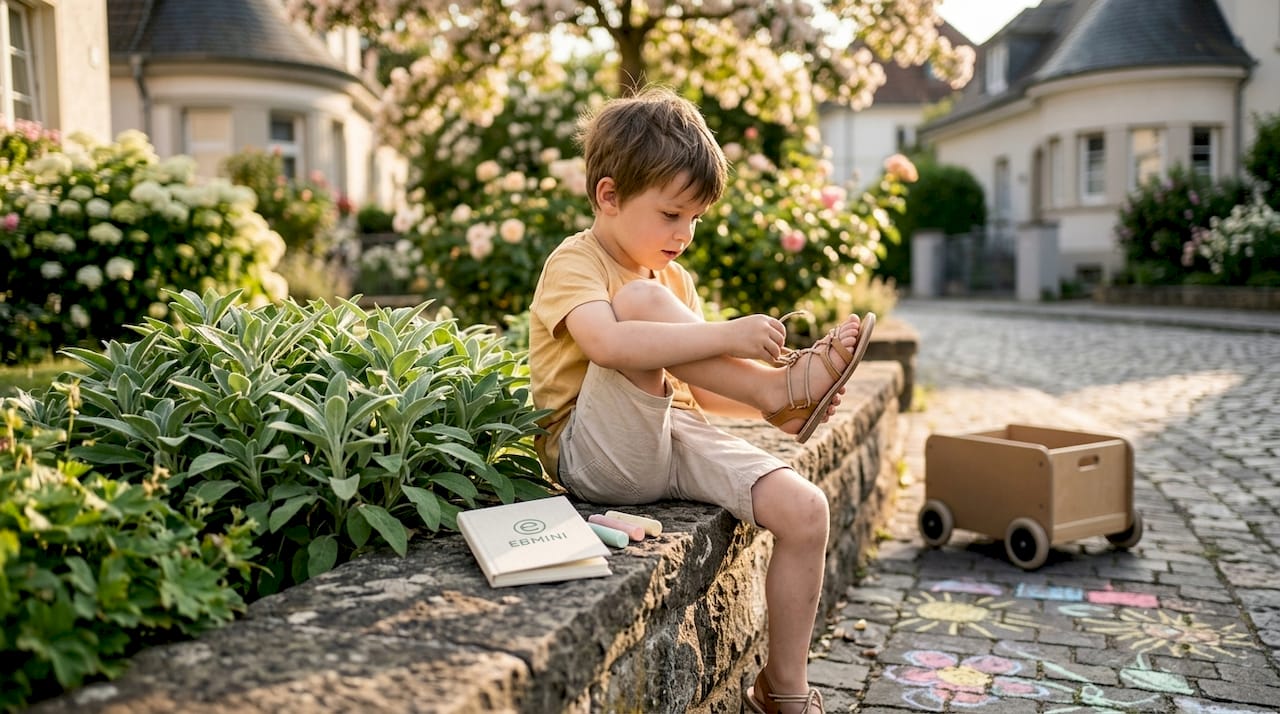
Open Sandals with Straps
This is the classic among lightweight children's sandals. Thin straps hold the foot, and the surface is completely open. Advantages: maximum air circulation, the feeling of almost barefoot walking. Disadvantages: no protection from stones or branches. Ideal for summer days at the playground, beach, or in the city.
Good open sandals have at least two adjustable straps: one over the forefoot and one around the ankle. A single strap is often not enough for stable support, especially for active children.
Closed Sandals with Toe Cap
This variant offers more protection. The toes are covered, while the midfoot and heel are often open. This makes them a better choice for children who enjoy climbing, running, or playing on uneven terrain. To make children's sandals comfortable here means using soft materials on the toe cap to prevent pressure on the toes.
A common misconception: Many parents buy closed sandals assuming they are automatically more stable. But stability in barefoot sandals doesn't come from a stiff upper material, but from the correct fit of the fastener.
Minimalist Huaraches
Huaraches originally come from Mexico and are the most radical form of barefoot sandal. A thin sole, a single strap. Almost no material between the foot and the ground. For children who already have experience with barefoot shoes, they are an exciting model. For beginners, they are too demanding because the foot is barely guided.
Barefoot Sandals with a Sporty Design
Between Huarache and classic sandal lies the type that is currently most popular: lightweight, flexible sandals with an anatomical shape, adjustable Velcro fasteners, and a thin rubber sole. The EBMINI® WAWE Barefoot Sandals and the EBMINI® CIC Sandals are examples of this type: suitable for everyday wear, child-friendly in handling, and consistently aligned with the principles of barefoot walking.
Materials at a Glance
- Natural Rubber Soles: Very flexible, good ground contact, environmentally friendly
- EVA Soles: Lightweight and shock-absorbing, slightly less ground contact
- Textile Upper Material: Breathable, quick-drying, easy to clean
- Leather Straps: Durable and dimensionally stable, requires more break-in time
Comparison of Top Barefoot Sandal Models for Children
Different models vary significantly in width, growth allowance, and material properties. This overview helps you with a direct comparison.
| Feature | Open Sandals | Closed Sandals | Huaraches | Sporty Barefoot Sandals |
|---|---|---|---|---|
| Airiness | Very high | Medium | Very high | High |
| Protection | Low | Medium to high | Very low | Medium |
| Ground Contact | High | Medium | Very high | High |
| Growth Allowance | 6 to 10 mm | 6 to 10 mm | 6 to 10 mm | 6 to 10 mm |
| Suitable for | Summer, beach, city | Outdoor, climbing | Experienced barefoot runners | Everyday, playground |
| Closure | Strap with buckle | Velcro fastener | Strap | Velcro fastener |
| Beginner-friendly | Yes | Yes | No | Yes |
| Maintenance | Low | Medium | Very low | Low |
What the table doesn't convey: the wearing comfort. Children with sensitive feet prefer softer sole materials. Children who spend a lot of time outdoors need more grip under the sole. Neither is visible from the outside. Therefore: If possible, let the child try on the sandals and walk a few steps before you make a decision.
The summer collection of EBMINI® Barefoot Sandals shows how diverse the models within an offering can be. From light and open to protected and off-road capable.
Practical Tips for Acclimatization and Use of Barefoot Sandals in Children
The most common mistake: The child receives new barefoot sandals and wears them all day long immediately. The result is sore muscles in the feet, Achilles tendon pain, and a child who hates their new shoes. Acclimatization requires a plan.
- Week 1 to 2: Wear for one to two hours daily, preferably on soft surfaces like grass or parquet. No long excursions, no hikes.
- Week 3 to 4: Increase wearing time to three to four hours. Now also possible on hard surfaces like asphalt. Pay attention to the child's reactions.
- Week 5 to 8: Gradually increase to full wearing times. For sports activities, test briefly first.
- From Week 8: Acclimatization is usually complete if no more pain occurs.
Pro Tip: Foot exercises speed up acclimatization. Toe-gripping exercises with small objects, toe-spreading exercises, or short barefoot walks on sand strengthen precisely the muscles that barefoot sandals challenge.
Recognize Warning Signs
- Pain in the heel or Achilles tendon after wearing
- Pressure points or redness in unusual areas
- The child avoids certain walking movements or limps
“In case of persistent discomfort or visible foot deformities, a specialist medical clarification is recommended before continuing to wear barefoot sandals.”
Not every child needs the same amount of time. Children who have played barefoot a lot adapt faster. Children who have always worn supported shoes take longer. This is not a problem. It is simply the reality of different starting situations. Further advice on selecting the right size and fit will help you make the right choice from the start.
Barefoot Sandals for Different Situations: Which Sandal Is Right When?
The choice of sandal depends not only on the foot type but also on what the child will be doing in it. Outdoor models offer protection and flexibility for rough terrain, while summer sandals excel with breathability and lightness.
For everyday city wear: Light, open sandals with a simple Velcro fastener. The child can put them on and take them off themselves. Important: Light colors dry faster in sunlight if they get wet.
For the playground: Sandals for warm weather for children should have a closed toe cap here. Sticks, stones, and edges are on every playground. A small toe cap prevents most typical injuries.
For outings and hikes: Robust sole, multiple adjustable straps, and an ankle strap for support. The WAWE Barefoot Sandals from EBMINI® are designed for precisely this use: flexible enough for the barefoot feeling, protected enough for real terrain.
For children with wide feet: Choose the best barefoot sandals for children with a wide toe box. If in doubt, try a size larger and see if the foot fits in completely without protruding sideways.
For everyday use at home and in kindergarten: Lightweight sandals that are easy to handle. The ELE Barefoot Sandals are particularly suitable for kindergarten: light, easy to put on, and comfortable to wear.
Quick Decision Guide by Situation
- Beach and water: Open sandals made of quick-drying material, preferably waterproof
- City stroll: Light sandals with one or two straps, without a toe cap
- Playground: Closed toe cap, grippy sole
- Hike: Multiple adjustable straps, robust sole, ankle protection
- Kindergarten: Velcro fastener, lightweight, easy to put on
Why the Conscious Choice of the Right Barefoot Sandal for Children Is More Than Just Fashion
There is a trend in the children's shoe industry that concerns us: More and more products advertise "barefoot feel," but ultimately mean a soft insole and a fashionable look. This misleads parents who truly want the best for their children's foot development.
Barefoot shoes enable natural movement sequences, strengthen foot muscles, and promote balance. The scientific data is not yet complete, but the assessment of their health value is high. This means you are not acting based on marketing, but on the real benefits for your child's development.
What sometimes bothers us about the barefoot movement is the absolutism. "Only barefoot shoes are good" is just as wrong as "barefoot shoes are dangerous." The truth is more nuanced. Well-fitting barefoot sandals are a tool. A very good tool for many situations. But not a panacea.
Parents face a real challenge: The beautiful, colorful sandals children would choose themselves are rarely the most functional. Here, foot health is actually more important than the child's fashion preferences. This is an uncomfortable position, but a necessary one. Children can find their favorite color in a well-designed barefoot sandal just as they can in a non-functional fashion shoe.
Sustainability is another factor. High-quality barefoot sandals made from robust materials last longer, can be passed down to younger siblings, and produce less waste than cheap models that fall apart after one season. Investing in good sandals and foot health pays off on multiple levels.
Discover healthy barefoot sandals for children at EBMINI®
You now know what types there are, what to look out for, and how to successfully get used to them. The next step is finding the specific shoe for your child's specific foot.
At EBMINI®, you'll find a wide selection of children's barefoot sandals, consistently developed according to the principles of true barefoot freedom: wide toe box, zero drop, flexible sole, and sustainable materials. The barefoot sandals summer collection offers models for every age group, from toddlers to school children. Those who want to dive directly into the most popular models will find a compelling introduction with the EBMINI® WAWE barefoot sandals. The entire range is available in the overview of all barefoot shoes, with easy-to-understand sizing advice directly on the page.
Frequently asked questions about children's barefoot sandals
How much room for growth should children's barefoot sandals have?
For open barefoot sandals, 6 to 10 millimeters of growth allowance is ideal. More leads to a tripping hazard, less leaves no room for natural growth.
How long does it take for children to get used to barefoot sandals?
In the first two weeks, one to two hours daily are sufficient. Most children manage the complete transition after four to eight weeks of gradual increase.
Are barefoot sandals suitable for all children's foot types?
Most children benefit from barefoot sandals. However, in cases of visible deformities or persistent pain, a specialist should be consulted before use.
What types of socks are best for barefoot sandals?
Thin socks or toe socks are the best choice because they do not restrict the natural toe position and hardly change the barefoot feeling.


