

Shoe, Stability, Focus: How to Choose the Right Children's Shoes
Stability in children's shoes means secure support without restricting natural movement. That sounds simple, but in practice, it's not so easy to judge. Many parents opt for stiff, high-top models because they assume they offer safety. However, research into foot health in children shows that the foot primarily needs space and freedom of movement to develop healthily. The shoe should guide, not restrict. Those who know the right criteria make better decisions when buying.
How does shoe size affect stability and foot health in children?
The correct shoe size is the foundation of stable foot guidance. A shoe that is too small compresses the toes and alters the gait. Too large, and the child has to curl their toes to hold the shoe. Both lead to compensatory movements that strain the ankle and knee.
Children's shoes should have an allowance of 12 to 17 millimeters in front of the longest toes. This distance gives the foot space when rolling and prevents the toes from hitting the shoe tip when walking. Less than 10 millimeters is considered too tight, and more than 20 millimeters is considered too wide.
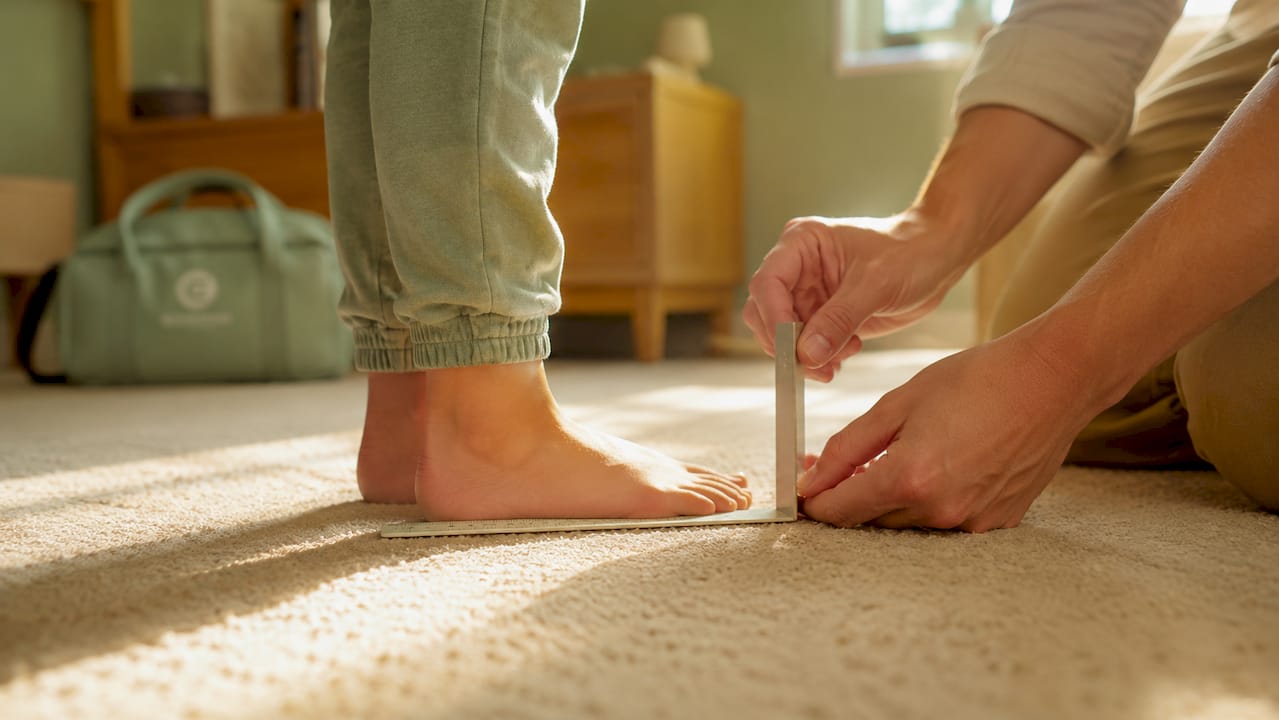
Children's feet grow quickly. Measurements should be taken every 3 to 4 months, and even more frequently for toddlers. Only measuring when buying shoes risks the child wearing shoes that are too tight for weeks without noticing.
A little-known fact: children often do not feel pressure pain from shoes that are too tight. Therefore, asking the child is not enough. Regular measurement of the insole, not the child's judgment, is crucial.
Consequences of incorrect shoe size on stability and gait:
- Shoes that are too small compress the toes, promote misalignments, and reduce the standing surface.
- Shoes that are too large force the child to actively hold the foot, which overloads the calf muscles.
- Uneven sole wear is an early indication of compensatory movements due to poor fit.
Pro Tip: Measure the insole of the shoe, not the foot directly. Place the child's foot on a piece of paper, trace its outline, and compare it with the insole. This will immediately show if there is enough space.
What role does the flex point of the shoe play in natural rolling?
The flex point of a child's shoe is where the sole bends when walking. It must be located under the metatarsophalangeal joints to allow for natural rolling. If it is too far back, in the middle of the foot, the shoe hinders the rolling motion. The child stumbles more often and tires faster.
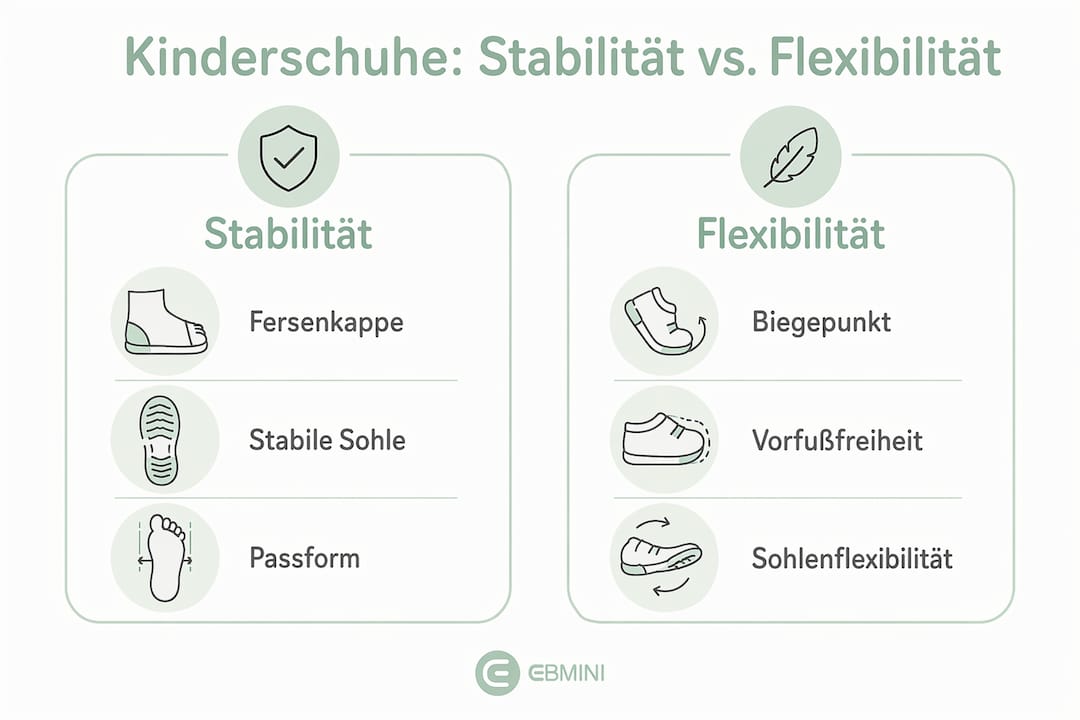
Many parents only check if the shoe can bend. However, the torsion test is just as important. This involves holding the shoe at the heel and toe and twisting it slightly against each other. A torsionally flexible shoe should give slightly. An absolutely stiff shoe forces the ankle to make unfavorable compensatory movements.
| Feature | Good for children's feet | Problematic |
|---|---|---|
| Flex point | Under the metatarsophalangeal joints | Middle of the foot or heel |
| Sole flexibility | Easy and effortless | Stiff, barely bendable |
| Torsion | Gives slightly when twisted | No give, rigid |
| Sole thickness | Thin enough to feel the ground | Too thick, no ground contact |
Incorrect flex points not only lead to stumbling. They create compensatory patterns that can affect the knees and hips in the long term. The foot is the basis of the musculoskeletal system, and incorrect loads due to unsuitable shoes propagate upwards.
Pro Tip: Press the shoe with both thumbs from heel and toe. The shoe should bend exactly where your finger would feel the metatarsophalangeal joints. If it bends in the middle, it is unsuitable.
For a detailed explanation of correct sole flexibility, it's worth checking out Ebmini's parent guide.
Which features of the heel, shaft, and sole support stability?
Stability during play does not come from a stiff shoe, but from the right combination of heel guidance, shaft height, and sole properties. These three areas work together. If one is missing, overall stability suffers.
Heel counter: Support without constriction
The heel counter is the most important stability element. A stable heel area prevents lateral tilting, especially on uneven ground. Press against the heel of the shoe from the outside. It should not give way. If it gives way immediately, the necessary guidance is missing.
Forefoot area: Freedom of movement for the toes
The forefoot area must remain flexible. Only then can the child spread their toes when rolling and actively contribute to balance. A wide toe box gives the toes space without squeezing them. Only 25% of the children examined had a straight big toe. This shows how often shoes that are too tight permanently change the natural toe position.
Sole: Grip without stiffness
The following features characterize a good children's shoe sole:
- Tread: A structured outsole provides grip on pavement, grass, and wet surfaces.
- Slip resistance: Non-slip soles with good grip promote safe movements on various surfaces.
- Thin sole: A thin sole allows the child to feel the ground. This improves body awareness and thus balance control.
- Zero drop: No height difference between heel and forefoot promotes an upright posture.
Depending on their developmental stage, some children need firmer shoes with a stable heel counter, while flexibility in the forefoot area always remains important. This is not a contradiction. It is the right balance.
How can parents observe gait and shoe behavior?
Parents don't have to be podiatrists to notice abnormalities. Regular observation in everyday life is sufficient. Video recordings, flexibility tests, and foot measurements help to identify problems early before they become established.
How to check stability and fit at home:
- Observe gait: Let your child walk in a straight line and watch from behind. Does the ankle turn inwards? Does the foot turn outwards when it lands? Both are signs that the shoe does not fit.
- Make a slow-motion recording: Film your child walking with a smartphone and watch the recording in slow motion. This will reveal compensatory movements that are barely visible to the naked eye.
- Check sole wear: Look at the outsole. Even wear is normal. Heavy wear on one side, especially on the inside of the heel, indicates incorrect loading.
- Perform a flexibility test: Bend the shoe upwards at the toe. It should bend easily and exactly at the right spot. Resistance or an incorrect flex point are clear disqualifiers.
- Perform the thumb test: Press your thumb on the tip of the shoe while the child is standing in it. There should be about a thumb's width of space between the toe and the end of the shoe. This corresponds approximately to the recommended 12 to 17 millimeters.
For a detailed overview of the criteria that really matter when choosing shoes, the article on children's shoes and gait analysis by Ebmini provides a good foundation.
Key findings
Stability in children's shoes comes from the right combination of fit, flex point, and sole properties, not from stiffness.
| Topic | Details |
|---|---|
| Shoe size and allowance | 12–17 mm space in front of the toes ensures freedom of movement and stable gait. |
| Checking the flex point | The shoe must bend under the metatarsophalangeal joints, not in the middle of the sole. |
| Heel counter | A stable heel prevents lateral tilting on uneven ground. |
| Regular measurement | Measure every 3–4 months, as children often do not feel the pressure of shoes that are too tight. |
| Observing gait | Slow-motion recordings and sole wear indicate incorrect loading early. |
What I've truly learned after years with children's shoes
Many parents think a stable shoe is a rigid shoe. That's the most common misconception I encounter. A shoe that encloses the foot from all sides gives the child a feeling of security. But it prevents exactly what the foot needs: active muscle work, feeling the ground, learning balance.
Healthy children's feet do not need excessive stability or an additional footbed. They need space and freedom of movement. This sounds counterintuitive but is well documented. A child who walks barefoot or in a thin, flexible shoe trains the foot muscles with every step. A child in a stiff shoe lets the muscles ride passively.
For children, stability means protecting the foot when necessary without imprisoning it in a rigid shell. This is the difference between a shoe that guides and a shoe that controls. Guiding is good. Controlling is harmful.
What truly surprised me: Parents who opt for expensive, high-top models are often convinced they are doing the best for their child. However, it is often the light, flexible shoes with a wide toe box that truly support foot development. The price says little about the quality. The flex test says more than any brand promise.
— Ebmini
Ebmini Barefoot Shoes: Stability that children's feet truly need
Ebmini has developed children's shoes that maintain this exact balance. Each model has a stable heel counter that prevents lateral tilting, and at the same time a flexible forefoot area that allows natural toe splay. The soles are non-slip, thin enough for genuine ground feel, and manufactured according to the zero-drop principle.

The children's shoes from Ebmini are ultralight, waterproof, and designed for everyday use as well as outdoor play. The wide toe box gives the toes room without sacrificing guidance. For parents who prioritize proven fit and children's foot health, Ebmini also offers detailed size advice directly on the website.
FAQ
What exactly does stability mean in children's shoes?
Stability in children's shoes means secure heel support and clear guidance when walking, without constricting the forefoot or toes. A stable shoe guides the foot but does not restrict it.
How often should I measure my child's shoe size?
Every 3 to 4 months, as children's feet grow quickly and children often don't perceive the pressure of shoes that are too tight. Measuring the insole is more reliable than asking the child.
What is the torsion test and why is it important?
In the torsion test, you hold the shoe at the heel and toe and twist it slightly against each other. If it gives way slightly, it is flexible enough for children. A rigid shoe forces the ankle to make compensatory movements that can cause long-term damage.
How do I know if a shoe doesn't fit my child?
Uneven sole wear, frequent stumbling, or an ankle turning inward are clear signs. Also, if the child takes the shoe off themselves or refuses to put it on, it's worth checking the fit.
Do children with flat feet (knick-senkfuß) need particularly stable shoes?
A slight flat foot in toddlers up to about 3 years old is normal and usually resolves itself. Stable shoes with a heel counter and flexible forefoot support development. For pronounced deformities, a pediatrician or podiatrist should be consulted.


