

Shoes and Coordination: Healthy Foot Development in Children
Around 65% of children wear street shoes that are too small, and 88% walk around in house shoes that are too tight. These figures may seem harmless at first, but their impact on motor development is significant. Parents who believe that a firm, supportive shoe best protects their child are often mistaken. This article explains why barefoot-like, flexible shoes genuinely promote coordination, balance, and natural foot development in toddlers between one and five years old, and how you can make the right choice.
Table of Contents
- The Importance of Shoe Choice for Coordination Development
- How Flexible Shoes Improve Balance and Motor Skills
- Consequences of Inappropriate Shoe Choice: Foot Deformities and Coordination Problems
- Special Cases: Flat Feet, Orthopedic Measures, and Targeted Exercises
- Perspective: The Underestimated Role of Shoe Choice in Children's Motor Skills
- Recommendations for Flexible Barefoot Shoes from the EBMINI® Range
- Frequently Asked Questions
Key Takeaways
| Point | Details |
|---|---|
| Flexible Shoe Choice is Crucial | Flexible, barefoot-like shoes support coordination and healthy foot development in toddlers. |
| Poor Fit Poses Risks | Shoes that are too small or stiff increase the risk of foot deformities and motor development disorders. |
| Balance through Sensory Feedback | Barefoot models promote balance by allowing for more sensory stimuli and muscle activity. |
| Differentiate Actions for Flat Feet | Not every case of flat feet requires insoles – often, specific exercises and appropriate shoes help. |
| Practical Product Recommendations | Versatile, flexible barefoot shoes are available for various weather conditions and everyday situations. |
The Importance of Shoe Choice for Coordination Development
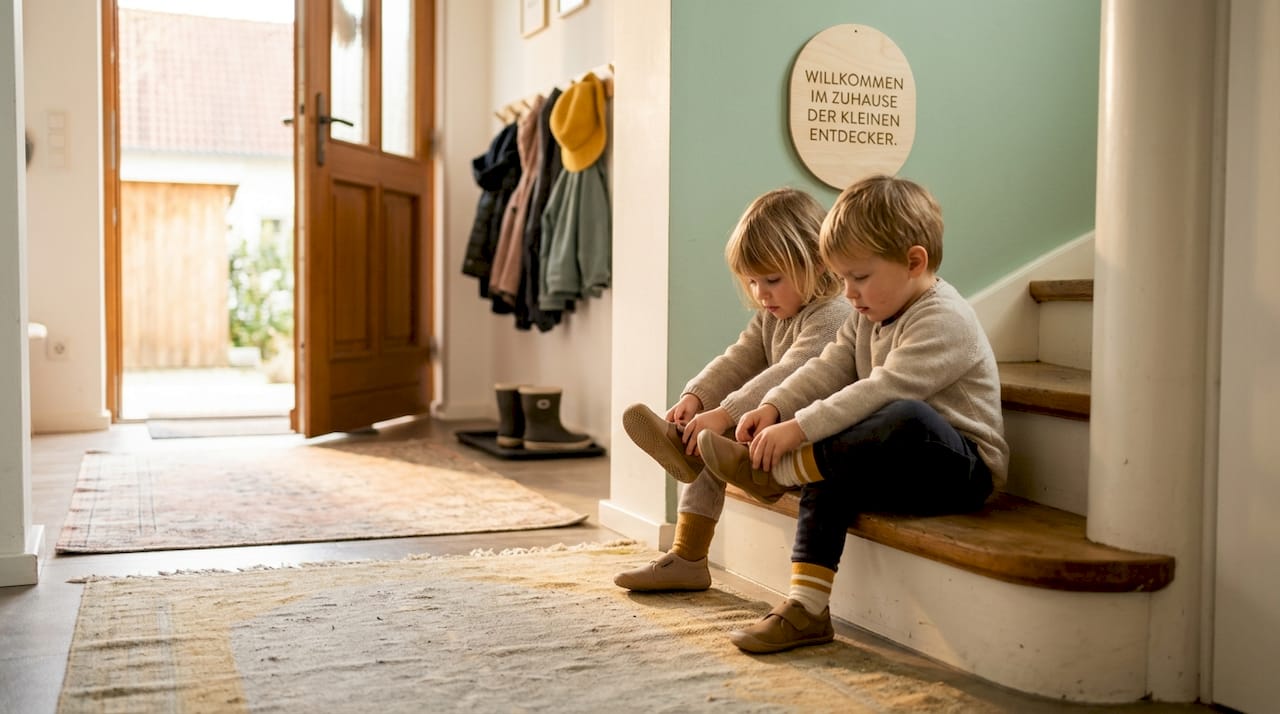
Children learn to walk as their brain and feet communicate with each other. Every step, every bump, and every surface sends signals to the nervous system. This process is called proprioception, which is the body's perception through sensory receptors in muscles, tendons, and joints. Shoes that interrupt this flow of information significantly hinder motor development.
Stiff, thick soles act like a sound barrier between the foot and the ground. The child barely feels whether they are on grass, asphalt, or sand. The consequence: the brain receives less feedback, the muscles have to work less, and coordination develops more slowly. Barefoot-like shoes demonstrably promote natural foot development, foot musculature, and coordination in children aged one to five years.
“The foot is the foundation of the body. Developing this foundation correctly from the beginning lays the groundwork for healthy posture and coordination throughout life."
What does this mean concretely for everyday life? Here are the most important connections:
- Natural Rolling Motion: Flexible soles allow the foot to roll from the heel over the middle to the toe when walking. Stiff soles suppress this movement and weaken the foot muscles in the long run.
- Sensory Feedback: Thin, pliable soles transmit ground stimuli. The child learns to stabilize their body and coordinate movements.
- Toe Freedom: A wide toe box allows the toes to spread during rolling. This improves balance and prevents deformities such as hallux valgus, i.e., the lateral deviation of the big toe.
- Zero Drop: No height difference between heel and forefoot ensures an upright, natural body posture.
Ill-fitting or stiff shoes can hinder foot development, cause deformities, and impair motor skills. Therefore, investing early in barefoot shoes for children in winter lays a healthy foundation for overall motor development.
A frequently overlooked point: children grow quickly, and shoes that fit today may be too tight in six weeks. Regularly checking shoe size is therefore just as important as choosing the right model.
How Flexible Shoes Improve Balance and Motor Skills
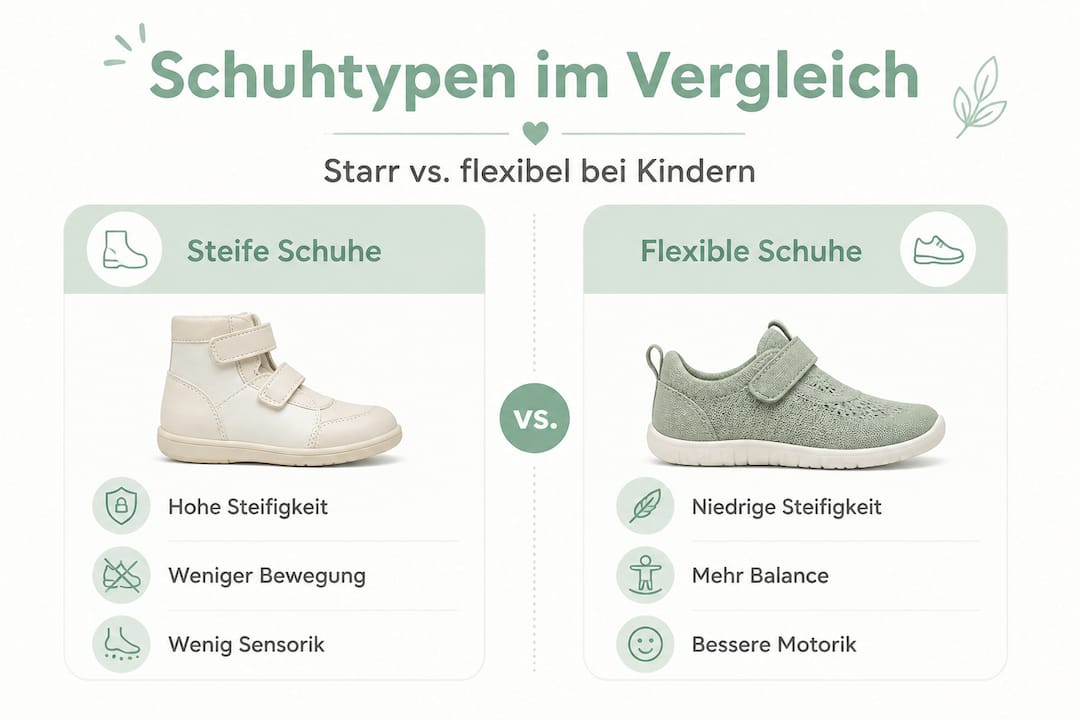
Flexibility is not just a marketing term. Scientifically, torsional stiffness, meaning a shoe's resistance to twisting, describes how much a shoe restricts natural foot movement. A shoe with high torsional stiffness hardly twists when you hold it at the ends and twist it. A barefoot-like shoe yields like a piece of fabric.
Flexible shoes with low torsional stiffness improve gait parameters like stance time and step width compared to stiff shoes, without compromising stability. This means children stand more securely, walk more smoothly, and develop a better sense of their body.
| Feature | Stiff Shoes | Flexible Barefoot Shoes |
|---|---|---|
| Torsional Stiffness | High | Low |
| Sensory Feedback | Low | High |
| Muscle Activation | Reduced | Natural |
| Stance Time while Walking | Shortened | Improved |
| Step Width | Restricted | Natural |
| Toe Freedom | Often Limited | Wide Toe Box |
Barefoot walking or barefoot-like shoes improve balance, proprioception, and coordination by activating foot muscles and providing sensory stimuli. Children who regularly walk barefoot or in barefoot-like shoes show measurably better balance performance than their peers in conventional footwear.
This is particularly relevant for different weather conditions. Many parents automatically opt for thick, stiff winter boots in autumn and winter, equating warmth with protection. However, alternatives have long existed: waterproof barefoot boots combine protection from wet and cold with the necessary flexibility for healthy foot development.
Here are concrete tips on what to look for in different weather conditions:
- Autumn and Rain: Waterproof outer materials, flexible sole, non-slip profile for wet surfaces.
- Winter and Snow: Insulation for warmth, but without a rigid sole. The EBMINI® MARG boot combines warmth and flexibility.
- Transitional Periods: Lightweight, breathable models like the EBMINI® KOKO autumn/winter boot are suitable for changeable weather.
- Summer: Sandals with a barefoot principle that allow the foot to breathe while still offering protection.
Pro Tip: Test a shoe's flexibility by holding it at the heel and toe and trying to fold it. A good barefoot shoe can be bent almost like a piece of paper. If you feel significant resistance, the shoe is too stiff for a toddler.
The effects on balance should not be underestimated. Children between one and three years old are in a critical phase of balance development. Every sensory information the foot receives is processed in the cerebellum and helps the child avoid falls and refine movements. Barefoot-like shoes reliably deliver this information, while stiff shoes block it.
Consequences of Inappropriate Shoe Choice: Foot Deformities and Coordination Problems
The numbers are clear. Ill-fitting shoes can hinder foot development, cause deformities, and impair motor skills. But what exactly happens when a child walks for years in shoes that are too tight or too stiff?
First, regarding size: Shoes that are too short force the toes into a compressed position. The toes cannot spread, the foot muscles are not adequately activated, and the rolling motion changes. In the long term, this leads to pressure points, nail bed problems, and in the worst case, permanent deformities such as hammertoes or hallux valgus.
Shoes that are too wide or too soft without an adequate fit are also problematic. The child has to cramp their toes to hold the shoe. This changes the gait and puts unnecessary strain on muscles and tendons.
| Problem | Cause | Possible Consequence |
|---|---|---|
| Shoes too short | Toes are compressed | Hammertoes, nail bed problems |
| Sole too stiff | No natural rolling motion | Weak foot muscles |
| Toe box too narrow | Toes cannot spread | Hallux valgus |
| No Zero Drop | Heel elevated, forefoot burdened | Poor posture, back pain |
| Poor fit | Compensatory movements | Coordination problems |
Here's how to choose shoes:
- Measure foot length: Place the child's foot on a piece of paper and trace the outline. Measure from the longest toe to the heel. Add one centimeter for wiggle room.
- Check width: The shoe should not constrict the foot at its widest point. Gently press the side of the shoe when the child is wearing it.
- Test flexibility: Perform the bending test as described above. There should be no significant resistance when bending.
- Check toe box: There should be enough space at the front for the toes to spread.
- Regularly check: Children's feet grow quickly. You should reassess the fit every six to eight weeks.
Pro Tip: Always buy shoes in the afternoon when the feet are slightly swollen. This ensures that the shoe will still fit comfortably after a long day of play and won't pinch.
For everyday use in autumn and winter, models like the EBMINI® BEM barefoot shoes are suitable, combining warmth and flexibility. For wet conditions, EBMINI® ZOE waterproof boots are a good choice, implementing the barefoot principle even in rain and snow. For those seeking particularly robust models, the KIKI waterproof winter boots offer a durable option with a wide toe box and non-slip sole.
An often-forgotten aspect: coordination problems caused by poor footwear are not always immediately apparent. Children compensate remarkably well. Only when compensatory patterns become habitual do visible problems arise, such as an unsteady gait, frequent falls, or noticeable posture. Early intervention is therefore crucial.
Special Cases: Flat Feet, Orthopedic Measures, and Targeted Exercises
Many parents worry if their child has flat feet. Flat feet, meaning a flattened or absent longitudinal arch, are completely normal in toddlers up to three years of age. The arch only develops during childhood. Nevertheless, insoles and special orthopedic shoes are often recommended very early on.
Research paints a more nuanced picture. For pain-free flat feet, insoles show no significant advantage over regular shoes, and the evidence for them is low. This means that if your child is not experiencing pain and is moving normally, they generally do not need expensive insoles or special shoes.
What truly helps is targeted muscle strengthening. Combined exercises for the intrinsic and extrinsic foot muscles improve foot posture, balance, and mobility in children with flat feet more effectively than intrinsic exercises alone. Intrinsic muscles are the small muscles within the foot, while extrinsic muscles originate in the lower leg and act on the foot.
“Not every case of flat feet is a problem. Many children fully develop their foot arches if they have the opportunity to walk barefoot or in flexible shoes and naturally strengthen their foot muscles."
Concrete recommendations for parents with children with flat feet:
- Increase barefoot time: Let the child spend time barefoot daily on various surfaces. Grass, sand, and pebbles activate the foot muscles particularly well.
- Playful exercises: Grasping cloths with their toes, picking up marbles, or standing on one leg strengthens the foot muscles in a playful way.
- Choose flexible shoes: Even with flat feet, barefoot-like shoes are usually better than stiff models because they promote muscle activity.
- Medical advice: In cases of pain, strong asymmetry, or an unusual gait, you should consult a pediatric orthopedist.
- Critically question insoles: When insoles are recommended, ask about the scientific basis and whether conservative treatment with exercises and flexible shoes has been attempted first.
For children with flat feet or other foot peculiarities, models such as the EBMINI® LIS waterproof boots are suitable, offering ample space for natural foot movement without resorting to stiff structures. The wide toe box and flexible sole support muscle development even with anatomical peculiarities.
Important: In genuine pathological cases, i.e., painful flat feet, neurological abnormalities, or structural deformities, a medical diagnosis is essential. Barefoot-like shoes are not a substitute for medical treatment, but they can be a useful supplement in many cases.
Perspective: The Underestimated Role of Shoe Choice in Children's Motor Skills
We regularly encounter parents who, with the best intentions, choose the wrong shoes. The reasoning behind it is understandable: a firm, high shoe looks protective. It appears stable, robust, and gives the feeling of keeping the child safe. But this is precisely where the misunderstanding lies.
Firm shoes do not protect against falls. They prevent the child from learning to stabilize themselves. A child who walks in stiff shoes does not develop adequate foot muscles or a fine sense of the ground. When they then walk on uneven terrain or change shoes, they lack precisely the foundation they needed.
This is comparable to an arm being immobilized in a splint for weeks. After removal, the muscles are weakened, and coordination is impaired. Shoes that permanently restrict the foot have a similar long-term effect.
Another misunderstanding: many parents believe that expensive brand-name shoes are automatically better. Price and quality do not reliably correlate in the children's shoe sector. Decisive factors are measurable properties such as torsional stiffness, sole thickness, toe box width, and the shoe's weight. A lightweight, flexible shoe for less money can be far superior to a heavy, stiff branded product.
What we've learned from experience: Parents who understand how barefoot shoes work and what they achieve rarely go back. The difference in gait, posture, and the enthusiasm with which children walk in these shoes is often visible to the naked eye. Children move more freely, stumble less, and explore their surroundings more actively.
Our honest advice: Start early. The younger the child, the more malleable the foot structure and the greater the impact of shoe choice. And regularly check if the shoes still fit. Not just in length and width, but also in their flexibility. Shoes that have become stiffer through frequent wear should be replaced, even if they still appear to be large enough.
Recommendations for flexible barefoot shoes from the EBMINI® range
You now have a solid understanding of why flexible, barefoot-like shoes so effectively support your children's coordination and foot development. The next step is choosing the right model for the respective season and your child's daily life.
The EBMINI® range includes models for every type of weather, all developed according to the barefoot principle: wide toe box, zero drop, flexible sole, and child-friendly weight. For cold winter days, the EBMINI® WOLK winter boots offer warmth and flexibility in one. For warmer months, the EBMINI® FREI barefoot sandals are the ideal choice, light, open, and perfect for active children. Those looking for a versatile all-weather model will find a reliable companion for rain, mud, and outdoor adventures in the LER waterproof barefoot boots. All models are available directly via ebmini.de, including size advice and customer reviews.
Frequently Asked Questions
Why are flexible shoes better for toddler coordination?
Flexible shoes enable natural movement sequences and promote sensory feedback, which strengthens coordination and foot muscles. Shoes with low torsional stiffness demonstrably improve gait parameters such as stance time and step width compared to stiff models.
How do I know if my child's shoes are too small?
Toes should have enough space at the front of the shoe; with at least one centimeter of space to the edge, the size is usually appropriate. 65% of children wear street shoes that are too short and 88% wear house shoes that are too small, which is why regular remeasurement is particularly important.
Does barefoot walking always help with foot problems or deformities?
Barefoot walking promotes natural development, but in pathological cases such as painful flat feet, targeted measures and medical advice are necessary. For pain-free flat feet, insoles show no significant advantage over normal shoes, which emphasizes the importance of an individual assessment.
What types of shoes are particularly suitable for different weather conditions?
Waterproof, flexible barefoot shoes are ideal for wet and cold weather conditions because they combine protection and freedom of movement. Light, open models with thin soles are suitable for summer and leisure, when maximum sensory feedback is desired.


