

Changing Shoes for Toddlers: When Is the Right Time?
When Should Parents Change Their Toddlers' Shoes?
The fit should be checked regularly, and changing shoes for toddlers is often necessary because their feet grow quickly. That sounds frequent, but it's no accident: children's feet grow particularly fast at this age, and because children rarely perceive tightness as pain, ill-fitting footwear often goes unnoticed for weeks.
What should you pay attention to immediately?
- Thumb Test: Press your thumb on the toe of the shoe while your child is standing. Ideally, there should be a gap of about 10–15 mm to the longest toe. No more room? Time for a change.
- Difficulty Putting On: If the child struggles to get their foot in even with thin socks, the shoe is too small.
- Redness and Pressure Marks: Visible marks or redness after taking off the shoes are clear warning signs.
- Changed Gait: Tiptoeing, wide-legged walking, or frequent stumbling can indicate poorly fitting shoes.
- Worn Soles: Soles that are worn down unevenly require a change, even if the size still seems to fit.
Brands like RICOSTA, PEPINO, and Ebmini offer models specifically designed for toddlers' foot health: wide toe box, flexible sole, breathable materials. But even the best shoe is useless if worn for too long.
Pro Tip: Mark control appointments directly in your family calendar, every six weeks, like a dental appointment. This way, the check-up won't be forgotten.
What Types of Shoes Suit Which Developmental Stage?
Children's feet are not just smaller adult feet. They are soft, malleable, and require very different support depending on their developmental stage.
- 0–12 Months: Barefoot walking indoors is the best choice. Socks or soft leather booties are completely sufficient. Stiff shoes are more of a hindrance than a help at this stage.
- 12–18 Months (First Steps Outdoors): Only when the child has been walking freely and confidently for a few weeks do they need a real shoe. First-walker shoes with soft, flexible soles and Velcro fasteners are ideal.
- 18 Months to 3 Years: Now activity and speed are added. The shoe needs to withstand more wear, but still requires a flexible sole and ample toe room.
Barefoot walking is not only permitted for small feet, but explicitly beneficial. The foot feels the ground, the toes can grip freely, and the musculature develops without artificial support. Shoes protect, but they do not shape.
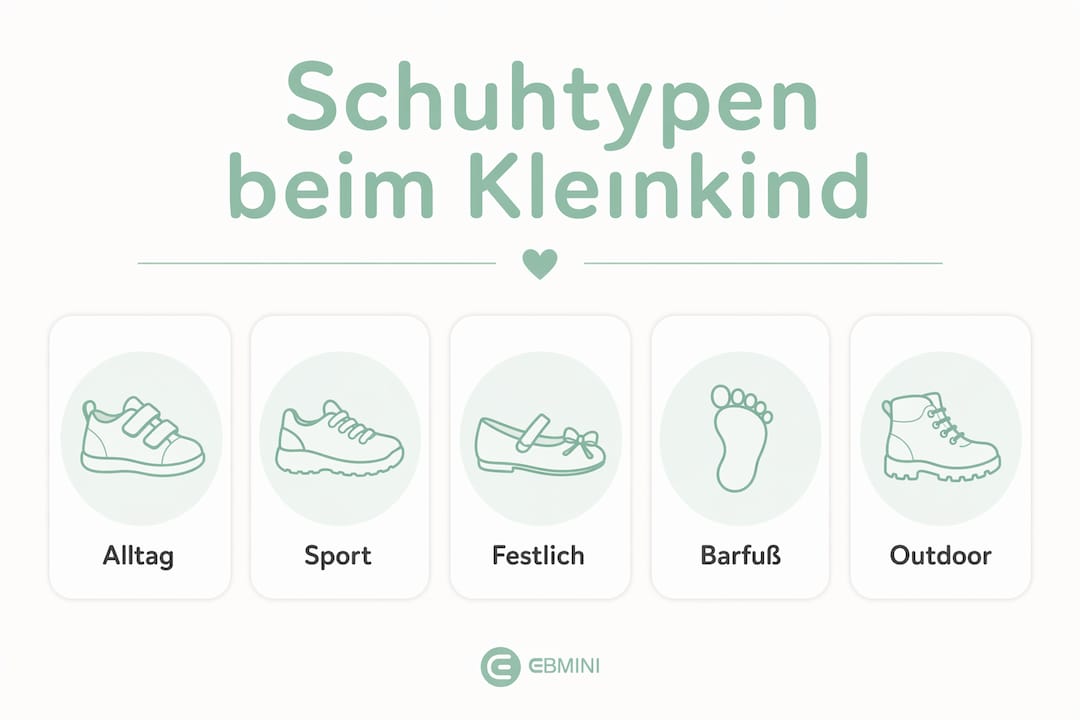
The Three-Shoe Rule recommends at least three different types of shoes: one for everyday wear, one for sports and activity, and one for special occasions. This variety distributes the load and promotes long-term foot health.
Pro Tip: Always test sole flexibility by hand: A good children's shoe should bend easily in the forefoot area. If you need force, the sole is too stiff.
As for materials: In summer, feet need air, so breathable fabrics like mesh or leather are best. In winter, waterproofing and warmth are important, but the shoe should not be so thickly lined that the foot loses its grip. Ebmini's all-weather models feature ultra-light, waterproof constructions with a wide toe box and zero-drop sole, meaning no heel elevation, which promotes natural foot roll.
How Often Do Toddlers' Shoe Sizes Change?
Toddlers' feet grow particularly quickly – on average up to 2 cm per year. The fit of shoes should therefore be checked every 6–8 weeks, and a shoe change for toddlers is recommended every 3–4 months. Growth does not occur evenly, but in spurts.
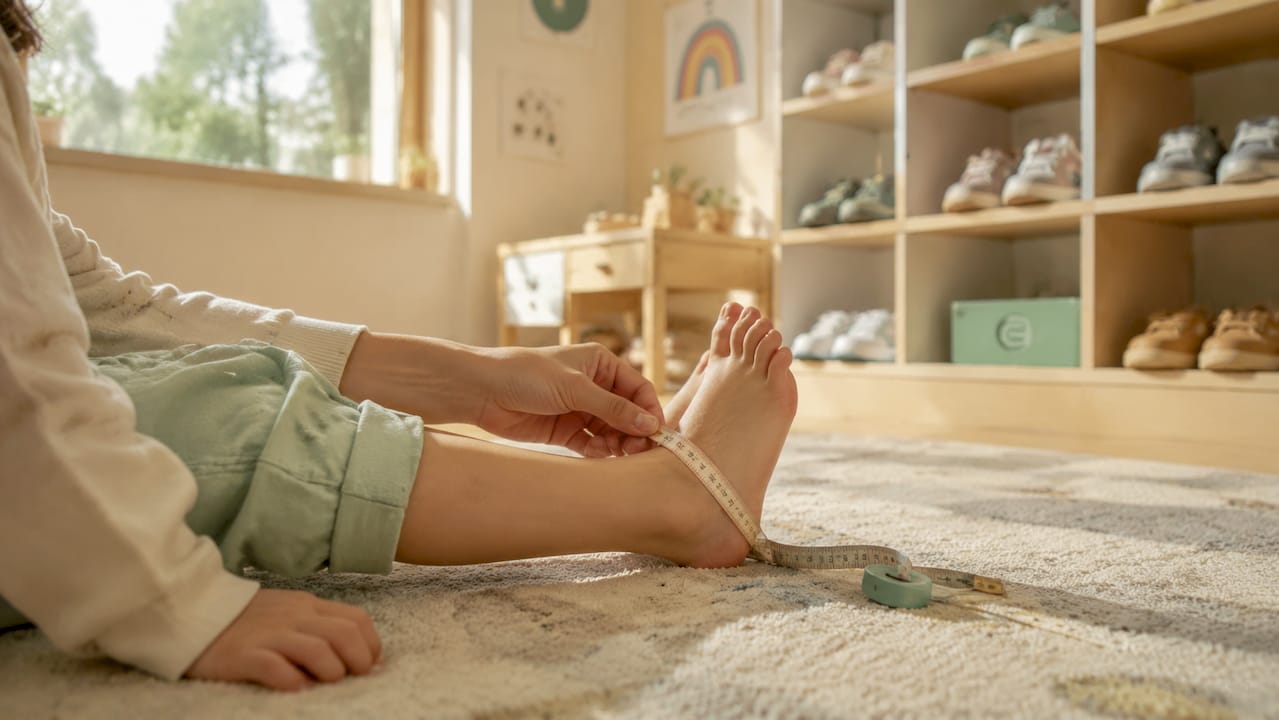
Shoe size checks should be more frequent for younger children and less frequent for older children, as growth decreases with age.
Practical tips for regular fit checks:
- Always check both feet; the larger one determines the shoe size.
- Measure in the afternoon, as feet swell slightly throughout the day.
- Do not rely on the printed shoe size: According to studies, the stated shoe size often does not correspond to the actual inner length.
- Shoes that are worn for too long can promote deformities that only become apparent years later.
Growth spurts often come without warning. A child who is comfortable in their shoes today might be half a size larger in three weeks. Therefore, regular checks are more important than any rigid schedule.
What Are the Signs That a Shoe Change Is Needed?
Children rarely complain about shoes that pinch. They get used to tightness without consciously noticing it, and silently adapt their walking pattern. Parents must therefore actively observe, not wait for complaints.
Checklist of warning signs:
- The child takes off their shoes unusually often or refuses to put them on.
- Redness, pressure marks, or small blisters on toes, heel, or instep after taking off the shoes.
- Visible indentations of the toes on the insole.
- Changed gait: tiptoeing, walking on tiptoes, or wide-legged walking.
- Worn or unevenly worn soles, even if the size is still correct.
- The child complains of tired legs after short distances.
- Pinched or ingrown toenails.
The last point in particular is often overlooked. Ingrown nails are not only caused by incorrect trimming, but also by constant pressure from shoes that are too tight. And: children who walk on their forefoot sometimes show a gait abnormality, but sometimes simply that their shoes are too big at the back or too tight at the front.
How Do You Measure Your Child's Foot Correctly?
The thumb test is practical but not always reliable. The more accurate method: Place your child's foot on a piece of paper, trace closely around the foot with a pen, and measure the length of this template. Then compare it with the insole of the shoe. There should be 12–17 mm of space between the template and the toe of the shoe.
Tips for choosing shoes:
- Check Width: The foot should not be squeezed sideways. Especially in the toe area, it needs room to spread out.
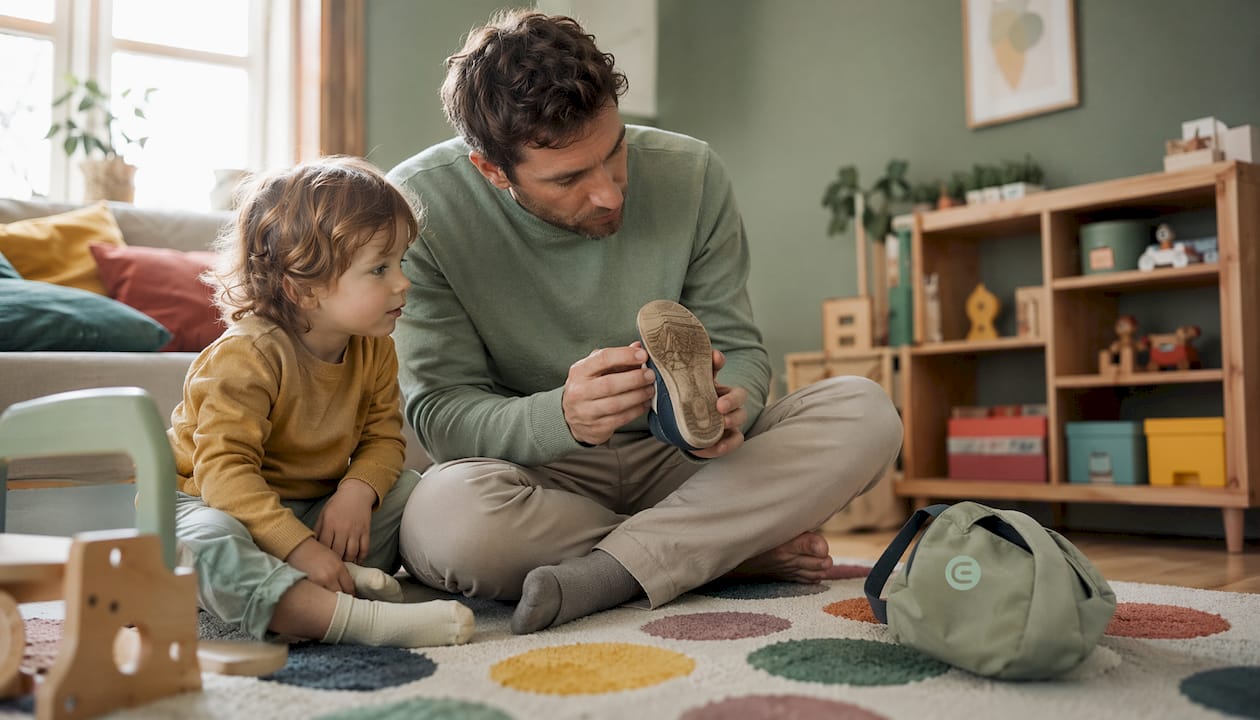
- Test Heel Counter: The heel must sit firmly without pressing. A shoe that slips at the back forces the child to curl their toes.
- Bend Sole: The shoe must bend well in the forefoot area, where the foot naturally rolls.
- Choose Material: Leather and breathable textiles regulate moisture better than pure synthetics.
For breaking in new shoes: Let your child wear the new shoes only for a short time initially, an hour on the first day, then gradually increase. This way, you'll notice early if anything is pinching before blisters appear.
Pro Tip: A professional foot measurement in a specialist shop not only captures length and width, but also foot shape, instep, and gait. This provides more certainty than any size chart alone.
Ebmini offers a detailed size guide for children's shoes on its website, which helps parents with selection, including notes on foot width and fit depending on the model.
What Do Experts Say About Healthy Footwear for Toddlers?
Shoes that are too small for months can lead to permanent deformities, including bunions (Hallux valgus) or hammertoes. These are not rare extreme cases, but real risks that could be avoided by timely shoe changes.
Important findings from professional practice:
- Children get used to pressure and tightness without consciously perceiving it. They shift their gait pattern, spread their toes less, or walk on their outer edges. The brain makes these adjustments silently.
- Growth occurs in spurts, not linearly. Daily observation is therefore more important than rigid check intervals.
- The 3-shoe rule distributes the load across different shoe types and thus protects the developing foot structure in the long term.
- Worn soles are a reason for replacement on their own, regardless of shoe size. Unevenly worn soles force the foot into incorrect movement patterns.
- Barefoot walking on suitable surfaces remains the best complement to any shoe. It simultaneously trains muscles, balance, and body awareness.
Parents who take flexible soles in children's shoes seriously as a buying criterion are doing their child a real favor. Stiff soles hinder natural foot roll and can slow down muscle development in the foot.
Ebmini: Barefoot Shoes for Healthy Little Feet
Ebmini develops children's shoes that come as close as possible to the barefoot feeling, in any weather. The models are ultra-light, waterproof, and feature a wide toe box that gives toes real freedom of movement. Zero Drop means: no heel, no artificial incline, the foot stands flat and naturally.
Whether for everyday wear, the playground, or winter: Ebmini's barefoot shoes are designed to support toddlers' shoe changes without impairing foot development. Size advice and fit information are available directly on the website.
Key Takeaways
Changing shoes for toddlers doesn't depend on the calendar, but on daily observation and regular checks every 6–8 weeks.
| Topic | Details |
|---|---|
| Check Interval | Check fit every 6–8 weeks, change toddlers' shoes typically every 3–4 months. |
| Growth Pattern | Children's feet grow in spurts, not uniformly; daily observation beats rigid schedules. |
| Recognizing Warning Signs | Redness, pressure marks, altered gait, and difficulty putting on shoes indicate a need for action. |
| Measurement Method | Paper template while standing, with 12–17 mm space to the toe of the shoe, is more reliable than the thumb test. |
| Risk of Deformities | Shoes that are too small for months can cause bunions or hammertoes that are difficult to correct later. |


