

Fitting Shoes Correctly During a Growth Spurt
With the next growth spurt, a simple rule applies: measure both of your child's feet while they are standing, preferably in the afternoon, and check the inside of the shoe. If there is less than 10–12 mm of space between the longest toe and the tip of the shoe, the shoe must be replaced immediately. Between 12 and 17 mm is the recommended room for maneuver — enough for movement, but not so much that the foot slips.
Immediate checklist for growth spurts:
- Measure both feet, use the larger one as a reference
- Measure the child standing, in the afternoon (feet are slightly swollen then)
- Remove the insole and have the child stand on it barefoot: check the distance to the tip of the toe
- Check shoes for wear, deformed soles, and compressed inner lining
- Remove removable insoles to gain some short-term leeway
- If there is less than 10 mm of space: no waiting, new purchase necessary
Key Takeaways
Adjusting shoes during a growth spurt means: regular measuring, checking the inside of the shoe, and acting immediately if there is less than 10–12 mm of space.
| Topic | Details |
|---|---|
| Measuring rule | 12–17 mm inside space is optimal; below 10 mm, the shoe must be replaced immediately. |
| Measuring frequency | Measure toddlers every 4–6 weeks, preschoolers every 4–6 weeks, more often during growth spurts. |
| Shoe characteristics | Flexible sole, wide toe box, and no rigid footbed protect natural foot development. |
| Short-term adjustment | Removing removable insoles creates 2–4 mm of space, but does not replace a new purchase. |
| Ebmini | Barefoot shoes with flexible soles, wide toe boxes, and size advice for children aged 1 to 10. |
Table of Contents
- How to measure your child's foot length correctly?
- How do you know if shoes are too small?
- How often should you check shoe size?
- Which shoe characteristics are particularly important during a growth spurt?
- What can you do in the short term until new shoes arrive?
- When should you consult a doctor or podiatrist?
- What do experts and studies say about this?
- Ebmini's View: What really works in everyday life
- Growth-friendly barefoot shoes from Ebmini
- Sources
How to measure your child's foot length correctly?
Measuring at home is more reliable than many think, if a few points are observed. According to Eltern, measurements should always be taken standing and in the afternoon, because children's feet swell slightly during the day. If you measure in the morning, you might buy a shoe half a centimeter too small.
Step-by-step at home:
- Place a sheet of paper or cardboard on the floor.
- The child stands with their foot flat on it, weight evenly distributed.
- Mark the heel and the longest toe with a pen.
- Measure the distance between both marks in millimeters.
- Repeat for the other foot. Use the larger value as the basis.
- Add 12–17 mm to the measured foot length: This is the insole length the shoe should have.
Calculation example: Foot length 155 mm + 15 mm allowance = 170 mm insole length. This usually corresponds to size 27.
In shoe stores, there is a practical alternative: remove the insole, have the child stand on it barefoot, and read the distance to the toe tip directly. Specialist staff should pay attention to relaxed toe positioning, as children instinctively curl their toes when someone presses on the shoe.
Pro-tip: Perform the thumb test with both hands: one hand flat on the toe area of the shoe, use the thumb of the other hand to feel the longest toe. This prevents the child from curling their toes and distorting the measurement.
| Method | Advantage | Note |
|---|---|---|
| Cardboard template (standing) | Very accurate, weight-bearing foot | Make template while standing |
| Insole test | Quick, visually clear | Insole must be removable |
| Thumb test | Possible everywhere | Only meaningful with both hands and relaxed toes |
The cardboard template must depict the foot in a weight-bearing state, because the arch of the foot expands when stepped on. A sole that is too short is often the starting point for later complaints.
How do you know if shoes are too small?
Children rarely say on their own that shoes are pinching. They get used to pressure. Therefore, regular physical checks are necessary, not just asking.
Physical warning signs:
- Redness, pressure marks, or blisters on toes, heel, or ball of foot
- Compressed or rubbed inner lining in the toe area
- Severely asymmetrical or unusually worn soles
- Sole bulges or is deformed
Behavioral signs:
- Child frequently takes off shoes without being asked
- Stumbling or altered gait when walking
- Reluctance to put on shoes, complaining of tired legs
- Toe walking or unusual rolling of the foot
For the at-home check, the insole test is best: remove the insole, have the child stand barefoot on it, measure the distance to the toe tip. Less than 10 mm means: act immediately. The thumb test alone is not enough, because children instinctively curl their toes when pressed, thus faking more space than is actually available.
How often should you check shoe size?
Children's feet do not grow uniformly. According to Spektrum der Wissenschaft, toddlers aged approximately one to three years grow an average of a few millimeters per month, preschoolers aged three to six years slightly less per month. This sounds little, but it adds up: in six weeks, a toddler can gain almost a full shoe size.
Rule of thumb for growth spurts: If you notice that your child has grown significantly in a short period of time, measure their feet every 4–6 weeks instead of as usual. Growth spurts affect feet just as much as height.
- Less than 10 mm internal space: shoe is too small, immediate change needed
- 10–12 mm: borderline, wearable for a short time, but plan a new purchase
- 12–17 mm: optimal room for active children
- More than 17 mm: too much space, shoe can slip when walking
Too much room, by the way, is not a harmless mistake. A shoe that is too big forces the child to curl their toes to keep the shoe on. This strains muscles and tendons just as much as a shoe that is too tight.
Which shoe characteristics are particularly important during a growth spurt?
A shoe bought during a growth spurt must above all be able to do one thing: allow the foot room to move. That sounds obvious, but it isn't.
Purchase criteria that really matter:
- Flexible, bendable sole: The shoe should bend easily in the middle. A rigid sole prevents natural rolling and strains the foot muscles.
- Wide toe box: The toes must be able to spread, especially when pushing off. A narrow toe box compresses the toes and can promote deformities in the long term.
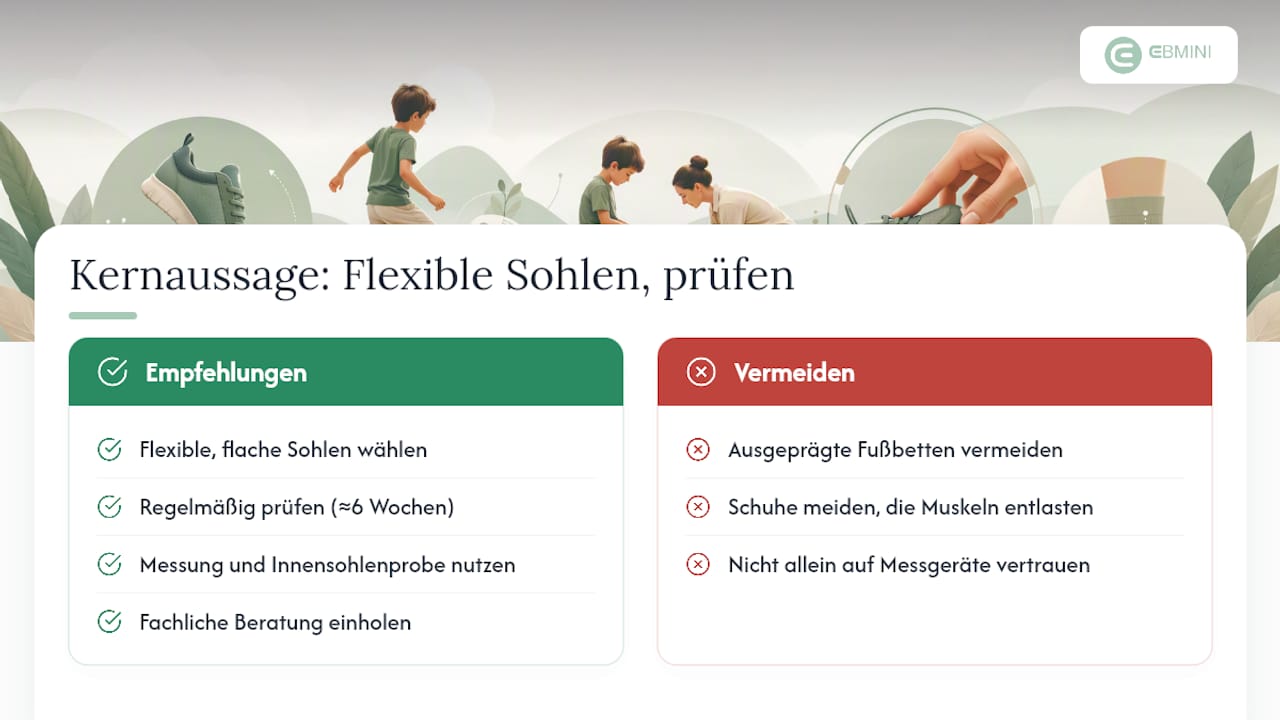
- Flat footbed without pronounced support structure: Specialists recommend avoiding strong footbeds for toddlers, as these can inhibit natural muscle development.
- Lightweight: Heavy shoes tire leg muscles faster, especially in active children.
- Breathable materials: Important for comfort and hygiene, especially during long wearing times.
- Adjustable fasteners: Velcro fasteners or laces allow for individual adjustment to the foot.
What you should avoid:
- Rigid, thick soles without flex flexibility
- Pronounced footbeds or insoles that are permanently installed
- Too narrow toe boxes, even if the length is correct
- Heavily worn used shoes (more on this in the next section)
When buying in the afternoon, try them on, measure both feet individually, and pay attention to the rolling motion: the child should not stumble or drag the shoe when walking. More about the advantages of flexible soles can be found in the parent guide to flexible soles.
What can you do in the short term until new shoes arrive?
Sometimes an immediate new purchase is not possible. There are some measures that are temporarily acceptable, and some that do more harm than good.
Permitted temporary solutions:
- Remove removable insoles: This immediately creates 2–4 mm of additional space without altering the shoe. Only useful if the shoe otherwise fits well.
- Loosen adjustable fasteners: With Velcro fasteners, a little more room in the instep area can help if the shoe is pinching.
- Use adjustable models: Shoes with multiple Velcro zones can be better adapted to a growing foot than models with a fixed shape.
- Check padding at the heel: If the shoe rubs at the back, a small heel pad can provide temporary relief.
What you should not do:
- Pass on or accept heavily worn used shoes: The sole has adapted to the gait of the previous wearer and can cause improper weight distribution for the new wearer. Barely worn rubber boots are an acceptable exception.
- "Break in" shoes that are clearly too small: This doesn't work with children's shoes and harms the foot.
- Insert rigid footbeds to "compensate" for growth: This is counterproductive.
Pro tip: If you remove insoles, check the fit again after two weeks at the latest. The space gained is limited and not a permanent substitute for the right shoe. More about insoles in children's shoes can be found in the guide to removable insoles in winter shoes.
When should you consult a doctor or podiatrist?
Most growth spurts occur without complications. But there are signals where a specialist medical clarification is advisable.
Red flags that should not be ignored:
- Persistent pain in the feet, knees, or hips that lasts longer than two weeks
- Significantly altered gait: toe walking, severe inward or outward pronation
- Visible deformities such as flat feet or splayfoot that do not improve
- Unilaterally severely worn soles, indicating asymmetrical stress
- Severe asymmetries between both feet in length or shape
In these cases, a referral to a pediatric orthopedist or a podiatric examination is advisable. Typically, a gait analysis follows, sometimes a foot pressure measurement. For special cases with orthopedic problems during a growth spurt, there are also adjustable medical children's shoes with removable insoles that are fitted by specialists.
Prepare for the doctor's appointment:
- Bring photos of the wear patterns of the old shoes
- Note current measurements of both feet
- Document observations about gait and pain (when, how often, during which activity)
What do experts and studies say about this?
The recommendations in this article are not arbitrary. They are based on expert opinions and scientific sources.
The General Children's Hospital (AKK) explicitly recommends flexible, flat soles for children's shoes and warns against pronounced footbeds for toddlers. The reason:
"Pronounced footbeds can be counterproductive for toddlers because they inhibit natural muscle development. Flexible, flat soles are preferable." AKK Children's Hospital
This position is consistent with what pediatric orthopedists and podiatrists observe in practice: a shoe that "takes over" the foot muscles does not train them, but weakens them.
With a check interval of six weeks, a toddler can therefore have already gained almost a whole shoe size.
Scientific work on foot biomechanics in children, accessible via PubMed, confirms that measurement accuracy and regular checks are crucial for healthy foot development. Measuring devices and WMS systems only provide orientation. The most reliable method remains the combination of measurement, insole test, and professional advice.
Ebmini's View: What really works in everyday life
Anyone who has ever tried to get a tired toddler to stand still in the afternoon so their feet can be measured knows that theory and practice sometimes diverge. A few things still help.
Barefoot time is not a luxury, but part of healthy foot development. Children who spend time daily without shoes, on grass, sand, or at home on the floor, train their muscles and balance in a way that no shoe can replace. Shoes protect, but they should do no more than that.
When buying shoes with an uncooperative child, a simple trick helps: remove the insole beforehand at home and measure the length. This way, the child only needs to stand still for a short time in the store, instead of for minutes. If you have several sizes at home, you can label the shoes and sort them into a box by size. This saves time and prevents a pair from being worn for too long because it was "still lying around somewhere."
Budget is a real issue. Children's shoes quickly become too small, that's a fact. But used, heavily worn shoes are not a solution, even if they are cheap. If you want to save money, you should rather focus on fewer pairs that have the right characteristics: flexible, light, wide toe box. Ebmini has a checklist for sizes and fit that serves as a guide for the next purchase.
Growth-friendly barefoot shoes from Ebmini
Anyone familiar with the criteria from this article – flexible sole, wide toe box, light weight, no rigid footbed – will find shoes at Ebmini that meet exactly these requirements. The models have been developed in collaboration with orthopedists and follow the principles of barefoot walking: zero drop, non-slip sole, breathable materials.

For children between 1 and 10 years old, Ebmini offers comprehensive sizing advice directly in the shop, including size charts and a return guarantee. This allows you to order the correct size without having the child present. The Ebmini shop for barefoot shoes displays all current models with size information. If you're looking for a light, flexible sneaker model, the EBMINI® FRO offers a shoe that inherently provides the recommended features for growth phases. Browse the current selection and use the sizing advice for your next shoe purchase.
Sources
Here you will find the sources on which the recommendations in this article are based, as well as links for further information:
- Questions & Answers | Kinderfüsse - Children's Shoes
- Eltern
- Children's shoes often too small: What parents should look out for when buying - Spektrum der Wissenschaft
- Children's shoes are often too small - SRF
This article contains general information and does not replace the advice of a qualified doctor. Consult a qualified medical professional about your personal situation before acting on the basis of this content.


