

Why walking barefoot really helps children learn to walk
Children today spend significantly more time in shoes than previous generations, and this has noticeable consequences for their foot development. Many parents are unsure whether their child should go barefoot more often, or if good children's shoes are the better choice. The truth is not an either/or, but rather a sound understanding of what children's feet really need. This article explains why barefoot walking offers real advantages for learning to walk, where limitations exist, and how you as parents can actively support your child's healthy foot development in everyday life.
Table of Contents
- The Role of Barefoot Walking in Children's Natural Foot Development
- Barefoot or Shoes? Scientific Facts and Myths Compared
- Common Mistakes and Risks of Barefoot Walking: What Should Be Avoided?
- Practical Tips: How to Achieve a Healthy Barefoot and Walking Learning Experience
- What We Really Learn from Modern Research and Parental Practice – Our Perspective
- Supporting Healthy Barefoot Experiences with the Right Children's Shoes
- Frequently Asked Questions About Barefoot Walking While Learning to Walk
Key Takeaways
| Point | Details |
|---|---|
| Promote natural foot development | Barefoot walking trains foot muscles and supports the healthy development of balance and coordination. |
| Barefoot-like footwear as an alternative | Where true barefoot walking is not possible, flexible shoes offer a practical solution for everyday life. |
| Assess risks correctly | Too quick an introduction or unsuitable surfaces can lead to injuries – a gradual transition and medical advice are important. |
| Combine strategically in everyday life | Clever selection of situations and footwear maximizes the benefits for children's feet without unnecessary risk. |
The Role of Barefoot Walking in Children's Natural Foot Development
Children's feet are not miniature adult feet. At birth, they are still largely composed of cartilage, which only gradually transforms into solid bone tissue over the years. The longitudinal arch of the foot, the curve clearly visible in adults, only fully develops by about the age of seven. This developmental process requires movement, stimuli, and stress to proceed optimally.
This is precisely where barefoot walking comes in. When a child walks over various surfaces without shoes, the muscles, ligaments, and tendons in the foot work more intensely than in a supportive shoe. The small muscles in the arch of the foot, known as the intrinsic foot muscles, are trained and strengthened. This is comparable to the difference between climbing stairs and taking an escalator: both get you to the top, but only one strengthens your legs.
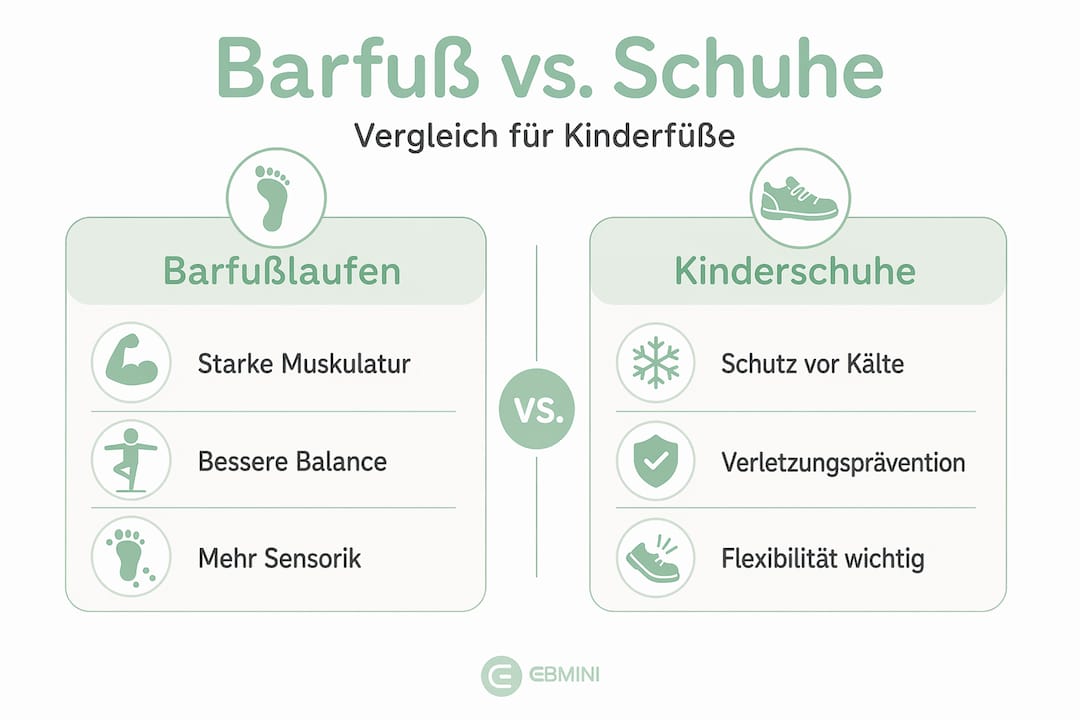
Barefoot walking promotes foot musculature and provides more sensory feedback for children. Direct ground contact allows receptors in the sole of the foot to send valuable signals to the brain, which are important for balance, coordination, and body awareness.
Sensory stimuli play an enormously important role in learning to walk. A child's sole is full of mechanoreceptors, special nerve endings that react to pressure, vibration, and unevenness. These receptors constantly send information to the brain, helping to adjust posture, prevent falls, and maintain balance. A thick, padded shoe dampens precisely these signals, similar to thick gloves when feeling details.
The Most Important Advantages from a Scientific Perspective
For parents who want a quick overview of the research, the key findings can be summarized as follows:
- Stronger foot muscles: Children who regularly walk barefoot develop stronger intrinsic foot muscles than children who primarily wear shoes.
- Better balance: Direct ground contact trains the balance system and improves postural control, i.e., the ability to keep the body upright.
- Improved proprioception: Proprioception means the perception of one's own body position in space. Barefoot walking demonstrably sharpens this sense.
- More natural gait: Without shoes, children place their feet differently, more with the midfoot than with the heel. This reduces impact on joints and the spine.
- Early arch development: Regular barefoot walking supports the natural formation of the foot arch in the first years of life.
For parents who want to learn more about the topic, our comprehensive barefoot shoes guide provides an in-depth look at all relevant aspects of barefoot-friendly shoes for children.
Barefoot or Shoes? Scientific Facts and Myths Compared
The question of whether barefoot walking is fundamentally better than wearing shoes cannot be answered universally. Scientific studies provide clear indications of certain advantages, but also of limitations and situations in which shoes are useful or necessary. Parents do not need an all-or-nothing concept, but rather practical guidance.
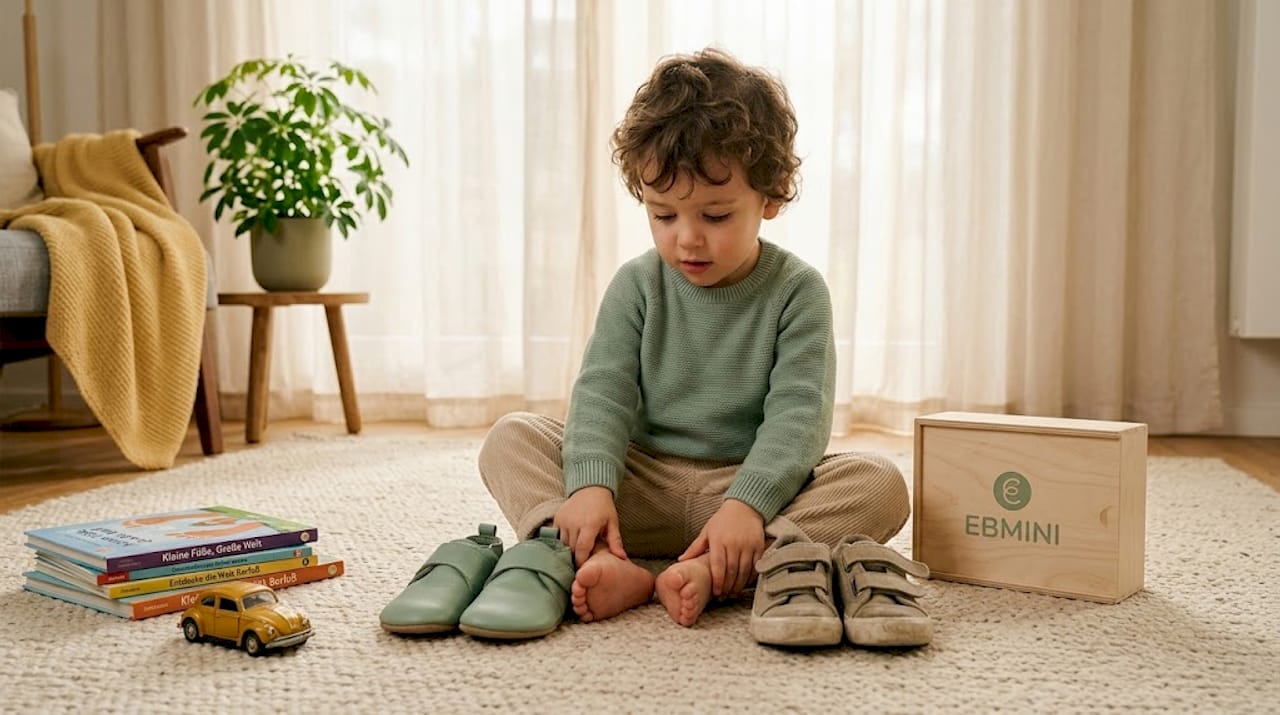
A much-discussed study by Stellenbosch University from 2015 to 2016 examined children from various countries and found that "barefoot" children showed better balance and jumping performance than children who primarily wore shoes. Particularly noteworthy: children from rural areas without regular shoe use performed significantly better in several motor tests.
However, these results do not mean that shoes are generally harmful. It depends on the type of shoe. A stiff, high-cut shoe with a thick sole prevents foot movements and dampens sensory feedback. A flexible barefoot shoe with a thin sole, a wide toe box, and no heel elevation (no so-called drop) gives the foot much more freedom and comes very close to barefoot walking.
In colder seasons, shoes may be necessary; it is important not to choose overly stiff footwear. Especially in autumn and winter, when the ground is cold or wet, suitable shoes protect against cooling and injuries without unnecessarily restricting natural foot movement.
Comparison: Barefoot Walking, Barefoot Shoes, and Conventional Children's Shoes
| Feature | Barefoot Walking | Flexible Barefoot Shoes | Conventional Children's Shoes |
|---|---|---|---|
| Foot Muscle Training | Very High | High | Low to Medium |
| Sensory Feedback | Maximum | High | Heavily Dampened |
| Protection from Injuries | Low | Medium to High | High |
| Balance and Coordination | Very Well Promoted | Well Promoted | Little Promotion |
| Everyday Suitability | Limited | Very High | Very High |
| Use in Cold and Wet Conditions | Not Suitable | Suitable (waterproof models) | Suitable |
| Arch Development | Optimal | Very Good | Often Restrictive |
This table clearly shows: barefoot shoes bridge the gap between pure barefoot walking and conventional shoes. They offer protection without hindering the natural function of the foot. For the best model for the transitional period, it is worth looking at waterproof yet flexible options.
Pro Tip: A proven combination strategy is the "70/30 rule." Try to have your child spend about 70 percent of the time barefoot or in barefoot shoes, and only 30 percent in more conventional shoes, for example, at formal occasions or in extreme weather. This balance supports foot development without creating unrealistic everyday pressure.
Those looking for the right starter shoe will find a detailed overview of all relevant quality features in the barefoot shoe guide.
Common Mistakes and Risks of Barefoot Walking: What Should Be Avoided?
Barefoot walking has many advantages, but an uncritical start can also cause problems. Especially parents who are enthusiastic about the positive effects sometimes tend to start too quickly, on too long distances or on too hard surfaces. This can backfire.
Too fast or long barefoot walking can, according to orthopedic expert knowledge, promote overuse and injuries. Muscles and tendons that have been "protected" by shoes for years need time to adapt to the new load. This applies to adults as well as children.
Important: Children who have mainly worn shoes until now should gradually introduce barefoot phases. A sudden switch to several hours of barefoot excursions is not a good idea, even if the child enthusiastically participates.
Common Mistakes and How to Avoid Them
- Too long distances from the start: Begin with short barefoot phases of 15 to 30 minutes on soft surfaces and gradually increase the duration over several weeks.
- Wrong surface: Hard surfaces like asphalt or concrete offer little cushioning and increase the risk of injury. Grass, sand, or forest floor are better choices for getting started.
- Barefoot walking in cold weather without preparation: Cold feet reduce blood circulation and can increase the risk of injury. Below 15 degrees Celsius outdoors, barefoot shoes are the safer choice.
- Ignoring broken glass, nails, and splinters: Always briefly check the surface before walking barefoot, especially in playgrounds or parks.
- Overlooking the child's pain signals: If a child complains of foot pain or changes their gait, this is a clear signal to take a break and examine the foot.
- Continuing to use old shoes: Shoes that no longer fit or whose soles are worn out can also cause damage. Our size checklist for children's shoes helps you recognize the right time for new shoes.
Special caution is advised for children with pre-existing conditions. Children with known foot deformities, neurological abnormalities, or metabolic disorders should be medically examined before starting regular barefoot walking. For foot problems, medical consultation should always precede intense barefoot phases. An orthopedist or pediatrician can individually assess whether and to what extent barefoot walking is advisable.
Practical Tips: How to Achieve a Healthy Barefoot and Walking Learning Experience
Now that we have clearly identified the risks, it's time for concrete strategies that you can implement in your family's daily life. The good news is: it doesn't require major changes. Small, consistent steps are enough to allow your child to benefit from barefoot experiences in the long term.
Start indoors: The easiest and safest way to introduce barefoot phases is to walk barefoot in your own home. On wooden floors, carpets, or tiles, children can spend several hours barefoot daily. This costs nothing, requires no planning, and already provides valuable sensory feedback.
Choose outdoors carefully: The following surfaces are particularly suitable for outdoor barefoot experiences:
- Fresh grass in the garden or park (check beforehand for broken glass and similar)
- Sandpit and beach (natural cushioning, high fun factor)
- Forest floor and meadows (maximum sensory variety due to moss, roots, and soil)
- Shallow water edges in warm weather (pebbles massage the sole of the foot)
Barefoot shoes for first steps are ideal for situations where the ground is not inspected or temperatures do not allow actual barefoot walking.
Everyday Situations and the Appropriate Shoe/Barefoot Option
| Situation | Recommendation | Reasoning |
|---|---|---|
| Indoors at room temperature | Barefoot | Maximum muscle training and feedback |
| Garden in summer (inspected lawn) | Barefoot or barefoot sandals | High fun and learning effect |
| Playground in summer | Barefoot shoes or sandals | Protection from splinters and hot surfaces |
| Autumn walk (wet, cool) | Waterproof barefoot shoes | Protection from cold and wet with flexibility |
| Winter walk | Lined barefoot shoes | Warmth and freedom of movement |
| Formal occasions, school | Barefoot-like flexible shoes | Compromise between appearance and foot health |
| Indoor sports on gym floor | Light barefoot shoes or barefoot | Coordination promotion |
A note on proper shoe care in autumn and winter: Barefoot shoes last much longer and protect better if they are regularly cared for and dried. This is especially worthwhile for high-quality models.
"Barefoot is better" should always be understood flexibly and not dogmatically, as emphasized by the editors of ELTERN.de. Combination strategies that realistically consider everyday life are more sustainable in the long run than strict concepts.
Pro Tip: Make barefoot walking an adventure, not a chore. Jumping through puddles barefoot, digging sand with toes, or balancing over tree roots: Children who enjoy barefoot experiences will want more of them on their own. Follow your child's pace and feedback, and increase intensity slowly and playfully.
What We Really Learn from Modern Research and Parental Practice – Our Perspective
The barefoot debate is conducted online with a passion that sometimes exceeds what science actually proves. We observe this daily in parent forums and counseling sessions. On one side are parents who are convinced that every shoe is automatically harmful. On the other side are those who fear endangering their child without shoes. Both extremes fall short.
What research actually shows: There is solid evidence that barefoot walking and barefoot-like footwear positively influence motor parameters, i.e., balance, coordination, muscle strength, and gait. An important Cochrane Review on foot orthoses in children points out that empirical evidence primarily supports these motor aspects and does not provide guarantees for the prevention of certain deformities such as flat feet. This is an important limitation that is often missing in popular articles.
What does this mean for you as parents? It means: barefoot walking is a valuable training principle, not a panacea. If you let your child walk barefoot or in real barefoot shoes for several hours a day, you are doing something good for their motor development. This is real, measurable added value. But if you expect to automatically prevent all foot problems, you are setting your expectations too high.
From our perspective, the question of why barefoot walking and barefoot-like shoes complement each other rather than competing is particularly interesting. A child who walks barefoot through the house in the morning, wears flexible barefoot shoes at the playground at lunchtime, and then tramps barefoot in the park in the afternoon gets a very good mix of protection and natural freedom of movement. This is not a compromise, but an intelligent strategy.
Research on transitional models for children's shoes confirms that flexibility and thin soles are the crucial criteria, not whether a shoe has the word "barefoot" on its label. A shoe that feels like a second skin, that can be bent in all directions, and that gives the foot enough space for natural toe splay, fulfills its purpose. Stiff shoes with high heels and narrow toe boxes, no matter how expensive or branded, do not achieve this.
Our honest recommendation: Make barefoot walking a normality in everyday life, wherever it is safe and comfortable. Invest in really good barefoot-friendly shoes for all other situations. And give your child the experience of getting to know and control their own body through direct ground contact. This is a gift that lasts far beyond childhood.
Supporting Healthy Barefoot Experiences with the Right Children's Shoes
You now have a solid understanding of why barefoot walking is so valuable for foot development and how you can safely integrate it into everyday life. The next step is to find the right footwear for all situations where true barefoot walking is not possible.
At ebmini.de, you will find a carefully selected range of children's barefoot shoes that are perfectly tailored to the needs of growing children's feet: wide toe box, zero drop, ultra-light and flexible materials, and waterproof options for all weather conditions. For the little ones, there are specially designed baby barefoot shoes for crawling babies and first steps. And for the warmer months, our children's barefoot sandals offer maximum freedom with reliable protection. Each model has been developed to enable barefoot-like movement in everyday life, whether on the playground, in kindergarten, or during a walk in the woods.
Frequently Asked Questions about Barefoot Walking when Learning to Walk
When should my child start walking barefoot?
As soon as a child takes their first confident steps, barefoot walking on suitable surfaces is generally recommended. Early barefoot experiences promote natural development but should be introduced individually and under supervision.
Is barefoot walking better than walking shoes for every child?
Barefoot walking is a real benefit for many children, but it is not always possible or advisable. In colder seasons and on uneven surfaces, flexible, barefoot-like shoes are a sensible and practical alternative for everyday life.
What are the risks of barefoot walking?
Risk of injury and overuse can occur, especially on very hard surfaces or with pre-existing conditions. Overuse due to walking barefoot for too long can be avoided by starting slowly and on soft surfaces.
On which surfaces should a child walk barefoot?
Natural surfaces such as grass, forest floor, or sand offer the most benefits for foot development. Natural surfaces provide more sensory stimuli than indoor surfaces and are therefore best suited for regular barefoot periods.
Should I have barefoot walking medically clarified?
In the case of known foot problems or pre-existing conditions, medical consultation is strongly recommended. For foot problems, medical advice should be sought before intensive barefoot periods to rule out individual risks.


