

What to do when shoes smell: Home remedies and prevention
Do five things immediately: air-dry your shoes, remove insoles, sprinkle baking soda, insert newspaper, and leave the shoes open until they are completely dry. These steps neutralize the odor in the short term and disrupt the conditions under which it develops.
- Ventilate: Immediately after wearing, place shoes in a dry, airy spot; do not store them in a shoebox.
- Remove insoles: Let removable insoles dry separately. They retain most of the sweat.
- Sprinkle baking soda: Sprinkle one teaspoon of baking soda per shoe, let it sit for a long time, then tap it out or vacuum it up.
- Insert newspaper: Crumpled newspaper absorbs residual moisture. Change after a few hours.
- Dry upright: Never on a heater. Room temperature, good air circulation.
Steps 1, 2, and 5 are preventative and structural. Baking soda and newspaper are immediate measures that dampen the odor but do not eliminate it permanently. For delicate materials like leather, remember: no vinegar, no freezing, no wet soaking.
Key Takeaways
Shoe odor is caused by bacterial decomposition of sweat, and permanently fresh shoes require consistent drying, regular care, and the right material choice.
| Topic | Details |
|---|---|
| Immediate Action | Remove insoles, sprinkle baking soda, air-dry shoes. |
| Washing | Wash textile shoes on a gentle cycle at max 30 °C, no fabric softener, air-dry. |
| Material Warning | Vinegar and freezing harm leather; coffee grounds and tea bags can stain light materials. |
| Prevention | Shoe rotation, daily airing, and regular insole changes prevent odor long-term. |
| Ebmini | Children's shoes with removable insoles and breathable materials structurally reduce odor formation. |
Table of Contents
- Why do shoes smell at all?
- Which home remedies quickly help against shoe odor?
- How to wash shoes correctly?
- Vinegar, freezing, disinfection: what really works
- What can you do with which material?
- How to prevent shoe odor permanently?
- When should you replace shoes or consult a doctor?
- Children's shoes: tips from Ebmini for odor prevention
- Breathable children's shoes as odor prevention
- Sources
Why do shoes smell at all?
The odor does not come from sweat alone. Sweat itself hardly smells. The problem begins when bacteria and fungi, which live on the skin and inside the shoe, decompose the organic components of sweat. This produces volatile organic acids like isovaleric acid, which are responsible for the typical, pungent smell. Heat and moisture significantly accelerate this process.
Cause → Conditions → Consequence: Sweat meets a warm, poorly ventilated shoe interior. Bacteria and fungi multiply. They decompose sweat components into organic acids. The result is the familiar odor. Those who only use scent sprays cover up the problem but do not solve it. Lasting freshness requires interrupting the nutrient conditions.
Synthetic materials exacerbate the problem because they wick away moisture less effectively than natural materials. Those who wear the same shoes daily do not give bacteria a chance to dry out.
Which home remedies quickly help against shoe odor?
The following remedies are tried and tested, inexpensive, and suitable for most shoe types. Exceptions are mentioned accordingly.
-
Baking soda (sodium bicarbonate): Sprinkle a heaped teaspoon per shoe. Let it sit overnight, then tap it out thoroughly or vacuum it up with a handheld vacuum cleaner. It binds odors due to its basic pH value, which neutralizes acidic odor molecules. Suitable for almost all materials. ÖKO-TEST recommends baking soda as a proven home remedy.
-
Lemon peels: Place fresh peels in the shoes overnight. The essential oils have a mild antibacterial effect and leave a fresh scent. For light materials, quickly check if a color stain occurs.
-
Coffee grounds: Fill dry coffee grounds into a thin cloth or sock, tie it up, and place it in the shoes overnight. Coffee grounds effectively bind odors. Caution with light-colored shoes: Coffee grounds can cause discoloration, so always use them wrapped in a cloth.
-
Dried tea bags: Place two to three cooled, dried black tea bags in the shoe overnight. The tannins in the tea have a mild antibacterial effect and bind moisture. Again, be careful with light-colored materials.
-
Baby powder: Sprinkle a thin film of baby powder on the insole. It binds moisture and prevents odor formation. Particularly practical as an immediate measure before putting on shoes.
Pro Tip: Baking soda and lemon peels can be combined: place peels in overnight, remove them the next morning, and then sprinkle in baking soda. The combination has both antibacterial and odor-neutralizing effects without one interfering with the other.
How to wash shoes correctly?
Many sneakers and textile shoes can be machine-washed. Leather, suede, and certain outdoor models with membranes do not belong in the washing machine.
- Check shoe type: Textile sneakers, canvas trainers, and many children's fabric shoes are generally machine washable. Leather, suede, shoes with glued constructions, or membranes are not.
- Prepare: Remove laces and removable insoles. Wash both separately or clean by hand.
- Use a laundry bag: Place shoes in a laundry bag to prevent them from banging against the drum.
- Temperature: Maximum 30 °C, gentle cycle. Higher temperatures can dissolve glue and deform materials.
- No fabric softener: Fabric softener leaves residues that can promote bacterial growth.
- Spin: Low spin speed or omit entirely. Strong spinning damages the shoe structure.
- Dry: Insert newspaper, air-dry at room temperature. Never on a heater or in a dryer, as glue and soles will suffer.
ÖKO-TEST confirms that washing on a gentle cycle at a maximum of 30 °C is a gentle and effective solution for many sneakers.
Vinegar, freezing, disinfection: what really works
Vinegar water as a spray solution
Mix white household vinegar with water in a 1:1 ratio and pour into a spray bottle. Lightly spray the inside of the shoe, do not drench it, and let it air dry completely. The vinegar smell will dissipate as it dries. CHIP recommends this vinegar water solution as an antibacterial immediate aid.
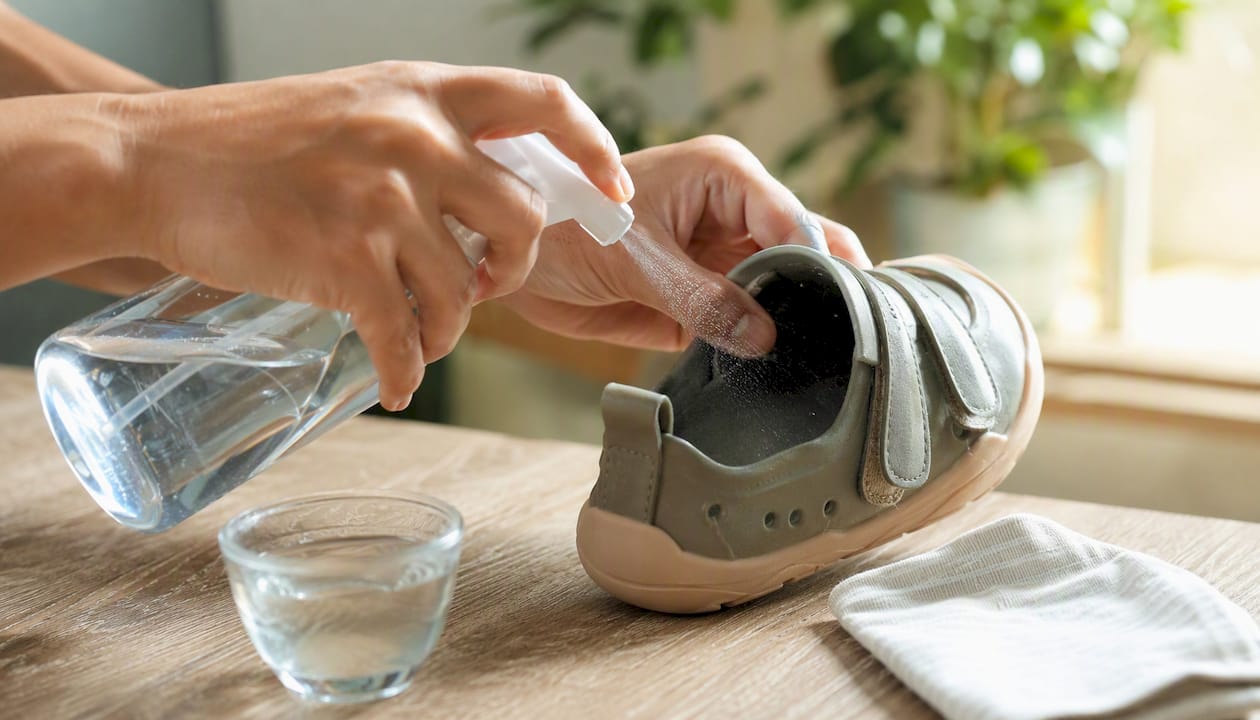
Important: Vinegar attacks leather and can cause discoloration or drying out. This method is unsuitable for leather shoes. Synthetics and textiles tolerate it well.
Freezer method
Place dry textile shoes in an airtight freezer bag and put them in the freezer for about 24 hours. The cold reduces odor-causing bacteria. Cleanipedia describes this method as a practical option for textile shoes and explicitly warns against using it on leather, as the material can become brittle and crack due to frost.
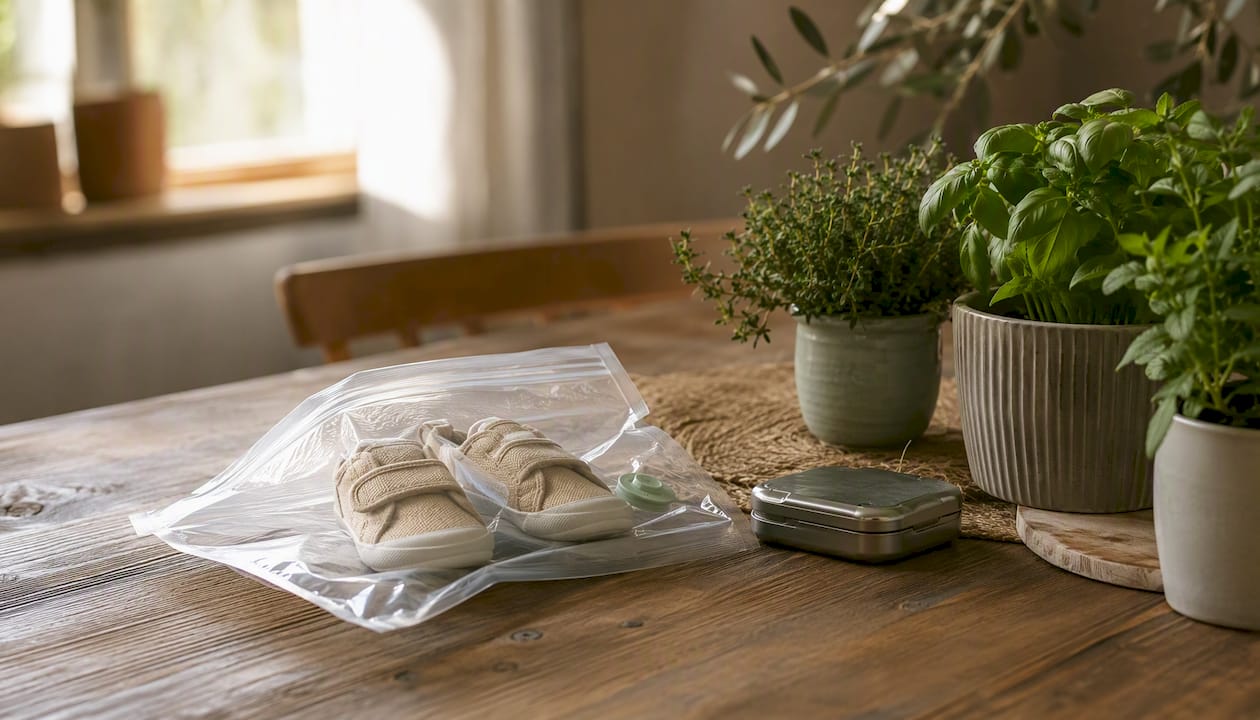
Limitation: Freezing does not kill all microorganisms. Bacterial spores survive sub-zero temperatures. The method noticeably reduces odor, but it is not a permanent substitute for regular washing.
Disinfection
Shoe disinfectants are useful for persistent odor, suspected athlete's foot, or after illnesses. Frequent use can damage materials and cause irritation with direct skin contact. If using disinfectants, shoes should be thoroughly aired and dried afterward.
Essential oils
Some essential oils, such as tea tree oil, show antimicrobial properties in laboratory studies. In vitro findings support these effects, although everyday conditions are less controlled than in the laboratory. Place a few drops on a cloth inside the shoe; do not apply directly to delicate materials. Further review studies support the plausibility but recommend cautious interpretation for home applications.
What can you do with which material?
| Material | Recommended Measures | Do not do |
|---|---|---|
| Textile / Canvas | Washing (≤30 °C), baking soda, vinegar water, freezing, tea bags | Hot wash, bleach |
| Leather (smooth) | Airing, baking soda, lemon peels, special leather care | Vinegar, freezing, washing machine, wet soaking |
| Suede / Nubuck | Airing, baking soda, suede brush | Water, vinegar, washing machine, freezing |
| Synthetic | Airing, baking soda, vinegar water, disinfection | Hot wash, aggressive solvents |
Removable insoles are almost always the main source of odor. They can be washed separately, air-dried, and replaced with antimicrobial inserts if necessary. Insoles store a lot of sweat, which is why replacing them is often more effective than cleaning the shoe's exterior material.
- Never treat delicate coatings and patent leather with vinegar or alcohol.
- Do not use bleach on colored materials.
- Do not soak shoes with glued constructions, as the sole may come off.
How to prevent shoe odor permanently?
Odor prevention is a matter of routine, not the right product. In the long term, odor control only works if the warm, moist environment in the shoe is systematically disrupted.
- Air daily: Place shoes upright immediately after wearing, remove insoles.
- Shoe rotation: Alternate at least two pairs so each pair can dry for 24 hours.
- Change socks: Fresh socks daily, preferably made of cotton or merino wool. Synthetic performance socks are useful for sports because they wick away moisture, but in everyday life, they often smell more intense than natural fibers.
- Cedar shoe trees: Cedar wood absorbs moisture and emits a fresh scent. Especially recommended for leather shoes.
- Check insoles regularly: Remove, wash, or replace every few weeks.
- Pay attention to breathability when buying shoes: Shoes with removable insoles and breathable materials are easier to care for and less prone to odor.
- Wash feet daily: Sounds obvious but is often underestimated. Clean thoroughly between toes and dry completely.
When buying, it's worth asking: Is the sole removable? What material is on the inside? Is there a membrane or a lining made of natural fibers? These questions determine the long-term care effort.
When should you replace shoes or consult a doctor?
Not every odor can be solved with home remedies. There are situations where shoes should be replaced or a doctor should be consulted.
- Replace shoes if: The insole is permanently discolored, highly porous, or can no longer be cleaned. The material is soaked and no longer dries completely. The odor returns within a few days despite repeated treatment.
- Consult a doctor or podiatrist if: Itching, redness, flaking, or blisters appear between the toes. These are possible signs of athlete's foot. Important: In case of athlete's foot, both feet and shoes must always be treated. Treating only the feet is not enough, as shoes serve as a reservoir.
- Recurrent infestation: If you repeatedly experience odor problems despite consistent care, you should check whether an underlying condition like hyperhidrosis (excessive sweating) is present.
For repairability and durability of children's shoes, there are further practical tips that are also relevant for hygiene decisions.
Children's shoes: tips from Ebmini for odor prevention
Children's feet sweat more than adult feet, and children often wear their shoes for hours without a break. This makes odor prevention particularly important for children's shoes.
Breathable materials and removable insoles are not a matter of comfort for children's shoes, but a matter of hygiene. Shoes that wick away moisture quickly and whose insoles can be cleaned regularly develop persistent odor much less often.
Concrete tips for parents:
- Remove insoles daily and let them dry separately, especially after outdoor activities.
- Never put shoes in the closet when damp. Briefly airing them out is often enough.
- No aggressive disinfection for children's shoes. Mild home remedies like baking soda or lemon peels are gentler on the skin and safer for children.
- Check insoles every few months: Are they still dimensionally stable? Are there visible discolorations or cracks? If so, replace them.
Ebmini shoes are equipped with removable insoles and breathable materials, which significantly simplifies daily care. The guide to vapor permeability in children's shoes explains which materials best regulate the internal climate. If you want to learn more about natural materials in children's shoes, you will find well-founded background information on material selection there.
Home remedies over chemicals: A stance that has proven effective
Fighting smelly shoes with aggressive disinfectants often doesn't solve the problem, but rather damages the material and skin. Baking soda, lemon peels, and consistent drying are usually sufficient. Disinfectants should be used specifically, not as a permanent solution. Sustainable care means less chemicals, more routine.
Breathable Children's Shoes as Odor Prevention
If you want to prevent shoe odor in children from the ground up, the best place to start is with the shoe itself. Shoes with synthetic lining materials and poorly ventilated insoles are harder to maintain and smell faster. Breathable materials, wide toe boxes, and removable soles make all the difference.

Ebmini barefoot shoes for children are designed precisely for this everyday life: ultralight, with removable insoles that can be washed separately, and made from materials that wick away moisture instead of retaining it. This structurally reduces odor formation, not just through post-treatment. Ebmini children's shoes are not a miracle cure for sweat, but a shoe that requires less maintenance from the start. For those looking for robust, waterproof models for outdoors, the Ebmini OTD offers an option that remains hygienic even with intensive use.
Sources
- What can I do if my shoes smell? - ÖKO-TEST
- Remove sweat odor from shoes - Cleanipedia
- Smelly shoes: Practical home remedies for immediate help - CHIP
- PMC3940030 - Antimicrobial Studies (2014/Review)
- Shoes smell, what to do? Get rid of the smell long-term! - Ultrana


