

Barefoot Shoes for Kids: Prices and Models Compared
For most parents in Germany, the reasonable price window per pair falls within a range considered typical for the German market. Below this, there are entry-level models from brands like Affenzahn or Slipstop, which meet the basic criteria but are often less robustly made. Above this, you'll find models from Leguano (Leguanito), Sole Runner, or Froddo with better material quality, reflectors, and longer durability. Eltern confirms this price corridor as typical for the German market.
For first-time walkers (sizes 19–24), light crawling shoes with thin soles and Velcro fasteners are recommended, typically costing €35–€55. For kindergarten and school, all-round models with Velcro or zippers in the €45–€75 range are the most common choice. Outdoor and winter options cost more: lined, waterproof models start at about €60 and go up to €110.
Pro Tip: Before buying, measure foot length, add 1–1.5 cm for growth, and check the shop's return policy. Many German online retailers offer 30-day free returns.
Key Takeaways
Barefoot shoes for children in the €40–€90 price range offer the best balance of sole flexibility, craftsmanship, and durability for the German market.
| Topic | Details |
|---|---|
| Recommended Price Window | €40–€90 covers most quality requirements; under €40 possible, over €90 for better craftsmanship. |
| Most Important Selection Criteria | Zero Drop, wide toe box, and flexible sole are non-negotiable; aesthetics are secondary. |
| Sizing Advice | Measure foot length, add 1–1.5 cm for growth, check both feet and use the larger one as a basis. |
| Savings Tip | Previous year's models and end-of-season sales often offer 20–30% discount with the same sole quality. |
| Ebmini | Ultralight, waterproof all-weather models with zero drop and wide toe box, available for direct online order. |
Table of Contents
- What model categories are available, and what do they cost in Germany?
- Brief reviews of the most important brands and typical prices in Germany
- How to choose the right barefoot shoe for your child
- Where to buy, what it costs, and how to save in Germany
- What do orthopedists and pediatricians say about barefoot shoes?
- Does the shoe really fit? Fit and sizing advice in detail
- What really matters in price comparison and what parents often overlook
- Ebmini's Barefoot Shoes: All-weather, waterproof, direct to your child
- Sources
What model categories are available, and what do they cost in Germany?
Children's barefoot shoes can be broadly divided into five categories. The following overview shows what characteristics are typical for each category and what prices parents can expect in German shops.
Age and foot width are the most important filters: first-time walkers need maximum flexibility and a light weight under 150g per shoe. Older children who spend a lot of time outdoors benefit from more robust material and reflectors.
Brief reviews of the most important brands and typical prices in Germany
The F.A.Z. Kaufkompass tested 15 pairs of children's barefoot shoes and documented prices between approximately €30 and €120. Workmanship, reflectors, and practical fasteners were considered crucial quality features. Here is an overview of the most important brands and model groups.
Ebmini offers ultralight, waterproof all-weather models with a wide toe box, zero drop, and non-slip sole, developed in collaboration with orthopedists. The shoes cover the range from crawling shoes up to size 34 and are available directly through their online shop. Particularly strong: the combination of genuine waterproofing and the barefoot principle, which many competitors do not offer simultaneously.
Leguano / Leguanito is one of the most well-known German barefoot shoe brands. The Leguanito line for children is in a higher price segment. The shoes are very light, have a thin sole, and pronounced toe freedom. They are less suitable for outdoor use with a lot of rubble or wet conditions but are very popular for everyday wear and school.
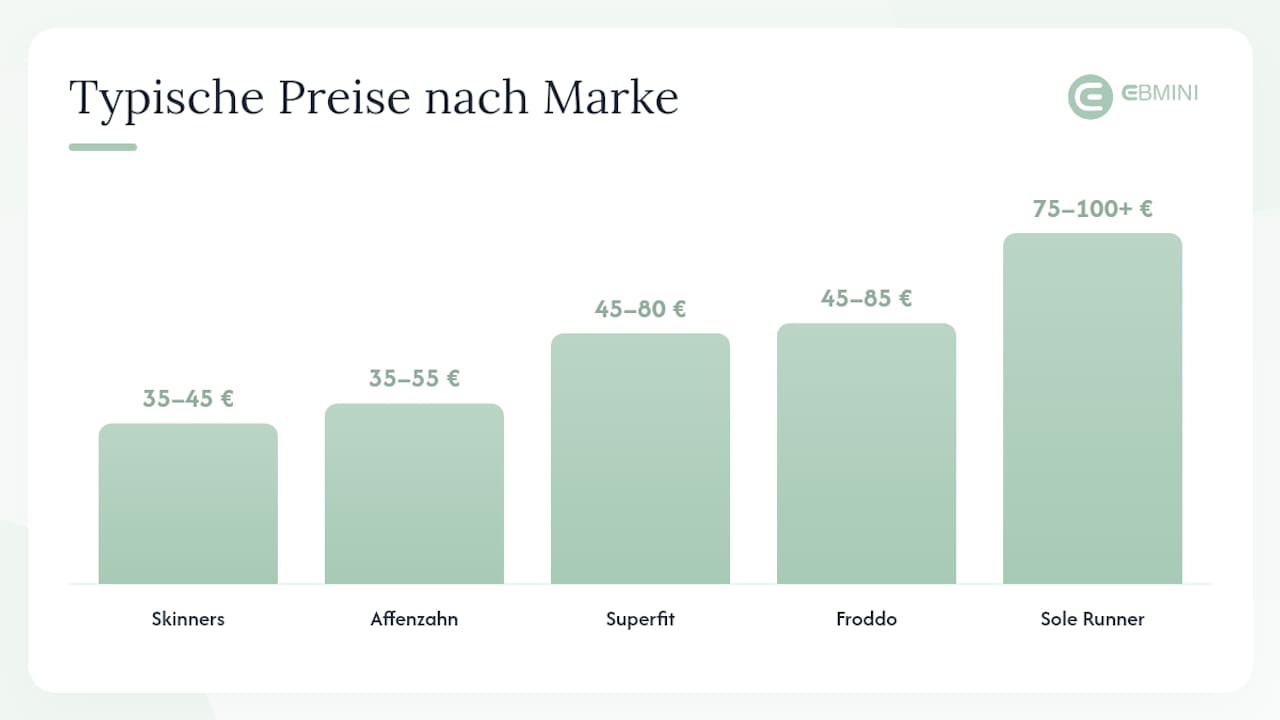
Skinners are essentially sock-shoes made of polymer fiber, thus a category of their own. For children, they are available from about €35–€45. They offer maximum ground feel but hardly any protection from cold or sharp stones. Good for the beach, indoor use, or short distances.
Koel 4 Kids comes from Austria and focuses on natural materials like wool and leather. Prices are usually between €65–€95. The craftsmanship is solid, and the models are particularly suitable for children with very wide feet. Sustainability is a clear selling point.
Affenzahn is widely available in Germany and in many specialist shops. The cotton models (e.g., the Affenzahn Cotton Lucky, favored by the F.A.Z. test) cost about €35–€55. Velcro fasteners, colorful animal motifs, and good sole flexibility make them popular with kindergarten children. Less suitable for wet conditions.
Superfit is not a pure barefoot shoe manufacturer but offers models with flexible soles and wide toe boxes. Prices: €45–€80. Good for parents looking for a compromise between classic children's shoes and the barefoot principle. Readily available in specialist shops.
Sole Runner produces in Germany and places great importance on sustainability and longevity. Prices start at about €75 and go up to over €100. The soles are thin and flexible, and the materials are high quality. This is the right choice for those who think long-term and value local production.
Froddo comes from Croatia and offers a wide range of barefoot models for children, including waterproof variants (Barefoot Waterproof). Prices: €45–€85. Good craftsmanship, genuine leather in many models, wide toe box. Available in Germany through specialist retailers and online shops.
Bundgaard is a Danish brand with a clear focus on foot health. Models for children typically cost €55–€90. Their lined winter models, in particular, have good reviews. For parents who appreciate Scandinavian design and solid craftsmanship.
Slipstop is a Greek brand primarily offering water shoes and bathing shoes for children. Prices: €20–€40. Very affordable, non-slip sole, quick-drying. Not a true barefoot shoe in the strict sense, but useful as an addition for the beach and swimming pool.
For sustainable materials and their advantages, a closer look is worthwhile, especially when parents are weighing between leather, textile, and synthetic.
How to choose the right barefoot shoe for your child
Fit is more crucial than price. A well-fitting model is more important than buying an expensive one that doesn't fit well.
Foot measurement in four steps
- Have the child stand on a white piece of paper, distributing weight evenly.
- Trace the outline of the foot with a pen, holding the pen vertically.
- Measure the longest distance from the heel to the tip of the longest toe.
- A certain allowance is recommended to be added to the measured foot length to determine the appropriate insole length.
For first-time walkers, it's better to choose a 1.5 cm allowance, as feet grow quickly. For older children, 1 cm is sufficient.
Key criteria for purchase
For a detailed guide on first walking shoes, it's worth taking a closer look. The most important points summarized:
- Zero Drop: No heel elevation, heel and ball of foot at the same height.
- Sole flexibility: Shoe can be easily bent in all directions, no resistance when rolling.
- Wide toe box: Toes can splay out, no lateral pressure.
- Weight: Under 200g per shoe for toddlers, under 300g for school children.
- Non-slip sole: Important for parquet, tiles, and wet surfaces.
- Material quality: Breathable, no sharp seams inside.
Red flags that lead to exclusion
A sharply tapered toe box is the most common problem. If the shoe is narrower at the widest part of the forefoot than the foot itself, it doesn't fit. Equally problematic: a stiff sole that hardly bends, or a significant heel drop of more than 4mm. Poor craftsmanship often shows up as loose seams or sharp edges inside.
Pro Tip: Inexpensive models that meet genuine barefoot criteria are easiest to identify with the bend test: fold the shoe in half. If it folds without resistance, the sole is flexible enough.
Where to buy, what it costs, and how to save in Germany
Retailers like OTTO offer children's barefoot shoes starting from about €37 and provide purchasing advice on fit and material. The market in Germany is well-established, both online and in brick-and-mortar stores.
Specialist retailers (shoe stores with a barefoot shoe assortment): The advantage is personal advice and the opportunity to try them on. Disadvantage: smaller selection, often higher prices than online. Good for first-time walkers, where the initial fitting is important.
Online shops (manufacturer's direct shops, specialized barefoot shoe retailers): Largest selection, often lower prices, usually a 30-day return policy. Important: check return conditions before purchasing. Some shops charge return fees.
Marketplaces (e.g., OTTO, Zalando): Wide selection of different brands on one platform, easy price comparison. Customer reviews help with assessment.
Savings potential at a glance: Previous year's models often offer the same sole flexibility at significantly reduced prices. Seasonal sales (January/February, July/August) regularly bring 20–30% discounts. Some manufacturers offer newsletter vouchers for first orders.
Regarding additional costs: Shipping is free for many German online shops for orders over €30–€50. Returns are often free with specialized barefoot shoe retailers, but this varies on marketplaces. Warranty: legally two years in Germany, some manufacturers voluntarily offer more.
Affordable alternatives for different budgets shows that getting started with barefoot shoes doesn't necessarily have to be expensive. Models under €50 are available from several brands that meet the core criteria.
What do orthopedists and pediatricians say about barefoot shoes?
The professional assessment is clear: barefoot walking and wearing thin, flexible soles promote foot perception and motor development in children. According to Kinderaerzte-im-Netz, barefoot walking improves agility in jumping and balancing. Thin soles allow the foot to feel the ground and actively engage the small muscles.
Barefoot shoes with flexible, thin soles support natural foot development by allowing the child to feel the ground and actively train the foot muscles. Pediatricians recommend letting children walk barefoot or in thin, flexible shoes as much as possible, especially in the first years of life.
For children with orthopedic abnormalities, flat feet (pes valgus), or other foot deformities, consulting a pediatric orthopedist is advisable before switching to barefoot shoes. For healthy children's feet: the more ground contact, the better. The decision for barefoot shoes is an investment in motor skills and balance, which is why ergonomics and sole flexibility are more important than appearance or brand name.
For more background information on sole flexibility and healthy foot development, a deeper dive is worthwhile.
How these price and model checks were conducted
The price information in this article is based on inquiries from German online retailers, marketplaces, and manufacturer websites (as of spring 2026). Categories checked included specialist retailers, large marketplaces, and direct manufacturer shops. The following criteria were used for model recommendations: sole flexibility, toe box width, weight, material quality, durability, and price-performance ratio. Prices are subject to seasonal fluctuations. Current prices should be checked directly in the respective shop.
Does the shoe really fit? Fit and sizing advice in detail
Zero drop means: heel and ball of foot are at exactly the same height. No heel, no drop. This sounds simple, but it's not the case with many children's shoes. Even models marketed as "flexible" sometimes have a drop of 4–8 mm. When buying, it's worth checking the technical specifications or asking the manufacturer.
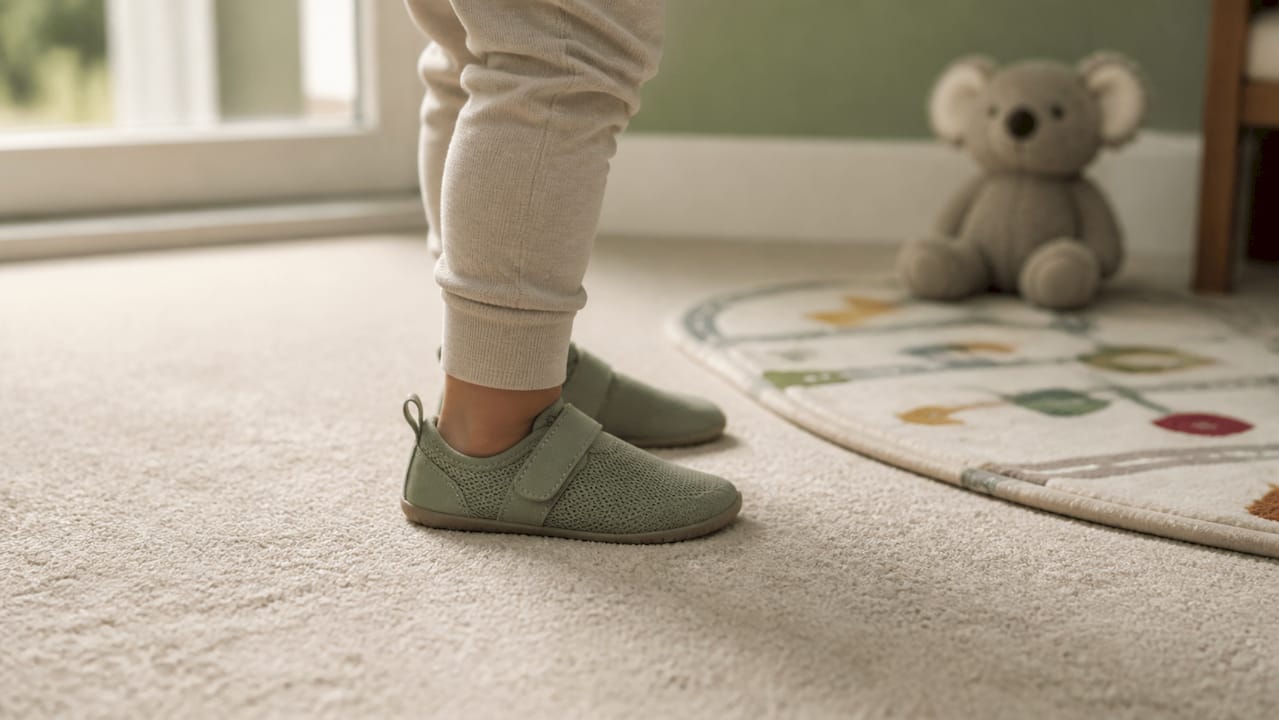
The wide toe box is the second crucial feature. Children's feet are wider at the front than at the back, naturally fan-shaped. Many conventional shoes force the toes together. A good test: remove the insole, place it on the child's foot. If the insole extends beyond the sides or fits perfectly, the toe box is wide enough. If the foot extends beyond the insole, the shoe is too narrow.
For sizing: measure feet in the morning and evening, as they swell slightly throughout the day. Take the larger measurement. For children just learning to walk, feet grow quickly, sometimes two sizes per year. Therefore, plan for a little more allowance, but not more than 1.5 cm, as too much space makes walking difficult.
Pro Tip: When buying online, always order two sizes and return the one that doesn't fit. This doesn't cost extra if the shop offers free returns and avoids a bad investment.
What really matters in price comparison and what parents often overlook
The most common mistake when buying children's barefoot shoes is equating price with quality. A shoe for €95 is not automatically better than one for €55 if the sole of the more expensive model is stiffer. Conversely, an inexpensive model that constricts the toe box does more harm than good, no matter how attractive the price.
What parents truly underestimate: durability. A barefoot shoe for €70 that lasts two seasons is cheaper than a €40 model that falls apart after six months. Craftsmanship, sole grip, and material quality are therefore not luxury features but cost considerations.
The second blind spot is fit when buying online. Many parents order only one size and keep the shoe even if it doesn't fit perfectly. This is a mistake. Order two sizes, try them on, keep the better one: This is not an inconvenience, but common sense.
And one more thing: seasonal variations are often underestimated. An unlined barefoot shoe in winter is not a budget option, but a problem. Lined models cost more, but they keep feet warm without completely sacrificing flexibility. Those who ignore this will buy twice.
Ebmini Barefoot Shoes: All-weather, waterproof, directly for your child
If you're looking for a model that combines the barefoot principle with real weather protection, Ebmini has a direct answer. The shoes are ultra-light, waterproof, and have a non-slip sole with zero drop and a wide toe box. Developed in collaboration with orthopedists, for children from their first steps up to size 34.

The difference to many other models: Ebmini combines true waterproofing with the sole flexibility that defines barefoot shoes. No compromise between dry feet and ground feel. Order directly from the online shop, with size advice, customer reviews, and transparent shipping and return policies.
For toddlers and young children, baby barefoot shoes for first steps are available directly on the product page. Measure size, choose model, order.
Sources
- Barefoot running promotes agility in jumping and balancing — Kinderaerzte-im-Netz
- The best barefoot shoes for children | Test — F.A.Z. Kaufkompass
- Eltern
- Buy children's barefoot shoes online | OTTO


