

Breaking in new children's shoes: Step by step
Acclimating to new children's shoes means carefully selecting shoes, fitting them correctly, and introducing them gradually so that children's feet grow healthily and feel comfortable. Many parents simply buy the next size and hope for the best. That's not enough. Children's feet are still developing, muscles and nerves are not yet fully formed, and the wrong shoe can encourage deformities. This guide shows when new shoes are due, how to truly check the fit, and what a gradual acclimatization process looks like, especially with barefoot-like models such as those from Ebmini.
When is the right time for new children's shoes?
Children's feet grow faster than most parents expect. Between the first and third year of life, children's feet grow by an average of 1.5 mm per month, and between three and six years, still about 1 mm monthly. This may seem small, but it quickly adds up to half a shoe size within a few months.
This leads to a clear recommendation: Parents should remeasure their child's shoe size every 3 to 4 months. Don't guess, don't press. Measure. Waiting longer risks the child wearing shoes that are too tight for weeks without noticing.
Concrete signs that a shoe change is necessary include:
- Pressure marks or redness on toes, heel, or instep after wearing
- Wear patterns indicating uneven stress
- Visible deformation of the shoebox due to toe pressure
- Altered gait, for example, turning toes inward or walking on tiptoes
- Discomfort when putting on or rejecting the shoe by the child
A particularly important point: Printed shoe sizes are unreliable. Studies show that about 87% of size indications are inaccurate in practice. This means parents should never rely solely on the number on the label. The actual inner length of the shoe matters, not the manufacturer's size indication.
Pro Tip: Always measure your child's foot in the afternoon. Feet swell slightly throughout the day, and a shoe that fits in the morning may already be too tight in the afternoon.
How to recognize the optimal fit for new children's shoes?
The fit is the most important characteristic of a child's shoe. Children's shoes need 12 to 17 mm of space between the longest toe and the tip of the shoe. Less than 12 mm is too tight and constricts the toes when rolling off. More than 17 mm impairs the gait because the child has to actively hold the shoe.
The well-known thumb test, pressing your thumb on the tip of the shoe, is unfortunately often unreliable. When pressure is applied to their toes, children often instinctively curl them, which suggests more space than is actually available. A more accurate method is the insole test.
How the insole test works
Remove the removable insole from the shoe. Have the child stand with their heel against the back edge of the insole. The distance between the longest toe and the front edge of the insole shows the actual space. This method can also be used when buying shoes in a store and provides more reliable results than any pressure test.
In addition to length, width also matters. Determining a child's foot width is just as important as measuring the length. Wide feet need shoes with a generous toe box so that the toes can spread naturally when standing and walking.
| Criterion | Recommendation |
|---|---|
| Toe space | 12–17 mm to the longest toe |
| Heel fit | Firm, without pressing |
| Toe box | Wide enough for spreading |
| Flexibility | Bendable in the forefoot, stable heel |
| Width | Matching individual foot width |
Pro Tip: Let your child take a few steps in the new shoe and observe if the heel slips out or the toes visibly hit the front. Both are clear fit errors.
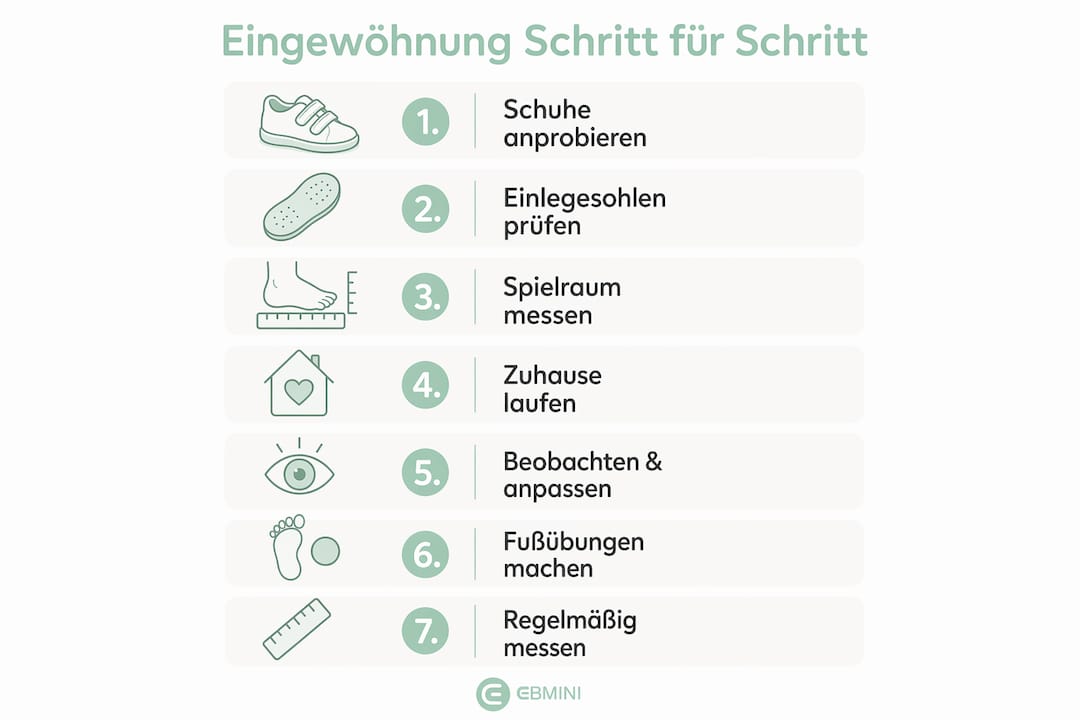
How to gradually accustom to new shoes step by step?
The transition to new shoes takes time. This is especially true for barefoot-like models, which challenge feet and muscles differently than conventional shoes with thick cushioning. Barefoot shoes should be broken in over 4 to 8 weeks, starting with short wearing periods of 1 to 2 hours daily.
A structured acclimatization plan looks like this:
- Weeks 1 and 2: Wear for 1 to 2 hours daily, preferably on soft surfaces like grass or carpet. The child should get to know the shoe without overstraining muscles.
- Weeks 3 and 4: Increase wearing time to 3 to 4 hours. Incorporate first walks on firm ground. Watch for redness or pressure marks after taking them off.
- Weeks 5 and 6: All-day wear is possible if no discomfort has occurred. Complement the process with short foot exercises like toe gripping exercises on a towel.
- Weeks 7 and 8: Normal daily life with the new shoe. Also wear on uneven terrain and during longer excursions.
Mild muscle soreness in the calf or arch is normal during acclimatization. It shows that muscles that were previously rarely used are now working. Severe pain is a warning sign and means: take a break, reduce wearing time, and consult a doctor if necessary.
When changing shoes for children, sock selection also plays a role. Thin cotton socks or special barefoot socks without thick seams prevent pressure points and allow the foot to slide naturally in the shoe. Thick winter socks change the fit and can make acclimatization more difficult.
Pro Tip: Keep a simple log with photos of pressure points or wear patterns. This way, you can identify patterns early and react specifically before discomfort arises.
Foot exercises actively support the process. Walking barefoot on different surfaces, toe gripping exercises with a cloth, or picking up small objects with the toes strengthen the foot muscles and prepare the foot for the changed demands.
What materials and closure systems support acclimatization?
The shoe must adapt to the foot, not the other way around. Deformities and movement disorders arise precisely when children continuously wear shoes that shape their foot instead of accompanying it. Material and construction determine whether a shoe meets this basic rule.
The following properties promote healthy acclimatization:
- Flexible sole in the forefoot: Children's shoes should be flexible in the forefoot and stable at the heel. A sole that cannot be bent blocks natural roll-off.
- Breathable materials: Leather and technical textiles allow moisture to escape. Synthetic materials without breathability promote sweat and friction, which encourages pressure points.
- Wide toe box: Shoes with a narrow, pointed toe force toes together. A wide toe box allows natural spreading when stepping.
- Zero Drop Sole: No height difference between heel and forefoot promotes an upright posture and natural gait mechanics.
- Lightweight: Heavy shoes tire children's feet more quickly and encourage a shuffling gait.
Regarding the closure system: Velcro fasteners make them easier to put on and allow individual adjustment of the width. This is especially important during acclimatization, when feet may still react to the shoe and swell slightly. Laced shoes offer more adjustment options across the entire shoe width but require more patience when putting them on.
A wear and tear log with photos helps to identify patterns early. If the sole is more worn on the inside than on the outside, it indicates improper loading. Such observations provide an objective basis for the next conversation with an orthopedist or shoe specialist.
For parents looking for podiatrist-recommended shoes, it is worth looking at models explicitly designed according to barefoot principles. These shoes combine the mentioned properties in one product and significantly simplify the selection process.
Key Takeaways
Acclimating new children's shoes is successful if parents regularly measure, actively check the fit, and gradually introduce new shoes over several weeks.
| Topic | Details |
|---|---|
| Measurement frequency | Re-measure shoe size every 3 to 4 months; do not rely on labels. |
| Space | 12 to 17 mm of space to the longest toe ensures a healthy fit. |
| Acclimatization plan | Introduce barefoot shoes over 4 to 8 weeks with increasing wearing time. |
| Material choice | Flexible sole, wide toe box, and Velcro fasteners facilitate adjustment. |
| Documentation | Photos of pressure points and wear help identify problems early. |
What I've learned after years with children's shoes
The most common mistake I observe in parents is impatience. A new shoe is bought, put on, and immediately worn all day. The child doesn't complain, so everything seems fine. But children's feet are not yet able to reliably report pressure pain. The pain often only comes hours later or not at all, even though the foot is already under strain.
What really helps is attention instead of trusting labels. I look at the feet after taking the shoes off. Redness, white pressure marks, or seam imprints are clear signs. They show where the shoe has been pressing, even if the child hasn't said anything.
Barefoot-like shoes are not a panacea, but they compel conscious acclimatization. You can't just put them on and forget about them. That's actually their biggest advantage. They make the acclimatization process visible and active. Those who take this process seriously learn more about their child's feet than through years of passive buying.
My honest advice: It's better to buy one less pair of shoes and invest the time in careful fitting and a structured acclimatization plan. The children's shoes for natural movement are those that follow the foot, not those that look the prettiest.
— Ebmini
Ebmini® Barefoot Shoes for Healthy Acclimatization
Ebmini develops children's shoes that are consistently built according to barefoot principles: wide toe box, flexible sole, zero drop, and lightweight. These features make the acclimatization process for children's feet as gentle as possible.

The Ebmini® children's barefoot shoe collection includes models for all seasons, from waterproof all-weather shoes to ultra-light barefoot sandals for summer. All models come with a removable insole, which allows for direct fit testing using the insole method. Ebmini also offers detailed sizing advice and customer service to assist with selecting the correct size.
FAQ
How often should I measure my child's shoe size?
Every 3 to 4 months, as children's feet grow an average of 1.5 mm per month between one and three years of age. Never rely solely on the printed shoe size.
What is the thumb test and why is it unreliable?
The thumb test involves pressing on the tip of the shoe to feel for space. Children often curl their toes when this happens, which gives the illusion of more space than there actually is. The insole test provides more accurate results.
How long does it take to get used to barefoot shoes?
A structured acclimatization plan takes 4 to 8 weeks, starting with 1 to 2 hours daily and gradually increasing. Mild muscle soreness is normal; severe pain is a sign to take a break.
How much space does a child's shoe need at the front?
Children's shoes need 12 to 17 mm of space between the longest toe and the tip of the shoe. Less than 12 mm is too tight, and more than 17 mm impairs the gait.
How do I know if new children's shoes are too tight?
Redness, pressure marks, or white imprints on the toes and heel after taking them off are clear signs. An altered gait or the child's refusal to wear the shoe are also warning signs. A fit checklist helps with regular checks.


