

Toe Box in Children's Shoes: Importance and Tips
The toebox is the front part of a child's shoe, where the toes need space, height, and freedom of movement. Its width directly determines whether a foot grows healthily or deforms under pressure. Especially in children aged 1 to 10, feet grow quickly and need room to spread. Once you understand the importance of the toebox in children's shoes, you'll never again buy a shoe that tapers at the front. This guide shows what parents need to look for when buying, which features truly matter, and why barefoot shoes with a wide toebox are so often recommended.
What does the toebox mean in children's shoes?
The toebox is not a marketing term. It refers to the front area of the shoe that encloses the toes and is described in orthopedics and podiatry as a crucial fit zone. A shoe with a toebox that is too narrow or too shallow compresses the toes, prevents natural spreading, and restricts muscle activity.
Wide toeboxes support natural growth and prevent long-term foot deformities. This is particularly relevant because children's feet are not yet fully ossified and can be permanently deformed by external pressure.
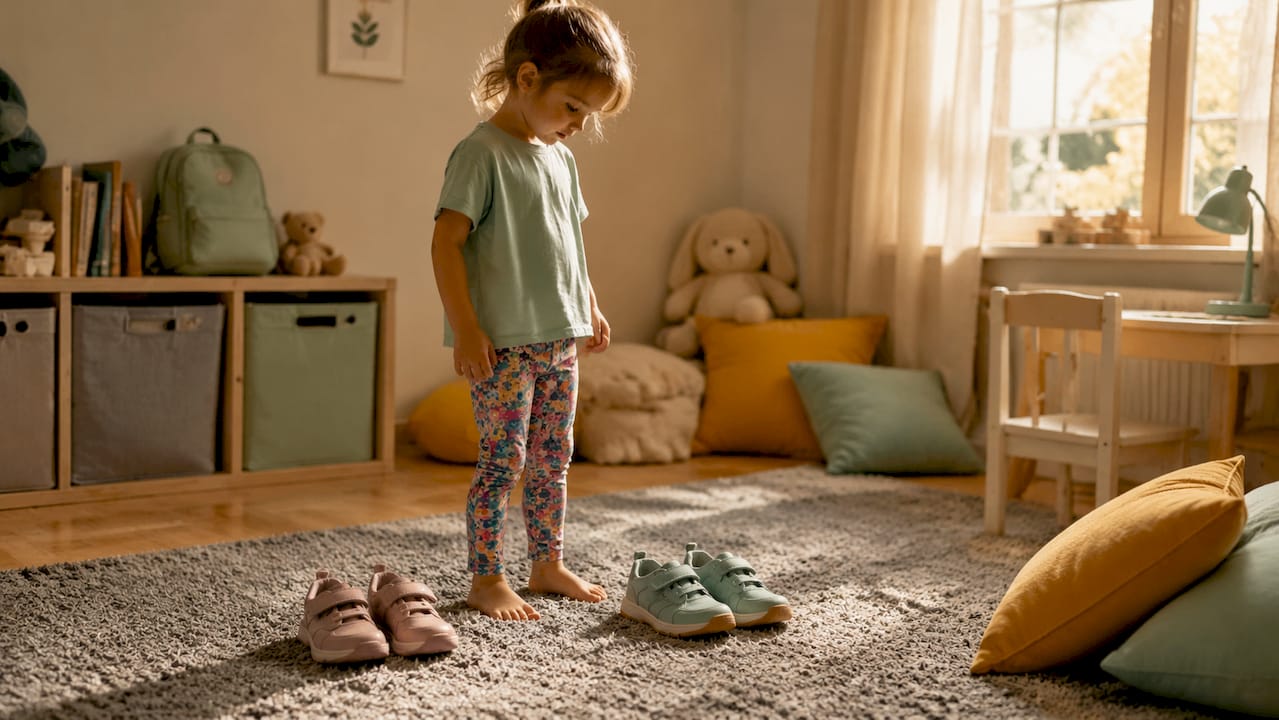
97% of children aged 19 months show a physiological flatfoot (Knick-Senkfuß). This usually resolves itself through freedom of movement and barefoot walking. A shoe that constricts the toes prevents precisely this natural correction.
How to recognize a wide toebox in children's shoes?
A wide toebox cannot be recognized by its external appearance alone. The shoe must be wide enough at the front so that all five toes lie flat and can spread slightly without pressing against the material.
The following features help with assessment:
- Width and height: The toebox must offer sufficient space both sideways and upwards. Especially the big toe and the little toe must not be squeezed sideways.
- Space reserve: 10–15 mm buffer to the longest toe is considered a guideline. This corresponds to about a thumb's width and gives the foot enough room when rolling off.
- Shaping: A good toebox follows the natural foot shape. It is wide at the front and does not taper to a point.
- Fit at heel and midfoot: Pediatric orthopedists emphasize that a wide toebox alone is not enough. The shoe must also fit well at the midfoot and heel so that the foot remains stable.
- Insole for comparison: Place the foot on a piece of paper, trace it, and compare it with the pulled-out insole. If the foot outline is wider than the sole, the shoe does not fit.
Brands like Froddo, Bisgaard, or Pololo offer wide toeboxes and extra volume for wide children's feet. The WMS system (Width, Measure, Safety) also provides orientation for width selection.
Expert Tip: Have the child stand in the shoe and gently press on the toebox. If you feel the toes, the shoe is too short or too narrow. If the foot slides from side to side, it is too wide.
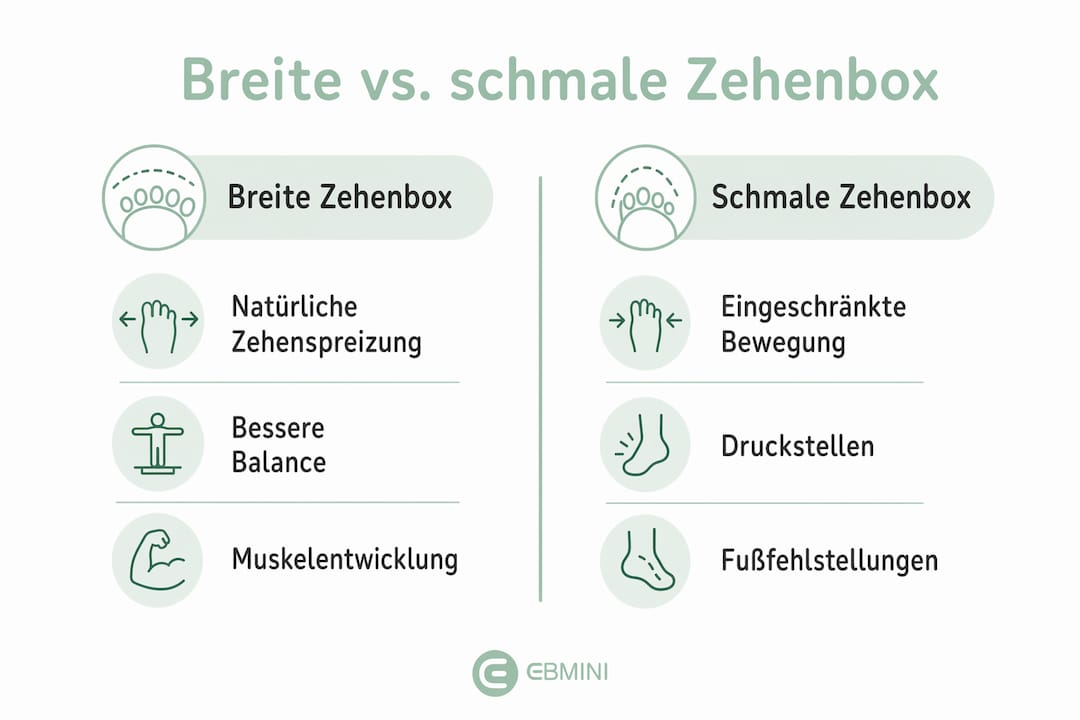
Why is a wide toebox so important for children's feet?
A wide toebox promotes natural toe spreading. This sounds simple but has far-reaching consequences for posture, gait, and muscle development.
When toes can spread freely, the small foot muscles actively participate. These muscles stabilize the arch of the foot, control balance, and prevent the foot from pronating. A tight shoe simply switches off these muscles.
"Barefoot walking is the most effective way to develop foot muscle strength and healthy statics. However, good shoes with a wide toebox are important additions for protected environments." Source: Orthinform
The consequences of a persistently tight toebox are concrete:
- Hallux valgus: The big toe is pushed inwards and permanently deforms.
- Hammer toes: Toes are bent upwards and can no longer straighten.
- Pressure points and blisters: Friction in the wrong places leads to pain when walking.
- Flatfoot: Without muscle work, the longitudinal arch collapses.
A suitable toebox allows for better balance, natural toe spreading, and reduces pressure points and blistering. This applies not only to adults but especially to children, whose foot bones are still soft and malleable.
According to pediatric orthopedists like Dr. Zwick, a balanced combination of a wide toebox and a secure heel fit is crucial for a healthy gait. Width alone is not enough. The shoe must guide the foot without constricting it.
Many parents also underestimate the value of barefoot movement. Shoes are often seen only as protection. Yet, barefoot walking is essential for the natural development of foot muscles. Barefoot shoes with a wide toebox are the best compromise when the ground requires protection.
Barefoot shoes with a wide toebox vs. classic children's shoes
Barefoot shoes and classic children's shoes differ fundamentally in their construction. Both protect the foot, but with very different effects on development.
Barefoot shoes feature a wide toebox, zero drop, and flexible, thin soles. Zero drop means that the heel and forefoot are at the same height. This promotes an upright posture and a natural gait. Classic children's shoes often have a raised heel, a stiff sole, and a tapering toebox.
| Feature | Barefoot Shoes | Classic Children's Shoes |
|---|---|---|
| Toebox | Wide, foot-shaped | Often narrow, tapering |
| Drop | Zero (flat sole) | 4–12 mm heel elevation |
| Sole Thickness | Thin, close to the ground | Thick, heavily cushioned |
| Flexibility | Very high | Low to medium |
| Foot Muscle Activity | Actively promoted | Partially supported |
| Protection | Sufficient for everyday use | High, also for rough terrain |
Barefoot shoes simulate natural foot movement with flexible soles, wide toeboxes, and flat heels. This promotes foot health when barefoot walking is not possible. Classic shoes are not inherently bad, but for the everyday life of an active child between 1 and 10 years old, barefoot shoes with a wide toebox are the better choice.
An important note: Even the best barefoot shoe doesn't help if it doesn't fit. Too much space allows the child's foot to swim in the shoe, which impairs stability and negatively affects gait. Wide toebox, yes, but always in combination with a secure fit at the heel and midfoot.
Tips for choosing the right children's shoes with a wide toebox
Buying children's shoes with a wide toebox is successful with a clear approach. These steps help you find the right shoe and avoid bad purchases.
- Measure the foot: Place the foot on paper, trace the outline, and measure length and width. Measurement should take place in the afternoon when the foot is slightly swollen.
- Compare insoles: Remove the insole and place it on the foot outline. If the sole is narrower than the foot, the shoe is too narrow.
- Check for space reserve: Ensure at least 10–15 mm distance to the longest toe. This is the space the foot needs when rolling off.
- Test flexibility: Bend the shoe in the middle. It should fold easily without creasing. A stiff sole prevents natural rolling motion.
- Check heel fit: The heel must sit firmly without pinching. A finger should barely fit between the heel and the shoe.
- Check material: Breathable materials like leather or mesh prevent sweating and pressure points.
- Regularly check growth: Children's feet grow quickly. It's worth re-measuring every 6–8 weeks, especially in the first year of life.
Expert Tip: Never buy children's shoes in advance in a size that the child is supposed to "grow into." A shoe that is too big is just as harmful as one that is too tight. The foot needs support, not emptiness.
There are separate guides for determining children's foot width that explain the measuring process step by step. Barefoot walking remains the best complement to any shoe. Whenever the surface allows, children should walk, climb, and play without shoes.
Key Findings
A wide toebox is the most important single feature of a children's shoe because it directly enables toe spreading, muscle development, and natural foot growth.
| Topic | Details |
|---|---|
| Toebox Definition | The front shoe area must be wide, high, and foot-shaped so that toes can spread freely. |
| Space Reserve | 10–15 mm distance to the longest toe is the recommended guideline for a secure fit. |
| Overall Fit | A wide toebox alone is not enough; the heel and midfoot must also sit firmly and securely. |
| Barefoot Shoes | Barefoot shoes with zero drop and flexible soles promote foot development the most. |
| Growth Control | Shoe size should be checked every 6–8 weeks, as children's feet grow very quickly. |
What I learned after years with children's shoes
At Ebmini, we often hear that parents only take the toebox seriously when the child complains of pain. That's too late. Children's feet rarely hurt, even if the shoe pinches, because the bones are still soft and yield. The child says nothing, but the shoe still deforms the foot.
What truly surprised me: Many parents consciously buy shoes with a wide toebox but still choose a size too large, believing it to be safer. A shoe that is too wide allows the foot to slide. This creates friction, blisters, and an unstable gait. More space is not automatically better.
My honest assessment: The combination of a wide toebox, zero drop, and a sole that can truly bend is the most important thing. Everything else, color, design, brand name, is secondary. And barefoot walking remains irreplaceable. No shoe, no matter how well designed, replaces the effect of bare feet on grass, sand, or stone.
A children's shoe size checklist helps maintain an overview and ensures no important points are forgotten when making the next purchase.
— Ebmini
Barefoot shoes for children at Ebmini
Ebmini has developed barefoot shoes for children that consistently focus on wide toeboxes, zero drop, and flexible soles. The models are ultra-light, waterproof, and built for everyday use, whether playing outdoors, on the way to school, or in winter.

Ebmini's baby barefoot shoes are suitable for first steps and support natural foot development from the start. Those looking for a shoe for warmer months will find the EBMINI® WAWE barefoot sandals a model with a wide toebox and secure hold. All products come with sizing advice and customer reviews to ensure the fit is right from the start.
FAQ
What is the toebox in children's shoes?
The toebox is the front area of a child's shoe that encloses the toes. It must be wide and high enough so that all toes lie flat and can spread freely.
How much space does the toebox need?
The recommended buffer is 10–15 mm between the longest toe and the end of the shoe. This corresponds to about a thumb's width and gives the foot enough room when rolling off.
Are barefoot shoes with a wide toebox better than classic children's shoes?
Barefoot shoes with a wide toebox, zero drop, and flexible sole promote natural foot development more strongly than classic children's shoes with stiff soles and narrow toeboxes. They are the more recommended choice for everyday wear.
Can a toebox be too wide?
Yes. Too much space allows the foot to swim in the shoe, which impairs stability and negatively affects gait. A wide toebox and secure heel fit must go together.
How often should I check my child's shoe size?
It's worth checking every 6–8 weeks, especially for children under 3 years old. Children's feet grow quickly, and a shoe that is too tight will deform the foot before the child expresses pain.


