

Barefoot Walking Indoors: Recommendations for Children
Many parents send their children through the house in slippers because bare feet on cold floors are considered unhealthy. But the opposite is true. Walking barefoot indoors, also known as proprioceptive training, directly promotes muscles, balance, and body awareness. These recommendations for children show you what's really important: which floors are suitable, what to look for when buying shoes, and how to safely integrate barefoot time into daily life without overlooking risks.
Table of Contents
- Key Takeaways
- Health Benefits of Barefoot Walking for Children
- Safe Indoor Design for Barefoot Children
- Recommendations: Barefoot Shoes for Children Indoors
- Barefoot Walking in Everyday Life: Practical Implementation
- My Experience: Why I Consider Barefoot Time Essential
- Ebmini® Barefoot Shoes: Complementing Barefoot Walking at Home
- FAQ
Key Takeaways
| Point | Details |
|---|---|
| Barefoot walking strengthens children's feet | Regular barefoot walking trains foot muscles and promotes the natural arch of the foot. |
| Indoors are ideal for starting | Controlled floor surfaces at home minimize injury risks and provide safe practice zones. |
| Shoe purchase needs clear criteria | True barefoot shoes have a zero-drop, flexible soles, and a wide toe box. |
| Gradual increase protects feet | Start with short sessions of 15 to 30 minutes and observe the feet's reaction. |
| Floor diversity promotes sensory perception | Different textures like cork, wood, and carpet specifically stimulate the soles of the feet. |
Health Benefits of Barefoot Walking for Children
Barefoot walking trains foot muscles, balance, and stimulates blood circulation in the sole of the foot. This sounds technical, but in everyday life it means something very specific: a child who walks barefoot through the house every day develops stronger, more coordinated foot motor skills than one who is constantly in shoes.
The reason lies in direct ground contact. The sole of the foot is rich in nerve endings. Every step without a shoe sends signals to the nervous system, thereby improving body awareness. This effect helps children stand more steadily, stumble less, and develop a better sense of their body.
"Barefoot walking strengthens the foot muscles and supports the natural development of the foot arch, but it is not the sole therapy for misalignments." Orthinform Parent Guide
Barefoot walking is also one of the preventive measures to avoid misalignments such as flat feet. This does not mean that shoes are fundamentally harmful. It means that barefoot phases should be actively planned. Especially between the ages of one and ten, when the foot is still pliable, every barefoot hour counts.
Specific health benefits at a glance:
- Strengthening of the small foot muscles that are hardly activated in shod shoes
- Improvement of balance through constant fine-tuning on different surfaces
- Promotion of the natural foot arch instead of passive support by insoles
- Strengthening of posture because foot, knee, and hip work together better
- Development of a healthy gait pattern without artificial elevation by heels
Pro-Tip: Barefoot walking is preventive, not a panacea. In case of visible misalignments or pain, always consult a pediatric orthopedist first.
Safe Indoor Design for Barefoot Children
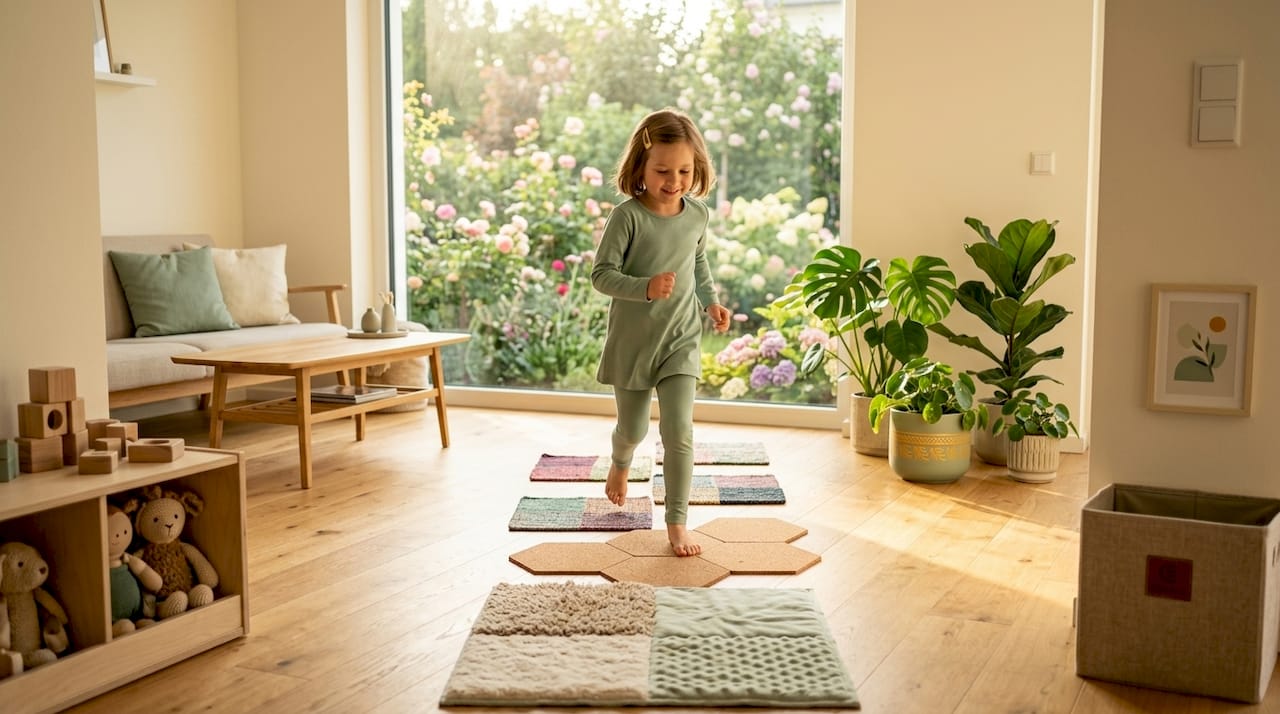
Indoors are often a better starting point for children than outdoors. Injury risks can be well controlled at home, and sensorially controlled barefoot zones with varying stimuli can be designed without sharp hazards. This does not require renovation. Sometimes it is enough to specifically check existing rooms and consciously set up a few areas.
Step-by-step to a barefoot-friendly home
- Check and consciously choose floor coverings. Short-pile carpets, naturally oiled wood, and cork are ideal barefoot surfaces. They offer grip, warmth, and different textures. Hard tile floors without slip protection are less suitable, especially for toddlers who are still unsteady on their feet.
- Systematically remove potential hazards. Before the first barefoot use, check all floors for splinters, nails, sharp edges, or toys lying around. This check should be repeated regularly, at least once a week.
- Consciously incorporate texture diversity. Create a small sensory path from different materials: a piece of cork flooring, a cotton rug, a sisal runner. Children discover these differences on their own and train their sensory perception.
- Consider indoor climate. Feet on cold floors are not a problem as long as there is no draft. A room temperature of at least 18 to 20 degrees Celsius and a balanced indoor climate create comfortable conditions.
- Keep hygiene simple. Walking barefoot in the apartment does not require a special hygiene strategy. Keep floors clean, dry wet spots immediately, and wash feet briefly after outdoor excursions. That's enough.
| Floor Covering | Barefoot Suitability | Texture | Warmth |
|---|---|---|---|
| Naturally Oiled Wood | Very good | Medium | Medium |
| Cork | Very good | Soft | Warm |
| Short-pile Carpet | Good | Soft | Warm |
| Smooth Tiles | Limited | Smooth | Cold |
| Laminate without texture | Limited | Smooth | Cold |
Pro-Tip: A simple sensory path made of three to four different materials costs almost nothing and playfully promotes foot perception. Children will walk on it again and again on their own.
Safe barefoot areas should offer different but hazard-free textures and be combined with regular indoor climate control. This sounds like a lot of work, but in practice it is a one-time effort with lasting effect.
Recommendations: Barefoot Shoes for Children Indoors
If going barefoot is not always possible, the right substitute is needed. This is where the wheat is separated from the chaff, because not every shoe marketed as a "barefoot shoe" delivers on this promise. The technical term is "minimalist shoe" or "barefoot shoe". The decisive difference lies not in the name, but in four measurable characteristics.
What you really need to look for when buying
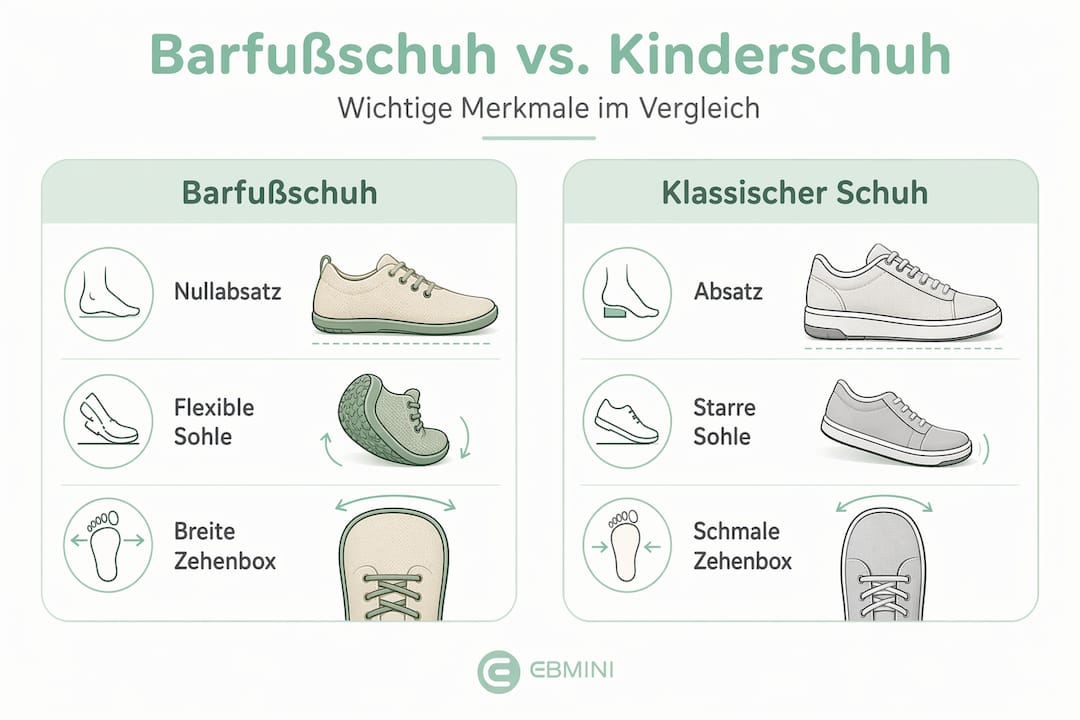
True barefoot shoes for children are characterized by zero drop, a thin flexible sole, an ergonomic toe box, and the absence of a cushioning midsole. These are not marketing promises, but verifiable criteria that you can check directly in the store or when buying online.
How to check a barefoot shoe specifically:
- Bend the sole: It should roll easily without a hard edge. Soles must be easily bendable to allow for sensory feedback.
- Check the heel: Place the shoe on a surface. Heel and toe should be at the same height. Any elevation at the back is not a zero drop.
- Look at the toe box: Place your hand flat on the shoe. The toe box should be wider than the heel, and the shoe should not narrow at its widest point.
- Feel the insole: It should be thin and flat, with no built-in arch that passively supports the foot arch.
| Feature | True Barefoot Shoe | Traditional Children's Shoe |
|---|---|---|
| Heel Height | Zero (same height front and back) | 5 to 15 mm elevated |
| Sole Flex | Very soft, rollable | Stiff or only slightly bendable |
| Toe Box | Wide and curved | Narrow, pointed front |
| Midsole | None or minimal | Thick and cushioning |
| Ground Feel | Direct and sensitive | Heavily cushioned |
A common mistake when buying: parents choose sizes that are too small because the shoe then "stays on". In barefoot shoes, the toes need space. There should be at least 10 millimeters of growth room between the longest toe and the tip of the shoe.
Barefoot shoes offer protection, but do not replace therapy for foot problems. If you suspect such a problem, consult a doctor first, not a shoe store.
Pro-Tip: Buy barefoot shoes for indoor use in a size that will still fit in six months, not one that is already tight. Children's feet grow quickly, and a barefoot shoe that is too tight blocks exactly what it is supposed to promote.
For further information on the right choice, the Parent Guide to Shoe Selection at Ebmini offers specific assistance, especially for toddlers when buying their first shoes.
Barefoot Walking in Everyday Life: Practical Implementation
Barefoot walking doesn't have to be a big project. It doesn't require a special room, a fixed plan, or expensive materials. What it does require is consistency and patience.
How to get started step by step
- Start small, stay consistent. It is recommended to start with 15 to 30 minutes daily on soft floors. The body needs time to get used to barefoot walking, just like any new sports activity.
- Approach playfully. Children cannot be motivated to walk barefoot by instructions, but they can be by games. A barefoot path made of cushions, carpets, and mats becomes an obstacle course. The result is the same.
- Observe the reaction of the feet. After the first few weeks of barefoot time, it's worth taking a close look at the feet. Pressure points, redness, or pain are signals to pause. Not a sign of weakness, but of healthy adaptation.
- Keep emergency shoes at hand. Especially for colder seasons or when guests come, barefoot-friendly shoes should be easily accessible. This avoids long discussions and foot health does not suffer from practical compromises.
- Increase barefoot times slowly. Gradual increase of barefoot times prevents overexertion and promotes long-term habituation. After two weeks daily, the units can be increased to 45 to 60 minutes.
Pro-Tip: Observe your child's gait. If they walk on their tiptoes or frequently stumble, these are indications that an orthopedist should evaluate, regardless of whether your child wears shoes or not.
Those who want to delve deeper into the topic will find a detailed guide on getting children used to barefoot shoes at Ebmini, which describes the transition from normal shoes to barefoot models.
My Experience: Why I Consider Barefoot Time Essential
I keep seeing the same pattern. Parents come with the desire to give their child the best, and buy well-padded, supportive shoes. They mean well. But these very shoes do the work that the foot muscles should be doing themselves.
What I have observed over the years: children who regularly walk barefoot have more flexible feet, better balance, and fewer complaints when walking. This is not theory, I see it in the feedback from families who have dared to make the change.
The most common mistake is not the wrong shoe choice, but the lack of consistency. Barefoot walking is treated as an occasional thing, instead of a daily habit. Yet 20 minutes a day on a soft floor is enough to make a difference.
My advice: Start today. Not perfectly, not with the ideal floor or the most expensive shoes. Just start.
— Ebmini
Ebmini® Barefoot Shoes: Complementing Barefoot Walking at Home
Barefoot walking is ideal. But for moments when shoes are required, the choice of shoe makes the difference between promotion and restriction.
The barefoot shoes for children from Ebmini were developed precisely for these situations. Ultra-light, flexible soles with zero drop, a wide toe box, and breathable materials create a wearing experience that comes as close as possible to barefoot walking. Whether your child is just taking their first steps or is already running through the entire house, the collection offers suitable models for every age and every need. Ordering and size consultation are possible directly on the website.
FAQ
What are the benefits of barefoot walking indoors for children?
Barefoot walking at home trains foot muscles, balance, and body awareness, thereby promoting the natural development of the foot arch. Indoors offer safe, controllable conditions without the risk of injury.
How long should children walk barefoot daily?
A good starting point is 15 to 30 minutes daily on a soft surface. The time can be gradually increased over several weeks once the feet have adapted.
Which floors are best suited for barefoot walking?
Naturally oiled wood, cork, and short-pile carpets are ideal. They provide warmth, grip, and different textures that promote the sensory perception of the feet.
How do I recognize a real barefoot shoe for children?
A true barefoot shoe has a zero drop, a flexible sole that can be easily rolled, and a wide toe box. No thick midsole and no heel elevation are the most important features.
When should I consult a doctor about my child's barefoot walking?
In cases of visible deformities, pain, or an unusual gait such as toe-walking or frequent ankle sprains, a pediatric orthopedic specialist should be consulted before starting any further barefoot programs.


