

Foot Health and Shoes: What Really Matters
Shoes influence how pressure is distributed on your foot, how freely your toes can move, and how much your foot muscles work. Incorrect shoes promote deformities, pain, and muscle atrophy. The German Shoe Institute states clearly: A shoe that pinches when first tried on will not "break in." Do not buy it.
The five most important rules at a glance:
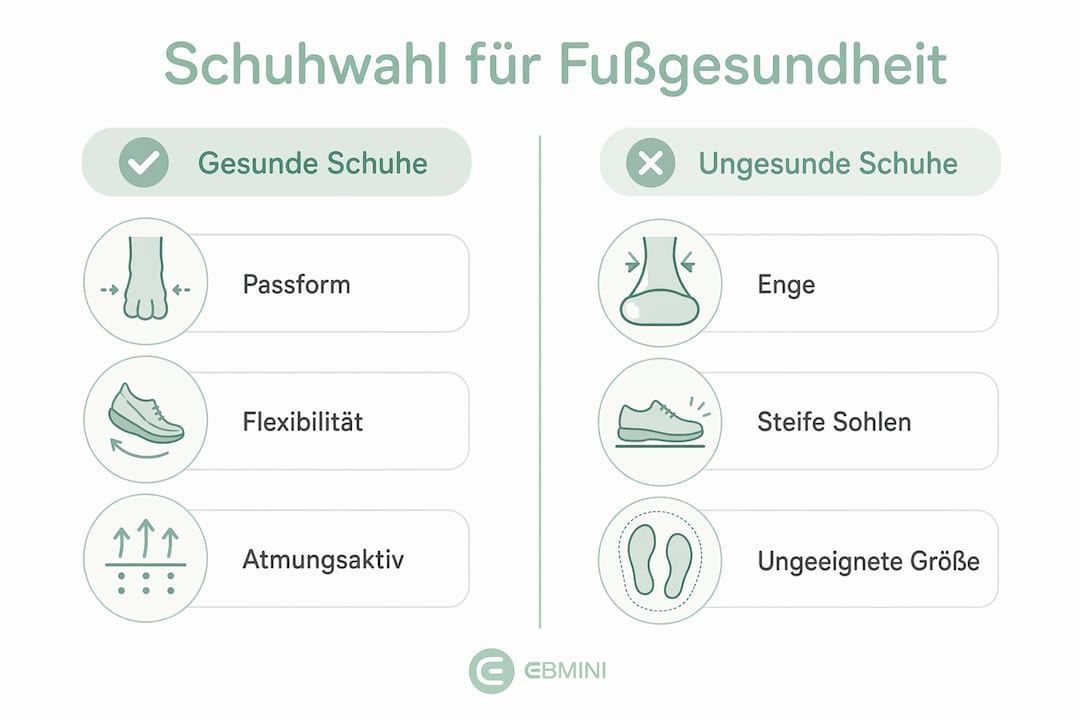
- Correct size and width: At least a thumb's width of space at the front, no lateral constriction.
- Wide toe box: Toes must be able to splay without hitting seams or caps.
- Flexible sole: The shoe should bend easily in the forefoot area.
- Low heel (Zero-Drop preferred): The flatter, the more natural the load on the ankle and knee.
- Regular shoe rotation and barefoot time: Wearing the same shoe every day trains the same muscles. Variety provides protection.
Orthopedist Markus Walther emphasizes that healthy feet do not need permanent prefabricated support. Taking work away from your feet permanently weakens them.
Pro Tip: Always try on shoes in the afternoon. Feet tend to swell slightly throughout the day. What fits in the morning might pinch in the evening.
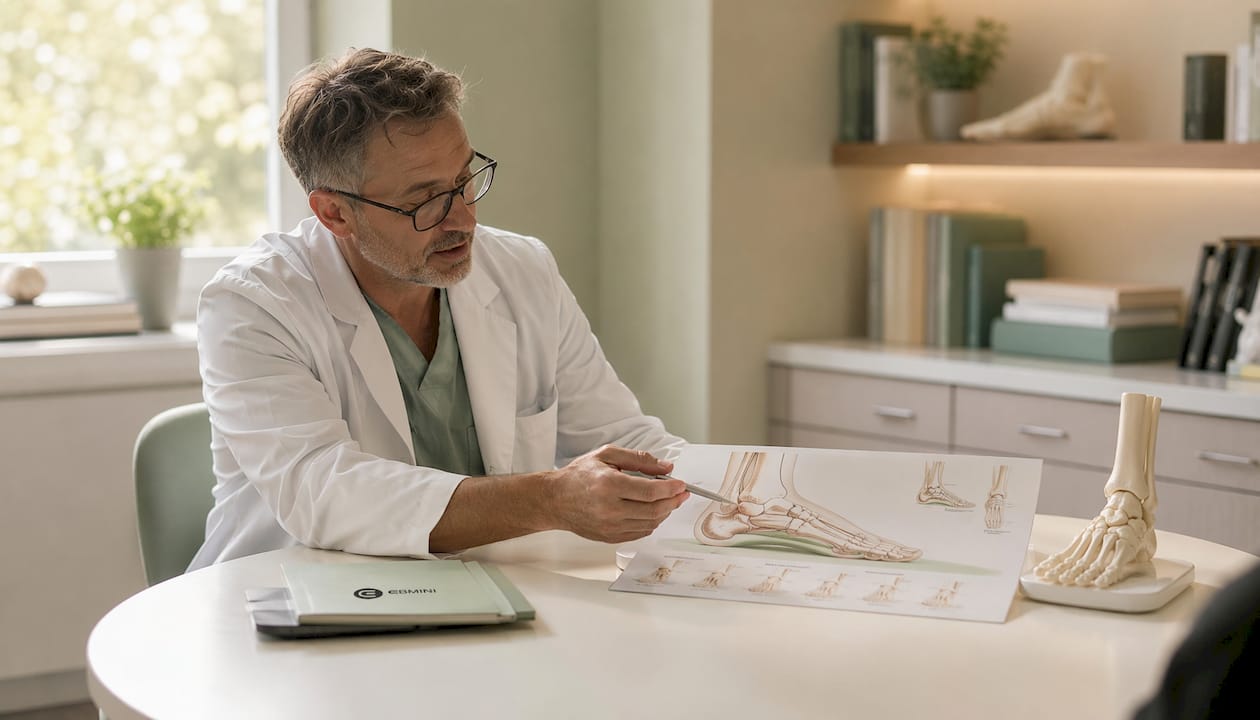
Table of Contents
- How Fit and Function Control Your Foot Health
- Which Shoe Types Often Cause Foot Problems
- How to Identify Healthy Shoes When Buying
- Barefoot Shoes or Supportive Shoes: What Fits When?
- What Children's Feet Really Need
- Prevention at Home: Exercises, Barefoot Training, and Correct Use of Insoles
- When You Should Consult a Specialist
- What Experts and Studies Really Say
- Key Takeaways
- Why Ebmini Takes the Barefoot Approach for Children Seriously
- Ebmini Children's Shoes: Recommended Features in Practice
- Useful Resources for Further Reading
How Fit and Function Control Your Foot Health
The connection between shoes and foot health can be explained mechanically. Three factors play the main role: pressure distribution, leverage, and freedom of movement.
Pressure distribution is the basic principle. Shoes that are too tight increase local pressure at certain points, which promotes blisters, corns, and clavus (hardened skin growths). Those who consistently walk in shoes that are too tight also change the load zones under the foot, which can lead to long-term deformities such as hallux valgus.
Statistics: Many people suffer from musculoskeletal pain that requires therapy at some point in their lives. Biomechanical research shows that shoes play an underestimated role in this.
Leverage from heels and stiff soles is less obvious but just as relevant. Every centimeter of heel height shifts body weight forward onto the forefoot and changes the angles in the ankle, knee, and hip. A stiff sole prevents natural rolling motion and forces the foot into an unnatural pattern.
Freedom of movement for the toes determines whether the intrinsic foot muscles can work or not. These small muscles stabilize the arch of the foot. Those who constantly cram them into a narrow toe box lose strength and control.
- Shoes that are too tight: Pressure points, deformities, a cycle of pain and compensatory posture.
- High heels: Forefoot overload, shortened calf muscles, altered knee load.
- Stiff soles: Suppressed rolling motion, weakened foot muscles.
- Soles that are too soft: Can destabilize the foot and increase the risk of sprains.
Pro Tip: Check the fit in three steps: Heel fits snugly, a thumb's width of space at the front, toe box wide enough for all toes to lie flat. If any of these points are not met, the shoe is wrong.
Which Shoe Types Often Cause Foot Problems
Not every problematic shoe looks dangerous at first glance. Here are the most common risk types:
- High Heels: Shift weight to the forefoot, increase the risk of bunions, and shorten the Achilles tendon with regular wear.
- Pointed, tight shoes: Squeeze the toes together and promote hammer toes, pressure points, and nerve pain (Morton's neuroma).
- Flip-flops without footbeds: Increase the risk of muscle cramps and deformities. Flip-flops with cork footbeds are less problematic but should not be worn daily.
- Very stiff soles: Prevent natural rolling motion and can weaken foot muscles in the long run.
- Very thick cushioning: Reduces feedback from the ground (proprioception) and can increase the risk of sprains because the foot "feels" less.
- Non-breathable synthetics: Promote moisture, skin irritation, and athlete's foot.
Important: Hiking boots, orthopedic shoes, or strong cushioning are not universally bad. For existing complaints, long hikes, or medical indications, they can be useful. The mistake lies in continuous wear without variety.
Are flip-flops always bad? No. Worn occasionally at the beach or in summer, they are unproblematic. The problem arises when they become everyday shoes.
How to Identify Healthy Shoes When Buying
A practical checklist for your next shoe purchase:
Fit:
- Heel fits snugly, no slipping out when walking.
- At least a thumb's width of space between the longest toe and the tip of the shoe.
- Toe box wide enough for all toes to lie flat and splay.
- No side seams that press on toes or balls of the feet.
- Always try on in the afternoon.
Construction:
- Sole bends easily in the forefoot area (flex line is under the metatarsophalangeal joints).
- Heel as low as possible, ideally zero-drop.
- Non-slip outsole.
- No overly rigid upper material.
Material:
- Breathable upper material (leather, mesh, or similar fabrics).
- Soft inner lining without hard seams.
- Regular airing after wear.
Pro Tip: Shoe rotation is underestimated. Those who alternate between two or three different models daily stress different muscle and joint areas. This reduces dependence on a single construction and strengthens the foot muscles overall.
Barefoot Shoes or Supportive Shoes: What Fits When?
Both concepts have their justification. The decision depends on the individual, the activity, and existing complaints.
Barefoot and Minimalist Shoes:
Advantages: They strengthen the intrinsic foot muscles, promote natural rolling motion, and improve proprioception. Barefoot shoes can demonstrably strengthen foot muscles in healthy adults. Risks: For advanced arthritis, they can exacerbate pain. Those who switch too quickly risk overuse injuries in tendons and muscles.
Supportive and Orthopedic Shoes:
Advantages: For deformities, painful conditions, or after injuries, they offer targeted relief. Risks: For healthy feet, continuous support can promote muscle atrophy, as Markus Walther expressly warns.
A practical guide is the 80/20 rule: Approximately 80% of the time barefoot or in functional, barefoot-like shoes, 20% in supportive footwear. Use insoles only on a trial basis for specific complaints and regularly question whether they are still necessary.
- Healthy feet: Prefer barefoot and minimalist shoes, use support sparingly.
- Existing complaints or deformities: Seek orthopedic advice before switching.
- Sports and long hikes: Situation-dependent, not generalized.
Pro Tip: If you want to switch to barefoot shoes, do so over several weeks. Start with short wear times (30–60 minutes daily) and gradually increase. Soreness in the calf or sole of the foot is normal; persistent pain is a warning sign.
What Children's Feet Really Need
Children's feet are not small adult feet. The arch of the foot develops until school age, and Dr. Eva Scheerer-Harbauer makes it clear: Artificial arch support can prevent natural muscle development. Children need flexible, wide shoes that do not restrict the foot.
Practical rules for buying children's shoes:
- Wide toe box: Toes must be able to move freely.
- Flexible sole: The shoe should bend easily.
- No heel, no heel padding that artificially supports the arch.
- Lightweight material: Heavy shoes tire leg muscles.
- Check size every three months; children's feet grow quickly.
The Straw Trick: Insert a straw into the front of the shoe, bend it at the tip of the toe, and compare the length to the child's foot. About 0.5 cm of leeway is ideal. Too much space is just as problematic as too little.
Barefoot shoes are generally well-suited for children because they support natural foot development. There are good reasons for breathable materials in children's shoes: they keep the foot dry and reduce skin irritation.
Pro Tip: Combine barefoot time at home with appropriate outdoor shoes. Walking barefoot a lot at home trains muscles and sensitivity. If your child frequently stumbles or complains of pain when walking, a physiotherapeutic check-up is advisable.
Prevention at Home: Exercises, Barefoot Training, and Correct Use of Insoles
Three exercises that help immediately and require no equipment:
- Toe splaying: Spread all toes as wide as possible, hold for three seconds, release. Ten repetitions per foot.
- Foot arch lift (Short Foot): Foot flat on the floor, toes not gripping, lift the arch of the foot as if pulling the heel and metatarsophalangeal joints together. Hold for five seconds.
- Calf stretch: Take a step back, keep the back knee straight, heel stays on the ground. Hold for 20–30 seconds, switch sides.
Walking barefoot at home strengthens tendons and muscles and is considered one of the most effective recommendations from experts for prevention. Start with 15–20 minutes daily on various surfaces (parquet, carpet, grass) and gradually increase.
Using insoles wisely: Only for specific complaints or medically diagnosed deformities. Insoles are not a permanent solution but a temporary aid. Those who wear them should regularly check if they are still necessary.
Daily routines also include: changing shoes every one to three days, airing them after wear, choosing breathable socks, and briefly inspecting feet daily.
Pro Tip: Integrate foot exercises into existing routines. Splay toes while brushing teeth, calf stretch while waiting for the kettle. Two minutes daily are enough for noticeable improvements.
When You Should Consult a Specialist
You should consult an orthopedist, podiatrist, or physical therapist promptly if you experience these warning signs:
- Persistent pain that does not improve after more than two to three weeks.
- Pain at rest or at night.
- Severe swelling without an apparent cause.
- Numbness or tingling in the foot or toes.
- Non-healing pressure sores or wounds (for diabetics: see a doctor immediately).
- Sudden change in gait or walking pattern.
- Recurrent injuries (sprains, strains) on the same foot.
What to expect at the specialist appointment: Clinical examination, often supplemented by foot pressure analysis (pedobarography) and, if necessary, imaging. Treatment options range from targeted physical therapy and insoles to surgical interventions for severe deformities.
When do insoles really help? For diagnosed deformities, overuse syndromes, or after injuries, individually fitted insoles can be beneficial. Over-the-counter insoles from drugstores do not replace orthopedic diagnostics.
This article provides general information and is not a substitute for medical advice. If you have complaints, consult a specialist.
What Experts and Studies Really Say
The research landscape is not black and white. Some important nuances:
Barefoot shoes: Studies show benefits for muscle strengthening in healthy adults. At the same time, orthopedists warn against too quick a transition and against use in advanced arthritis. A Harvard report discusses barefoot shoes positively for muscle strengthening, but explicitly emphasizes the risk of too rapid a transition.
Expert opinions:
- Markus Walther (Orthopedist): Permanent prefabricated support for healthy feet can promote muscle atrophy. Variation is crucial.
- Dr. Eva Scheerer-Harbauer: The child's foot arch develops naturally. Artificial support can prevent muscle development.
- Experts generally: Walking barefoot at home is one of the proven measures for preventing foot diseases.
Limitations of the study situation: Many studies have short observation periods and small sample sizes. Long-term data on barefoot shoes are largely lacking. Study populations differ significantly, making direct comparisons difficult.
- No study proves that a specific shoe type is optimal for all people.
- Individual factors (foot shape, activity level, pre-existing conditions) outweigh general recommendations.
- Clinical expertise and publication venue are important quality criteria when evaluating sources.
Pro-Tip: Be wary of studies that only examine one type of shoe and test a homogenous group. Foot health is individual. What applies to a marathon runner does not apply to an office worker with flat feet.
Key Insights
Choosing the right shoes is one of the most significant modifiable factors for long-term foot health: fit, toe freedom, and barefoot time in daily life matter more than shoe price.
| Topic | Details |
|---|---|
| Fit is crucial | Shoes that pinch at the first try-on will not break in. |
| Toe freedom protects | A wide toe box prevents deformities and strengthens intrinsic foot muscles. |
| Incorporate barefoot time | According to experts, walking barefoot at home is one of the most effective preventive measures. |
| Children don't need support | Flexible, wide shoes without arch support promote natural foot development. |
| Ebmini for children's feet | Ebmini shoes feature zero-drop, a wide toe box, and flexible soles for natural foot development. |
Why Ebmini Takes the Barefoot Approach for Children Seriously
Anyone who explores the connection between shoes and foot health quickly encounters an uncomfortable truth: most children's shoes on the market are designed for adult feet and then scaled down. A wide toe box, truly flexible soles, and zero-drop are the exception, not the rule.
Ebmini believes that foot health in children develops through natural movement, not through support. This means specifically: shoes that allow the foot to work, instead of doing the work for it. Ultra-light materials, because heavy shoes tire children. A wide toe box, because toes need to splay to train muscles. Flexible soles, because natural foot development requires freedom of movement.
This is not a marketing promise, but the direct consequence of what orthopedists and podiatrists have been recommending for years.
Ebmini Children's Shoes: Recommended Features in Practice
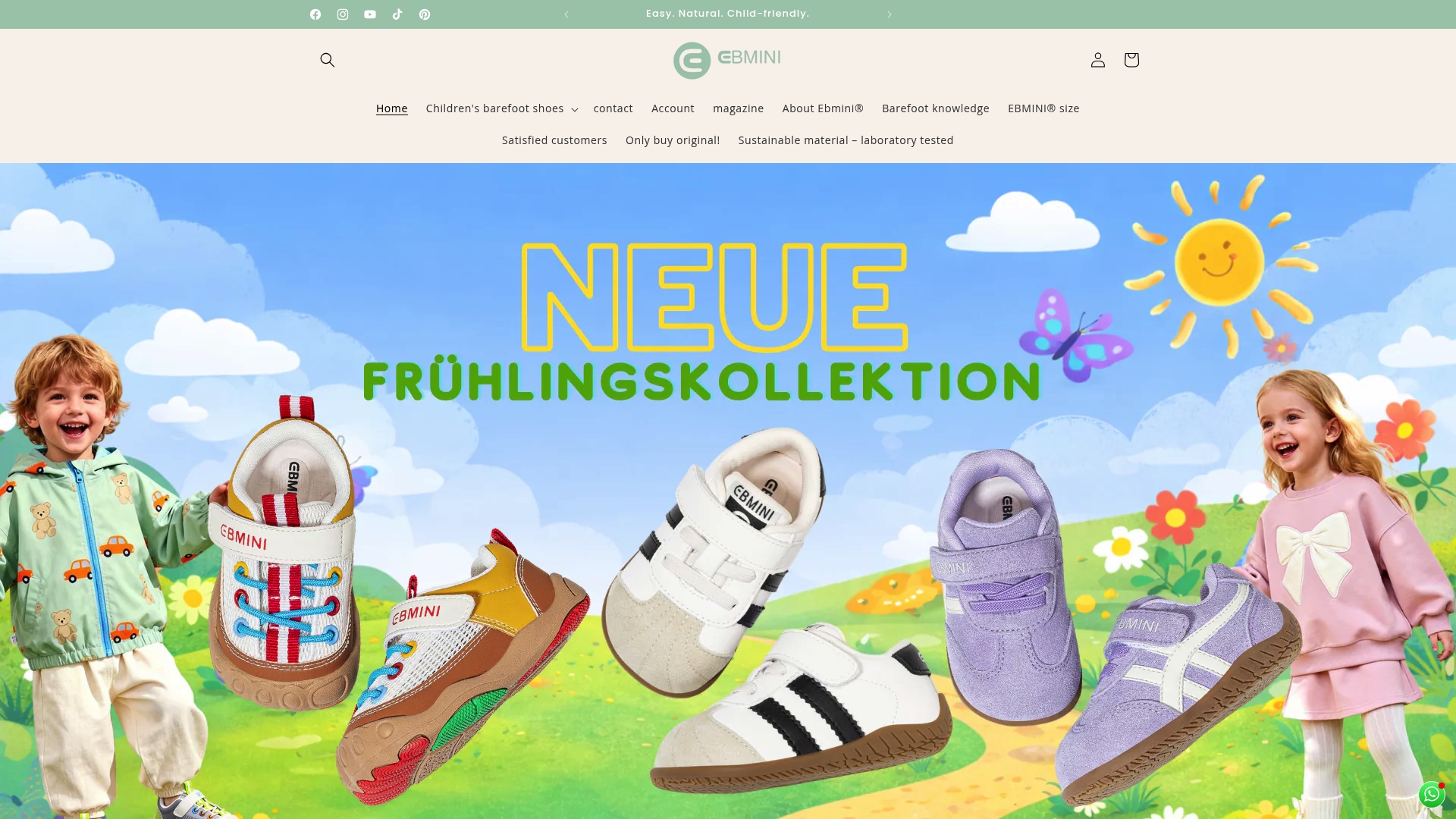
Parents who, after reading this article, know what matters, no longer have to guess when buying shoes. Ebmini children's shoes meet the most important criteria recommended by experts: wide toe box, zero-drop sole, flexible bending axis in the forefoot, and lightweight, breathable materials.
For everyday wear, barefoot sneakers are particularly suitable: flexible enough for movement, robust enough for the schoolyard and playground. For warmer months, barefoot sandals offer maximum freedom of movement with secure support.
Pro-Tip: Combine Ebmini shoes with regular barefoot time at home. Barefoot indoors, in the right shoes outdoors: This is the simplest and most effective routine for healthy children's feet.
Browse the entire collection of children's shoes and use the size guide directly on the website.
Useful Resources for Further Reading
Verified sources for those who want to delve deeper:
- Tips for healthy children's feet and shoe shopping — Children's Hospital: Practical recommendations from Dr. Eva Scheerer-Harbauer, including the straw trick and size control.
- Healthy shoes: Orthopedist gives tips — NWZ Online: Expert assessment on flip-flops, fit, and barefoot recommendations.
- Healthy feet with six tips — Helios Gesundheit: Proven measures for preventing foot diseases.
- Healthy feet: Proceed with caution — PTA-Forum: Recommendations from the German Shoe Institute on fit and breaking in.
- Barefoot shoes: Orthopedist warns of risks — Express: Differentiated assessment of barefoot shoes, including arthritis warning.
- Which summer shoes are healthy? — NZZ: Markus Walther on the question of support and muscle loss.
- The 80/20 rule for foot health — Der-Fuss.de: Practical rule for balancing barefoot and support.
- How shoes cause pain in the musculoskeletal system — Eversion.tech: Biomechanical analysis of shoe-body interaction.
- Children's shoes podiatrically recommended — Ebmini Blog: Guide with podiatric recommendations for children's shoes.
- Integrating barefoot shoes into everyday life — Ebmini Blog: Step-by-step guide for getting used to barefoot shoes.


