

Foot Length vs. Shoe Size: An Explanation for Parents
Children's shoe size is not a reliable measure. It is a manufacturer-dependent value that varies greatly depending on the brand and country. The only objective basis for buying shoes is the measured foot length plus an allowance of 12 to 17 mm for rolling motion and growth. Anyone who only looks at the size label risks the child wearing a shoe that either pinches or is too loose. This article explains the difference between foot length and shoe size, shows how to measure correctly, and why the inner length of the shoe is the decisive fit measure.
Why are children's shoe sizes not uniform?
Shoe sizes are not standardized. The same size, for example, EU 26, can mean an inner length of 16.0 cm to 16.8 cm for different manufacturers. This is not a misprint, but a system. Each manufacturer defines its lasts itself, and the printed size does not follow a binding standard.
The ISO 19407 standard proves that conversion tables between EU, UK, and US do not guarantee an accurate fit. Only the Mondopoint system, which measures directly in millimeters, defines foot length and width clearly. For everyday use, this means: size charts are guides, not guarantees.
The most reliable measure is the inner length of the shoe. The inner length is the measurement from the inner heel area to the toe box. Inner length differences can be up to two shoe sizes wide, even if the label is identical. If you know the inner length, you can compare safely.
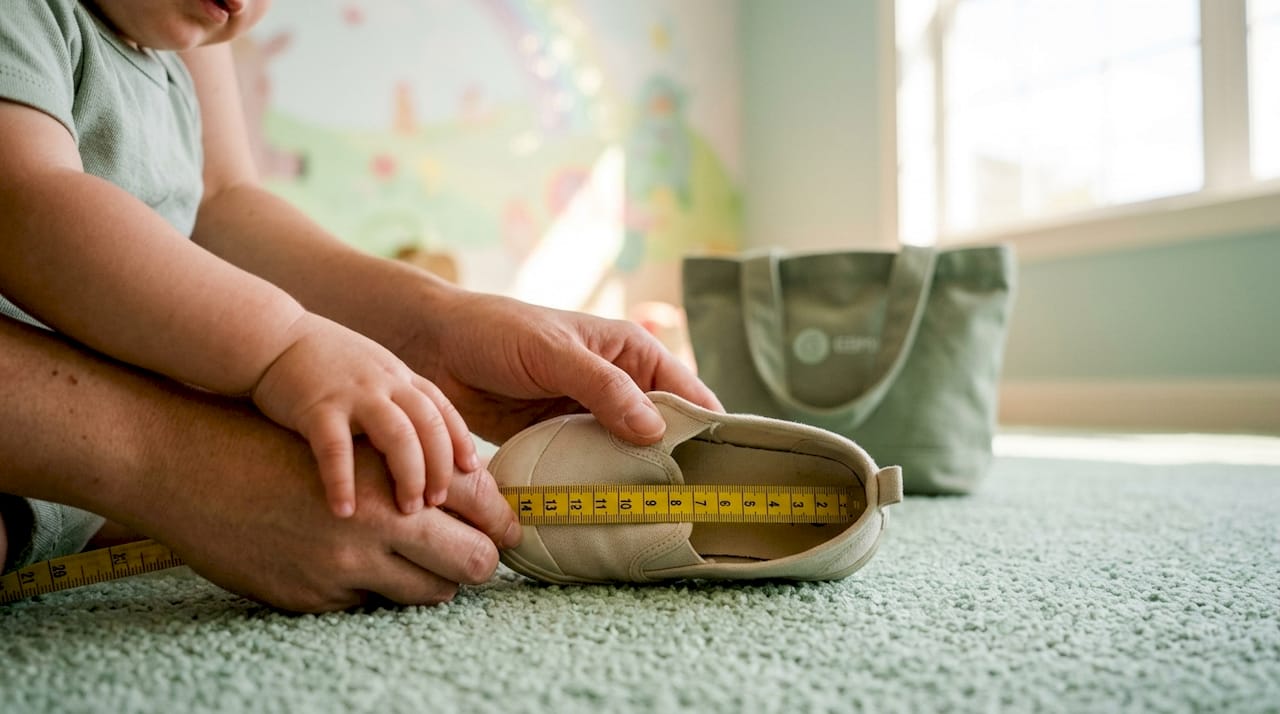
The formula is simple: foot length plus allowance equals the required inner length. The following table shows typical values for children's feet:
| Foot length (cm) | Allowance (mm) | Required inner length (cm) | Approximate EU size |
|---|---|---|---|
| 13.0 | 15 | 14.5 | 22 |
| 15.0 | 15 | 16.5 | 26 |
| 17.0 | 15 | 18.5 | 29 |
| 19.0 | 15 | 20.5 | 32 |
| 21.0 | 15 | 22.5 | 35 |

The EU size here is only a guideline. The crucial factor is the inner length of the specific shoe, not the number on the label.
How to measure children's foot length correctly?
Measuring foot length correctly is easier than many think. But there are persistent mistakes that lead to incorrect results.
- Place the child on a hard, flat surface. The child stands upright, with full weight on both feet. This is the only way for the foot to show its actual length and width.
- Place a sheet of paper under the foot. Trace the outline with a vertically held pen. The pen must be held vertically, otherwise the angle will distort the result.
- Measure the longest line. From the back of the heel to the tip of the longest toe. This is the foot length.
- Measure both feet. Children's feet are often not the same length. The longer foot always determines the shoe size.
- Add the allowance. At least 12 mm, preferably 15 mm, for rolling motion and growth.
Measurements taken while sitting systematically underestimate the length and width of the foot. The foot spreads under load and becomes longer and wider. Those who measure while sitting buy shoes that are too small.
Pro-tip: Measure in the afternoon. Feet swell slightly during the day, and an afternoon measurement reflects the real foot size better than a measurement taken right after getting up.
Paper templates are a proven method. The child stands on the paper, the outline is traced, and the template can be placed directly into the shoe. If the template fits with a slight margin, the shoe fits. Digital measuring apps can supplement the measurement but do not replace regular practical checks.
What role does toe allowance play in foot development?
Toe allowance is not a matter of comfort. It is a prerequisite for healthy foot development. At least 10 to 12 mm distance between the longest toe and the end of the shoe is recommended by the Federal Centre for Health Education and experts. For active children or softer shoes, 15 mm is more sensible.
Shoes can never truly fit without sufficient room for movement and growth. No child reliably feels if a shoe is too tight, because the foot adapts, not the shoe.
Shoes that are too small are not a minor problem. Over 50% of children wear shoes that are too small, with long-term orthopedic consequences such as toe deformities, pressure points, and gait problems. Children often do not report pain because they perceive the pressure as normal.
However, shoes that are too big are also not a solution. They cause tripping hazards, blisters, and an incorrect rolling motion because the foot slips in the shoe. The correct allowance is precisely in this range of 12 to 17 mm.
- Too little allowance (under 10 mm): Pressure points, nail problems, toe deformities
- Correct allowance (12–17 mm): Natural rolling motion, room for growth, healthy foot development
- Too much allowance (over 20 mm): Risk of tripping, blisters, incorrect muscle strain
Children's feet grow about 1 mm per month. This sounds little, but it means that a shoe that fit well in January can be too tight in April. Regular checks every two months are therefore not over-cautious, but essential.
Why is width just as important as length?
Foot length and shoe size only explain part of the fit. Width is the second crucial factor that many parents overlook. Two children with identical foot lengths can have completely different foot volumes. A narrower foot needs a different last than a wider foot, even if the length is the same.
The so-called fit quotient describes the relationship between foot volume and foot length. It explains why many parents buy shoes that are too tight, even though the length is correct. The shoe pinches at the sides, not at the front. The reaction is often to buy a larger length, which does not solve the problem, but shifts it.
For children's foot width, there are width specifications, which are marked as W (wide), M (medium), or S (narrow) depending on the manufacturer. Not all manufacturers offer these specifications, but they are an important quality feature.
- Wide feet need a wide toe box so that the toes can spread.
- Narrow feet slip in wide shoes and develop posture problems.
- Barefoot shoes with an anatomically shaped toe box, such as the models from Ebmini, take into account the natural foot shape and give wide children's feet the necessary space.
International sizing systems make the choice of width even more complicated. Anyone who deals with French sizing systems or other international standards quickly realizes that even the length specifications do not match, let alone the width. The inner length remains the only measure that can be directly compared.
Children's shoes should fit not only in length but also in width. Wide feet require special last shapes, not a larger shoe size. This is a difference that is significant for healthy foot development.
Key Takeaways
Children's shoe size is only meaningful if it is compared with the measured foot length plus an allowance of 12 to 17 mm and the checked inner length of the shoe.
| Topic | Details |
|---|---|
| Foot length as basis | The measured foot length while standing is the only objective measure for buying shoes. |
| Check inner length | The inner length of the shoe, not the size label, determines the actual fit. |
| Allowance of 12–17 mm | This distance in front of the toe ensures rolling motion and growth reserve. |
| Measure both feet | The longer foot determines the shoe size, as children's feet are often of different lengths. |
| Don't forget width | Width and last shape are just as important as length for a healthy fit. |
What I really believe after years with children's shoes
Many parents come with a child complaining of pain, and the shoe is the right size. At least according to the label. This is the moment it becomes clear how little the printed number actually says.
What I consider really important: measure the inner length before buying, and do it with a tape measure or a template, not with the thumb test. The thumb test, where you press your thumb over the tip of the shoe, is too inaccurate. It says nothing about the width, nothing about the heel fit, and nothing about whether the foot slips in the shoe.
And then there's the regularity. Children's feet grow irregularly and quickly. Measuring every two months sounds tedious, but it's the only way to be sure. A shoe that fit in autumn can already cause problems in winter.
What convinces me about barefoot shoes is the wide toe box. Children naturally spread their toes when walking. A narrow, pointed shoe prevents this. Over time, this changes the foot shape. This is not a theoretical risk; you can see it in X-rays of schoolchildren. Shoes with a flexible sole and natural toe box allow the foot to work as it should.
— Ebmini
Healthy children's shoes that really fit

Once you have measured the foot length and calculated the inner length, you need a shoe that truly implements these values. Ebmini develops barefoot shoes for children that offer exactly that: a wide toe box for natural toe spreading, zero drop for an upright posture, and flexible soles that follow every step. The size guide on the website helps to directly convert the measured foot length into the correct inner length. No guessing, no thumb test. All Ebmini children's barefoot shoes are specified by inner length and designed for healthy foot development from 1 to 10 years.
FAQ
What is the difference between foot length and shoe size?
Foot length is the objectively measured distance from the heel to the longest toe. Shoe size is a manufacturer-dependent value without a uniform standard, which can represent different inner lengths depending on the brand.
How much allowance does a child's shoe need?
At least 12 mm, preferably 15 mm, between the longest toe and the end of the shoe. This allowance ensures natural rolling motion and allows room for foot growth.
When should I re-determine my child's shoe size?
Every two months, as children's feet grow about 1 mm per month, and a shoe that fit in spring may already be too tight in summer.
Why should I measure while standing and not while sitting?
When standing, body weight is distributed over the foot, causing it to lengthen and widen. Measurements taken while sitting systematically yield values that are too small and lead to shoes that are too tight.
Is length alone sufficient for the right shoe choice?
No. The width of the foot is just as crucial. A shoe with the right length but a too-narrow last will pinch at the sides and can cause deformities. Always determine the child's foot width and compare it with the shoe last.


