

Determining Children's Foot Width: Choosing the Right Shoes
Children's foot width is the crucial fit factor that determines comfort, freedom of movement, and healthy foot development. Many parents measure the length of their child's foot but completely forget the width. This leads to shoes that are correct in length but pinch at the sides or leave too much room. This guide shows how to accurately determine children's foot width at home, correctly interpret width information from brands like Nanga or using the WMS system, and select shoes that truly fit.
How to Determine Children's Foot Width at Home?
You don't need special equipment for a reliable measurement. A sheet of paper, a pen, and a ruler are enough to accurately measure your child's foot width.
What you should prepare:
- A white A4 sheet of paper (or larger for children from shoe size 30)
- A soft pencil or a thin felt-tip pen
- A ruler or tape measure with a millimeter scale
- The socks your child normally wears
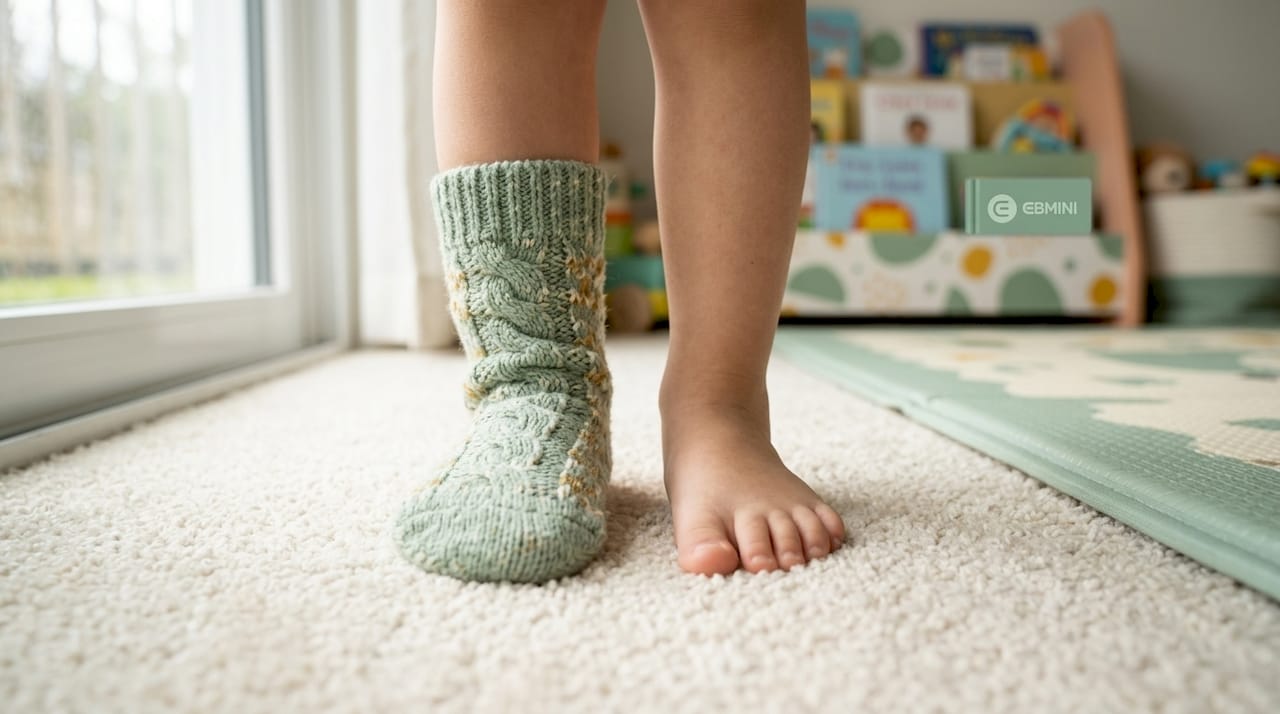
The choice of socks is not a minor detail. Thick winter socks can influence foot width by up to 3 mm, which corresponds to half a width in children's shoes. Therefore, always measure with the socks your child typically wears with that type of shoe.
Pro Tip: Never measure while sitting. Measurement errors often occur when measuring while sitting because the foot widens under pressure. Have your child stand upright and shift their full weight onto their foot.
Perform the measurement at least twice and note both values. If the results differ by more than 2 mm, measure a third time. Reproducible measurements only occur under defined conditions: always standing, always with the same socks, always at the same time of day. Feet are slightly wider in the evening than in the morning because they expand throughout the day.
Step-by-Step Guide to Measuring Foot Width and Foot Length
Accurate measurement of both feet is mandatory, not optional. Children's feet are rarely symmetrical, and the larger value of both feet is always the basis for shoe selection.
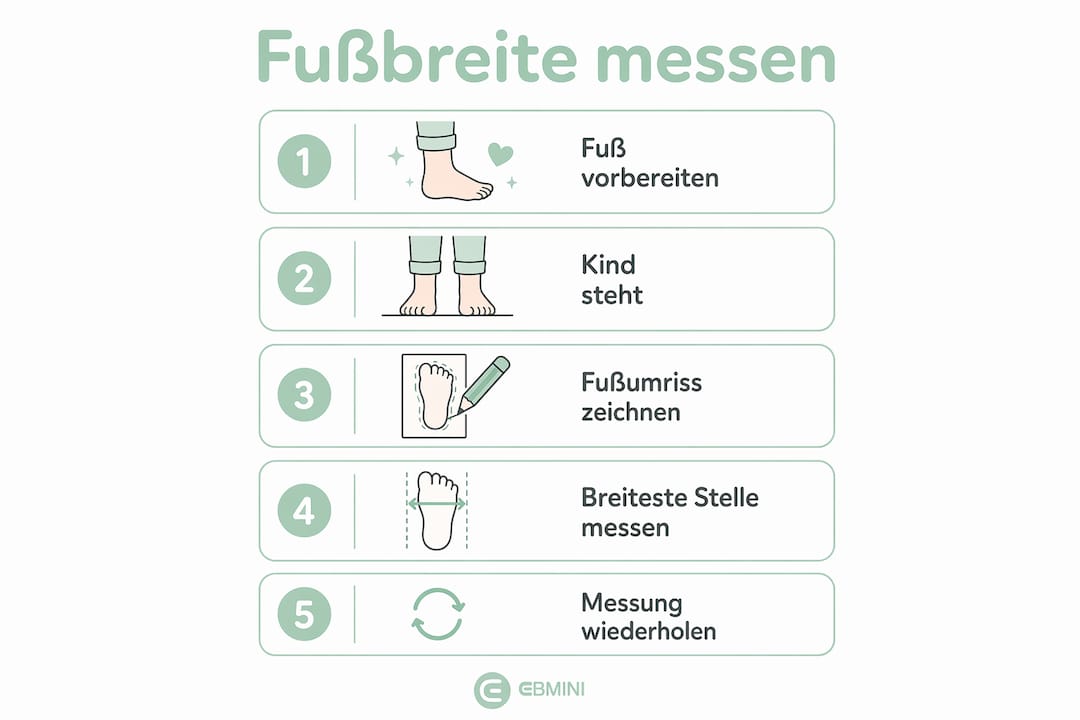
Here's how to proceed:
- Place the paper on a hard, flat floor. Carpet distorts the result.
- Your child places one foot flat on the paper and shifts their weight completely onto this foot.
- Hold the pen vertically and trace the entire foot outline. The pen must be held close to the foot, not at an angle.
- Mark the widest part of the forefoot, i.e., the area between the ball of the big toe and the ball of the little toe.
- Measure this width with the ruler in millimeters.
- Measure the length from the back of the heel to the longest toe.
- Repeat for the other foot.
| Measurement | Description | Use |
|---|---|---|
| Foot width | Widest part of the forefoot in mm | Comparison with insole inner width |
| Foot length | Heel to longest toe in mm | Basis for shoe size determination |
| Greater value | The greater value of both feet | Decisive for shoe selection |
Foot length alone is not enough. The inner length of the shoe plus individual toe room is more practical for fit determination than the nominal shoe size according to EU standards. Plan for at least 10 to 12 mm of toe room. The BZgA recommends at least 12 mm of toe room as a growth reserve and for freedom of movement. This corresponds to about the distance you feel when you gently press the toe of the shoe with your thumb.
The difference between foot width and shoe width is important: Foot width is the measured value in millimeters. Shoe width is a manufacturer's classification that describes how much internal space the shoe offers in the ball area. Both values must match but are not identical.
Pro Tip: Cut out the foot outline from the paper and place this template in the shoe. Templates make it easier to check the width directly on the model without your child having to try on the shoe.
How to Correctly Read Shoe Width Information for Children's Shoes?
Shoe width specifications are not standardized, and this is the most common source of confusion when buying shoes. The WMS system classifies shoe widths into three categories: W for wide, M for medium, and S for narrow. It is a recognized retail measure for classifying children's foot widths and helps parents assess width beyond just length.
Other manufacturers use letters such as E, EE, or EEE, where more E letters mean a wider width. Still other brands provide no width indication at all and rely on the last shape. This makes direct comparison between brands difficult.
What to consider when reading width specifications:
- Width specifications refer to the interior space in the ball area, not the overall width of the shoe.
- The same width designations from different manufacturers can have different internal dimensions.
- Last shape and material influence how shoes with the same size indication offer internal width and fit.
- Leather stretches, synthetic materials often do not. This changes the effective width after a few weeks of wear.
- Removable insoles are a more reliable comparison value than labels.
The most reliable way to find the right shoe width: Take the insole out of the shoe and place the foot template on it. The inner width of the insole at the ball is the decisive comparison value. If the template is wider than the insole, you need a larger width or a different model.
| Width System | Designation | Meaning |
|---|---|---|
| WMS | W | Wide, for wide children's feet |
| WMS | M | Medium, standard width |
| WMS | S | Narrow, for narrow feet |
| Letter system | E / EE / EEE | Increasing width, manufacturer-dependent |
A larger width is necessary if the foot template extends beyond the insole, if your child complains of pressure on the sides after a short period of wear, or if you see that the shoe is stretched at the sides.
What Mistakes Should Parents Avoid When Measuring Foot Width?
The most common measurement errors cost time, money, and in the worst case, the child's foot health. Many parents underestimate the importance of inner dimensions and use "fits somehow" as a benchmark. This leads to pressure points and long-term deformities.
The seven most common mistakes:
- Measuring only one foot: Children's feet often differ in length and width. Always measure both.
- Measuring while sitting: The foot is wider under pressure. Always measure while standing.
- Ignoring sock thickness: Thin summer socks and thick winter socks result in different measurements. Measure with the appropriate socks.
- Checking only the length: Shoes that are correct in length can pinch in width. Width and length are equally important measurements.
- Planning too little room: Less than 10 mm of toe room restricts freedom of movement and inhibits growth.
- Planning too much room: More than 17 mm of room allows the foot to slide in the shoe and strains muscles and joints.
- Not considering insoles: Wearing insoles or thicker socks changes the interior space and must be factored into measurement and shoe selection.
Pro Tip: Keep a simple measurement log with the date, foot length, and foot width of both feet. Measurement logs with repeated measurements improve comparability and help you detect growth spurts early.
Another underestimated error: choosing shoes based solely on shoe size without checking the inner dimensions. Two shoes of size 26 can differ by up to 8 mm in inner width, depending on the manufacturer and last shape. Shoe size is a starting point, not a guarantee of fit.
How Often Should Parents Check Shoe Fit?
Children's feet grow quickly and irregularly. Shoe fit should be checked every 3 to 4 months. For babies and toddlers under two years old, a check every two months is even recommended, as growth is particularly rapid during this phase.
Signs that the shoe has become too small:
- Your child takes off their shoes themselves or complains of pressure
- Redness or pressure points on toes, balls of feet, or heels after wearing
- Changed gait: Your child walks on tiptoes or turns their feet outwards
- The foot template extends beyond the insole
- The thumb test shows less than 10 mm distance to the shoe tip
Signs that the shoe is too big:
- Your child stumbles more often than usual
- The foot slides forward when walking
- Blisters on the heel due to rubbing
Parents should keep measurement logs and use thresholds, for example, a 3 mm increase in width as a signal for a possible shoe change. Such a log makes growth spurts visible and prevents your child from wearing shoes that are too tight for weeks. Also, note with each measurement whether your child wears insoles or plans to wear thicker socks. This directly changes the requirements for shoe width.
The decision to buy new shoes is easier if you have concrete measurements. If the foot length exceeds the inner length of the current shoe minus 10 mm, or if the foot width exceeds the insole width, it's time for new shoes.
Key Takeaways
Children's foot width is most reliably determined by standing and using the paper-and-pencil method, with the inner width of the insole being the decisive comparison value for the correct shoe width.
| Point | Details |
|---|---|
| Standing measurement | Always measure while standing, as the foot widens under pressure. |
| Measure both feet | Use the larger value of both feet as the basis for shoe selection. |
| Compare insole | Place the foot template on the insole to directly check the width. |
| Maintain toe room | Plan for at least 10 to 12 mm of room for growth and freedom of movement. |
| Regular checks | Check fit every 3 to 4 months and log measurements. |
What I've Learned After Years with Children's Shoes
At Ebmini, we see daily how much uncertainty there is regarding shoe width. And honestly, most wrong purchases don't happen due to incorrect shoe sizes, but due to ignored widths.
What still surprises me: even parents who carefully measure the length never take out the insole. Yet, that's the simplest and most reliable test. An insole doesn't cost extra time. It's in the shoe. Take it out, put the foot template on it. Done.
Another point often missing in many guides: the shaft shape and volume of the shoe often affect wearing comfort more than just the width. A shoe with wide width but a narrow shaft can still pinch. That's why at Ebmini, we recommend models with a wide toe box that gives the foot all-around room, not just in the ball area.
My personal advice: Don't buy shoes without a measurement log. Not because measuring is fun, but because with the second purchase, you'll immediately know if your child has grown and in which direction. That saves time, money, and frustration.
— Ebmini
Healthy Children's Shoes from Ebmini: Fit for Every Foot
Ebmini develops barefoot shoes for children that are designed from the outset for natural foot shapes. The wide toe box gives children's feet the space they need. The removable insoles make it easy to compare widths directly at the time of purchase. All models are ultra-light, flexible, and designed for everyday use, from the first step to school age. Those looking for sandals with an adjustable fit will find models at Ebmini that adapt to different foot widths while providing support and comfort. Discover the collection and find the shoe that truly fits your child's foot width.
FAQ
How do I measure my child's foot width at home?
Have your child stand on a sheet of paper, trace the outline of their foot, and measure the widest part of the forefoot with a ruler in millimeters. Always measure both feet while standing and use the larger value.
What does the WMS system mean for children's shoes?
The WMS system classifies shoe widths as W (wide), M (medium), and S (narrow), and is a recognized retail measure that helps parents assess the width of a child's shoe beyond just length.
How much room does a child's shoe need in length?
At least 10 to 12 mm of toe room is considered a guideline for growth reserve and freedom of movement. The BZgA recommends 12 mm as a minimum.
How often should I check my child's shoe size?
The fit should be checked every 3 to 4 months. For toddlers under two years old, a check every two months is recommended, as children's feet grow particularly fast during this phase.
Why isn't shoe size alone sufficient for shoe selection?
Two shoes of the same size can differ significantly in inner width, depending on the manufacturer and last shape. The inner width of the insole compared to the measured foot width is a more reliable standard for the correct shoe width.


