

Children's sandals and foot development in summer explained
Good children's sandals protect the foot but do not support it. That is the crucial difference. For natural foot development, children need a flat, flexible sole without a heel (the so-called zero-drop principle), a wide toe box, and a firm heel strap that holds the sandal on the foot without constricting it. Around 98% of all children are born with healthy feet; malpositions almost always arise from a lack of movement or ill-fitting footwear, not from genetic bad luck.
What parents can do immediately:
- Measure feet in the afternoon or evening, when they are slightly swollen from activity.
- Allow 10–12 mm of space in front of the longest toe, no less.
- Actively increase barefoot time: grass, sand, forest floor are the best training tools for children's feet.
- Avoid rigid support shoes and thick insoles, unless a medically confirmed malposition exists.
Table of Contents
- Why foot development needs especially much room in summer
- How to reliably determine the correct sandal size
- Which sole properties truly promote natural rolling motion
- Which materials really work in summer
- What really matters at which age
- How to tell when a sandal has become too small
- Buy in-store or order online?
- How parents can further promote foot development
- Ebmini sandals: Why the design supports foot development
- Key Takeaways
- What parents often underestimate when it comes to children's sandals
- Further sources and guidelines
Why foot development needs especially much room in summer
Summer is the most productive season for children's feet. Warmth, soft ground, and the natural desire to take off shoes create precisely the conditions the arch of the foot needs to develop. Muscles, tendons, and ligaments are still soft and pliable in the first few years of life. They respond to stimuli, and these stimuli are precisely what is missing when a child is in stiff shoes all day.
"Almost all toddlers start with rather flat feet, which is completely normal. Only through movement and different stimuli does the arch of the foot gradually develop. Walking barefoot on varying surfaces activates the muscles and supports this development."
Dr. Jörn Dohle, Vice President of the DGOU
According to the S2k guideline of the AWMF, the arch of the foot develops predominantly until the age of ten. A flat child's foot in the early years is therefore not an alarm signal, but a normal state. Preventive support shoes do not help; rather, they prevent the foot muscles from doing the work themselves.
How to reliably determine the correct sandal size
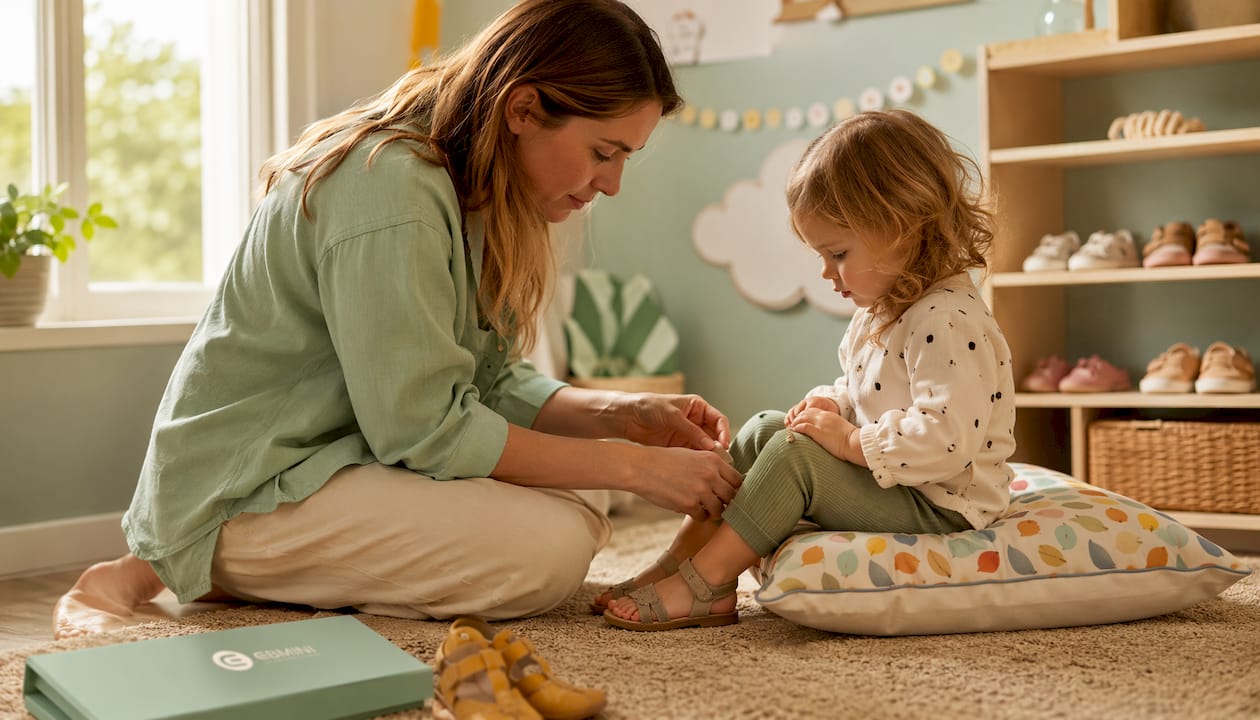
The most common mistake when buying sandals: measuring in the morning, buying in the afternoon, and then the sandal is too tight. Feet swell during the day due to strain. Those who measure in the afternoon or evening buy the size the child actually needs for playing.
Step-by-step measurement:
- Have the child stand on white paper, trace their foot with a pen.
- Measure the longest line from the heel to the longest toe.
- Compare this value with the insole of the sandal, not the outsole.
- Allow at least 10–12 mm of space at the toe.
- Measure both feet. Use the larger foot as the measurement.
Check when trying on:
- Let the child take a few steps in the sandal, not just stand.
- Finger test: A finger should easily fit behind the heel.
- Toes should not touch the front edge and should not protrude over the edge.
- Pay attention to different foot widths: Some children have very wide feet, where standard models press on the sides.
Pro tip: Children's feet grow quickly. Checking the size every two to three months prevents the child from wearing sandals that are too small for weeks without saying anything.
Which sole properties truly promote natural rolling motion
The sole is the most important feature of a child's sandal, and here most inexpensive models make the crucial mistake: they bend in the middle of the foot, not at the front. However, a good sole must bend exactly where the foot does: at the ball of the foot. The middle of the foot, on the other hand, should retain some stability.
What makes a foot-healthy sole:
- Zero Drop: No heel, no incline from heel to toe. The foot stands flat and can roll naturally.
- Flexibility at the front: The sole must be able to fold in the ball-of-foot area, not in the middle.
- Firm heel strap: Holds the sandal on the foot without pinching. Prevents shuffling, which tires the foot muscles.
- Moderate footbed: Slight contouring is fine. Strong orthopedic insoles do not belong in an everyday sandal for healthy children's feet.
- Grippy tread: Especially on wet stones or uneven ground, a good sole tread protects against slipping.
Pro tip: Quick test in the store: Press the front of the sole upwards with both thumbs. Does it bend easily? Good. Does it bend in the middle? Put it away.
Which materials really work in summer
Breathability is not a luxury in summer, but a prerequisite. A foot that sweats in a poorly ventilated sandal will become sore, and a sore child will no longer enjoy walking.
- Leather and high-quality textiles regulate moisture well and adapt to the shape of the foot. For everyday wear and moderate temperatures, they are the first choice.
- Quick-drying synthetic fibers are suitable for water activities, the beach, and paddling pools. They dry in minutes and do not mold.
- To avoid: hard inner seams that rub on toes or heels; tight plastic edges that cut into the skin; non-breathable coatings that trap sweat.
For care: Clean the inner material regularly with a damp cloth and let it dry completely before wearing the sandal again. Check the sole and seams for wear every few weeks. If you want to know more about material selection and comfort in heat, you will find a detailed overview there.
What really matters at which age
Not every sandal suits every age. A two-year-old needs different characteristics than a seven-year-old.
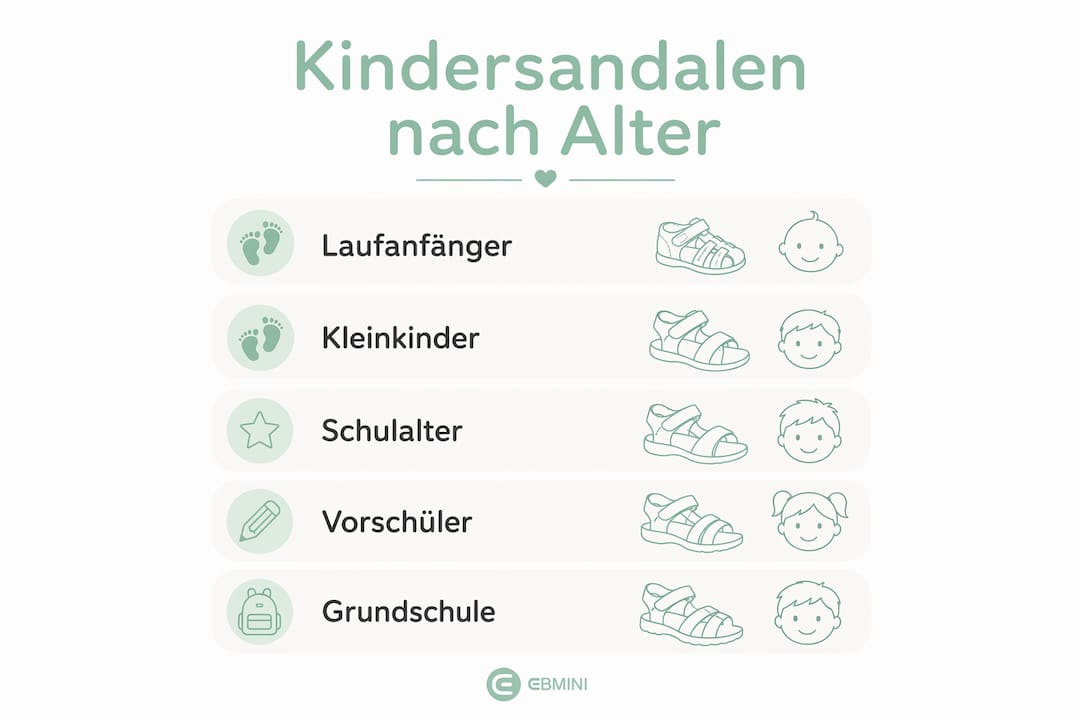
| Age Group | Recommended Sandal Characteristics | Barefoot Time per Day | Typical Risks |
|---|---|---|---|
| Toddlers (1–2 years) | Very soft sole, semi-closed toe box, light weight | As much as possible, almost always indoors | Too stiff soles inhibit learning to walk |
| Young Children (2–4 years) | Flexible sole, firm heel strap, wide toe box | At least 1–2 hours daily | Too tight models curb urge to move |
| School Children (5+ years) | Durability, non-slip sole, still zero drop | Regularly, especially outdoors | Fashion consciousness leads to tight models |
Toddlers particularly benefit from lots of barefoot time at home. The flexible pes planus is detectable in almost 97% of 19-month-old children and is completely physiological. It disappears on its own with increasing muscle strength, provided the foot gets enough movement stimuli. For school children: The arch of the foot is still developing. Those who opt for barefoot-like shoes now lay a good foundation for the coming years.
How to tell when a sandal has become too small
Children rarely say "my shoe is pinching." They simply stop walking, or they walk strangely. These are the signs to look for:
- Sliding: The child curls their toes to hold the sandal. This indicates that the sandal is too big or the heel strap isn't holding. However, sandals that are too small can also cause this pattern.
- Blisters and pressure points: Especially on toes, heel, or the side of the foot. Signs of chafing and pressure points can often be recognized early by checking briefly after taking them off.
- Changed gait: Shuffling, limping, or avoiding stairs for no apparent reason.
- Reduced urge to move: Dr. Eva Scheerer-Harbauer expressly warns that ill-fitting sandals can inhibit the urge to move and thus prevent muscular development.
- Toes protruding over the edge or red marks after taking them off.
If there are pressure points or a changed gait: change sandals immediately. Orthopedic clarification is only necessary if pain persists or a visibly rigid malposition is present.
Buy in-store or order online?
Both work if you know what to look for.
The store has a clear advantage: The child can try on the sandal, walk a few steps, and a specialist can assess the fit. This is difficult to replace, especially for toddlers and children with unusual foot widths.
Online offers more choice and often better prices. It is crucial that the retailer offers a generous return period, at least 14 days according to German law. Always check size charts critically: Some manufacturers measure the insole, others the outsole. The difference can be half a size. The Ebmini size checklist helps to measure reliably.
Pro tip: If you buy online, the sandal should only be worn for a short time on the first day, and then immediately checked for pressure points. This leaves enough time for a return if the size is wrong.
How parents can further promote foot development
Sandals are protection, not a training device. The actual work is done by bare feet on real ground.
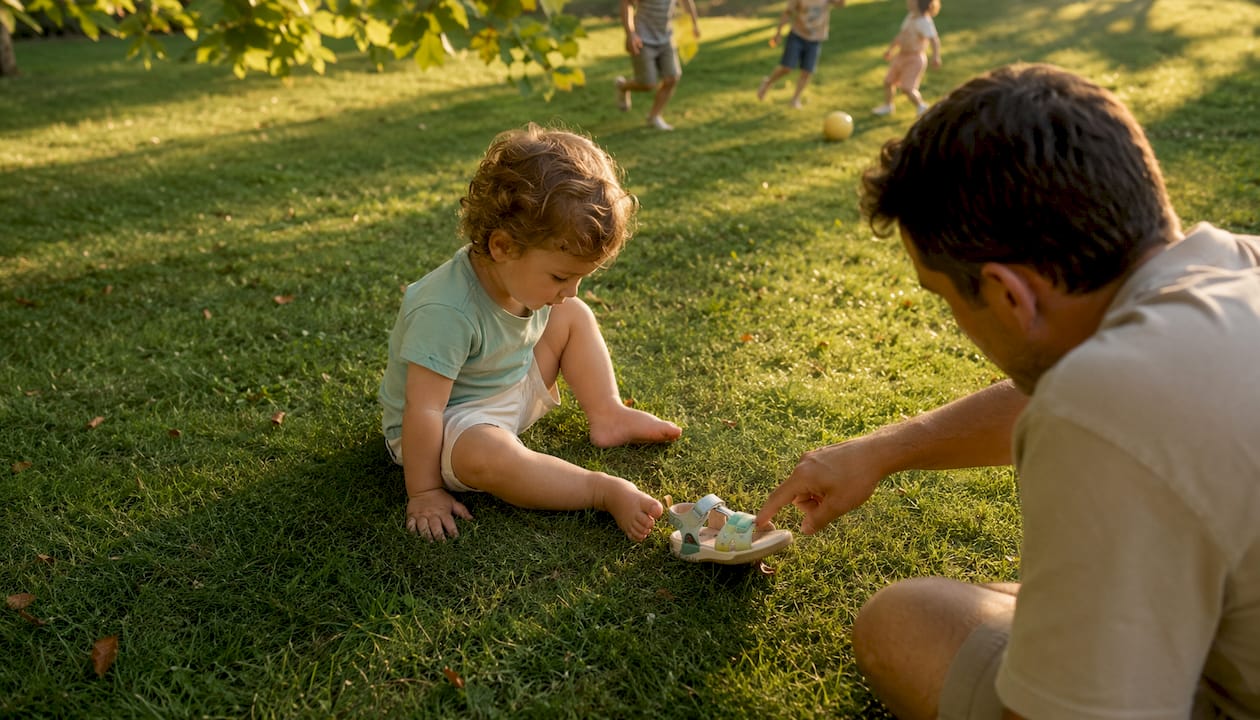
- Plan for barefoot time on varying surfaces: Grass, sand, gravel, and forest floor provide different stimuli and train various muscle groups. The DGOU expressly recommends this as the most effective measure to strengthen the arch of the foot.
- Toe-gripping games: Picking up small cloths or marbles with the toes. Sounds simple, but specifically trains the short foot muscles.
- Balancing: Standing on one leg, balancing on a log, trampoline. Anything that challenges balance strengthens the foot muscles.
- Less sitting, more free play: Children who sit a lot hardly move their feet. Free play outdoors is the best foot training.
- Normal body weight: Overweight disproportionately strains the still soft foot structures and can promote the development of a pes planus that does not regulate itself.
Barefoot-like sandals offer protection while allowing ground stimuli to pass through, but they are not a complete substitute for true barefoot walking. When to see a doctor: for persistent pain, an asymmetrical gait, or a visibly rigid deformity.
Ebmini sandals: Why the design supports foot development
If you take the criteria mentioned above as a checklist – zero drop, flexible sole, wide toe box, firm heel strap – you quickly arrive at barefoot sandals. This is exactly the basis on which Ebmini developed its children's sandals, in collaboration with orthopedists and with the goal of translating the barefoot principle into an everyday summer shoe.
The sandals are ultra-light, the sole bends at the ball of the foot at the front and remains stable in the middle. The toe box provides enough space even for wide children's feet. The heel strap holds securely without cutting in. For sizing, the same applies as described in the article: measure in the afternoon, allow 10–12 mm of space, consider both feet. If unsure, Ebmini offers size advice directly in the shop.
All Ebmini children's barefoot sandals are available with free returns. If you prefer to browse the entire range, you can find all models in the overview of children's barefoot shoes.
Key Takeaways
Correct children's sandals protect the foot in summer without hindering its natural development: a flexible sole, wide toe box, and 10–12 mm of space are the three criteria that truly matter.
| Topic | Details |
|---|---|
| Barefoot Principle | Sandals protect, but do not replace barefoot time; let children walk on varied surfaces daily. |
| Most Important Features | Flat sole (zero drop), flexibility at the front at the balls of the feet, wide toe box, firm heel strap. |
| Measurement Rule | Measure in the afternoon, allow 10–12 mm of space in front of the longest toe, always consider both feet. |
| Arch Development | The arch of the foot develops until about the age of ten; a flat child's foot is normal in early years. |
| Ebmini Recommendation | Ebmini barefoot sandals meet all mentioned criteria and are available with size advice and a return policy. |
What parents often underestimate when it comes to children's sandals
The debate about children's shoes usually revolves around brands and prices. What is overlooked is this: the sandal is neither the problem nor the solution. It is just the framework. What the child does for the rest of the day is crucial.
A child who walks barefoot on grass and sand for an hour every day will develop healthy arches almost regardless of what sandals they wear the rest of the time, as long as they are not actively harmful. Conversely, even the most expensive barefoot sandal will be of little help if the child mainly sits.
What parents really have control over: planning barefoot time, encouraging movement, and regularly checking shoe size. The sandal is a tool, not a miracle cure. Those who understand this will automatically make better purchasing decisions because they are not looking for the shoe that solves everything, but for the one that gets in the way the least.
Further Sources and Guidelines
For those who want to delve deeper, here are the most important references:
- S2k Guideline on Pediatric Flexible Flatfoot (AWMF): Medical guideline for the diagnosis and treatment of pediatric flexible flatfoot; basis for age-dependent recommendations.
- DGOU: Barefoot Walking Promotes Healthy Children's Feet: Press release from the German Society for Orthopaedics and Trauma Surgery with specific summer recommendations.
- AOK: Healthy Feet in Children: Easy-to-understand guide on foot health, shoe selection, and prevention for parents.
- IMTEST: Children's Sandals in Check: Practical buying guide with expert interviews and specific testing criteria.
This article provides general information on foot health in children and is not a substitute for medical advice. In case of pain, an unusual gait, or persistent complaints, a pediatrician or orthopedist should be consulted.


