

Children's Sandal Sole: Hardness and Flex Point Explained
The most important characteristic of a child's sandal is not its color, not its price, and not even the material alone. It is the flex point. A sole that bends precisely under the ball of the foot promotes natural foot roll-off. Everything else is secondary.
What parents should check immediately when buying:
- Flex point at the forefoot: Bend the sole with both hands. It should crease at the front, not in the middle.
- Torsion test: Hold the sole at both ends and twist them against each other. Slight resistance is good; complete stiffness is a warning sign.
- Slip test: Check the tread on the underside. Briefly test on a smooth surface whether the sole provides grip.
- Sole thickness as a guide: For toddlers, 3–6 mm is sufficient, for confident walkers on rough terrain, 6–10 mm is sensible.
Pro Tip: Bend the sandal in the store with one hand. If you need both hands, or if the sole doesn't give at all, leave that model.
Key Insights
The right child's sandal is not recognized by its Shore A value, but by the fact that it flexes at the ball of the foot, allows ground feel, and is non-slip.
| Topic | Details |
|---|---|
| Check flex point | The sole must crease at the ball of the foot, not in the middle. This is the most important single criterion. |
| Sole thickness by age | Toddlers: 3–6 mm; confident walkers on rough terrain: 6–10 mm; over 10 mm usually counterproductive. |
| Measuring allowance | 10–12 mm distance to the toe tip, measure in the afternoon, use the larger foot as a reference. |
| Recognize warning signs | Permanently deformed sole, asymmetrical wear, or frequent stumbling are reasons for replacement. |
| Ebmini as an option | Ebmini sandals meet the criteria: flexible forefoot, wide toe box, non-slip sole, zero drop. |
Table of Contents
- What does the hardness of a child's sandal technically mean?
- Why sole hardness and flex point influence foot development
- Which sole thickness suits which age and use?
- How to check a child's sandal in a store in 90 seconds
- Which materials are suitable for children's sandal soles?
- Fit and measurement time: What sole thickness has to do with comfort
- When is a sole too soft, too hard, or worn out?
- What research and professional associations say about sole selection
- Ebmini's perspective: Why we design soles the way we do
- Ebmini sandals: Flexible sole, wide toe box, available for immediate order
- Sources
What does the technical hardness of a child's sandal mean?
The term "hardness" sounds like a laboratory term, but it's actually simple. It's measured on the Shore A scale: a measuring device presses a needle into the material and measures the resistance. The higher the Shore A value, the harder the sole. Soft shoe soles typically range from Shore A 30–50, while firmer outsoles are at Shore A 60–80.
However, for everyday use in a shoe store, this number is of little help. No parent carries a durometer in their pocket. And even if they did: Shore A alone doesn't tell you where the sole bends, how well it springs back, or how much ground feel it allows through.
What really matters: It's not the Shore A value that determines whether a sandal is good for children's feet, but the interplay of flex point, rebound elasticity, tread depth, and overall thickness. A soft sole that creases in the middle is worse than a slightly firmer one that breaks cleanly at the ball of the foot.
Added to this is the material composition: EVA foams can spring entirely differently at the same Shore A value than natural rubber. And cold noticeably changes the hardness. A sole that feels pleasantly flexible in the store at room temperature can be significantly stiffer after ten minutes in an autumn wind. This is not a defect, but physics. For a flexible children's shoe, this means that material and construction must match.
Why sole hardness and flex point influence foot development
Children's feet are not small adult feet. Until school age, a large part of the foot skeleton still consists of cartilage, and the musculature is developing. What a child experiences or doesn't experience in terms of ground feel during this phase shapes the development of foot muscles and balance.
Reviews show that walking barefoot or close to barefoot promotes foot motor skills and balance. This is the biomechanical reason why flexible, tactile soles are recommended for children: they allow stimuli to pass through that the foot needs to calibrate itself.
The flex point is not a detail, but a basic condition:
- Flex point under the ball of the foot: The roll-off occurs naturally, and the toe extensors and short foot muscles actively participate.
- Flex point in the middle of the foot: The child compensates, shifts weight, and stumbles more frequently. According to the IMTEST expert check, a mid-foot crease is a clear warning sign.
- No flexibility: The foot muscles are hardly activated, and proprioception suffers.
Incidentally, soles that are too soft and lack tread are not a free pass. If there is no protection whatsoever, the child risks injuries on sharp stones or hot asphalt. The guide to proprioception explains how tactile feedback and protection are not mutually exclusive.
Pro Tip: Let your child run barefoot as much as possible at home. The sandal should complement barefoot walking, not replace it.
Which sole thickness suits which age and use?
Specific millimeter measurements are more helpful than vague descriptions. Three zones serve as a guide:
| Sole thickness | Age group / Developmental stage | Typical use | Material note |
|---|---|---|---|
| 1–3 mm | Babies, crawlers (not yet walking independently) | Indoors, soft floors, short outings | Soft natural rubber or thin EVA |
| 3–6 mm | Toddlers (approx. 1–3 years) | Daycare, playground, sandbox, even paths | EVA or rubber-EVA combination |
| 6–10 mm | Confident walkers (approx. 3–10 years) | Hiking, beach, wet surfaces, city pavement | Natural rubber outsole with EVA midsole |
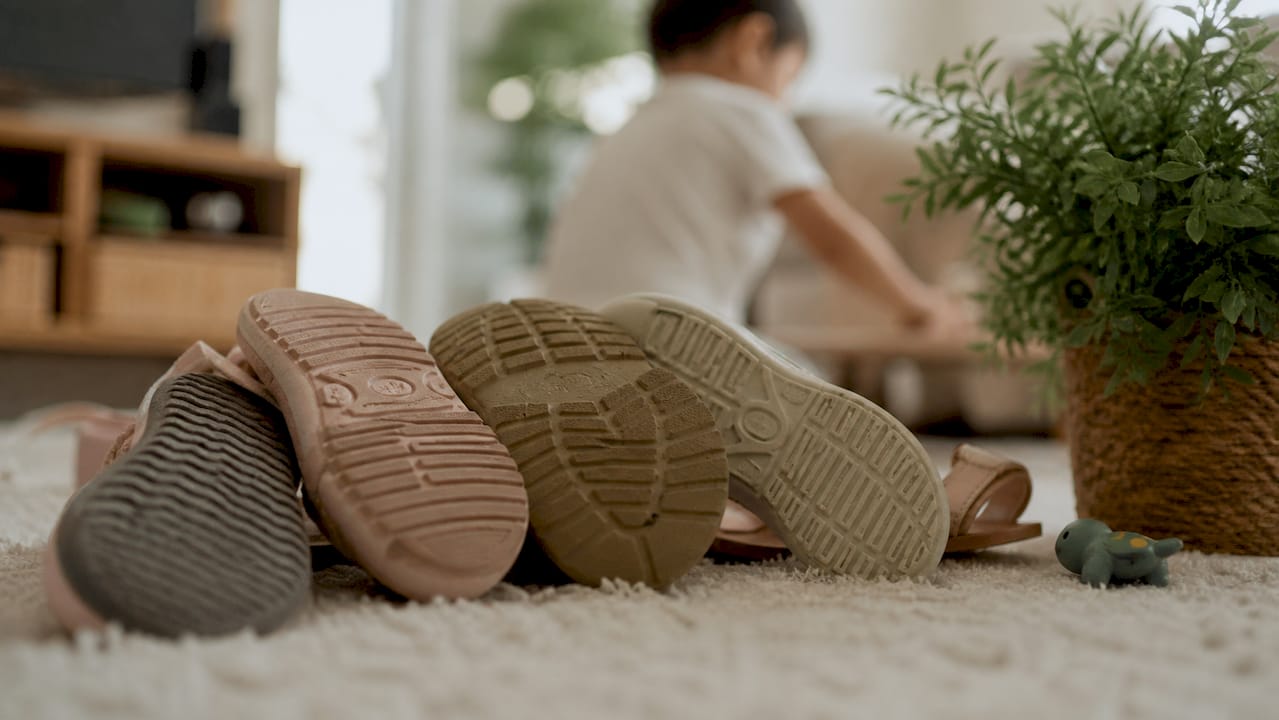
Soles over 10 mm are counterproductive for most children: they dampen too much, reduce ground feel, and generally make the sole too heavy for small feet.
Functional hardness can be described as follows: For toddlers, the sole should be bendable with one finger. For confident walkers, it can be a little firmer, but must still give at the forefoot. For wet surfaces and the beach, a deep tread is more important than a specific hardness.
How to check a child's sandal in a store in 90 seconds
Four tests that work without tools:
- Crease test: Hold the sole at the heel and toe, then press together. The sole should crease at the front by the ball of the foot, not in the middle. If it creases in the middle, the flex point is incorrectly constructed.
- Torsion test: Twist both ends of the sole against each other. Slight resistance indicates that the sole provides support without blocking. If it twists completely freely, it lacks stability; if it doesn't twist at all, it's too stiff.
- Thumb pressure: Press your thumb on the middle of the outsole. The material should give slightly and spring back. If a dent remains, the material is too soft and will wear through quickly.
- Wet grip check: Briefly test on a smooth tiled floor (many shoe stores have tiled areas). If the sole slips immediately, the tread is insufficient.
Practical checks from test reports confirm: Forefoot flexibility plus non-slip tread are the two criteria that matter most in everyday life.
When trying them on, let the child walk, briefly run, and if possible, climb stairs. If they stumble more often than usual or lift their feet unusually high, the sole doesn't match their gait.
Pro Tip: Remove the insole and have the child stand on it. This way, you can immediately see if the foot has full contact and if there's enough room at the front.
Which materials are suitable for children's sandal soles?
The choice of sole material directly influences hardness, wet grip, and durability. No single material is superior in every respect.
| Material | Ground feel | Wet grip | Abrasion | Special feature |
|---|---|---|---|---|
| Natural rubber | Very good | Very good | Good | Becomes noticeably stiffer in cold temperatures |
| EVA foam | Medium | Medium | Moderate | Lightweight, good rebound, gives way after prolonged stress |
| PU (Polyurethane) | Medium | Good | Very good | Heavier than EVA, more durable |
| Rubber (synthetic) | Good | Good | Good | Cheaper than natural rubber, less tactile |
Combinations of natural rubber outsole and EVA midsole provide the best results in everyday use: the outsole provides grip and ground feel, while the midsole keeps the weight low. Pure EVA soles are lightweight but slippery on wet stone and wear out faster.
Temperature dependence is an underestimated factor. Natural rubber and EVA become noticeably firmer at temperatures below 10°C. If sandals are also used in autumn, this should be considered when purchasing in summer, and the sole should be checked at cool room temperature.
Fit and measurement time: What sole thickness has to do with comfort
A good sole is of little use if the shoe doesn't fit. And fit isn't a one-time issue, but a routine.
Measuring rules:
- Measure feet in the afternoon or evening: Children's feet swell slightly during the day.
- Use the larger foot as a reference.
- Remove the insole, have the child stand on it, check the distance to the toe tip with your finger.
Recommended allowance:
- Standard rule: 10–12 mm between the longest toe and the shoe edge.
- Seasonally (growth spurt, longer wear time): up to 17 mm possible.
- For very flexible soles: a firm heel strap and adjustable hook-and-loop fasteners are mandatory, otherwise the foot will slip in the shoe.
Practical measurement guidelines confirm these reference values. If you want to know more about width adjustment, the fit guide for children's sandals provides specific tips on foot width and hook-and-loop closures.
Harder soles are less forgiving of fit errors. If the sole hardly yields and the shoe is too short, it immediately causes pressure. With flexible soles, the child often only notices the pressure after prolonged wear.
When is a sole too soft, too hard, or worn out?
Visual and tactile warning signs that parents should be aware of:
- Too soft: The sole has permanently deformed, yielding at the heel or under the ball. The child slides in the shoe, and the heel strap no longer holds. The tread is barely visible anymore.
- Too hard: The child stumbles more frequently, lifting their feet unusually high when walking. The sole hardly flexes when bent. Complaints of pressure or fatigue after short distances.
- Worn out: The tread on one side is significantly more worn than on the other. This indicates an asymmetry in foot roll-off and is a sign to replace the shoe and consult a pediatric orthopedist if the asymmetry persists.
- Replacement time: When the tread is flat, the sole is permanently deformed, or the shoe has become too short inside. Children grow quickly; many sandals are due for replacement after one season.
The AWMF guideline on childhood flatfoot recommends specialist medical clarification for noticeable foot deformities or pain. A worn sole pattern alone is not a diagnosis, but a reason to look more closely.
What research and professional associations say about sole selection
The recommendations in this guide are based on several independent sources:
- The DGOU describes barefoot walking as beneficial for foot development and recommends shoes that mimic this principle.
- AOK advises flat, flexible soles and explicitly warns against strongly shaped footbeds for toddlers, as these can passive the muscle development.
- The AWMF guideline emphasizes that passively forming insoles and footbeds should be used cautiously in toddlers.
Key message from professional associations: It's not the binary distinction "hard vs. soft" that matters, but the function: Where does the sole flex? How much ground feel does it allow through? Does it provide support without blocking?
IMTEST has practically tested children's sandals and comes to the same conclusion: flex point, tread, and heel support are more important than marketing claims about hardness. None of the sources mentioned provide general Shore A target values, because the material alone does not determine the function.
Ebmini's perspective: Why we design soles the way we do
Developing children's shoes presents a real conflict of objectives: A sole should protect and at the same time stand as little as possible between the foot and the ground. Many manufacturers solve this by simply using more material. More cushioning, more tread, more weight. This sounds safe, but it is the opposite of what children's feet need.
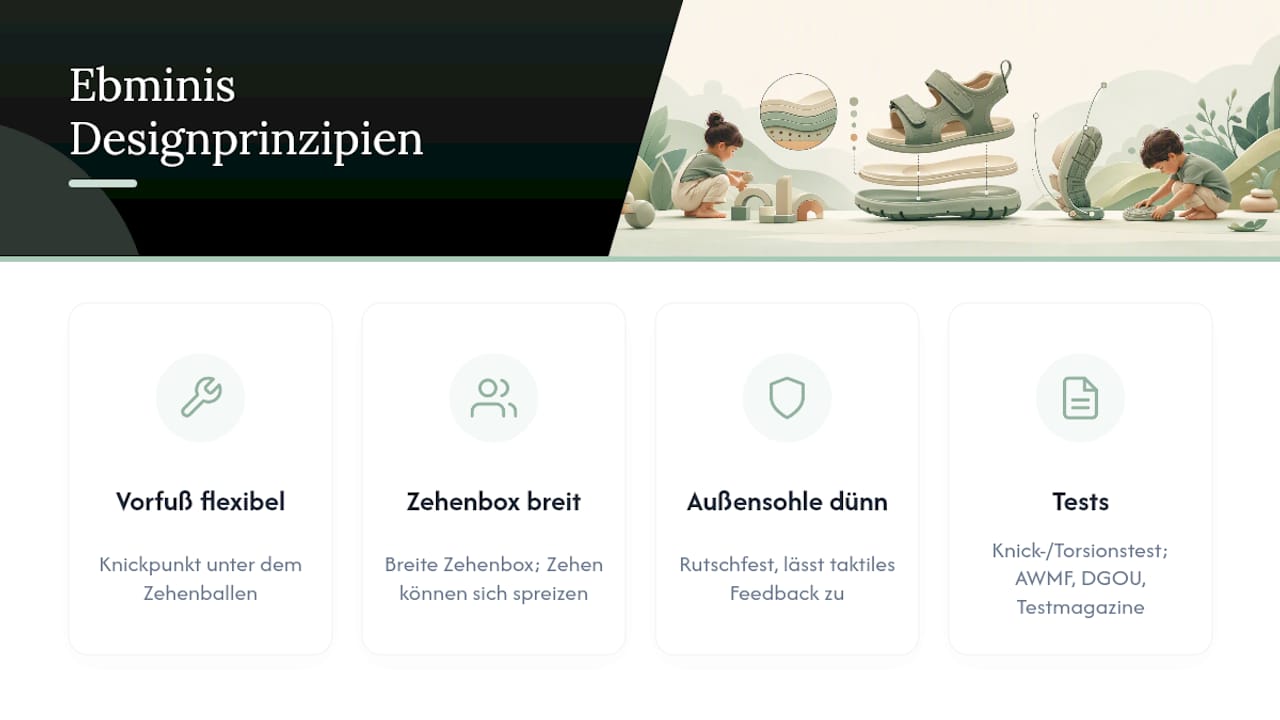
At Ebmini, we decided to resolve this compromise differently. The forefoot area remains intentionally flexible so that the bending point is exactly where it belongs: under the ball of the foot. The toe box is wide enough for the toes to splay out. The outsole is non-slip but thin enough to allow tactile feedback. Zero drop means that the heel and forefoot are at the same height. This sounds like a small design decision, but it has noticeable effects on posture and gait.
What's important to us: These decisions are not marketing. They follow the same guidelines described by AWMF, DGOU, and independent test magazines. Anyone who checks our sandals in a store with the bend test will see that the sole gives way at the front. Those who perform the torsion test will feel slight resistance, but no blockage.
For parents who are unsure about which size fits or how to properly measure their child's foot, we offer a measuring guide and a size advisor on our website.
Ebmini Sandals: Flexible Sole, Wide Toe Box, Available Now
For those looking for sandals that meet the aforementioned criteria without spending hours comparing them in a shoe store: Ebmini's children's sandals are designed to meet these exact requirements. Flexible bending point at the forefoot, wide toe box, non-slip outsole, ultra-light, and waterproof for everyday outdoor use.

The online shop offers an integrated size advisor and a measuring guide, so parents can find the right size even without trying them on in a store. If you're unsure, you can remove the insole after delivery and compare it directly with your child's foot. Simply view the collection and determine the correct size with the measuring guide.
Sources
- PubMed Central Article (relevant review on foot development)
- S2k Guideline Childhood Flatfoot (AWMF)
- Finding the Right Children's Sandals: Expert Explains What Children's Feet Really Need – IMTEST
- The Best Children's Sandals: Recommendations 2026 | WUNSCHKIND Community


