

Children's Sandals in Summer: A Selection Guide for Parents
For summer, choose barefoot-friendly, flexible sandals with a wide toe box, a thin, flexible sole, and ample space in front of the toes. This is not a fashion choice but an orthopedic one. If these three criteria are met, you’re usually making the right choice, whether your child is just learning to walk or is already tearing up the playground.
In summary, here’s what matters:
- Sole: ultra-flexible, no heel (zero drop), between 3 and 6 mm thick
- Toe box: wide enough for toes to splay; 12–17 mm space in front of the big toe
- Closure: Velcro with heel support so the shoe doesn’t slip
- Material: chrome-free tanned leather or low-pollutant textiles; Öko-Test and REACH as guidance
- Fitting: measure in the afternoon, both feet, use insole as a template
Öko-Test and orthopedists agree: children don’t need molded footbeds or rigid soles. What they need is ground contact, freedom of movement, and a shoe that moves with them, not against them. Ebmini develops its barefoot sandals precisely according to this principle, in collaboration with orthopedists.
Pro Tip: Always measure in the afternoon when feet are slightly swollen. And let the child walk for five minutes after trying them on. If they don’t immediately take the shoe off and don’t stumble, it fits well.
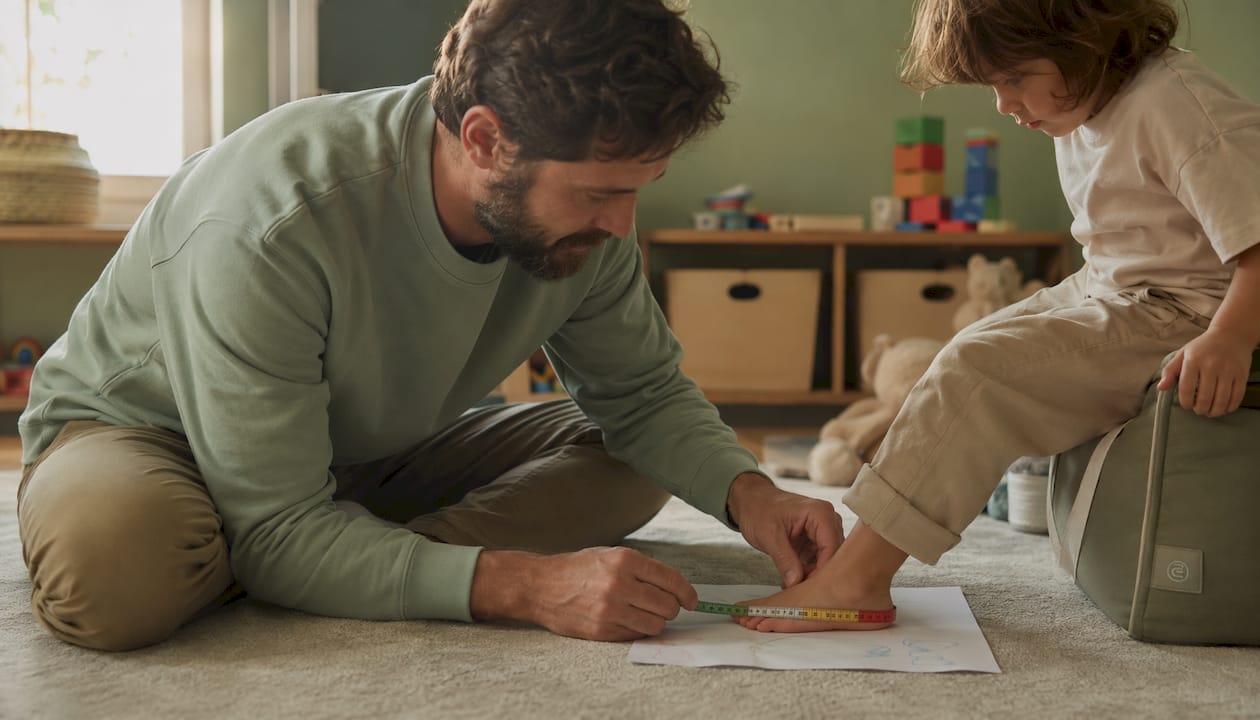
Table of Contents
- What makes a good children's sandal?
- When open, when closed sandals?
- Which materials are safe and low in pollutants?
- How to measure and try on correctly?
- Velcro, buckle, or elastic: which closure is right for when?
- Care and cleaning: how to make sandals last longer
- Checklist: 7 questions before buying
- Why barefoot-friendly sandals promote foot development
- Key Takeaways
- Why the barefoot principle is more than a trend
- Order barefoot sandals for children directly from Ebmini
- Useful sources and further links
What makes a good children's sandal?
Sole, toe box, drop, and grip in detail
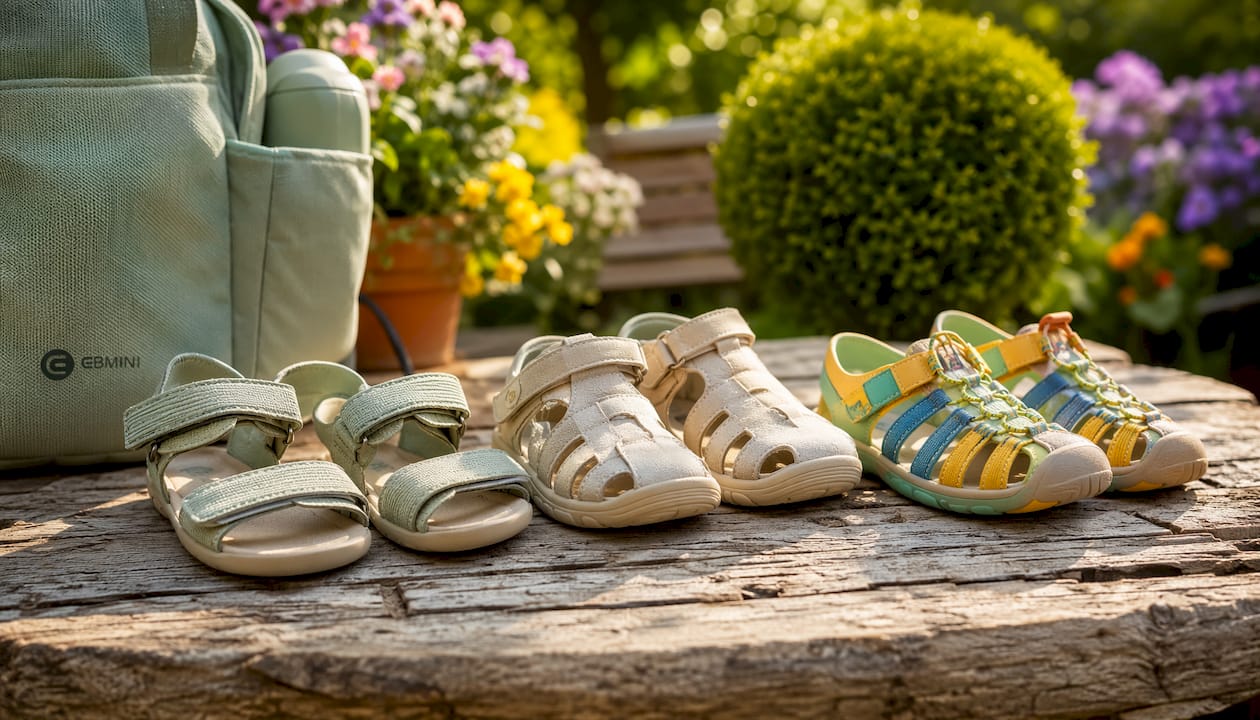
The sole is the heart of the shoe. A flexible sole can be easily bent with two fingers, without resistance. If not, it’s too stiff. For children's feet that are still developing, a rigid sole means the foot muscles work less and remain weaker in the long term.
The sole thickness should be between 3 and 6 mm to provide sufficient protection without dampening the ground feel too much. Zero drop, meaning no height difference between heel and forefoot, is not a trend but anatomically sensible: the foot stands flat, as it naturally does.
The wide toe box is at least as important. Children naturally have wide, fan-shaped feet. A pointed shoe forces the toes together, which over time can lead to deformities. Orthopedists recommend 12–17 mm of space in front of the big toe to prevent toes from being constricted. The benefits of a wide toe box become apparent after just a few weeks: children walk more stably and grip the ground more actively.
No pronounced footbed. This sounds counterintuitive, but it's an orthopedist’s recommendation: a flat, flexible sole strengthens the natural foot muscles through ground contact. A molded arch support does the work that the foot itself should perform.
For grip: a profiled rubber sole that holds on dry and slightly damp surfaces. This is crucial, especially on playgrounds with wood chips or wet stones.
Öko-Test evaluates children's sandals based on ingredients and suitability for use. In past tests, many models failed due to problematic ingredients or lack of everyday usability. Only a few pairs received the rating "good."
When open, when closed sandals?
Uses by age and activity
The rule of thumb is simple: the younger the child and the more active the movement, the more protection the forefoot needs.
- Learning to walk phase (approx. 1–3 years): Closed sandals with toe cap and heel support. The foot muscles are still underdeveloped, and open models offer too little guidance.
- Daycare and playground: Closed or semi-open models with toe cap, especially when riding balance bikes. Toes hit obstacles when braking and climbing.
- Hot days, beach, quiet walks: Open barefoot sandals with heel support are ideal. Maximum ventilation, minimal weight.
- Water play, swimming pool: Quick-drying materials, non-slip sole, preferably no textile lining that stays wet for a long time.
- Hiking and outdoor: Closed trekking sandals with a profiled sole and adjustable straps.
Barefoot sandals with zero drop and a sole thickness of 3–6 mm, as well as 12–17 mm of space in front of the toes, are generally the best choice for foot development, provided grip and protection are sufficient for the respective use. For everyday city life or in the garden, they almost always fit. For climbing frames and gravel paths, a bit more sole is needed.
| Area of Use | Recommended Type |
|---|---|
| Learning to walk phase | Closed, toe cap, heel support |
| Daycare / Playground | Closed or semi-closed |
| Beach / Summer walks | Open, barefoot sandal |
| Water play / Swimming pool | Quick-drying, non-slip |
| Hiking / Outdoor | Closed, profiled sole |
Which materials are safe and low in pollutants?
Öko-Test recommends chrome-free tanned leather and explicitly warns against hard plastic and synthetic linings that cause sweating. Chrome tanning is the classic process where heavy metal residues can occur. Vegetable or chrome-free tanned leather is more skin-friendly and is also recommended for preventing contact allergies.
For water sandals, pollutant-free plastics and quick-drying textiles are sensible. Recycled materials, such as those made from PET fibers or vegetable-tanned leather, are sustainable alternatives increasingly offered by manufacturers. Vegan models made from synthetic materials are common, but not automatically lower in pollutants than leather.
Warning signs when buying:
- Strong chemical smell directly from the packaging
- Strongly bleeding fabrics (rub test on a white cloth)
- Hard, non-bendable plastic in the lining
- No information on tanning processes or certification
Certification marks as guidance:
- Öko-Test Seal: Tests ingredients and usability
- Öko-Tex Standard 100: Tested textiles for harmful substances
- REACH Compliance: European chemical regulation, applies to all products sold in Germany
How to measure and try on correctly?
Step-by-step guide for a secure fit
The best measuring method is to use the insole as a template: remove the sole, have the child stand on it, and measure the space in front of the big toe. Measure both feet, as they are often different lengths. Use the larger foot as the benchmark.
The finger-pressure test at the front is unreliable: children reflexively curl their toes when pressed. The result is misleading. Better: have the child actively splay their toes while standing and observe whether the toe box offers enough space.
Trying on in the afternoon is not a myth. Feet swell slightly throughout the day, especially in warm weather. A shoe that fits in the morning might pinch in the afternoon.
| Step | What to check | Why |
|---|---|---|
| Remove insole | Place foot on it while standing, measure space | Most accurate method, no reflex problem |
| Measure both feet | Use the longer foot as the basis | Feet are often different lengths |
| Measure in the afternoon | Feet slightly swollen | Prevents too tight a fit in warm weather |
| Check toe box | Have child splay toes | Shows actual space needed |
| Test heel support | Observe heel while walking | If the heel slips, the shoe is too big or too wide |
| Walking test | 5–10 minutes on various surfaces | Stumbling and slipping indicate fit problems |
Common mistakes: Relying solely on shoe size (sizes vary by manufacturer), buying a toe box that's too narrow because "they'll grow into it," or measuring in the morning and buying in the afternoon.
The child's behavior is the most honest test: if they don't immediately take the shoe off and walk steadily without stumbling, it fits well. Children who constantly tug at their shoes or become restless signal discomfort, even if they can't express it in words.
Velcro, buckle, or elastic: which closure is right for when?
Velcro closures are the standard for daycare and elementary school children. They are quick to open, easy for children to close themselves, and with a large Velcro area, they hold up well even after many washes. Important: The Velcro area should be wide enough so that even children with less dexterity can put on the shoe themselves.
Buckles allow for finer adjustment, especially for unusual foot shapes. They last longer than Velcro, but are harder for small children to operate.
Elastic closures are practical for quick on and off, but offer fewer adjustment options. A good choice for water sandals or beach models.
What really matters:
- A heel strap is mandatory. Without it, the shoe slides forward when walking.
- Adjustable instep allows adaptation to different foot volumes.
- Reflective elements are a plus for dusk walks.
- Removable insole facilitates cleaning and drying.
- Water-repellent seams extend lifespan in wet conditions.
Pro Tip: Pay attention to the quality of the Velcro closure. A wide Velcro area with dense pile lasts significantly longer than narrow strips. After a season, it becomes clear whether the Velcro still grips or is already worn out.
Care and cleaning: How to make sandals last longer
Everyday cleaning is straightforward. Remove coarse dirt with a brush, wipe leather with a damp cloth, and wash textile and synthetic models with mild soapy water if necessary. Always air dry, never on a heater or in direct sunlight.
Leather-specific:
- Do not soak chrome-free tanned leather.
- After drying, occasionally treat with a nourishing leather cream.
- Do not use aggressive cleaning agents.
Water and beach sandals:
- Rinse with clear water after each use.
- Remove insole and let dry separately.
- Do not store in closed bags while still damp.
Regular care check:
- Check Velcro closures for wear: does the Velcro still grip securely?
- Observe sole wear: is the tread still visible?
- If the sole is severely deformed or the heels are worn through, a replacement is due, even if the shoe still looks good visually.
Checklist: 7 questions before buying
Before you buy, whether in a store or online, these seven questions will help:
- Is the sole flexible enough to bend with two fingers?
- Does the sandal have a wide toe box that allows splaying?
- Is there 12–17 mm of space in front of the toes?
- Is the heel firmly seated without slipping?
- Is the material tested for harmful substances (Öko-Test, Öko-Tex, or similar)?
- Does the sole have a non-slip tread?
- Is there a size chart with inner lengths in millimeters?
At-home fitting ritual:
- Remove the insole, place foot on it, measure space.
- Have the child walk for 10 minutes on various surfaces.
- Observe: Do they stumble? Does the heel slip? Do they take off the shoe?
For online purchases:
- Measure the insole from an old shoe and compare it with the size chart.
- Check return policy before ordering.
- If unsure, order two sizes and return the less suitable one.
Why barefoot-friendly sandals promote foot development
Barefoot-friendly sandals strengthen natural muscle and coordination development when they offer protection, grip, and a wide toe box. This is not a marketing statement, but the core of what orthopedists and Öko-Test have been recommending for years.
The logic behind it: walking barefoot is the most natural form of locomotion for children. Every step on uneven ground trains small muscles that are barely activated in a cushioned, stiff shoe. A barefoot-friendly sandal transfers this principle to everyday life: it protects against heat, sharp stones, and dirt without blocking natural rolling motion.
Ebmini develops its sandals in collaboration with orthopedists according to precisely these principles:
- Zero Drop: No heel drop, the foot stands flat.
- Wide toe box: Toes can splay freely.
- Flexible, non-slip sole: Ground contact is maintained, grip is secure.
- Ultra-lightweight: No unnecessary resistance when walking.
In addition, Ebmini offers detailed size advice, customer reviews, and a guarantee that secures online purchases.
Key Takeaways
The most important buying rule for children's sandals in summer: sole thickness between 3 and 6 mm, wide toe box, 12–17 mm of space, and heel support are non-negotiable; everything else is secondary.
| Topic | Details |
|---|---|
| Sole thickness and flexibility | 3–6 mm, bendable with two fingers, Zero Drop for natural foot roll |
| Toe box and room | Wide toe box with 12–17 mm space in front of the toes prevents deformities |
| Open vs. closed models | Toddlers and active children need toe caps; open models for quiet summer days |
| Measuring and fitting | Measure in the afternoon, use insole as a template, observe behavior while walking |
| Ebmini recommendation | Barefoot sandals with Zero Drop, wide toe box and orthopedic development, available for direct order |
Why the barefoot principle is more than just a trend
Anyone who takes a closer look at children's shoes will notice: most parents buy shoes that are too tight, too stiff, and have arch support too early. This is understandable, as the market is full of models that sell support as a quality feature. However, the opposite is true.
Customer reviews from parents who have switched to barefoot sandals regularly report that children prefer wearing these shoes significantly more than conventional models. This is no coincidence. A shoe that feels like a second foot is not perceived as a foreign object.
Ebmini is a provider of barefoot-friendly children's shoes and recommends the barefoot principle out of conviction, not just product interest. Even if you prefer other models, you should still pay attention to the three core criteria: flexible sole, wide toe box, no heel. The rest is a matter of taste.
Order barefoot sandals for children directly from Ebmini
Ebmini sandals meet exactly the criteria recommended by this guide: Zero Drop, wide toe box, flexible and non-slip sole, ultra-light weight, and developed in collaboration with orthopedic specialists. No molded footbed, no unnecessary heel.
If you are looking for the right sandals for summer, you can find the current collection directly in the Ebmini Barefoot Sandals Collection. For parents also looking for everyday shoes or sneakers, the full range is available under Children's Barefoot Shoes.
Ebmini offers detailed size advice with an inner length chart, free shipping, and a guarantee that also secures online purchases. Customer reviews help with model selection. Simply measure foot length, check the size chart, and order.
Useful Sources and Further Links
For a deeper dive into individual topics from this selection guide, the following sources are recommended:
External Sources:
- Öko-Test: Children's Sandals in Review: Test results on ingredients and suitability for use; shows which materials are problematic and which models pass.
- Barfußhelden: Barefoot Sandals for Children: Measurement instructions, sole values, and brand overview for barefoot-friendly models.
- ENFK: The Best Children's Sandals: Practical measurement and fitting tips, including a note on the finger-pressure test.
- Wunschkind Community: Children's Sandal Recommendations: Testimonials, checklist, and orthopedic advice for everyday life.
- Eltern.de: Children's Shoes in Summer: Overview by age groups and areas of use, from first walking shoes to water sandals.
Internal Resources at Ebmini:
- Sandal Fit: Foot Width and Comfort: Detailed explanation of the relationship between foot width and toe box.
- Toe Box in Children's Shoes: Practical tips for checking the toe box when buying.
- Children's Barefoot Sandals 2026: Current model overview and positioning of the Ebmini collection.
- Summer Shoes for Children: UV Protection and Material Choice: Notes on summer conditions and material selection in heat.


