

Children's shoes flexibility test: Here's how to do it right
A child's shoe is considered suitable if it can be bent at the ball line by at least 90 degrees, because only then does it support the natural rolling motion of the foot. For children between 1 and 10 years of age, this flexibility is not a comfort feature, but a basic prerequisite for healthy foot development. Stiff soles force the foot muscles into a passive role, which can lead to weakness and incorrect loading in the long term. Knowing how to properly test the flexibility of children's shoes helps to make a better purchase decision. This article shows how to check flexibility at home, what matters at the bending point, and which mistakes you should avoid.
How to properly test the flexibility of children's shoes?
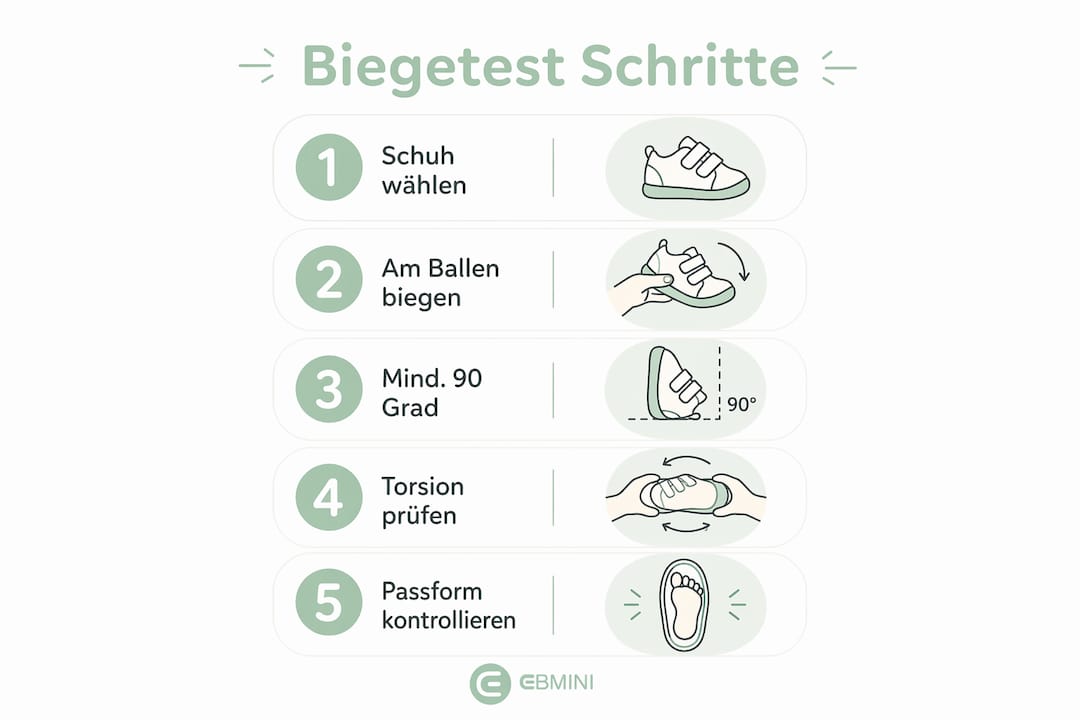
The most important test is the 90-degree bend test. Hold the shoe at the toe and heel, press both ends together, and observe where and how much it gives way. A good child's shoe bends easily and without much resistance exactly in the ball area.
Here are the step-by-step instructions for the test at home:
-
Bend test in the ball area: Hold the shoe with one hand at the toe and with the other at the heel. Press both ends together. The shoe should bend at least 90 degrees in the front third, exactly where the toes push off when rolling.
-
Check the bending point: Look closely at where the shoe creases. The bending point must be exactly under the metatarsal heads, i.e., under the ball of the foot. If the shoe creases in the middle or too far back, the construction is incorrect.
-
Torsion test: Hold the shoe at the toe and heel and twist both ends against each other, as if wringing out a wet cloth. A good shoe will give way slightly, but will not twist like a rag. Too much torsional freedom means a lack of lateral stability.
-
Repeated bending: Bend the shoe several times in a row. A single bend is not enough to detect material fatigue. Look for cracks in the sole material, squeaking noises, or areas that deform permanently.
-
Hand test: Place the shoe in your palm and press the sole with your thumb. It should give way noticeably without immediately springing back into a stiff shape.
Pro tip: Always perform the bend test on both shoes. Quality differences between the left and right shoe of a pair do occur and are a sign of poor workmanship.
The torsion test is often forgotten but is just as important as the bend test. A shoe that twists too easily offers no lateral support for the foot. This is especially a problem on uneven terrain.
What role do sole thickness and material flexibility play?
Sole thickness determines how much the foot feels of the ground. This is not by chance, but intentional: ground sensitivity trains the foot muscles and sharpens the sense of balance. Overly thick soles dampen this sensation.
The recommended sole thicknesses vary depending on the child's developmental stage:
| Developmental phase | Recommended sole thickness | Purpose |
|---|---|---|
| Before walking age | 1–3 mm | Maximum ground sensitivity |
| Beginner walkers | 3–6 mm | Protection during first steps |
| Confident walkers | 6–10 mm | Balance of protection and flexibility |
These guidelines show: The younger the child, the thinner the sole can be. With increasing age and more activity on hard surfaces, the foot needs a bit more protection without losing flexibility.
The sole material also plays a crucial role. Rubber with high rebound immediately returns to its original shape after bending. This is good. Materials that permanently deform or turn white after bending show material fatigue. Such shoes quickly lose their flexibility.
Barefoot walking is considered ideal for strengthening foot muscles. Shoes should support this natural function with maximum flexibility and flat, heel-less soles. This does not mean that children's shoes do not need a sole. But it should be as thin and flexible as possible without endangering the foot.
Pro tip: Lightly press the sole with your fingernail. If a visible dent remains, the material is too soft and will quickly lose its shape. If the sole springs back immediately, that's a good sign.
The balance between flexibility and support is particularly important for older children. A shoe for an 8-year-old child who plays soccer needs more lateral stability than a shoe for a 2-year-old playing in the living room. Flexibility in the forefoot and support at the instep are not mutually exclusive.
How do you check fit and space in the shoe?
The best sole flexibility is useless if the shoe doesn't fit. Shoes that are too tight force the toes together and prevent natural splaying when rolling off. Shoes that are too big cause the foot to slide and unnecessarily strain the muscles.
Here's how to reliably check fit and space:
-
Make a foot template: Place the child's foot on a piece of cardboard and trace it. Cut out the template and slide it into the shoe. It should fit with about 1.5 cm of play, without buckling or creasing. This extra space allows for growth and movement when rolling off.
-
Thumb test: After putting on the shoe, press your thumb on the toe cap. There should be about a thumb's width of space between the longest toe and the end of the shoe. Less means too tight, significantly more means too big.
-
Check toe freedom: Ask the child to splay their toes in the shoe. If this is not possible, the toe box is too narrow. A wide toe box is not a luxury, but a prerequisite for healthy rolling.
-
Heel test: Slide a finger between the heel and the back of the shoe. If the finger fits loosely, the shoe is too big. If it doesn't fit at all, the shoe is too tight.
-
Note measurement time: Measure feet in the afternoon, standing and with socks, as feet are largest then. Use the larger foot as the measurement.
Children often don't notice when shoes are too tight. They get used to the pressure and rarely complain. Therefore, it is the parents' responsibility to check regularly. Every two to three months is advisable for toddlers, as children's feet grow quickly. Helpful tips on the correct shoe size can be found in a detailed checklist.
Which mistakes do parents often make when testing shoe flexibility?
Many parents test children's shoes in the store briefly and consider that sufficient. It's not enough. Here are the most common mistakes:
-
Bending only once: A single bend test does not show if the material is durable. Repeated bending reveals material fatigue that remains invisible on the first attempt.
-
Wrong bending point: If the shoe creases in the middle instead of the ball area, the construction does not fit the child's foot. This leads to an unnatural rolling motion and can cause malpositions.
-
Too soft soles for older children: A shoe that can be folded like a rag does not provide sufficient support for a 7-year-old child on uneven ground. Flexibility in the forefoot is the goal, not complete softness.
-
Overlooking heel drop: The drop describes the height difference between the heel and the forefoot. A heel drop permanently changes posture and strains the calf muscles, even if the sole is flexible. The marble test helps: Place a marble in the shoe. If it rolls to the toe, there is a drop.
-
Prioritizing aesthetics over function: Colorful shoes with glitter or superhero motifs sell well. But stiff soles, narrow toe boxes, and high heels harm the foot, no matter how beautiful the shoe looks.
Excessive cushioning or a heel drop can passively alter natural foot posture and weaken active foot muscles. This is an argument for choosing shoes with a zero-drop sole, meaning no height difference between the heel and forefoot. More on why flexible soles are so important for children's foot development is explained in a separate guide.
Key findings
A child's shoe that bends at least 90 degrees in the ball area, has a correctly placed bending point, and provides enough room for the toes reliably supports the natural foot development of children between 1 and 10 years of age.
| Topic | Details |
|---|---|
| Checking flexibility | Shoe must bend at least 90 degrees in the ball area. |
| Checking the bending point | The bending point must be exactly under the metatarsal heads, not in the middle. |
| Considering sole thickness | 1–10 mm depending on age; thinner soles promote ground sensitivity in toddlers. |
| Regularly checking fit | Remasure every two to three months, in the afternoon standing with socks. |
| Avoiding heel drop | Zero-drop soles maintain natural foot posture and strengthen muscles. |
What I've learned after years in children's footwear
At Ebmini, we talk to parents every day who are frustrated. They've bought expensive shoes that became stiff after two months or that their child no longer wants to wear. Almost always, the reason is a lack of testing before purchase.
What truly surprised me was that most parents don't even test flexibility because they don't know how. They briefly press the sole and think that's enough. It's not. The bending point is crucial. A shoe can bend and still crease in the wrong place. It's like a hinge placed in the wrong spot.
I've also learned that parents often put too much trust in brands. A well-known name doesn't guarantee good sole flexibility. We've seen shoes from unknown manufacturers that passed all tests, and shoes from big brands that failed the torsion test immediately.
My honest advice: Take five minutes to test the shoes when buying. Bend, twist, press. Slide the template in. Check the bending point. And if you're unsure, ask someone who knows. A good parent's guide to shoe quality helps ask the right questions.
— Ebmini
Ebmini: Flexible children's shoes for healthy feet
Anyone who knows how to test flexibility immediately recognizes what makes a good barefoot shoe.

Ebmini's barefoot shoes are specially designed for children between 1 and 10 years old. They offer a wide toe box, a zero-drop sole without a heel drop, and a sole that easily passes the 90-degree bend test. The range includes models for all seasons, from light barefoot sandals for summer to waterproof all-weather models for winter. All shoes are ultra-light and designed not to alter the child's gait. Check out the full range and find the right shoe for your child.
FAQ
What does flexibility mean in children's shoes?
Flexibility describes how easily a shoe can be bent in the forefoot area. A suitable children's shoe should give way at least 90 degrees in the ball area without much resistance.
Where must a child's shoe bend?
The shoe must crease exactly under the metatarsal heads, i.e., in the ball area. If it creases in the middle of the sole, the bending point is wrong, and the rolling motion will be unnatural.
How often should I check my child's shoe fit?
For toddlers, every two to three months, as children's feet grow quickly. Measure the foot in the afternoon while standing and with socks, and use the larger foot as the reference.
Are very soft soles always better for children?
No. Very soft soles without lateral support can be problematic for older children on uneven ground. The goal is flexibility in the forefoot while maintaining sufficient lateral stability.
What is the marble test?
The marble test checks for heel drop: Place a marble in the shoe. If it rolls towards the toe, the shoe has a drop, meaning a height difference between the heel and the forefoot. This is unfavorable for children's shoes.


