

Children's Shoe Flexibility Test: Methods for Parents 2026
The flexibility test for children's shoes checks whether the sole moves smoothly at the foot's natural flexion point while remaining stable enough to support healthy foot development. Children's shoe flexibility test methods include three proven approaches: the manual bend test at the metatarsophalangeal joint, the torsion test, and the practical walking test on various surfaces. Maximally flexible, thin soles without a heel promote natural muscle stimuli and are especially important for new walkers. Combining all three methods ensures the safest decision for your child's foot health when buying shoes.
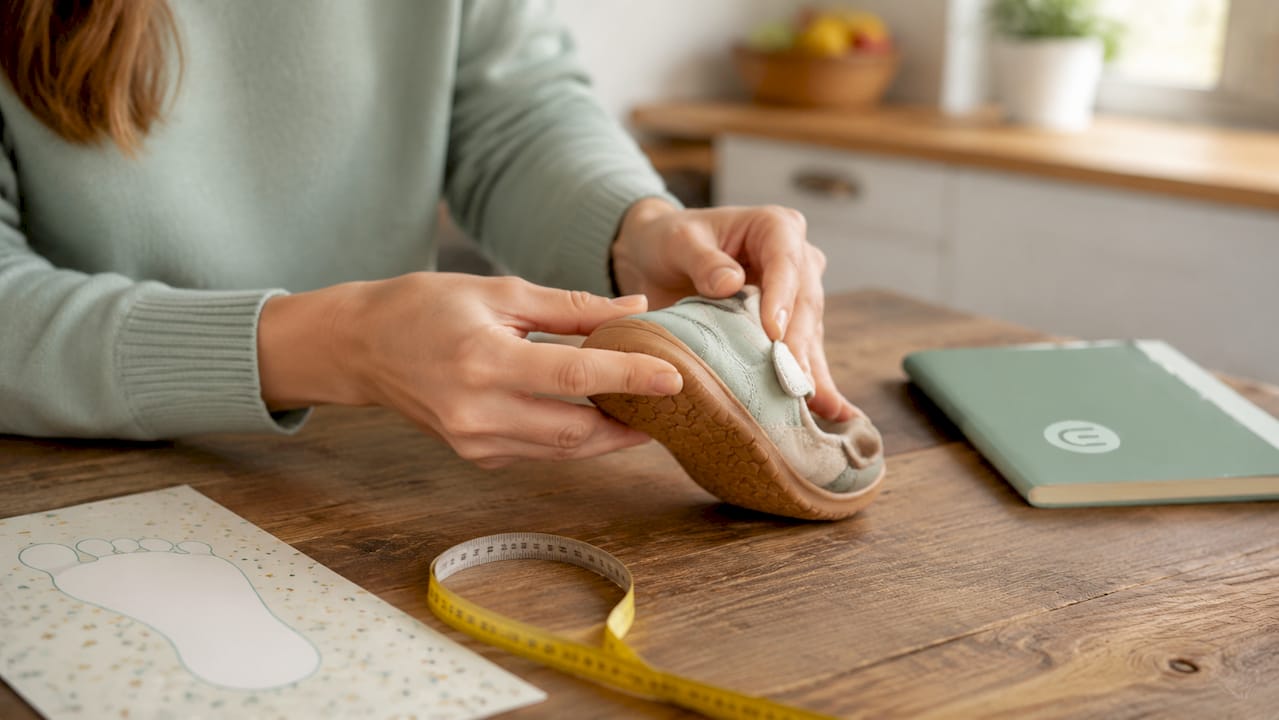
1. Manual Bend Test: Finding the Right Flex Point
The correct flex point is under the metatarsophalangeal joints and is crucial for a natural rolling motion. If a shoe bends at the wrong place, for example in the middle of the sole, it incorrectly strains the foot muscles. The child often doesn't notice this immediately, but over time, it can lead to postural problems.
Here's how to perform the test:
- Remove the insole if it is removable.
- Hold the shoe at the heel and toe cap.
- Slowly bend the shoe upwards until it resists.
- Check exactly where the bend occurs: It should be in the front third, not in the middle.
- Release the shoe and observe how quickly it springs back to its original shape.
A good shoe flexes exactly where the foot rolls during walking. If it flexes too far back, it lacks the necessary support. If it doesn't flex at all, the sole is too stiff.
Pro Tip: After bending, press your thumb on the sole. If a permanent dent or crease remains, it indicates inferior material. A high-quality shoe springs back immediately without leaving visible marks.
Warning signs are shoes that only bend under strong pressure or show cracks during the first test. Such models are immediately disqualified, no matter how pretty they look.
2. Torsion Test: Assessing Lateral Stability Correctly
In the torsion test, the shoe should yield gently lengthwise, but must not collapse sideways. This balance is more difficult to assess than pure flexibility, but just as important. Insufficient torsional rigidity compromises ankle stability, while excessive stiffness hinders natural rolling.
Here's how to test for torsion:
- Hold the shoe with both hands, one hand on the heel, one on the toe cap.
- Twist both halves against each other, as if wringing out a cloth, but only gently.
- A healthy shoe gives way slightly without the sole buckling or deforming sideways.
- Then check the sole structure: deep grooves perpendicular to the direction of travel increase flexibility, while grooves parallel to the direction of travel provide torsional stability.
Shoes that behave like a wet rag during the torsion test offer no support to the foot. Shoes that cannot be twisted at all are too stiff for active toddlers.
Pro Tip: Look at the sole profile from below. Many tread patterns already visually reveal whether a shoe is designed more for flexibility or stability. A fine, uniform profile indicates balanced torsional properties.
The torsional capacity prevents lateral collapse, while overly stiff soles hinder rolling. Both harm foot development in different ways.
3. Walking Test on Various Surfaces
The combination of a hand test and a walking test on various surfaces provides sound insights into flexibility and everyday suitability. The hand test alone is not enough. Only when the child wears the shoe and moves does it become clear whether the flexibility works in everyday life.
Here's how to conduct the walking test:
- First, let the child walk barefoot over different surfaces: smooth floor, gravel, grass.
- Observe the gait closely: How does the foot roll? How does the child react to unevenness?
- Then put on the shoes and repeat the round on the same surfaces.
- Compare: Does the gait change? Does the child trip more often? Does it seem more unsteady?
- Unevenness should be perceived similarly to being barefoot to ensure natural perception.
A shoe that significantly alters the gait dampens too much or is too stiff. The child loses contact with the ground and thus important information for balance regulation. Especially on gravel or grass, it quickly becomes clear if a sole is too hard.
The walking test should last at least five minutes. Short test runs in the store on a smooth floor reveal little. If possible, the shoe should also be tested outdoors before making a purchase decision.
4. Material and Workmanship as an Indicator of Flexibility
Material quality is crucial: flexibility must not come at the expense of being free from harmful substances. A shoe can bend wonderfully and still contain problematic ingredients. Both aspects must be right.
What to look for in material:
- Leather: Vegetable-tanned leather is preferable to chrome-tanned, as it contains fewer harmful substances and feels more natural.
- Synthetics: High-quality synthetic fibers can be flexible and low in harmful substances, but quality varies greatly depending on the manufacturer.
- Odor: A strong chemical odor is a warning sign. New shoes may smell slightly of material, but not pungent.
- Recovery behavior: A good shoe springs back to its original shape immediately after bending, without leaving visible creases or cracks. Permanent deformations indicate inferior material quality.
The material's memory is evident in how the sole springs back after bending and is a crucial quality characteristic. If you buy a shoe that already shows creases after the first bend test, you are buying a model that will lose its flexibility after a few weeks of use.
Signs of wear on new goods are also a warning sign. They indicate stored goods that have already suffered damage. Cracks in the sole, even small ones, disqualify a shoe for children.
5. Toebox and Fit as Part of Comfort Analysis
The shoe should be wider at the front to give the toes enough freedom of movement. A narrow toe box prevents the natural splaying of the toes during the roll-off motion. This is not a comfort problem, but a developmental problem.
Therefore, the children's shoe comfort analysis also includes a fit check. Press on the toe cap from the outside: there should be about a thumb's width of space between the longest toe and the end of the shoe. Less space means pressure points, more space means the child slides around in the shoe and cannot utilize its flexibility.
Have the child stand on their tiptoes in the shoe. If the heel noticeably lifts out of the shoe, it is too big. A well-fitting shoe remains stable at the heel even during this movement.
The toe box can also be checked from the inside: Place the child's foot on a piece of paper, trace the outline, and compare it with the insole outline of the shoe. The shoe should not be narrower than the foot at any point.
6. Sole Weight as an Underestimated Criterion
A lighter shoe promotes natural movement more than a heavy one. Toddlers don't lift their feet as efficiently as adults when walking. Every extra gram on the sole costs energy and changes the gait.
Weigh the shoe in your hand. A good children's shoe for toddlers feels almost weightless. If you test it on a kitchen scale, a single shoe in size 24 should be significantly under 150 grams. Heavier models often have thicker, stiffer soles that restrict flexibility.
The weight also reveals something about the material. Very light soles are often made of foamed materials, which are flexible but less durable. Here, the rebound test is particularly worthwhile to assess the material quality.
Pro Tip: Hold the shoe at the heel and shake it gently. A good shoe hardly moves. If the sole rattles or the construction seems loose, it indicates poor workmanship.
7. Comparing Methods: When Is Which Test Method Useful?
Simple hand tests combined with observing the child while walking help find the right balance between flexibility and stability. But not every test fits every situation.
| Test Situation | Recommended Method | Goal |
|---|---|---|
| Purchase decision in the store | Flexibility test and torsion test | Check basic flexibility and stability |
| Everyday suitability at home | Walking test on various surfaces | Assess natural gait and ground contact |
| Assessing material quality | Rebound test and odor check | Assess freedom from harmful substances and durability |
| Fit and toe freedom | Thumb-width test and paper outline | Ensure no pressure points and freedom of movement for toes |
| New walkers (first steps) | All methods combined | Ensure especially high flexibility and light weight |
Static tests like the bend test and torsion test are suitable for purchase decisions because they can be performed without the child. The walking test shows whether the shoe lives up to the hand test's promises in everyday life. Material checks complement both approaches and protect against hidden quality defects.
Many parents mistakenly prioritize stability over flexibility, although the latter is crucial for natural foot development. Those who know the methods make an informed decision instead of a fashionable one.
Adapting the tests to the child's developmental stage is important. New walkers need maximum flexibility and minimal weight. Older toddlers who are already walking confidently can benefit from slightly more torsional stability without sacrificing basic flexibility.
Key Takeaways
The most effective method for testing the flexibility of children's shoes is a combination of the bend test at the metatarsophalangeal joint, the torsion test, and the walking test, because only all three together ensure flexibility, stability, and suitability for everyday use.
| Topic | Details |
|---|---|
| Checking the bend point | The shoe must flex under the metatarsophalangeal joints, not in the middle of the sole. |
| Assessing torsion | Gentle twisting shows whether the shoe remains stable laterally without blocking the rolling motion. |
| Performing the walking test | At least five minutes on various surfaces, comparing barefoot and with shoes. |
| Ensuring material quality | Vegetable-tanned leather and immediate rebound after bending are signs of quality. |
| Checking the toe box | A thumb's width of space in front of the longest toe protects against pressure points and maldevelopments. |
What I really think after years of shoe consulting
Many parents come with a clear idea: the shoe should be stable so that the child doesn't twist an ankle. That sounds reasonable. But it's exactly wrong. A foot stuck in a stiff shoe doesn't train the muscles it needs to stabilize itself. The shoe does the work that the foot should actually do itself.
What I observe again and again at Ebmini: Parents who have once understood how the bend test works never buy a stiff shoe again. The test takes 30 seconds. It costs nothing. And it makes the difference between a shoe that promotes foot development and one that hinders it.
The second common mistake is forgetting the material aspect. Flexibility tests often overlook the material, although quality and freedom from harmful substances are just as important as flexibility itself. A shoe can bend perfectly and still be problematic. Both must be right.
My honest advice: Don't buy shoes that you haven't bent, twisted, and checked for rebound yourself. And let the child walk, not just in the store on a smooth floor, but outside, on real ground. Your child's foot will show you whether the shoe fits. You just have to look.
— Ebmini
Ebmini: Flexible Children's Shoes with Proven Quality
For those seeking children's shoes that meet all the mentioned flexibility criteria, Ebmini is a clear choice. Ebmini's barefoot-like children's shoes are designed for natural foot development: wide toe box, zero drop, ultralight soles, and tested materials free from questionable ingredients.

Ebmini also offers detailed sizing advice for parents, ensuring the shoe is not only flexible but also fits correctly. If you're unsure which model suits your child's developmental stage, you'll find detailed product information and customer reviews on the website. At Ebmini, quality and foot health are not at odds with everyday usability, even in rain, mud, and winter conditions.
FAQ
What is the most important flexibility test for children's shoes?
The manual bend test at the metatarsophalangeal joint is the most important test. The shoe must flex exactly where the foot bends during natural rolling.
How do I know if a children's shoe bends at the right point?
Hold the shoe at the heel and toe cap and bend it upwards. The bend should occur in the front third, not in the middle of the sole.
What does the torsion test reveal about children's shoes?
The torsion test checks if the shoe remains stable laterally. A good shoe will give way slightly when gently twisted without collapsing sideways.
How long should the walking test for children's shoes last?
The walking test should last at least five minutes on various surfaces, ideally outdoors on gravel or grass, not just on smooth store floors.
Why is the sole's rebound behavior a quality characteristic?
A shoe that springs back to its original shape immediately after bending is made of high-quality material. If creases or dents remain, the sole quickly loses its flexibility in everyday use.


