

Investing in Children's Shoes for the Long Term: The Parents' Guide
Investing in high-quality children's shoes long-term means actively protecting your child's foot health, not just spending money. Until school age, a child needs an average of 12 pairs of shoes, which puts a significant financial and ecological burden on families. Those who prioritize quality, fit, and sustainable materials early on save money in the long run and prevent orthopedic damage that can manifest in adulthood. This guide explains what truly matters, what characteristics define healthy shoes, and how you as a parent can plan wisely.
Why is the period between kindergarten and puberty crucial?
The period between kindergarten and puberty is the most critical for a child's foot development. During these years, the foot arches, muscles, and gait pattern are formed. Growth spurts occur rapidly, and the foot is sensitive to external influences like footwear.
The problem is concrete: More than two-thirds of children wear street shoes that are too small. Shoes that are too tight squeeze the toes together, hinder natural rolling, and can cause permanent deformities. Orthopedists observe that many postural defects in adulthood originate from poorly chosen footwear in childhood.
Shoes with thick, rigid soles and narrow toe boxes impede the natural rolling motion. This is not a minor issue. Fashionable sneakers, designed for adults and appearing in children's sizes, are often functionally unsuitable for growing feet.
Children's shoes are not miniaturized adult shoes. They must actively support the natural movement of the foot, offer wide toe rooms, and be flexible enough for the foot muscles to work independently. Only then can strength, coordination, and a stable gait pattern develop.
Functional shoes promote intrinsic foot muscles but do not replace movement. Barefoot walking on various surfaces remains the best training stimulus. Good shoes complement this; poor shoes hinder it.
How do you recognize healthy and sustainable children's shoes?
You can recognize healthy children's shoes by a few clear characteristics. Parents should view shoes as functional developmental tools, not fashionable accessories. Internalizing this leads to better purchasing decisions.
The most important quality features at a glance:
- Wide toe box: Toes must be able to spread freely without lateral pressure.
- Flexible sole: The shoe bends easily. A flexible sole allows for natural rolling motion.
- Zero Drop: No elevation of the heel compared to the forefoot. This promotes an upright posture.
- Natural materials: Leather and breathable textiles regulate the foot climate and adapt to the foot shape.
- Repairability: Shoes with replaceable soles or sewable seams last longer and reduce overall costs.
- No rigid footbed: Molded footbeds prevent the foot muscles from working independently.
Natural materials like leather support better fit and foot development. This is because leather adapts to the individual foot shape over time, while synthetic materials often remain rigid and worsen the foot climate.
Pro Tip: Calculate the purchase price not at the moment of purchase, but over the wear time. A €80 shoe that lasts 18 months costs less per month than a €30 shoe that is worn out after 4 months. The "cost-per-wear-time" principle makes high initial investments more economically sensible than frequent cheap purchases.
Avoid shoes with heels, even small ones, and models with very thick cushioning. Both sound comfortable but weaken foot muscles in the long term. And glitter or prints say nothing about quality.
What advantages do grow-along children's shoes offer?
Grow-along children's shoes solve a specific problem: children's feet grow quickly, shoes become too small before they are worn out. Adjustable shoes save about a complete pair by size adjustment of 8 mm in length. That sounds small, but it corresponds to a full growth step.
| Feature | Advantage for parents and child |
|---|---|
| Stepless size adjustment | Shoe fits over several growth steps, fewer new purchases necessary |
| Flexible construction | Foot muscles can develop freely, no restriction of movement |
| High-quality materials | Longer durability, better foot climate, adaptation to individual foot shape |
| Repairable soles | Extendable lifespan, significantly lower overall costs |
| Wide toe box | Toes spread freely, deformities are prevented |
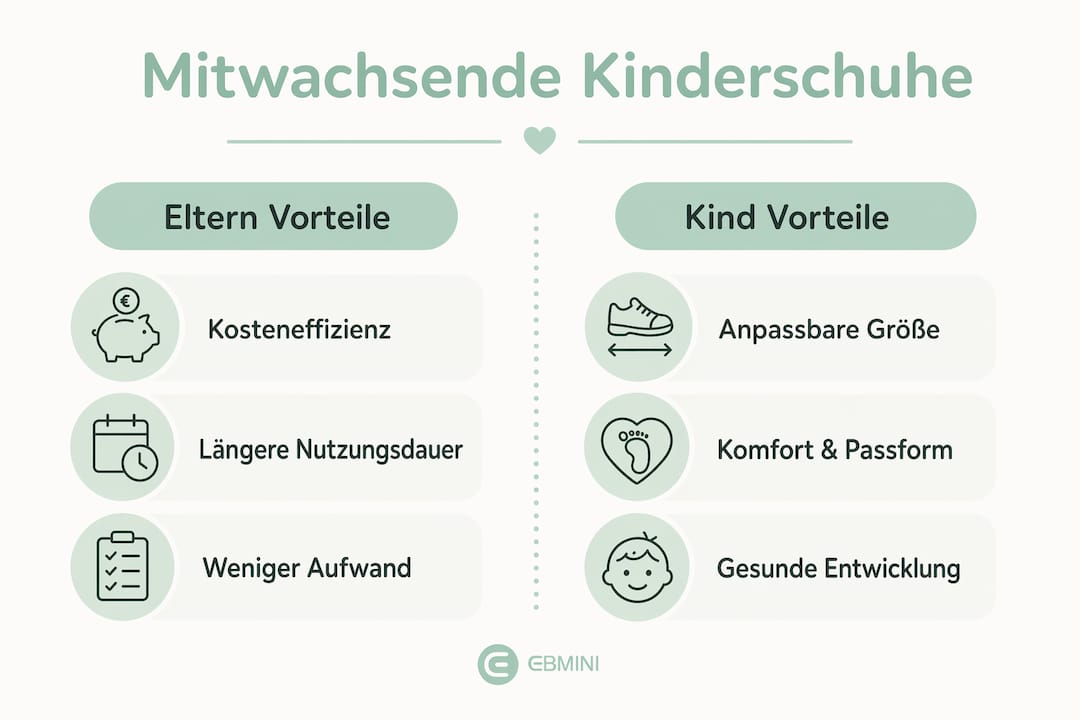
Patented mechanisms enable size adjustment without loss of stability. This is the crucial difference from simply wide-cut shoes. A grow-along shoe must still provide support, otherwise it does more harm than good.
Pro Tip: When buying adjustable shoes, always check that the sole remains flexible even at maximum size. Some mechanisms stiffen the construction. Bend the shoe in the middle: it should fold without much resistance.
Grow-along shoes are also an ecological argument. Fewer new purchases mean less resource consumption, less packaging, and fewer transport routes. Those who want to buy sustainable children's shoes will find a practical entry point in adjustable models.
How can you save money on shoe purchases in the long term?
Saving money on shoe purchases doesn't mean buying cheaply. It means planning wisely. Those who approach their child's shoe needs in a structured way will spend less overall and buy better quality.
- Measure foot size regularly: Every 8–12 weeks, you should have your child's feet measured. Children often don't feel when shoes become too tight. Shoes that are too small cause damage before you see it.
- Plan the purchase time: Don't buy shoes in summer for winter or vice versa without knowing the current foot size. Plan the purchase shortly after a measurement.
- Quality over price: A shoe for €70–90 made of natural materials with a repairable sole often outlasts two to three cheaper models. Calculate the price based on the useful life.
- Repair instead of new purchase: Many shoemakers replace soles for €15–25. This significantly extends the lifespan of a good shoe and is almost always worthwhile for high-quality models.
- Plan for hand-me-downs: High-quality shoes that have been well cared for can be passed on to younger siblings or other children. This further reduces the cost per child.
Cheap shoes are rarely truly inexpensive. Those who buy new shoes every 3–4 months spend more annually than someone who invests in a durable model once. In addition, there are invisible costs: deformities, physiotherapy, orthopedic insoles. These consequential costs arise insidiously and are rarely associated with the original shoe purchase.
Shoe care significantly extends lifespan. Regularly treat leather with leather care, allow shoes to dry after wearing, and never dry them directly on a radiator. This maintains the flexibility of the material and prevents cracks.
What materials and features make children's shoes sustainable?
Sustainable children's shoes combine durability, foot health, and environmental compatibility. These are not contradictions, but three sides of the same decision. Material quality determines foot climate, fit flexibility, and thus also the healthy development of foot muscles.
What you should pay attention to when it comes to materials:
- Natural leather: Breathable, adapts to the foot shape, durable with good care. Particularly suitable for everyday shoes.
- Recycled textiles: Some manufacturers use recycled materials for uppers and lining. Ensure breathability is maintained.
- Natural rubber soles: Flexible, grippy, and more durable than many plastic soles. Ideal for active children.
- Biodegradable adhesives: Less relevant for foot health, but a clear sustainability feature.
When buying, it's worth checking for certifications like OEKO-TEX Standard 100. This seal confirms that no harmful substances were used in the material. This is particularly relevant for children's shoes because children spend a lot of time on the floor and often put shoes in their mouths.
Those who want to choose shoes for children correctly will find concrete checklists for shoe buying in specialized guides. Brands that specialize in barefoot-like constructions often combine these material requirements with functional designs that give children true freedom of movement.
Fittingly, if you also make dressing fun for your child, a well-fitting children's snowsuit helps ensure that the right shoes are consistently worn even in cold weather. Because the best shoe helps little if the child rejects it.
What I've learned after years with children's shoes
Many parents buy the first shoe based on appearance. This is understandable, as children's shoes often look really cute. But I've observed that precisely this first shoe is often the most harmful, because toddlers can't yet say that something is pinching.
What surprised me most: Expensive branded goods are not automatically healthy. Some well-known manufacturers produce shoes with rigid soles, narrow toe boxes, and raised heels that are orthopedically questionable. The price says nothing about the function. The measurable features are crucial: flexibility of the sole, width of the toe box, weight of the shoe.
What I always advise parents: Let your child wear the shoe briefly before buying and observe their gait. If the gait changes, the child pulls up their toes, or walks unsteadily, the shoe doesn't fit. This takes two minutes and saves a lot of trouble.
And one more thing: Barefoot walking is not a trend. It is the natural state of the foot. Shoes should disturb this state as little as possible. Those who understand this as a basic principle will almost automatically make better purchasing decisions.
— Ebmini
EBMini: Barefoot shoes for healthy children's feet
Those who want to invest in barefoot shoes for children will find models at Ebmini that are consistently built according to the principles of natural foot development. Wide toe box, zero drop, flexible soles, and ultra-light material are not marketing promises, but measurable construction features of every model.

Ebmini offers all-weather models for everyday use, outdoor play, and winter conditions. The shoes are waterproof, non-slip, and so light that children barely feel them. Whether you're looking for barefoot sandals for summer or robust sneakers for school, you'll find both in the collection. Size advice, customer reviews, and clear product information help you make the right choice.
FAQ
How many pairs of shoes does a child need before starting school?
Children need an average of 12 pairs of shoes before starting school, as children's feet grow quickly and shoes need to be replaced regularly.
How often should I have my child's feet measured?
Every 8–12 weeks is recommended, as children often don't notice when shoes have become too tight, and deformities develop gradually.
What is the difference between a cheap and a high-quality children's shoe?
High-quality children's shoes have flexible soles, a wide toe box, and natural materials. Cheap models are often rigid, narrow, and impede natural foot development.
Are grow-along children's shoes really useful?
Yes, adjustable shoes with patented mechanisms can cover a full growth step, significantly reducing the number of new purchases.
What does "Zero Drop" mean for children's shoes?
Zero Drop means that the heel and forefoot are at the same height. This promotes an upright posture and corresponds to the natural stance of the foot.
Key Takeaways
Investing in children's shoes long-term means prioritizing function over appearance, quality over price, and actively planning shoe needs.
| Topic | Details |
|---|---|
| Shoe needs before school age | An average of 12 pairs of shoes, so quality with a long useful life is worthwhile. |
| Critical development phase | Between kindergarten and puberty, foot arches and gait patterns form permanently. |
| Healthy shoe features | Wide toe box, flexible sole, and zero drop are the three most important purchasing criteria. |
| Cost-per-wear time | An expensive, durable shoe is cheaper over its useful life than frequent cheap purchases. |
| Regular foot measurement | Measuring every 8–12 weeks prevents children from wearing shoes that are too small for too long. |


