

Children's Shoes and Motor Skills: Buying Barefoot-Like Shoes for Parents
Barefoot-like children's shoes support motor development if they offer three things: a wide toe box, a truly flexible sole, and the correct inner length. If any of these are missing, the shoe is at best neutral, at worst harmful. When buying: measure first, then decide.
Immediate pre-purchase checklist:
- Measure foot length and allow for 12–17 mm growth allowance
- Sole bends easily in the middle (not a stiff board)
- Toe box wide enough for all toes to lie freely
- Shoe weight: as light as possible
- Non-slip sole structure, especially for indoor use
According to an HBSC study, only a small proportion of schoolchildren meet the recommended minimum of 60 minutes of physical activity daily. Shoes that restrict movement exacerbate the problem. Maintain barefoot phases at home, and consult a pediatrician if pain persists or an unusual gait is observed.
Table of Contents
- Why barefoot-like shoes promote motor development
- Which shoe features truly promote motor skills
- Which shoes are suitable for which age?
- How to properly measure children's feet and try on shoes
- Everyday life and motor development: What shoes alone cannot achieve
- When should parents consult a specialist?
- What matters in terms of material, care, and safety
- Why Ebmini shoes meet the stated criteria
- Key Takeaways
- What drives us at Ebmini
- Try Ebmini shoes for your child
- Further sources and specialist bodies
Why barefoot-like shoes promote motor development
Barefoot walking directly strengthens sensory perception and foot muscles. The sole of the foot is equipped with thousands of nerve endings that constantly provide the brain with information about the ground, inclination, and balance. This effect is called proprioception. Shoes with thick, stiff soles dampen precisely this signal.
The mechanics are simple: barefoot contact generates better sensory feedback, which trains the intrinsic foot muscles, and a stronger foot leads to a more stable gait. Barefoot-like shoes with thin, flexible soles maintain this cycle where true barefoot walking is not possible.
Experts emphasize that shoes alone cannot compensate for a lack of activity. Holistic neuromotor promotion, i.e., time for movement, play space, and targeted incentives, achieves more than merely choosing the right model. The shoe is support, not a substitute.
Which shoe features truly promote motor skills
Not every feature is equally important. Here's the distinction between indispensable and desirable:
| Feature | Indispensable | Desirable |
|---|---|---|
| Wide toe box | ✓ | |
| Flexible sole (bendable in the middle) | ✓ | |
| Zero drop (no elevated heel) | ✓ | |
| Low weight | ✓ | |
| Non-slip sole structure | ✓ | |
| Removable insole | ✓ | |
| Breathable material | ✓ | |
| Waterproof design | ✓ |
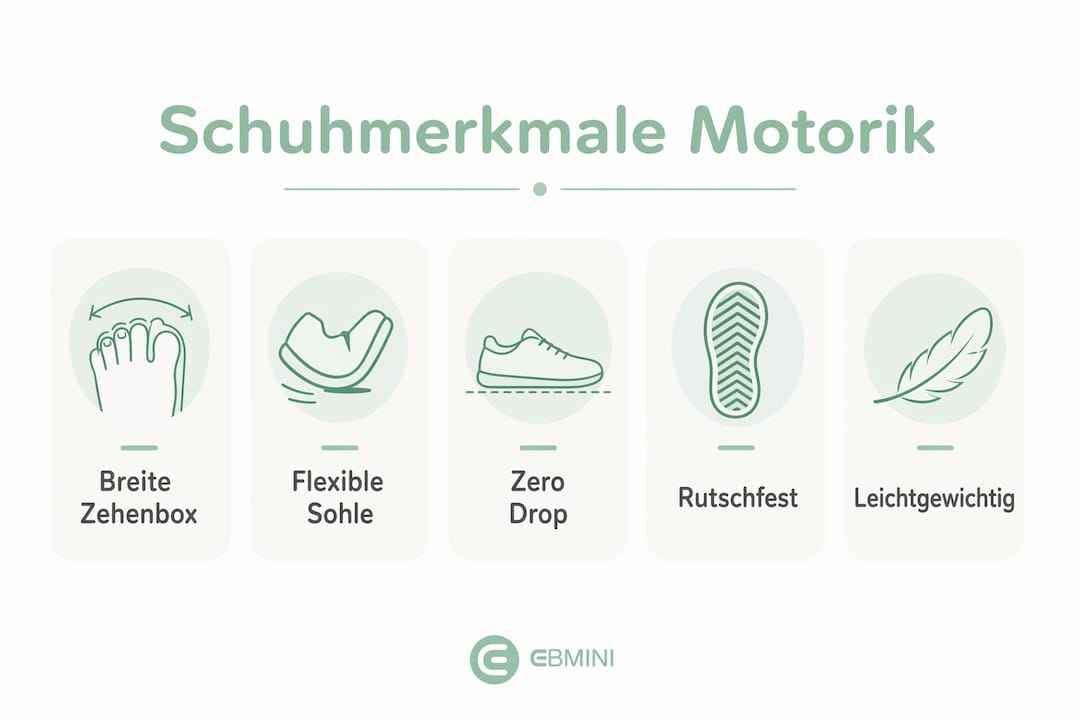
Lightweight shoes with flexible rubber soles support natural foot roll. Strong arch supports and elevated heels are less advisable for developing feet because they take over the work of the foot muscles instead of challenging them.
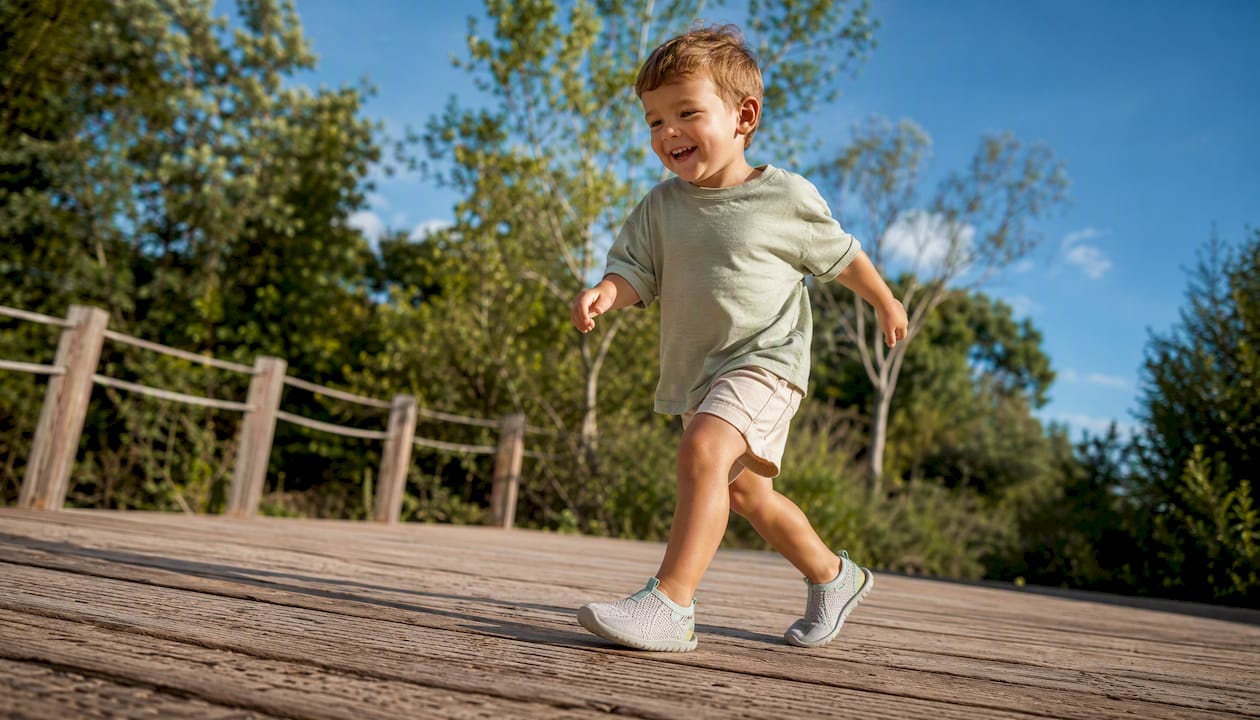
Pro Tip: For very active toddlers, the combination of maximum sole flexibility and good slip resistance is particularly important. A shoe that bends but slips on smooth parquet creates insecurity when walking and inhibits the urge to move.
Which shoes are suitable for which age?
Walking age (approx. 9–18 months)
During this phase, children learn to find their balance. Experts view first-walker shoes as protection with high flexibility requirements. Stabilizing footbeds are out of place here. The goal is internal freedom of movement, not support. As long as the child is walking on safe surfaces, barefoot is the first choice.
Kindergarten age (approx. 3–6 years)
At this age, children run, climb, and jump a lot. Feet grow quickly, often several sizes per year. Measuring every two to three months is advisable. The shoe must allow movement, not restrict it.
School entry (from approx. 6 years)
Longer wearing times, changing demands between school commute, sports, and leisure. A second pair for different situations is worthwhile here. Feet grow slower, but a shoe change should still be checked regularly.
How to properly measure children's feet and try on shoes
Step-by-step measurement
- Place the child on white paper, trace the foot with a pen
- Measure the longest point (usually from heel to big toe)
- Add 12–17 mm to the measured length to provide enough room for growth and movement
- Remove the insole from the shoe and compare it directly with the outline
- The insole should extend slightly beyond the outline on all sides
When trying on, check:
- Toe freedom: thumb's width space in front of the big toe
- Heel hold: heel sits firmly, no slipping out
- Lateral freedom of movement: toes can spread
- No pressure on toes or sides when standing and walking
- Child walks a few steps: observe gait
Everyday life and motor development: What shoes alone cannot achieve
Gross motor skills are the basis for everything else, including fine motor skills. Movement incentives such as climbing, balancing, and ball games strengthen strength, coordination, and balance. Short sessions of 10–15 minutes daily are sufficient if they occur regularly.
Concrete exercises for home: balancing on a piece of tape on the floor, climbing over sofa cushions, throwing and catching a crumpled piece of paper. Curbs and tree trunks during a walk are natural balance devices. Such everyday exercises for balance can be incorporated effortlessly.
When barefoot, when in shoes? At home on carpet or wooden floor: prefer barefoot. Outside on asphalt, in cold or wet conditions: shoes for protection. Different surfaces, sand, grass, gravel, also train foot sensory perception.
Pro Tip: Pedagogical approaches from daycares can be easily adapted at home. Simple, playful movement incentives sustainably strengthen the motor basis without the need for special equipment.
When should parents consult a specialist?
Some abnormalities require more than just the right shoe. Parents should take these warning signs seriously:
- Recurring pain in feet, knees, or back after walking
- Visible pressure marks or redness after taking off the shoe
- Unilateral gait or a noticeable limp
- Rapid fatigue when walking that is not age-appropriate
- Pronounced knock-knees or bow-legs that do not improve
- Child avoids movement or frequently complains of tired legs
The first point of contact is the pediatrician, who will refer to an orthopedist or physiotherapist if necessary. Helpful for the appointment: photos or short videos of the gait, information about the shoe model, and daily wearing time. Dr. Werkmeister points out that the phase from kindergarten age to puberty is particularly critical. Early clarification prevents deformities from becoming fixed.
For motor abnormalities, it is also worth looking at the entire body posture. Weak core muscles or unstable shoulders can manifest in the gait, even if the cause is not in the foot.
What matters in terms of material, care, and safety
Natural materials like leather or textile breathe well but require more care and dry slower. Synthetic materials are easier to care for and often more waterproof but can be less comfortable in heat. For everyday German weather, a waterproof model is useful for autumn and winter.
For care: always let shoes dry at room temperature after wet use, never on the heater. Regularly check soles for wear, especially in the ball and heel areas. Slip resistance decreases when the tread is worn down. Re-waterproof textile shoes every few weeks to maintain water resistance.
There are good arguments for natural materials in children's shoes, but the compromise between care effort and function ultimately determines which material works best in everyday life.
Why Ebmini shoes meet the stated criteria
Ebmini develops its children's shoes in cooperation with orthopedists. The models combine a wide toe box, zero-drop sole, ultra-lightweight, and maximum sole flexibility. The removable insole makes measuring at home easier: take out the insole, compare it with the foot outline, done.
For wet conditions, Ebmini offers the OTD model, a waterproof barefoot shoe for trekking and everyday use. If you're looking for a lighter option for summer, the sandal line offers a breathable alternative with the same basic principles.
The ordering process is entirely online. Ebmini offers size advice with measuring instructions directly on the website, shipping to Germany, and a return option if the size doesn't fit. Further guide articles on topics such as proprioception and shoe selection or movement analysis help parents make the right decision.
Key Takeaways
Barefoot-like children's shoes promote motor development if they offer a wide toe box, flexible sole, and the correct inner length with 12–17 mm growth allowance.
| Topic | Details |
|---|---|
| Key purchase criteria | Wide toe box, flexible sole, zero drop, and non-slip structure are indispensable. |
| Measuring rule | Measure foot length and allow 12–17 mm growth allowance for the inner length. |
| Prefer barefoot | Let children walk barefoot as often as possible at home on safe surfaces. |
| Take warning signs seriously | Consult a pediatrician or orthopedist for pain, pressure marks, or an unusual gait. |
| Ebmini as a solution | Ebmini models meet all core criteria and offer size advice and returns for Germany. |
What drives us at Ebmini
Parents deserve clear answers, not marketing promises. At Ebmini, we believe that a good child's shoe shouldn't compromise between function and comfort. That's why we work with orthopedists and offer genuine size advice, not guesswork. If a shoe needs to be returned because the size is wrong, it should be possible to do so without complications. That's not goodwill; that's our standard.
Try Ebmini shoes for your child
Feet measured, checklist in mind? Then the next step is simple. Ebmini provides measuring instructions directly on its website, so the size is right the first time.
For everyday wear and changeable weather, the OTD model with a waterproof sole is recommended. For a lighter option in summer, the sandal line is available. All models with a wide toe box, zero drop, and flexible sole can be found in the barefoot shoe collection for children. Shipping to Germany, easy returns, size advice included. For questions, the Ebmini customer service is available via email.
Further sources and specialist bodies
For parents who want to delve deeper, here are the most important contact points by question:
| Topic | Source | Suitable for |
|---|---|---|
| Fit and growth allowance | ras-team.de: Children's feet and children's shoes | Measuring instructions, guidelines, deformities |
| Warning signs and developmental phases | Wiener Sport: Barefoot children's shoes | Dr. Werkmeister insights, clinical notes |
| First steps and walking shoes | Befamily.at: The first shoes | Walking age, shoe selection, barefoot phases |
| Gross motor skills and movement incentives | Kita.de: Gross motor skills | Exercise ideas, developmental fundamentals |
| Neuromotor promotion in daycares | ErzieherIn.de: Slippers and Neuromotor Promotion | Promotion approaches, daycare practice, transfer to home |
| Practical exercises for home | PPH Augustinum: Brief information on motor skills | Concrete play ideas, balance, coordination |


