

Recognizing Children's Shoes That Are Too Tight: Signs and Tests
Children's shoes are too tight if there is less than 10 to 15 mm of space between the longest toe and the tip of the shoe. This thumb-width space is considered a key measure for identifying children's shoes that are too tight before pain or deformities occur. Children rarely complain on their own, because they simply cannot classify the feeling of tightness. Regularly checking the fit of children's shoes protects natural foot development and prevents long-term problems. The following sections show which warning signs indicate shoes that are too tight, how to perform reliable tests, and when a shoe change is really necessary.
What warning signs indicate that children's shoes are too tight?
Shoes that are too tight leave visible and invisible marks. Typical warning signs include pressure points, redness, and blisters on the toes or heel. These occur because the shoe constantly rubs or presses at certain points. Parents often only see these signs when taking off the shoes in the evening.
In addition to visible skin changes, the gait also changes. Children then walk on their tiptoes, shuffle unusually carefully, or avoid certain movements. If you observe that your child takes off their shoes after a short time or refuses to put them on, you should check the fit immediately. These behavioral changes are often the first signal that parents perceive, long before pressure points become visible.
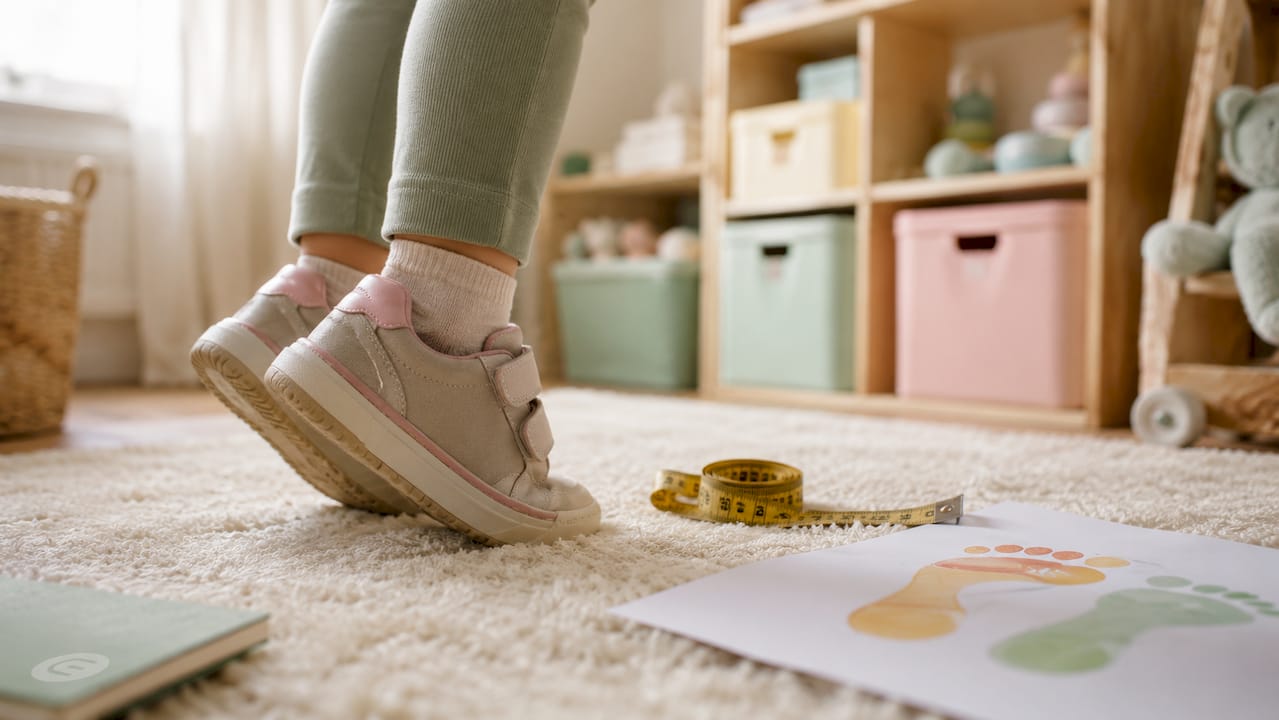
Another serious sign is numbness or tingling in the toes. Numbness in the toes can indicate nerve or blood vessel compression caused by shoes that are too tight. If this feeling persists for more than 24 to 48 hours, medical clarification is necessary. Children often cannot describe this tingling sensation, so targeted questioning after playing or walking can help.
Overview of the most common warning signs:
- Redness, pressure points, or blisters on toes, balls of the feet, or heels
- Changed gait: tiptoe walking, shuffling, or unusually careful walking
- Frequent removal of shoes or refusal to put them on
- Complaints of pain or pressure in the shoe after a short wearing time
- Numbness or tingling in the toes that lasts longer
- Toenails with pressure marks or ingrown nails
Pro Tip: Always look at your child's feet after they take off their shoes. Redness that has not disappeared after 20 minutes indicates that the shoe is too tight at that spot.
Important: Children often do not associate the feeling of tightness because they have no comparison. Regular checks are therefore necessary even if the child does not complain.
How to identify tight children's shoes with simple tests?
The thumb test is the best-known test for checking the fit. The child stands upright in the shoe, and you place your thumb vertically between the tip of the shoe and the longest toe. There should be about 10 to 15 mm of space between the toe and the tip of the shoe. If there is no longer a thumb-width space, the shoes are too tight. If there is more than a full thumb-width space, they are too big and offer too little support.
A reliable alternative is the footprint method. Here's how to do it:
- Place the child on a white sheet of paper and trace the foot precisely with a pen.
- Measure the length from the heel to the longest toe in millimeters.
- Add 12 to 17 mm as a reserve for movement and growth.
- Cut out the template and place it in the shoe. If it lies flat and without bending, the shoe fits.
- If the template bends at the sides or front, the shoe is too tight or too short.
Tracing children's feet on paper and measuring with an allowance is considered a particularly precise method because it works independently of manufacturer sizes. Shoe sizes vary considerably depending on the brand, so your own template is more reliable than the printed size.
| Method | Advantage | Potential source of error |
|---|---|---|
| Thumb test | Quick, applicable anywhere | Child curls toes, distorts result |
| Footprint template | Precise, brand-independent | Inaccurate tracing during movement |
| Observation while walking | Shows real stress | Requires time and attention |
| Heel test | Simple | Less meaningful for toe room |
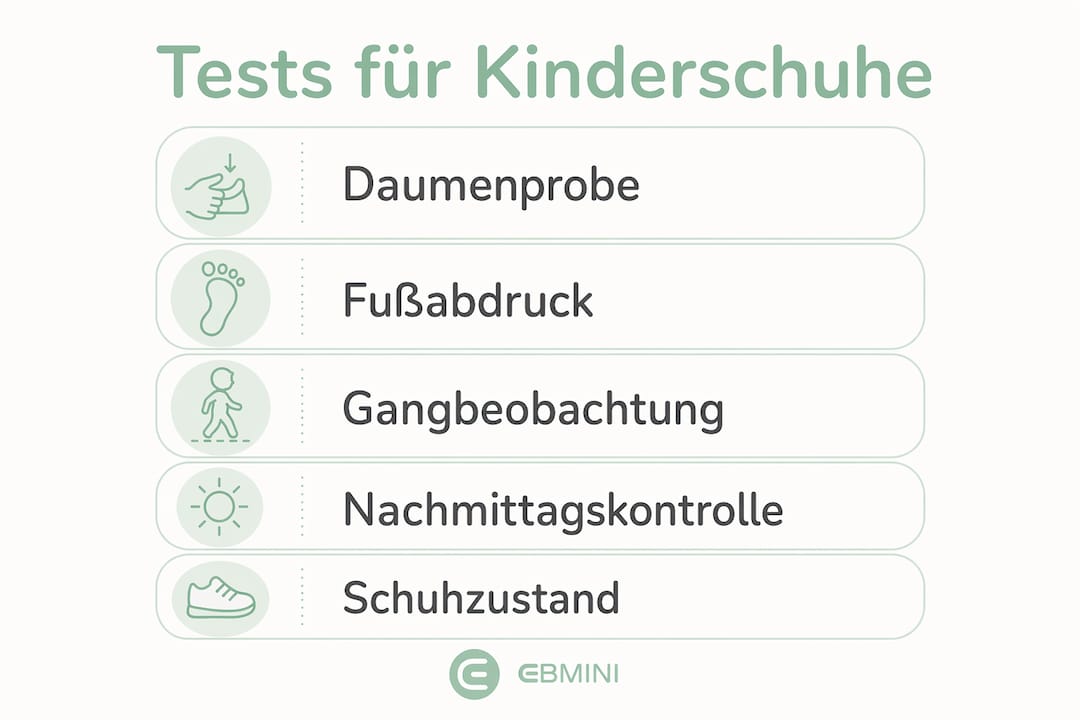
A common mistake in self-tests: children curl their toes when measuring, which makes the shoe appear larger than it is. Therefore, observation after a short walk is particularly meaningful. Let the child take a few steps and pay attention to their gait, facial expression, and whether their toes have room in the shoe. You can find more information in Ebmini's Children's Shoe Size Checklist.
Pro Tip: Always perform the test in the afternoon. Children's feet swell slightly during the day, so the afternoon test shows the real fit under everyday conditions.
How quickly do children's feet grow and how often should you check the size?
Children's feet grow faster than many parents expect. Depending on age, children's feet grow about 0.5 to 2 cm per year. Toddlers aged 1 to 3 years are at the upper end of this range, while growth slows down for school-aged children. This means that a shoe that fit in the fall may already be too tight in the spring.
| Age group | Growth per year | Recommended measurement interval |
|---|---|---|
| 1 to 3 years | up to 2 cm | every 6 to 8 weeks |
| 4 to 6 years | approx. 1 to 1.5 cm | every 8 to 10 weeks |
| 7 to 10 years | approx. 0.5 to 1 cm | every 10 to 12 weeks |
Growth spurts often occur irregularly. A child can stagnate for months and then gain half a size within a few weeks. It is therefore advisable to actively check the fit every 6 to 12 weeks, not just when the child complains. If you only buy new shoes once a year, you risk your child walking in shoes that are too tight for several months.
In addition to length, the condition of the shoe also plays a role. Wear and tear on the outsole and lining is an independent reason for a shoe change, regardless of size. Worn lining causes chafing, and an unstable heel counter impairs foot guidance. Both are detrimental to healthy foot development, even if the shoe still seems to fit.
Practical tip: Mark the date of the last measurement on a sticky note inside the shoe. This way you always know when the next check is due, without relying on the child to express discomfort.
What are the consequences of wearing children's shoes that are too tight?
Shoes that are too tight are not a small problem that solves itself. Pressure points can develop into blisters or pain if the pressure persists for weeks. In the short term, redness and calluses develop. In the long term, structural changes to the foot are threatened.
The most common health consequences:
- Hallux valgus: Foot deformities such as hallux valgus are promoted by tight footwear and can lead to further problems in the long term. The big toe is permanently pushed outwards.
- Claw toes and hammer toes: Toes that have no space in the shoe adapt to its shape. These deformities are still reversible in childhood if treated early.
- Back and hip pain: Tight shoes change the gait. The altered gait unevenly strains the knees, hips, and spine. Children who constantly walk on their tiptoes develop tension in their calf muscles.
- Ingrown toenails: Constant pressure on the nail edges promotes ingrown nails, which are painful and prone to infection.
Walking barefoot on natural surfaces such as grass, sand, or forest floor strengthens the foot muscles and promotes body awareness. It is one of the most effective complements to good footwear. If walking barefoot is not possible, shoes with a wide toe box, flexible sole, and zero-drop construction are the next best choice. Ebmini's barefoot shoes are based precisely on these principles, so that children's feet can move naturally even in shoes. The Ebmini guide explains how you can avoid pressure points on summer shoes from the outset.
„Repeated or persistent pressure and sensory disturbances require professional podiatric advice in addition to changing shoes, as nerve and vascular compression pose serious risks." Source: berlinpodo.de
When should you see a doctor or podiatrist? If pressure points do not heal despite changing shoes, if numbness or tingling occurs repeatedly, or if the child consistently limps or their gait changes permanently, an orthopedic or podiatric examination is advisable. Acting early protects against expensive and lengthy treatments later.
Key Takeaways
You can reliably identify tight children's shoes by performing the thumb test, regular foot measurements every 6 to 12 weeks, and consistent observation of the gait after wearing them.
| Point | Details |
|---|---|
| Thumb test as a basic test | There must be 10 to 15 mm of space between the longest toe and the tip of the shoe. |
| Take warning signs seriously | Pressure points, changes in gait, and frequent removal of shoes are clear signs of shoes that are too tight. |
| Regular measurement intervals | Measure toddlers every 6 to 8 weeks, school children every 10 to 12 weeks. |
| Check shoe condition | Worn lining and unstable heel counters require a shoe change, regardless of size. |
| Prevent consequences early | Hallux valgus, claw toes, and back pain are caused by consistently tight footwear. |
What I've truly learned after years with children's shoes
Many parents buy children's shoes with too much room, believing the child will quickly grow into them. This is a misconception that is just as harmful as shoes that are too tight. A shoe that is significantly too big offers no support, causes the foot to slip, and strains muscles and tendons in other ways. The correct fit lies within a narrow window, and this window shifts every few weeks for toddlers.
What surprised me most after many years of working with barefoot shoes and children's foot health: Most parents test shoes while standing, not while walking. However, the true fit only becomes apparent in motion. A shoe that fits while standing can pinch when walking, because the foot spreads out when rolling off. Therefore, observation after a few steps is more meaningful than any static test.
Another point that is often underestimated: shoe width. Many children have wide feet, and standard shoes are built on narrow lasts. A tight toe box forces the toes together, even if the length is correct. Shoes with an anatomically shaped, wide toe box, as Ebmini consistently implements, give the toes the space they need for healthy development. This is not a marketing promise. It is anatomy.
My honest advice: Don't buy shoes online without first measuring your child's foot. Use the template method, not just the printed size. And don't check the fit once a year when buying shoes, but every few weeks at home. Your child won't tell you. But their feet will show you if you know what to look for. Ebmini explains step-by-step how to correctly determine your child's foot width.
— Ebmini
Healthy children's shoes from Ebmini: A fit that really fits
Once you know what matters for fit, the next step is choosing the right shoe. Ebmini develops barefoot shoes for children that consistently focus on a wide toe box, zero-drop sole, and flexible construction. These features allow children's feet to move naturally, instead of forcing them into a fixed shape.
Ebmini's range includes models for all seasons, from a baby's first steps to an active school child. All shoes are ultra-light, breathable, and designed so that children enjoy wearing them. For those also looking for a comfortable everyday shoe, the children's barefoot sneakers offer a combination of comfort and healthy foot posture. Check out the entire range on ebmini.de and use the integrated size guide for the perfect fit.
FAQ
How much space should a children's shoe have in the front?
There should be about 10 to 15 mm of space between the longest toe and the tip of the shoe. This corresponds to approximately a thumb's width and is considered the standard measure for a healthy fit.
When are children's shoes too small?
Children's shoes are too small if a thumb no longer fits between the tip of the shoe and the longest toe, if pressure marks or redness are visible after wearing, or if the child frequently takes off the shoe. A changed gait is also a clear sign.
How often should children's shoes be checked for fit?
For toddlers aged 1 to 3, a check every 6 to 8 weeks is recommended, as their feet grow fastest at this age. For school children, an interval of 10 to 12 weeks is sufficient.
Can children's shoes also be tested for fit online?
Yes, using the template method. Trace your child's foot on paper, measure the length, and add 12 to 17 mm. Place the cut-out template in the shoe: if it buckles, the shoe is too tight or too short.
When should you consult a doctor or podiatrist?
If numbness or tingling in the toes lasts longer than 24 to 48 hours, pressure points do not heal despite changing shoes, or the gait changes permanently, a podiatric or orthopedic examination is advisable.


