

Learning to Walk: Barefoot Principle and First Steps
Let your child walk barefoot as much as possible. Shoes are for protection, not for correction. This is the core message that child physiotherapists, orthopedists, and the DGOU agree on. Here are three things you can implement immediately:
- Let them go barefoot indoors. On carpet, parquet, tiles: every surface trains perception and balance.
- Create safe surfaces. Grass, sand, forest floor are ideal. Check for sharp edges, broken glass, and hot asphalt beforehand.
- Shoes only outdoors, when necessary. And then: flexible, light, wide toe box.
Table of Contents
- Does your child need shoes right now?
- When do children learn to walk? Milestones and timeframes
- What do the DGOU and S2k guideline say about barefoot walking?
- When is the first proper shoe needed?
- How do you choose the right first shoe?
- How do you measure the foot correctly?
- Introducing barefoot shoes gradually
- When should you see a doctor or physiotherapist?
- Ebmini meets the criteria for barefoot-like children's shoes
- Key Takeaways
- Why Ebmini shares these recommendations
- Further Reading and Sources
- Ebmini: Barefoot shoes for the first step outdoors
Does your child need shoes right now?
Three questions, one minute:
- Is your child outdoors? No → barefoot or non-slip socks are sufficient.
- Is the ground sharp-edged, very hot, or wet? Yes → put on shoes.
- Is there cold or a hygiene risk (e.g., public playground)? Yes → put on shoes.
Non-slip socks are almost always sufficient indoors. Only when the child regularly walks outdoors is a barefoot-like first shoe worthwhile.
Pro Tip: Broken glass and hot asphalt are the most common immediate triggers for shoes. Everything else can usually be solved with socks.
When do children learn to walk? Milestones and timeframes
Most children take their first independent steps between 9 and 18 months of age. The window is wide, and that's normal.
Early signs preceding independent walking:
- Pulling up on furniture (from approx. 8–10 months)
- Sidestepping along the couch
- Standing independently for a few seconds
- First wobbly steps with arms outstretched for balance
Crawling is not a detour, but preparation. Children who crawl extensively develop core stability and coordination, which they need directly for walking.
Some children skip crawling and still walk without problems. But crawling builds a solid foundation.
Warning: If your child is not walking independently by 18 months, a check-up with the pediatrician is advisable. The same applies to asymmetrical standing, pain, or an unusual gait pattern.
What do the DGOU and S2k guideline say about barefoot walking?
The DGOU explicitly recommends barefoot walking on varying surfaces. Different grounds provide different stimuli, strengthen foot muscles, and promote the arch of the foot.
According to the S2k guideline "Childhood flatfoot," flexible flatfoot in toddlers is in most cases a normal developmental phase, with pain occurring very rarely.
This means that parents do not need to act immediately if their child has a slightly flattened arch. The body usually corrects itself if it gets the chance to walk barefoot.
Specific advantages of barefoot walking:
- Better deep sensation of the sole of the foot
- Strengthening of the short foot muscles
- Natural development of the longitudinal and transverse arches
- Improved balance through direct ground feedback
Various surfaces such as grass, sand, and forest floor are particularly valuable because they train perception in a way that smooth ground cannot.
When is the first proper shoe needed?
The first shoe should only be put on a child when they have been walking independently and safely outdoors for several weeks. Not at the first pull-up, not at the first wobble. Only when actual walking phases occur outdoors.
Its purpose: protection from cold, wetness, and injuries. Not shaping, not supporting, not correcting.
| Option | When suitable | What to look for |
|---|---|---|
| Non-slip socks | Indoors, dry floors | Good grip, breathable |
| Prewalker / soft shoe | First steps indoors | Very flexible, no stiff edges |
| Barefoot-like first shoe | Outdoors, after stable walking phases | Flexible sole, wide toe box, lightweight |
How do you choose the right first shoe?
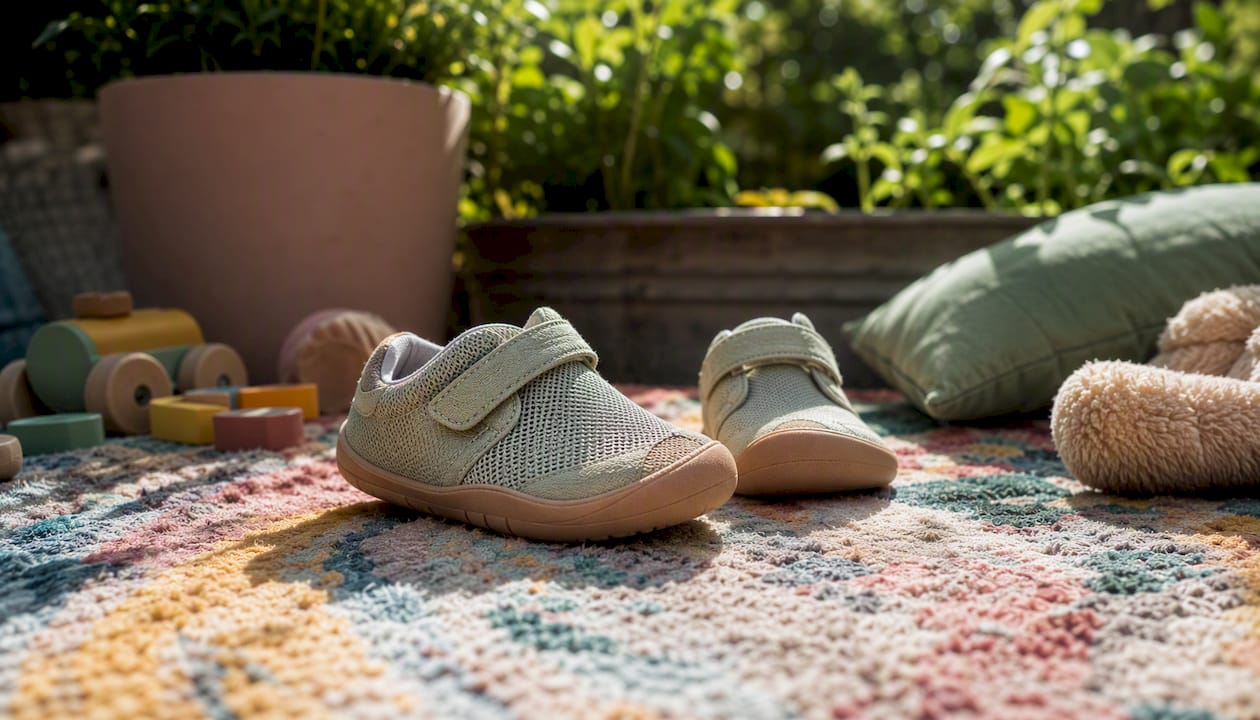
Good first walking shoes are lightweight, have flexible soles, and a wide toe box. In addition, they should be made of non-toxic materials. These are not wishes, but minimum requirements.
| Criterion | Why it matters |
|---|---|
| Flexible, thin sole (Zero Drop) | Enables natural rolling and ground feel |
| Wide toe box | Toes can spread, balance improves |
| Low weight | Less effort required to lift the foot |
| Non-slip sole | Safety on pavement, parquet, wet ground |
| Breathable material | Prevents overheating and moisture |
| OEKO-TEX certificate | Proven freedom from harmful substances |
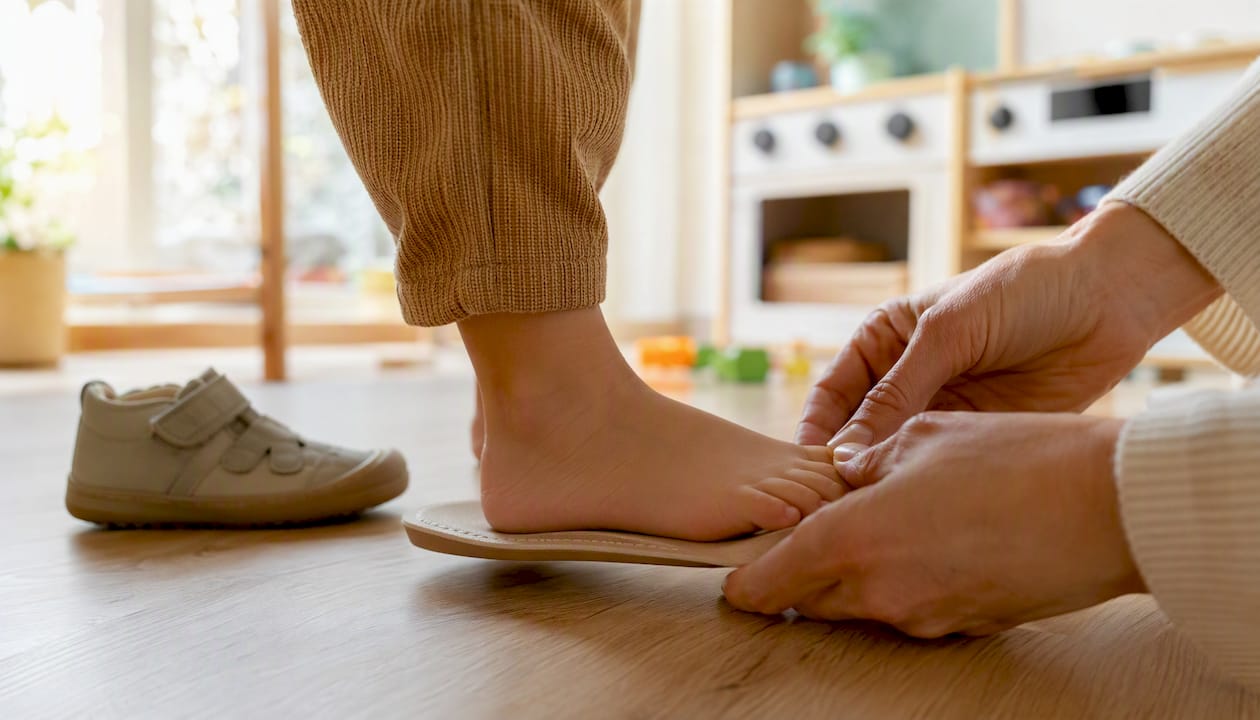
Removable insoles are practical for checking the fit: take out the insole, place the foot on it, and see if the toes are free. Healthy children's feet generally do not need orthopedic insoles.
Pro Tip: Velcro fasteners are significantly better for toddlers than shoelaces. The child can put them on and take them off themselves, which increases acceptance of the shoe.
Checklist when buying:
- Sole can be easily bent and twisted
- Toe box wide enough for a splayed foot
- Heel sits firmly without pressing
- Opening wide enough for easy on and off
- OEKO-TEX or comparable certificate available
How do you measure the foot correctly?
- Place the foot on a piece of paper, trace the outline.
- Measure from the longest toe to the heel.
- Measure the widest part of the foot.
- Compare with the shoe's inner length: allow 8–12 mm of growth space.
| Growth space | Meaning |
|---|---|
| Under 8 mm | Too tight, toes will be squeezed |
| 8–12 mm | Ideal: space for growth, no shuffling |
| Over 15 mm | Too much play, child stumbles more easily |
When trying them on: toes have room at the front, heel fits without play, the child can roll off normally. Use the removable insole again as a control method.
Introducing barefoot shoes gradually
Children who have previously walked barefoot or in soft socks need time to get used to shoes. This also applies to barefoot-like models.
- Days 1–3: Put on shoes indoors for 15–20 minutes while playing.
- Days 4–7: Increase duration to 30–45 minutes, include short outdoor walks.
- Week 2: Normal outdoor use, duration according to the child's comfort.
- Continuously observe: Take redness, pressure marks, or reluctance seriously.
Exercises that support the transition:
- Standing on one leg (short, playful)
- Going up and down stairs with assistance
- Short target distances on grass or sand
A child who takes off their shoe after 10 minutes is telling you something. Don't scold, but check: Is something pressing? Is it too warm? Does the size still fit?
Pro Tip: Let the child choose the shoe themselves, if possible. Children wear shoes longer if they had a choice. Color and motif mean more to them than to you.
When should you see a doctor or physiotherapist?
Clear warning signs where clarification is advisable:
- Child is not walking independently by 18 months
- Asymmetrical standing or walking (one foot turns significantly inward or outward)
- Pain when walking, child refuses to walk
- Stiff foot that can barely move
- Unusual gait pattern that does not change after weeks
In case of pain, a stiff foot, or an unusual gait pattern, a medical clarification is advisable. Physiotherapy can specifically improve balance, core stability, and gait quality.
Well prepared for the appointment:
- Write down observations: Since when? How often? In which situations?
- Video on phone: Gait pattern when walking and standing.
- Note down questions: Is the arch of the foot normal? Does the child need insoles? When should physiotherapy be considered?
A pediatrician or pediatric orthopedist can usually quickly assess whether there is a developmental delay or if the child is simply at the lower end of the normal timeframe.
Ebmini meets the criteria for barefoot-like children's shoes
For those looking for a shoe that truly implements these criteria, Ebmini offers a range designed precisely for this purpose. The shoes were developed in collaboration with orthopedists.
What Ebmini technically offers:
- Ultralight, flexible sole with zero drop
- Wide toe box for natural splaying
- Non-slip outsole for pavement, grass, and wet floors
- Waterproof material for all-weather use
- Removable insole for fit control
- Size consultation directly in the shop
Ebmini also offers a return policy and customer reviews to help with size comparison. If you are unsure, you can use the size consultation and fit information before ordering.
Pro Tip: Start with an all-weather model that works indoors and outdoors. This way, the child doesn't have to switch between several pairs of shoes and gets used to them more quickly.
Key Takeaways
Barefoot as much as possible, shoes only outdoors after stable walking phases, and then only with a flexible sole, wide toe box, and the correct growth space of 8–12 mm.
| Topic | Details |
|---|---|
| Barefoot principle | Let them go barefoot indoors; shoes are for protection, not correction. |
| Timing for the first shoe | Only buy after several weeks of safe independent walking outdoors. |
| Fit rule | Allow 8–12 mm growth space, also check width. |
| Warning sign | No independent walking by 18 months: see a pediatrician. |
| Ebmini | Barefoot shoes with zero drop, wide toe box, and size consultation for beginners. |
Why Ebmini shares these recommendations
At Ebmini, we didn't design our shoes because barefoot-like children's shoes are a trend. We developed them because the evidence is clear: children's feet need freedom of movement, not support. Collaboration with orthopedists was not a marketing argument but a prerequisite for our products to deliver what we promise.
What we constantly notice is that many parents buy shoes too early and too stiffly because they feel they are doing something good for their child. The opposite is true. A foot stuck in a stiff shoe before it has learned to walk loses precisely the sensory stimuli it needs for development.
Our size consultation, removable insole, and return policy are not just extra services. They are a consequence of the fact that a poorly fitting shoe does more harm than no shoe at all. If you have any questions about the fit, please contact us directly.
Further Reading and Sources
Important guidelines and professional articles:
- DGOU: Barefoot walking promotes healthy children's feet with references to the S2k guideline "Childhood flatfoot"
- Hallo Eltern: When does your child learn to walk? on developmental windows
- windeln.de: What to look for when buying first walking shoes on technical and material criteria
- suissePHYSIO: My child is not walking yet on developmental delays and walking aids
Internal resources at Ebmini:
- Choosing the right first walking shoes for baby
- Introducing barefoot shoes: step by step for children
- Flexible sole: Parent's guide
For specific concerns about your child's foot development or gait: consult a pediatrician or pediatric physiotherapist. This article is not a substitute for medical advice.
Ebmini: Barefoot shoes for the first step outdoors
Your child is ready for the outdoors, and you're looking for a shoe that doesn't take away the barefoot feeling but rather protects it. That's exactly the starting point behind every Ebmini model: ultralight, waterproof, with zero drop and a spacious toe box.
No shoe that forces the child's foot into a specific shape. No unnecessary weight that makes lifting the foot difficult. And a sizing guide that helps you get the right shoe on the first try. Take a look at Ebmini children's shoes and find the perfect model for your child's current developmental stage.


