

Kids' Balance Bike Weight: Why It Really Matters
Yes, the weight of a balance bike is crucial. As a rule of thumb: the bike should weigh no more than about 30% of the child's body weight. For toddlers between 1.5 and 3 years old, this practically means 2.5 to 4 kg. Older children aged 3 and above can manage well with 3 to 5 kg, provided the bike fits their height.
Three checks you can perform immediately:
- Lift: Lift the bike with one hand. Does it feel light to you? It will feel even heavier to your child.
- Test push: Let your child push or steer the bike briefly. Can they move the bike in the desired direction effortlessly?
- Seat height: Both feet must be flat on the ground, with slightly bent knees being ideal.
Pro Tip: Bring a small kitchen scale to the test ride. Many store models deviate from the manufacturer's specifications because valves, rim tape, or pedal guards are missing.
Key Takeaways
A lightweight balance bike is not a luxury feature, but rather the fundamental prerequisite for toddlers to effectively train their balance and coordination.
| Topic | Details |
|---|---|
| The 30-percent rule | The balance bike should weigh a maximum of 30% of the child's body weight, meaning for a 12 kg child, a maximum of 3.6 kg. |
| Target weight for beginners | For children under 3 years old, bikes under 3.5 kg are recommended; under 3.0 kg is even better. |
| Check manufacturer specifications | Always inquire about the ready-to-ride weight or weigh it yourself, as specifications are often incomplete. |
| Seat height before weight | Both feet must be flat on the ground; incorrect seat height makes even a light bike unsafe. |
| Ebmini balance bike | The Ebmini balance bike (2–8 years) is height-adjustable, equipped with air tires, and available with size consultation. |
Table of Contents
- Why balance bike weight influences balance and riding fun
- What specific guidelines apply by age and size?
- When is a heavier balance bike useful or unavoidable?
- How to test weight, seat height, and handling when buying
- Which brands and models are available in Germany?
- What accessories contribute to weight and how maintenance preserves riding performance
- How balance bike weight and shoe weight interact
- What Ebmini really thinks about balance bike weight
- The Ebmini balance bike: light, adjustable, and designed for toddlers
Why balance bike weight influences balance and riding fun
A child who moves a balance bike that is relatively heavy in relation to their own body weight has significantly more to carry. Imagine pushing a bicycle that weighs 30 kg. This exact relationship is accurately described by Eltern: A balance bike that is too heavy is not a luxury problem, but a real learning obstacle.
What weight specifically affects:
- Balance training: A light bike is easier to get upright and steer. The child reacts more spontaneously, learning balance intuitively rather than through brute force.
- Rotational mass: Heavy wheels have more inertia. Steering requires more effort, turns are made more hesitantly, and speed remains low.
- Getting up after a fall: If a child falls, they have to lift the bike again. At 5 kg, this is simply too much for a 2-year-old child to manage alone.
- Motivation: Children who can move their bike effortlessly ride longer and more often. This is not an educational concept, but simple physics.
Safety aspects go both ways. A bike that is too light and made of inferior materials can become unstable if the child rides faster or on uneven ground. Radfahren precisely poses the question: "As light as possible, but how light can it get?" The answer lies in the material and quality of workmanship, not just the number on the scale.
Pro Tip: Very small or delicate children under 10 kg body weight particularly benefit from bikes under 3 kg. Here, every half-kilogram makes a noticeable difference.
What specific guidelines apply by age and size?
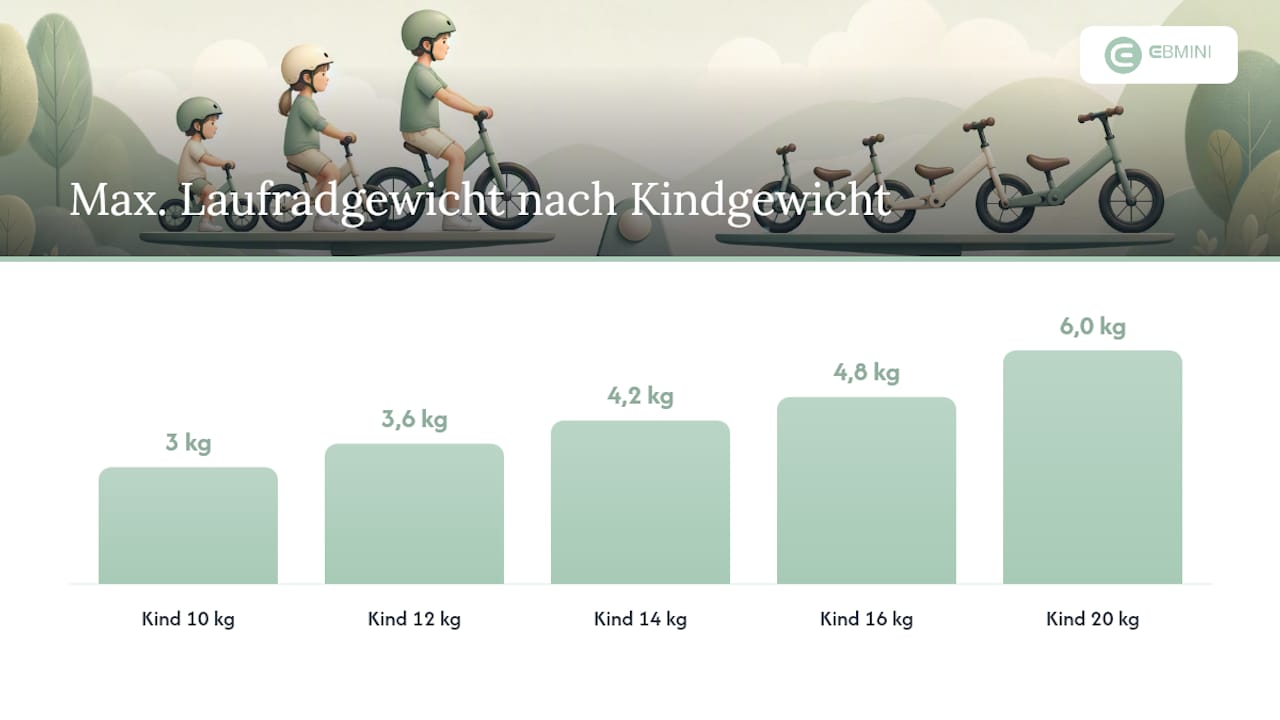
The 30-percent rule describes the maximum ratio of balance bike weight to the child's body weight as a rule of thumb. A child weighing 10 kg should therefore use a bike weighing a maximum of 3 kg. For 14 kg, it's 4.2 kg.
This rule has limitations. It considers neither the child's height nor their motor skills. A tall, strong 3-year-old child will do well with a 4 kg bike, but a small, delicate child of the same age might not.
Example calculations:
- For very light children, it is recommended to choose particularly lightweight balance bikes that are easy to handle.
- Child, 12 kg, 2 years: Maximum weight = 3.6 kg. Good models are between 3.0–3.5 kg.
- Child, 16 kg, 3.5 years: Maximum weight = 4.8 kg. Here, bikes up to 4.5 kg are still acceptable.
- Child, 20 kg, 5 years: Maximum weight = 6.0 kg. From this age, a child's bicycle with training wheels often becomes more interesting.
ELTERN.de shows in their comparison test that ready-to-ride models typically weigh between 2.5 kg and 4.4 kg. For beginner balance bikes, Splim recommends a maximum weight of 3.5 kg as a practical guideline.
When is a heavier balance bike useful or unavoidable?
Lighter isn't always better. There are situations where a few extra grams are actually the right choice.
Durability vs. Weight:
- Aluminum frames offer the best balance of weight and stability. Steel frames are heavier but more durable, which is beneficial for kindergarten use or rentals.
- Wooden balance bikes are visually appealing and often light, but less weather-resistant and more expensive to maintain.
- Magnesium frames (as seen in some Woom models) are very light and stable, but also more expensive.
Pro Tip: For use on forest paths or gravel trails, a slightly heavier bike with air tires is worthwhile. The better suspension more than compensates for the added weight on uneven surfaces.
Use cases and recommendations:
- City and playground: Here, low weight is paramount. EVA solid rubber tires are sufficient; air tires are not a must.
- Forest path and gravel: Air tires and a slightly sturdier frame are advisable. 3.5–4.5 kg is acceptable here.
- Kindergarten or rental: Robustness takes precedence. Steel frames, reinforced axles, and a brake justify 4–5 kg.
- Very active, older children: A handbrake adds approx. 200–300 g of weight but significantly increases safety at higher speeds.
How to test weight, seat height, and handling when buying
Measure before buying:
Determine your child's inseam: Have the child stand upright barefoot, hold a tape measure between their legs, and measure the distance from the floor to the crotch. The saddle height of the balance bike should be 1–2 cm below this measurement, so the child can confidently place their feet flat on the ground.
Test in the store:
- Lift the bike: Can you lift it with two fingers of one hand? Then it is manageable for a toddler.
- Let the child sit on it: Both feet flat on the ground? Knees slightly bent? Good.
- Observe a short test push: Can the child push and steer the bike without assistance?
- Check steering angle: Too large a steering angle leads to falls. Good bikes limit it by design.
- Check saddle and handlebars for adjustability: How much growth is still possible?
Buying online:
Inquire about the ready-to-ride weight, not the frame weight. 11bar-Magazin points out that manufacturer specifications are often incomplete because valves, rim tape, or protective parts are missing. When buying online, therefore, always check the return policy and weigh the bike yourself upon delivery.
Checklist for in-store and online:
- How much does the bike weigh ready to ride (including all attachments)?
- What is the minimum and maximum saddle height?
- Is there a steering limiter?
- What type of tires: air tires or EVA solid rubber?
- Are spare parts (tires, saddle) available?
- How long is the warranty?
Pro Tip: Bring child socks, not shoes, for the test ride. This way, your child can feel the ground better, and you'll immediately see if the seat height truly fits.
Which brands and models are available in Germany?
Four brands dominate the German market for high-quality balance bikes. Their weights differ significantly.
PUKY is the most well-known German brand and relies on steel frames with solid workmanship. The LR M is one of the best-selling beginner models and weighs around 3.5–4.0 kg ready to ride. Robust, durable, well-suited for playground and everyday use. Not the lightest, but one of the most reliable.
Woom from Austria (widely available in Germany) uses aluminum frames and magnesium components. The Woom 1 weighs about 2.9–3.2 kg ready to ride and is considered one of the lightest series models in its class. Particularly a good choice for small, delicate children.
Early Rider from Great Britain offers wooden and aluminum models. The Belter Trail 12" weighs approx. 3.5 kg and is designed for slightly rougher use. The wooden models weigh 2.8–3.2 kg but are less weather-resistant.
Banwood positions itself in the design segment. Their bikes typically weigh 3.5–4.0 kg and are made of steel. Visually very appealing, but not the lightest choice for very small children.
Typical weights by material type:
- Magnesium frame: 2.5–3.2 kg
- Aluminum frame: 2.8–3.8 kg
- Wooden frame: 2.8–3.5 kg (dry, without brake)
- Steel frame: 3.5–5.0 kg
Important note: 11bar-Magazin shows that manufacturer specifications sometimes state the frame weight without attachments. Always inquire about the ready-to-ride weight or weigh it yourself. ELTERN.de measured values from 1.6 kg to 4.4 kg in their test, with 3–4 kg being considered the typical range for good models.
What accessories contribute to weight and how maintenance preserves riding performance
Every attachment adds grams. If you buy a lightweight base model and then upgrade it, you quickly end up with a heavy bike again.
Typical weight drivers:
- Air tires instead of EVA solid rubber: approx. 150–300 g more, but better damping
- Handbrake: approx. 200–350 g additional weight
- Metal kickstand: 100–200 g
- Luggage rack or basket: 200–500 g
- Mudguards: 100–250 g
Maintenance keeps riding performance stable and extends lifespan:
- Check tire pressure (for air tires): Too little pressure increases rolling resistance and makes riding more strenuous, even if the weight remains the same.
- Tighten screws: Loose connections make the bike wobbly and unsafe.
- Oil saddle clamp: Facilitates height adjustment, which is necessary every few months for growing children.
- Clean bearings: Dirt in the wheel bearings noticeably slows down the bike.
- Keep spare parts: A spare tube or saddle saves time if the bike unexpectedly breaks down.
How balance bike weight and shoe weight interact
Movement starts at the ground. A child riding a lightweight balance bike but wearing heavy, stiff shoes loses some of the advantage. Lightweight, flexible shoes support natural foot development and allow for better ground feel when pushing off and braking.
When riding a balance bike, children brake with their feet. Those who wear heavy shoes with thick, rigid soles feel the ground less and react slower. A lightweight shoe with a flexible sole gives the child direct feedback from the ground, which actively trains their sense of balance.
Orthopedic arguments point in the same direction: Shoes that are too heavy strain the still soft foot bones and slow down muscle development. This is especially true during the phase when children learn to ride a balance bike, i.e., between 18 months and 4 years.
- Ultralight children's shoes with flexible soles perfectly complement a lightweight balance bike.
- Wide toe box and zero-drop sole allow natural push-off without restriction.
- Non-slip soles provide grip when braking on various surfaces.
Ebmini develops its barefoot shoes according to these principles, in collaboration with orthopedists, and offers suitable first-walking shoes for the balance bike phase.
What Ebmini really thinks about balance bike weight
The most common mistake when buying a balance bike isn't the wrong brand. It's the wrong weight. Parents look at color, design, and price, lift the bike briefly, and think, "That'll do." But "that'll do" from an adult's perspective is often simply too much for a 2-year-old child.
What we notice is that many parents buy a balance bike that would be perfect for the child in a year, but is currently too heavy and too big. The child barely rides it, loses interest, and the bike ends up in the basement. A bike that fits today is more valuable than a bike that will fit in a year.
Typical bad purchases we know of: steel frame models for 1.5-year-olds under 10 kg, because they seem "sturdier." Or bikes with air tires and brakes for children who aren't even riding fast enough to need a brake. Every gram counts at this stage.
Ebmini therefore offers size consultation, not just for shoes, but also for balance bikes. If you're unsure which model suits your child, you'll receive concrete recommendations based on body height and weight, not standard answers.
The Ebmini balance bike: lightweight, adjustable, and designed for toddlers
The Ebmini children's balance bike is designed for children aged 2 to 8, covering a wide age range. It is height-adjustable, equipped with pneumatic tires, and designed to match the guidelines mentioned here.

What's particularly relevant for parents: Ebmini offers size advice, a clear return policy, and warranty services directly through their online shop. If you prefer to feel the bike before buying, you can weigh it in-store and compare it with the guidelines in this article. The product page states the ready-to-ride weight and the adjustment range, so you can directly apply the 30% rule. Check out the model on ebmini.de and see if it's right for your child.
Sources
External sources for in-depth information:
- Eltern
- Balance bike size and buying criteria – how to find the right model in 2026 - Kinder Tipps
- How to choose the right balance bike? What to look for?
- Children's bikes: As light as possible? About weight and…
- What balance bikes really weigh - and why manufacturers cheat - 11bar | the cycling magazine
Internal Ebmini guides:


