

Minimalist Shoes vs. Barefoot Shoes: The Difference Explained
Many parents use the terms minimal shoes and barefoot shoes as if they were the same. This is understandable, but the minimal shoes vs. barefoot shoes difference is real and actually relevant for your child's healthy foot development. Buying the wrong shoe may not promote what one intends to promote. This article will show you exactly where the line between the two types of shoes lies, what advantages and disadvantages each option has, and how you as a parent can make the right decision.
Table of Contents
- Key Insights
- What Minimal Shoes and Barefoot Shoes Are
- The Main Differences in Direct Comparison
- Pros and Cons for Children Honestly Assessed
- Practical Tips for Selection and Introduction
- When Which Type of Shoe Is the Better Choice
- My Personal Assessment as Ebmini
- Discover Barefoot Shoes for Children at Ebmini
- FAQ
Key Insights
| Point | Details |
|---|---|
| Minimal shoes are the umbrella term | Barefoot shoes are a specific subset with an even thinner sole and a wider toe box. |
| Zero-drop is crucial | No heel-to-toe drop means natural posture and even distribution of pressure on the foot muscles. |
| Slow transition protects children | Gradual acclimatization over several weeks prevents discomfort and overuse. |
| Barefoot shoes do not replace barefoot walking | Sensory feedback is only partially replicated; true barefoot walking remains the gold standard. |
| Fit beats marketing promises | Flexible sole, wide toe box, and zero drop are the three criteria that truly matter. |
What Minimal Shoes and Barefoot Shoes Are
Before you can compare, you need clear definitions. The term minimal shoes describes a broad category of footwear that deliberately foregoes many typical shoe features, including thick cushioning, high heels, and stiff soles. Within this category, there is a wide range. Some minimal shoes still have a slightly thicker sole or a slight drop of a few millimeters.
Barefoot shoes, on the other hand, are a particularly consistent variant. According to Barefoot shoes for children by ELTERN.de, good barefoot shoes have soles between 1 and 4 millimeters thick, no heels, and a significantly wider toe box. The goal is to mimic the natural barefoot feeling as closely as possible, while still protecting the feet from cold, wetness, and sharp objects.
Typical features at a glance:
- Sole thickness: Barefoot shoes are 1 to 4 mm, many minimal shoes are 4 to 8 mm or more
- Drop: Barefoot shoes have zero-drop (no heel), minimal shoes sometimes still have 4 to 6 mm
- Toe box: Barefoot shoes have a significantly wider toe box that allows the toes freedom of movement
- Flexibility: Barefoot shoes can be bent in all directions, minimal shoes vary more here
- Weight: Barefoot shoes are often ultralight, which promotes natural gait in children
For children's feet, this specifically means: a true barefoot shoe allows the foot to work as it would without a shoe. Muscles, tendons, and ligaments are actively engaged. This is the decisive difference between barefoot and minimal shoes in everyday life.
The Main Differences in Direct Comparison
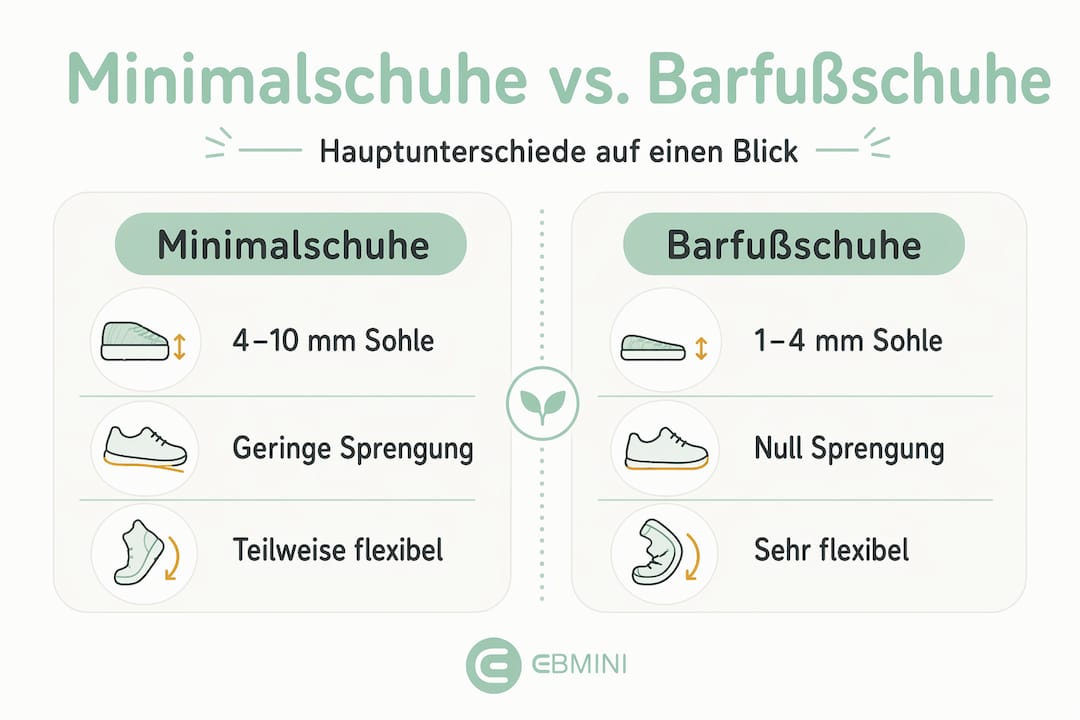
If you want to buy minimal shoes or barefoot shoes for your child, a direct comparison of the most important features will help. The following table shows where both types of shoes differ.
| Feature | Minimal Shoes | Barefoot Shoes |
|---|---|---|
| Sole Thickness | 4 to 10 mm | 1 to 4 mm |
| Drop | 0 to 6 mm | 0 mm (Zero-Drop) |
| Toe Box | Slightly wider than conventional | Significantly wider, anatomically shaped |
| Cushioning | Minimal to none | None or virtually none |
| Flexibility | Medium to high | Very high |
| Protective Function | Moderate | Low to moderate |
| Sensory Feedback | Moderate | High |
As the comparison by ELTERN.de shows, barefoot shoes are more consistent in implementing zero-drop and flexibility. This means more training stimulus for the foot muscles, but also less protection on uneven terrain.
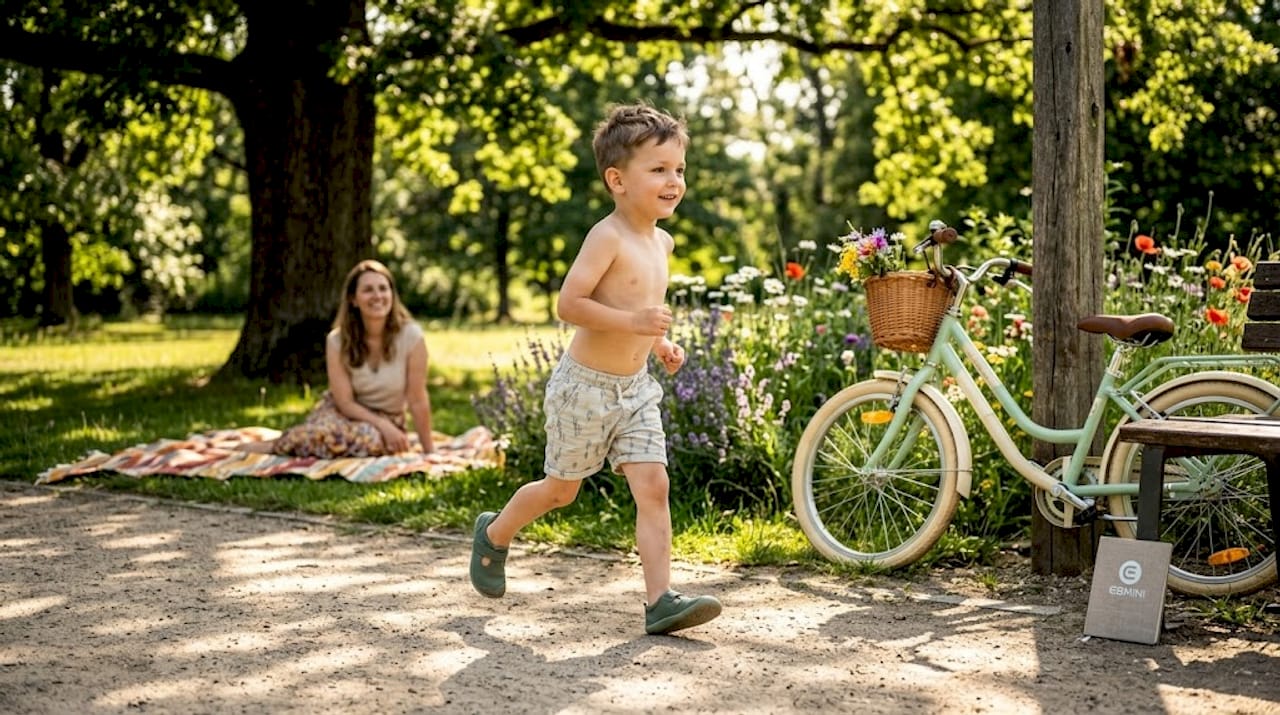
The drop is a point many parents underestimate. Even a height difference of 4 mm between the heel and forefoot changes how the child shifts their weight. In zero-drop shoes, the entire sole of the foot bears weight evenly. This promotes a more natural gait, which children are inherently born with if not hindered.
Regarding the effects on foot muscles: The sole of the foot has about 1700 nerve endings that constantly send sensory feedback to the brain and muscles. The thinner the sole, the more of this feedback is received. Barefoot shoes transmit this feedback better than minimal shoes with a thick midsole.
Typical initial reactions when transitioning to barefoot shoes: The child initially walks more hesitantly; sometimes children complain of leg fatigue. This is not a sign that something is wrong. It shows that muscles are working that were previously supported by stiff soles.
Pro Tip: Have your child wear new barefoot shoes only for short walks at first, not immediately for a long trip to kindergarten. Thirty minutes daily in the first week is perfectly sufficient.
Pros and Cons for Children Honestly Assessed
No shoe is perfect. Listing the advantages of minimal shoes must also include the disadvantages of barefoot shoes, otherwise an incomplete picture emerges.
What speaks for barefoot shoes and minimal shoes:
- Promotion of natural foot musculature through active work without artificial support
- More natural posture due to absent or minimal drop
- Better sensorimotor skills through thinner soles and more ground contact
- More freedom of movement for the toes due to a wide toe box
- Orthopedic surgeon Arne-Björn Jäger confirms: Barefoot shoes are a meaningful addition for children with healthy feet
What you should consider critically:
- Lack of cushioning can lead to heel and calf discomfort with abrupt transitions
- The risk of spraining an ankle on uneven terrain is higher with barefoot shoes, especially during the initial phase
- Barefoot shoes offer less protection against gross injuries from sharp stones or shards
- For toddlers who are still unsteady on their feet, very flexible soles can initially feel unfamiliar
- Dr. Jörn Dohle from ÖKO-TEST emphasizes: no confirmed studies demonstrate clear health benefits. Barefoot shoes are not a therapeutic agent
This doesn't mean you should stay away from them. It means that realistic expectations help make better decisions. Barefoot shoes are not a miracle cure. They are a valuable tool to support natural foot development when used correctly. You can also read more about foot health through barefoot shoes to better understand the scientific background.
Practical Tips for Selection and Introduction
Now comes the part you really need: concrete guidance on how to proceed with purchasing and getting started.
-
Check the sole: Take the shoe in one hand and squeeze the sole and upper together. If you can barely do this with one hand, the sole is too stiff. According to the buying guide from ELTERN.de, a good barefoot shoe sole should be compressible with one hand.
-
Measure the toe box: Place the shoe on a piece of paper and put your child's foot next to it. The shoe should be wider at the front than the foot, not narrower. Especially the little toe should not be squeezed sideways.
-
Check for zero drop: Place the shoe on a flat table. The heel and forefoot should be at the same height. A visible difference indicates a drop.
-
Test the weight: Hold the shoe in your hand. For a child between 2 and 6 years old, a pair of shoes should not weigh more than 200 grams.
-
Introduce slowly: Start with 30 to 60 minutes daily. Increase this over four to six weeks. Observe if the child complains of heel or calf pain. If so, slow down the pace.
Pro Tip: Let your child walk truly barefoot as often as possible, i.e., without any type of shoe. On grass, sand, or a clean wooden floor. Barefoot shoes do not completely replace actual barefoot walking. They are a good supplement, not a complete substitute.
Seasonal specificities also play a role. In summer, thin barefoot sandals or sneakers are ideal. In winter, children need shoes with warming materials and a waterproof membrane that still don't sacrifice sole flexibility. Here, look for winter models for children that combine zero-drop with thermal protection. ÖKO-TEST's introduction recommendation shows: conscious, slow transition is crucial, because the foot muscles need time to adapt.
When Which Type of Shoe Is the Better Choice
Are barefoot shoes better? The honest answer: it depends. It depends on your child's age, the health of their feet, and their daily activities.
Barefoot shoes are the more consistent choice for healthy children's feet that should learn the most natural possible way of walking. They are particularly well suited for children between 1 and 8 years old, whose feet are still actively developing. The younger the child, the more they benefit from maximum freedom of movement and sensory feedback.
Minimal shoes offer more choice. They cover a broader spectrum and are suitable for children who have previously worn conventional shoes and are gradually transitioning. This gradual transition to barefoot shoes is often more sensible than a direct switch to the thinnest soles.
No shoe, no matter how well designed, replaces daily observation of your child. How do they walk? Do they complain of pain? Do they enjoy walking? These are the most important indicators of whether the shoe fits.
The combination of barefoot shoes and actual barefoot walking is the best strategy for most children. Shoes for outside, barefoot walking indoors, on the playground, or in the garden whenever possible. This gives feet the variety they need for healthy development. Also, find out what to consider when choosing shoes for active children.
My Personal Assessment as Ebmini
I have had many conversations with parents who were concerned about whether they were doing the right thing for their children's feet. And I notice the same pattern again and again: the term "barefoot shoe" is laden with so much expectation that the actual purchase sometimes leads to disappointment.
What I've learned: It's not the marketing term that counts. What counts are three measurable things. Flexible sole. Wide toe box. Zero drop or close to it. A shoe that meets these three criteria is a good shoe for a child's foot. Whether it calls itself a barefoot shoe or a minimal shoe is secondary.
What always surprises me is how even small differences in sole thickness or toe box width have visible effects on how a child walks. A child in a true barefoot shoe walks differently than in a shoe with a 6 mm drop. You can see this if you look closely.
My appeal, therefore, is this: Don't get carried away by any hype and don't be deterred by any panic. Look at the criteria. Look at your child. And give the foot time to adapt, no matter what type of shoe you choose.
— Ebmini
Discover Barefoot Shoes for Children at Ebmini
Now that you know what really matters when it comes to barefoot shoes for children, the next step is choosing the right product. Ebmini specializes precisely in this: shoes for children's feet that consistently implement the principles of natural foot development.
The Ebmini range includes flexible barefoot shoes for all age groups, from a baby's first steps to everyday wear for schoolchildren. All models feature wide toe boxes, zero-drop soles, and are ultra-lightweight. For summer, there are light barefoot sandals, and for colder months, there are heat-insulated and waterproof models. Check out the entire children's shoe collection at Ebmini and find the right shoe for your child that offers genuine added value for healthy feet. Detailed sizing advice and customer reviews will help you make an informed decision.
FAQ
What is the main difference between minimal shoes and barefoot shoes?
Minimal shoes are an umbrella term for shoes with little cushioning and a low drop. Barefoot shoes are a special subgroup with a particularly thin sole of 1 to 4 mm, zero-drop, and an exceptionally wide toe box that replicates the barefoot feeling as much as possible.
Are barefoot shoes really better for children than regular shoes?
Barefoot shoes promote natural foot musculature and sensory perception in children with healthy feet. However, they are not a therapeutic tool and do not fully replace true barefoot walking.
How do I recognize a good barefoot shoe for my child?
Squeeze the sole with one hand. It should yield. Check if the toe box is wider than the foot, and place the shoe flat to ensure the heel and forefoot are at the same height, meaning zero-drop is present.
From what age are barefoot shoes suitable for children?
Barefoot shoes are suitable from the first steps, roughly from 10 to 14 months. Specially designed models, known as crawling shoes, are particularly flexible and lightweight to not hinder motor development.
How long does the transition to barefoot shoes take?
The foot muscles need time to adapt. According to ÖKO-TEST, positive effects are noticeable after 4 to 6 weeks if the introduction is gradual with short wearing times daily.


