

Finding Sustainable Kids' Shoe Brands: A Parent's Guide
Sustainable children's shoes are footwear made from low-pollutant, ecologically responsible materials, while actively supporting the natural foot development of children. Finding sustainable brands for children's shoes is a real challenge: the market is full of green promises, but with little substance behind them. Brands like Wildling, Doghammer, and Pololo show that both are possible. Flexible soles, wide toe boxes, and fair production are not contradictions. This guide shows parents what really matters, which materials are worthwhile, and how to distinguish greenwashing from genuine quality.
What parents should look for in sustainable children's shoes
Healthy children's shoes follow a clear principle: the shoe adapts to the foot, not the other way around. Flexible zero drop, wide toe box, and thin soles have been proven to promote natural foot development in children between 1 and 10 years old. This means specifically: no raised heel, no narrow toe area, no stiff construction that forces the foot into a specific shape.
Orthopedists emphasize that overly stiff shoes hinder muscle development. Children's feet need maximum mobility so that the small muscles, tendons, and ligaments can develop properly. Insoles are only useful for actual deformities, not as a standard.
The following criteria help in the selection:
- Zero Drop: Heel and forefoot are at the same height. This promotes an upright posture and natural rolling motion.
- Wide Toe Box: Toes can spread freely. Tight toe caps deform toes in the long run.
- Thin, Flexible Sole: Children feel the ground. This trains deep sensitivity and strengthens foot muscles.
- 12–17 mm Toe Room: This rule of thumb is considered the minimum for a healthy fit. Children often don't show pain with shoes that are too small, so measuring is essential.
- Removable Insole: Allows for accurate remeasurement and improves hygiene in the shoe.
- Velcro Closure: Experts recommend Velcro closures because children can open and close them themselves. This promotes independence.
Pro Tip: Take out the insole and have the child stand on it. There should be a thumb's width of space between the longest toe and the end of the sole. This is more reliable than any shoe size chart.
Firm heels and tight toe caps are the most common mistakes in children's shoes. They look stable, but they block precisely the movements that children's feet need for their development. Those who pay attention to flexible soles make the better choice for foot health.
Comparing children's shoe materials: What really counts
Comparing materials for sustainable children's shoes is more complex than it seems. Natural leather is breathable and durable, while organic cotton and recycled fabrics are lightweight, washable alternatives. Both approaches have their justification, depending on the situation of use.
| Material | Advantages | Disadvantages | Best Use |
|---|---|---|---|
| Vegetable-tanned leather | Breathable, durable, molds to the foot | Heavier, more elaborate care | Everyday, school, autumn/winter |
| Organic cotton | Lightweight, skin-friendly, washable | Less water-repellent | Summer, indoors |
| Recycled synthetic fiber | Lightweight, easy-care, often water-repellent | Less breathable than natural materials | Transitional period, outdoors |
| Merino wool | Temperature-regulating, water-repellent due to lanolin | More expensive, more sensitive to friction | Autumn/winter, changeable weather |
| Rubber sole | Very abrasion-resistant, good grip | Heavier than EVA | Outdoor, active children |
| EVA sole | Lightweight, flexible | Wears out faster | Everyday, light activities |
| PU sole | Good cushioning, durable | Medium weight | School, mixed use |
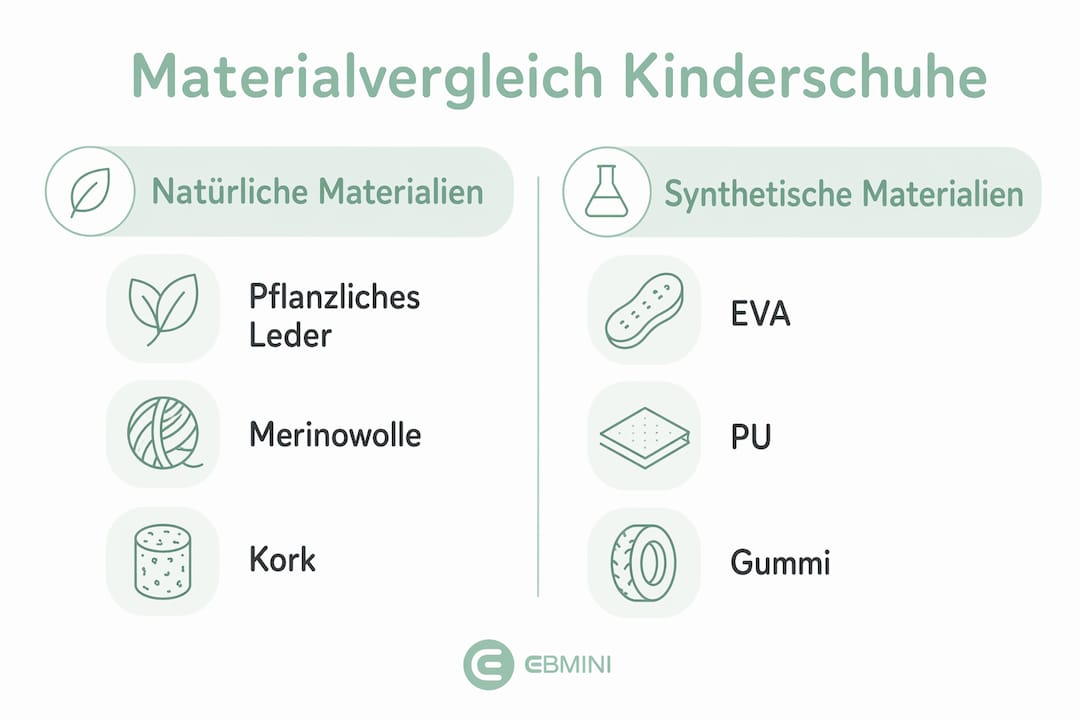
Merino wool deserves special attention. Wool has natural temperature-regulating properties due to lanolin and is naturally water-repellent. Doghammer uses merino wool from Portugal combined with cork for its children's barefoot shoes. The result is a pleasant foot climate even in changeable weather.
Leather is durable and robust, synthetic materials are lighter and easier to care for, but less durable. For everyday use and school, a combination of leather and textiles is recommended. This combination creates a good compromise between durability, comfort, and foot climate.
Pro Tip: Regarding sole material: Rubber for active children who spend a lot of time outdoors. EVA for lightweight everyday shoes. PU if cushioning and durability are equally important. A conscious choice is worthwhile depending on the activity level.
How to recognize truly sustainable children's shoe brands?
Parents can recognize sustainable children's shoes not by the price, but by concrete evidence. Ethical production and vegetable-tanned leather are measurable standards, not marketing terms. If you only read “eco” or “green” on the packaging, you should ask more questions.
The following points indicate genuine sustainability:
- Substantial Certifications: Oeko-Tex Standard 100 checks for harmful substances in the final product. GOTS (Global Organic Textile Standard) certifies the entire supply chain for organic textiles. Vegetable-tanned leather excludes chromium-containing chemicals.
- Transparent Supply Chain: Reputable brands name their production sites and suppliers. Short transport routes within Europe are a good sign.
- Fair Working Conditions: Brands like Wildling produce in Europe and openly communicate where and how manufacturing takes place.
- Durability as a Sustainability Feature: A shoe that lasts two seasons is ecologically better than three cheap shoes that fall apart after two months each.
- Repairability: Some brands offer repair services or replaceable soles. This significantly extends the lifespan.
Marketing promises alone are not enough. Parents should specifically ask: Where is it produced? What certifications are there? Are the materials fully listed? Anyone who cannot or will not answer these questions probably doesn't have convincing answers either. Sustainable family brands for children's shoes stand by their production conditions because they have nothing to hide.
Even waterproof children's shoes can be produced in an ecologically responsible way. The difference lies in the membranes and coatings used. Fluorine-free impregnations are a better choice than PFAS-containing alternatives.
Practical tips for buying sustainable children's shoes
Buying sustainable children's shoes can be achieved with a clear process. Those who proceed systematically avoid the most common mistakes.
- Measure feet, don't guess. Remove the insole, have the child stand on it, measure length and width. Children do not show pain with shoes that are too small. 12–17 mm of toe room is the minimum for a healthy fit.
- Look for Velcro closures. They allow children to put on and take off the shoe themselves. This promotes independence and ensures a consistent fit.
- Choose material according to the season. Leather and wool for autumn and winter, organic cotton or recycled textiles for summer and transitional periods.
- Check fit every 6–8 weeks. Children's feet grow quickly. A shoe that fits in March may already be too tight in May.
- Care for sustainable materials correctly. Rub leather with natural leather grease. Wash wool shoes at low temperatures. Air shoes after wearing, remove insoles. This significantly extends their lifespan.
Children rarely show discomfort when shoes are too small. Parents must therefore actively measure and check, not wait for signals from the children.
The most common mistake is buying shoes that are meant to be "grown into." A shoe with more than 17 mm of toe room offers too little support and can negatively affect the gait. Too large is just as problematic as too small. When switching to barefoot shoes for children, give the child a short adjustment period. The foot muscles need a few weeks to get used to the new freedom of movement.
Key Takeaways
Sustainable children's shoes best promote natural foot development when flexible soles, low-pollutant materials, and transparent production come together.
| Topic | Details |
|---|---|
| Fit and toe room | 12–17 mm space in front of the toes is mandatory; remove insole for measuring. |
| Material choice by season | Leather and wool for cool months, organic cotton and recycled textiles for summer. |
| Check certifications | Oeko-Tex, GOTS, and vegetable-tanned leather are reliable sustainability proofs. |
| Choose sole material | Rubber for active children, EVA for lightweight everyday shoes, PU as a balanced option. |
| Regular check | Check fit every 6–8 weeks as children's feet grow quickly. |
What I've learned after years with barefoot shoes
At Ebmini, we observe a clear trend: parents are asking more targeted questions today than five years ago. The questions have become more specific. No longer "Do you have sustainable shoes?", but "What leather do you use and where is it tanned?" This is a good sign.
But there's a trap many fall into. Ecology and foot health are sometimes treated as opposites. A shoe made of organic cotton, but with a stiff sole that constricts the toes, is neither sustainable nor healthy. Both criteria must fit together. We understood this as our core mission from the beginning.
What I always tell parents: Trust your child's foot more than the shoe. A child who walks barefoot develops stronger foot muscles than one who is always in supportive shoes. The best sustainable children's shoe is one that interferes as little as possible and protects as much as necessary. Finding this balance is not rocket science. But it requires parents who are willing to look more closely.
— Ebmini
Ebmini Barefoot Shoes: Sustainable, Healthy, Suitable for Everyday Use
Ebmini has developed sustainable barefoot shoes for children that meet all the key criteria of this guide. Flexible zero drop, wide toe box, and thin soles are standard, not optional, in every model.

The shoes are manufactured in Europe, using materials such as vegetable-tanned leather, merino wool, and cork. Pollution-free processing and short supply chains are part of the concept. The range includes models for all seasons, from lightweight barefoot sandals for summer to waterproof winter shoes. If you are looking for a shoe for your child that combines foot health and ecological responsibility, you will find a well-thought-out selection among Ebmini barefoot shoes for children.
FAQ
What makes a children's shoe truly sustainable?
A sustainable children's shoe combines low-pollutant materials such as vegetable-tanned leather or GOTS-certified organic cotton with fair production and long durability. Certifications like Oeko-Tex Standard 100 are a reliable indicator.
How much space should a children's shoe have in front of the toes?
The recommended toe room is 12–17 mm. Less than 12 mm constricts the toes, while more than 17 mm provides too little support for the gait.
Are barefoot shoes suitable for all children?
Barefoot shoes are suitable for most children between 1 and 10 years old and promote natural foot musculature. In cases of diagnosed deformities, an orthopedist should decide whether special insoles are necessary.
Which sole material is best for children's shoes?
Rubber offers the highest abrasion resistance for active children outdoors. EVA is lighter and more flexible for everyday use. PU balances cushioning and durability for mixed use in school and leisure.
How often should I check my child's shoe size?
Checking every 6–8 weeks is advisable, as children's feet grow quickly. Removing the insole and measuring the foot directly on it is the most reliable method.


