

Promoting natural gait in children: How to succeed
Four measures are reliably effective: regular barefoot walking on varied surfaces, active everyday movement, targeted balance and strengthening games, and, if needed, flexible, wide shoes. Anyone wanting to encourage a natural gait in children doesn't need expensive diagnostics, but primarily needs to create opportunities for feet to work.
The German Society for Orthopaedics and Trauma Surgery (DGOU) and the S2k guideline for paediatric flat feet support precisely this approach. Specifically, this means for everyday life:
- Daily barefoot time outdoors, on grass, sand, or forest floor
- Balancing and climbing games instead of a rigid training plan
- Utilize everyday situations: stairs, curbs, playground equipment
- Seek medical clarification for pain, stiffness, or unilateral abnormalities
Key Findings
A natural gait primarily develops through regular barefoot walking on varied surfaces, active everyday movement, and appropriate, flexible shoes only where genuine protection is needed.
| Topic | Details |
|---|---|
| Prioritize barefoot time | Daily use of grass, sand, or forest floor strengthens foot muscles and arches. |
| Games instead of training | Exercises like marble-grabbing or tiptoe running work without resistance from the child. |
| Take warning signs seriously | Pain, stiffness, or unilateral toe walking for over three months warrant clarification. |
| Shoes only when necessary | Wide toe box, zero drop, and flexible sole are mandatory for every model. |
| Ebmini as an everyday option | Models like EBMINI® FRO, TOB, PLUTO, and OTD complement barefoot time where protection is needed. |
Table of Contents
- Why Barefoot Walking and Playful Movement Promote Gait Development
- Which Surfaces and Everyday Activities Provide the Strongest Support
- Seven Playful Exercises for Home and Outdoors
- When Shoes Are Needed: Selection and Proper Fit
- Warning Signs and Timeframes: When Medical Clarification is Advisable
- Everyday Strategies: How to Make Promotion a Routine Without Effort
- Barefoot Shoes as Safe Everyday Protection: Our Models at a Glance
- Sources
- FAQ
Why Barefoot Walking and Playful Movement Promote Gait Development
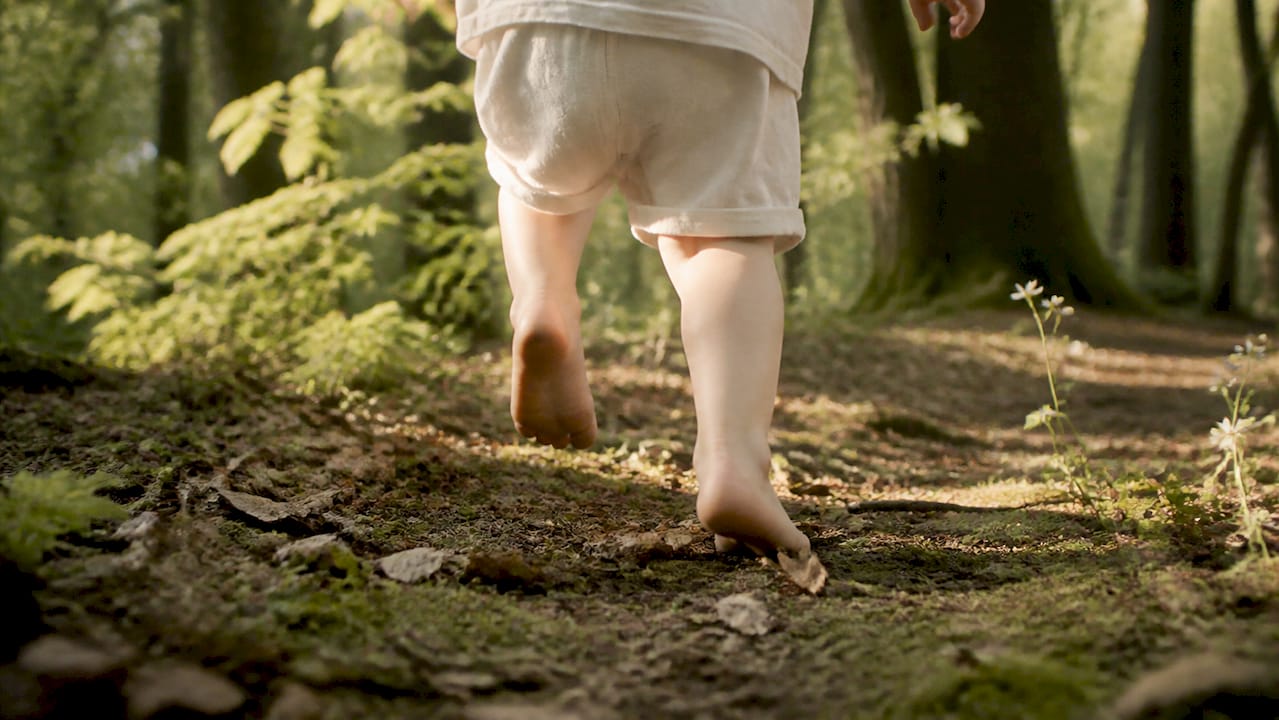
Barefoot walking activates the small foot muscles that are rarely used when wearing rigid shoes, thus supporting the development of the foot arch. The DGOU explicitly recommends this as one of the most effective everyday measures.
The S2k Guideline on Paediatric Flat Feet classifies flexible flat feet in most children as physiological. Insoles or therapy are generally not necessary for pain-free, mobile feet. Observation is often sufficient.
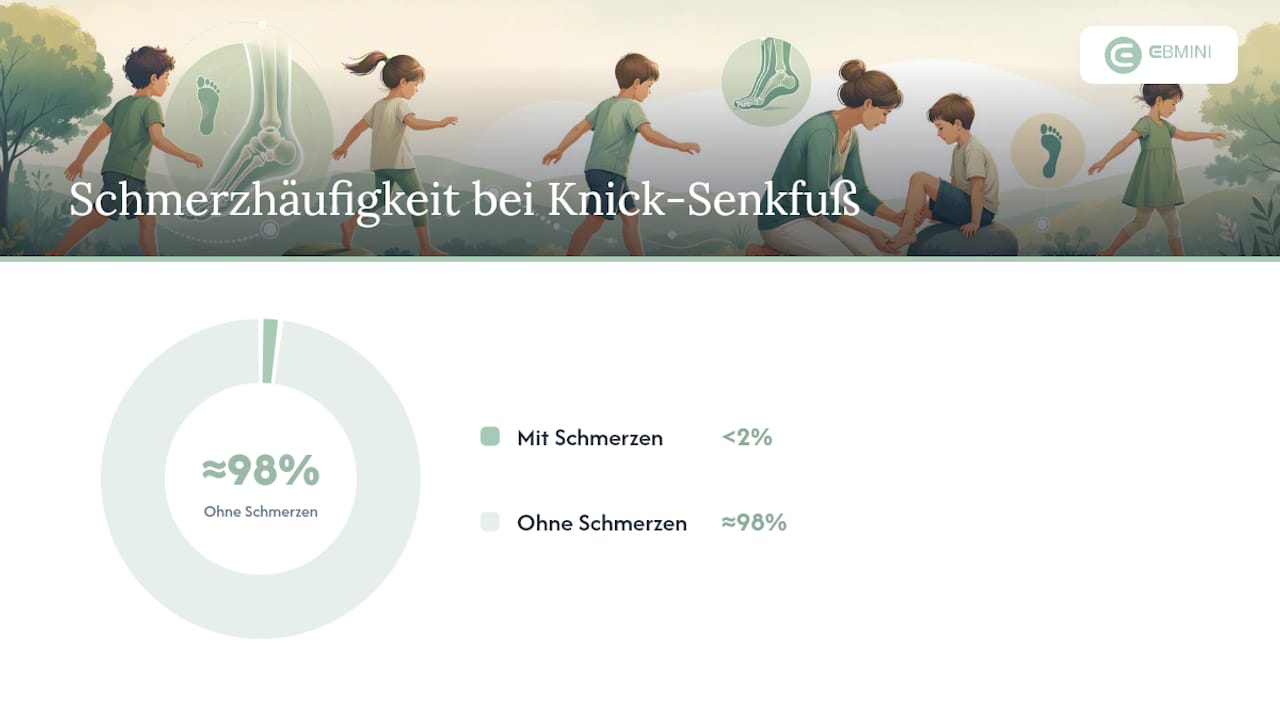
Important to know: According to Thieme, pain occurs in less than 2% of children with flat feet. However, with overweight or neuromuscular disorders such as muscle hypotonia, the situation changes: the foot bears more load than it can stabilize, the gait appears more unstable, and supportive measures should be more targeted and patient.
| Criterion | Flexible Flatfoot (Physiological) | Abnormal Finding (Requires Clarification) |
|---|---|---|
| Pain | None | Present, even independent of load |
| Mobility | Freely mobile, arch visible on tiptoes | Stiff, arch remains flat |
| Progression | Usually improves with growth | Remains the same or worsens |
Which Surfaces and Everyday Activities Provide the Strongest Support
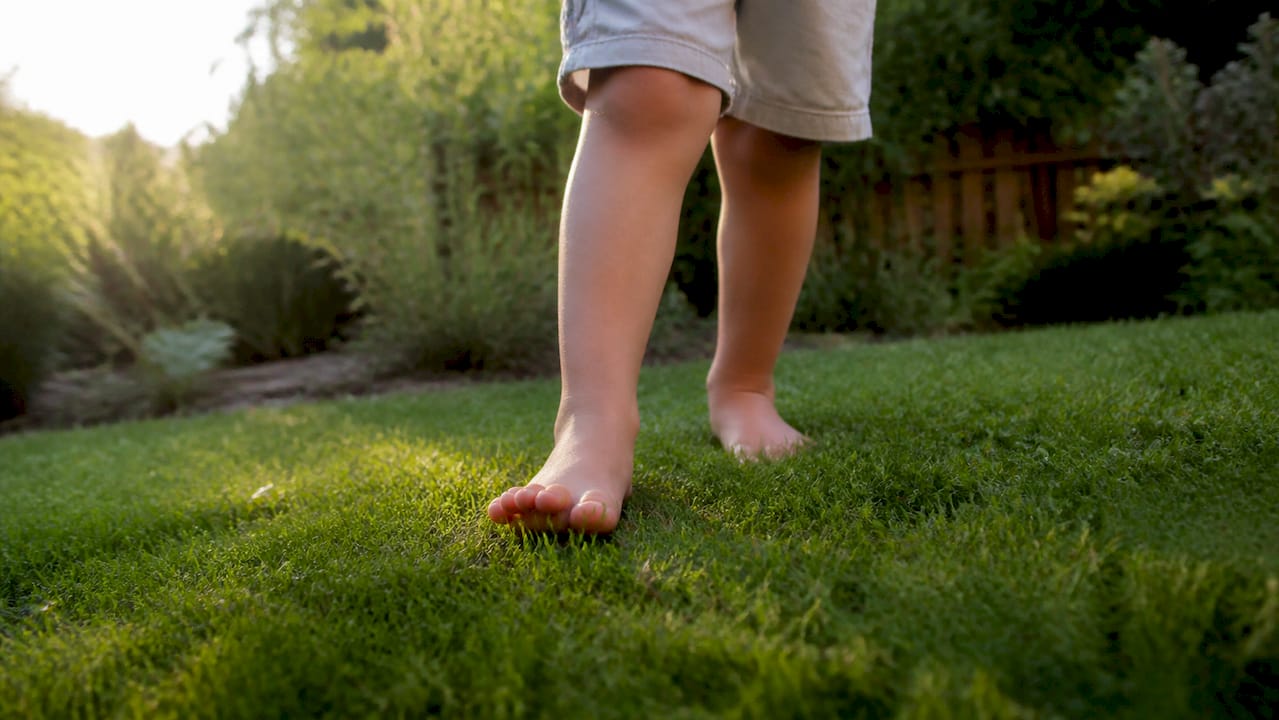
Not every surface provides the same stimuli. Grass offers slight balance challenges and protects the skin, sand strengthens by lacking firm resistance, gravel educates sensory perception through pinpoint pressure stimuli, and forest floor with roots and unevenness trains coordination and attention simultaneously. This mix of sensory stimuli and strengthening works significantly better than a single, isolated exercise, according to the DGOU.
A few precautions are necessary:
- Briefly check the surface beforehand for glass shards or sharp stones
- Avoid asphalt and concrete in midday heat, as feet can get burned
- In cold weather, pay attention to toe color; pale or bluish toes are a stop signal
Climbing, jumping, and stair climbing contribute to development just as much as conscious barefoot time. Ten to twenty minutes, spread out several times a day, is completely sufficient. A playground visit with a climbing net and balance beam often covers more than an entire hour of exercises at home.
Pro Tip: Use garden time as a fixed barefoot appointment. Ten minutes before dinner on the lawn can be as effective over weeks as a targeted training session, but without the child's resistance.
Seven Playful Exercises for Home and Outdoors
Exercises work best when nobody realizes they are physiotherapy exercises. A tiptoe race feels like a game, but it trains precisely the muscles that ensure a stable gait.
- Marble Grasp with Toes: Pick up marbles or small building blocks with toes and sort them into a bowl. From 3 years, 2x daily for 2 to 3 minutes each. Directly strengthens the small foot muscles.
- Balance Path: Arrange cushions, towels, and a balance board in a line. From 2 years, one circuit daily. Develops balance and core stability simultaneously.
- Box Jumping: Jump off a sturdy box or step and land safely. From 4 years, 3x 5 jumps. Strengthens calf muscles and ankle stability.
- Tiptoe Race: Walk a short distance on tiptoes. From 3 years, 2x 1 to 2 minutes. Improves extensor muscles of the feet.
- One-Leg Stand Competition: Who can stand on one leg the longest? From 4 years, 3 attempts per side. Trains proprioceptive awareness.
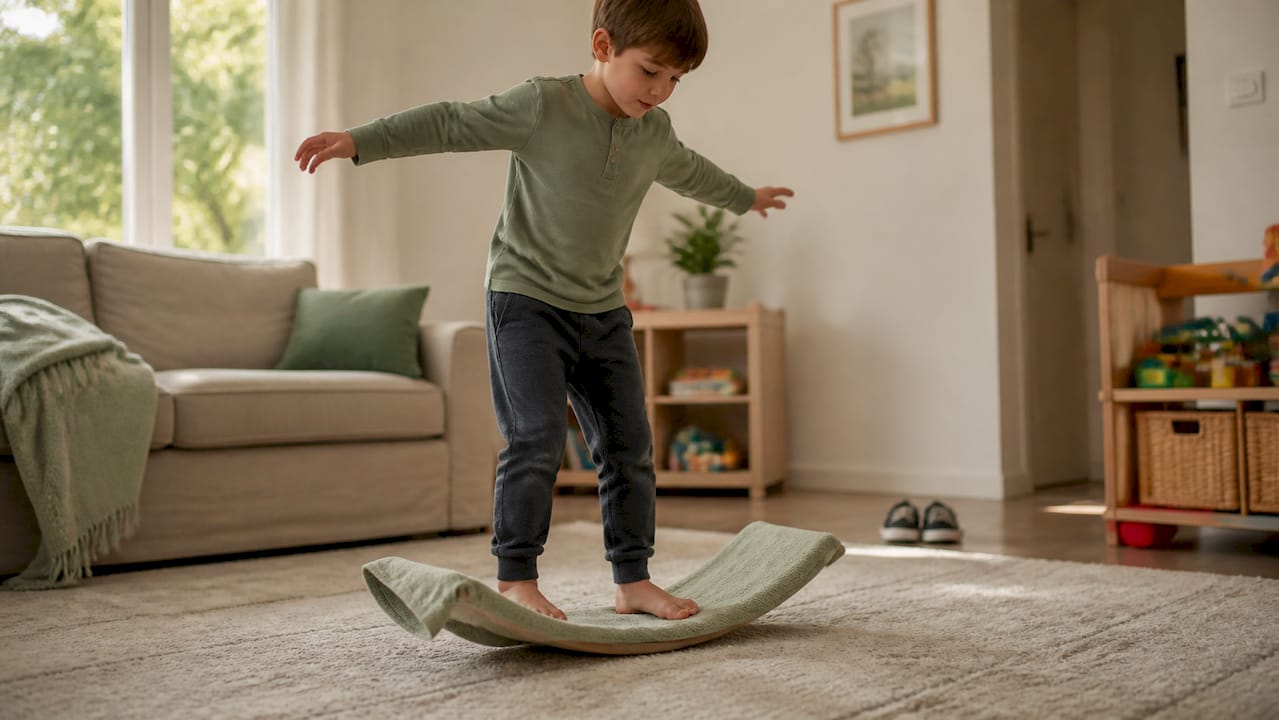
- Towel Seesaw: Stand on a folded towel and gently rock. From 3 years, 1 to 2 minutes daily. Challenges stabilizing foot muscles due to unstable surface.
- Toe Raises on Stair Step: Stand with toes on a stair edge and lift onto tiptoes. From 5 years, 3x 8 repetitions. Specifically strengthens calf muscles and foot arch.
Each of these movements provides new sensory stimuli and strengthens precisely the muscles that keep a child's gait stable and fluid.
Pro Tip: Link an exercise to an existing routine, such as tiptoe walking while brushing teeth or single-leg standing while putting on socks. This turns an extra task into a fixed part of the day, with no additional time commitment.
When Shoes Are Needed: Selection and Proper Fit
The basic rule of pediatric orthopaedics is: as much freedom of movement as possible, as much protection as necessary. This specifically means that a shoe should only restrict where there is a risk, such as on sharp gravel or wet asphalt, as pointed out by Orthopädische Praxis Beckum.
When buying, a few clear criteria are important:
- Wide toe box so toes can splay freely
- Flexible sole that can be easily twisted by hand
- Zero drop, meaning no elevation of the heel compared to the toes
- Approximately 12 millimeters of length reserve between the longest toe and the shoe tip
- Non-slip sole for grip on smooth surfaces
Barefoot shoes are not a competitor to actual barefoot walking, but rather a sensible complement for situations where protection is needed: wet ground, sharp stones, longer walks. Ebmini's own model range covers precisely these scenarios: EBMINI® FRO is suitable as a lightweight everyday sneaker, EBMINI® TOB as an open summer sandal, EBMINI® PLUTO as a comfortable alternative for uneven terrain, and EBMINI® OTD as a waterproof companion for hikes and rainy weather.
| Use Case | Suitable Model | Protection Need |
|---|---|---|
| Everyday, playground | EBMINI® FRO | Low to medium |
| Summer, beach, garden | EBMINI® TOB | Low |
| Uneven ground, leisure | EBMINI® PLUTO | Medium |
| Hiking, wet ground | EBMINI® OTD | High |
Pro Tip: Measure your child's foot length in the evening, when their feet are slightly larger, and have them stand on a piece of paper. This way, you avoid the shoe fitting in the store but being too tight two weeks later.
Warning Signs and Timeframes: When Medical Clarification is Advisable
Most gait abnormalities are part of normal development. A flat foot in a four-year-old is usually no cause for concern, but a developmental stage that corrects itself over the years.
Parents should pay attention to the following signs:
- Toe-walking that persists or occurs only on one side
- Significant pain during or after walking
- A foot that feels stiff and does not arch when standing on tiptoes
- Frequent ankle sprains or a noticeable limp
- Weak muscle tone or a rapid deterioration of gait
Unilateral toe-walking that persists for over three months is a clear indication for further investigation. The S2k guideline and the DGOU form the professional basis for this assessment. A pediatric orthopedic consultation with simple functional tests such as tiptoe standing or single-leg standing is often sufficient; X-rays are only necessary for painful or rigid findings.
Everyday Strategies: How to Make Promotion a Routine Without Effort
Promotion doesn't need its own entry on the calendar. A dedicated barefoot corner in the hallway where shoes are taken off is enough as a daily impetus.
- Set up a barefoot corner at home where shoes are always taken off
- Short barefoot time before dinner, for example, in the garden or on the balcony
- Balance path in the park with logs, stones, or a slackline
- Leave shoes off when playing with friends, if the ground is safe
Core stability also plays a role in a natural gait, as a stable torso makes foot alignment easier. Short exercises like planks or crawling on all fours support exactly this. An overweight child particularly benefits from these daily routines because they strengthen the foot muscles without overload.
Pro Tip: Photograph your child's gait from behind every few months. Small progress is barely noticeable in everyday life, but immediately visible when comparing two photos.
Author's Perspective: Why Natural Foot Development is Important to Us
Ebmini develops barefoot shoes for children and often hears a recurring concern from parents: the fear of not doing enough for their child's gait. Usually, the opposite is the problem – too much shoe and too little free movement. Our aim is to combine protection and freedom of movement, not to weigh them against each other. If you are unsure about the fit, our size guide can help.
Barefoot Shoes as Safe Everyday Protection: Our Models at a Glance
Anyone who implements the principles from this guide will automatically reach a point where shoes are needed, be it for the walk to kindergarten, the playground in winter, or a hike on wet forest ground. Ebmini designs its models precisely for these situations.

EBMINI® FRO is suitable for everyday wear, light enough to feel almost like going barefoot. EBMINI® TOB is the open sandal for warm days at the beach or in the garden. EBMINI® PLUTO provides additional comfort for uneven paths, and EBMINI® OTD is the waterproof choice for rainy days and hikes when wet or stony ground becomes an issue. All models follow the same philosophy: wide toe box, zero drop, flexible sole, non-slip grip.
For sizing, refer to our shoe buying guide for children, and if you're unsure after purchase whether the shoe truly fits, you can make use of our return policy and guarantee. Check out the suitable model directly in the shop, such as EBMINI® OTD for wet days or EBMINI® FRO for everyday use, and choose the right size based on your child's foot length.
Sources
- Barefoot Walking Promotes Healthy Children's Feet | DGOU
- S2k Guideline on Paediatric Flat Feet
- Healthy Children's Feet - A Parent's Guide to Foot Deformities - Orthinform
- Children's Shoes & Barefoot Shoes | Orthopaedic Practice Beckum
In case of uncertainty, a pediatric orthopedic consultation remains the most reliable point of contact, even just for reassurance.
This article contains general information and does not replace advice from a qualified medical professional. Consult a qualified medical professional about your personal situation before acting on the basis of this content.
FAQ
How can I motivate my child to walk and move?
Lure it with interesting goals like a toy or a step instead of pulling it by the hand. Barefoot time on grass or carpet makes standing up even easier because the feet feel better grip.
How do I promote my child's body awareness?
Varying surfaces such as sand, gravel, and forest floor constantly provide new stimuli to the sensory system, thus particularly effectively training body awareness, as Orthinform describes. Balancing exercises like the towel seesaw enhance this effect.
When should children be able to walk at the latest?
Most children walk independently during their second year of life. If independent walking is significantly delayed or the gait appears very unsteady, a pediatric orthopedic evaluation is advisable.
When should I take my child to the doctor because of their gait?
For persistent, unilateral toe walking over three months, pain, a stiff foot, or significant worsening of gait, you should seek an evaluation. A flexible, pain-free flat foot, however, usually does not require treatment.
Are barefoot shoes as good as actual barefoot walking?
No, actual barefoot walking provides more sensory stimuli. However, barefoot shoes like EBMINI® FRO or EBMINI® OTD are a sensible addition where the ground is too dangerous, wet, or cold for bare feet.


