

Weather Protection in Outdoor Children's Shoes Explained for Parents
Weather protection for outdoor children's shoes means: the shoe keeps external water out and at the same time allows moisture to escape from the inside. Both together provide climate comfort. Those who only focus on "waterproof" may buy a shoe in which the foot stays dry but sweats and freezes. Three checkpoints help immediately when buying:
- Check membrane specification: Is there a specific membrane designation in the product text (e.g., GORE-TEX or a comparable manufacturer's membrane)? If it is missing, it is usually just a surface treatment.
- Pay attention to shaft closure: A low shaft allows water to penetrate from above, no matter how good the membrane is.
- Test sole grip: Non-slip tread soles are not a comfort feature on wet ground, but a safety issue.
Table of Contents
- What do "weatherproof", "water-repellent" and "waterproof" really mean?
- How do membranes, DWR coating and sealed seams work?
- Why "completely sealed" is not always the best choice
- Which protection suits which use?
- What to check when buying: Checklist for store and online shop
- Care and maintenance: How to maintain weather protection
- How Ebmini implements weather protection
- Key Takeaways
- Fit before protection level: A practical note
- Ebmini barefoot shoes: Weather protection without compromising foot health
- Further sources and manufacturer information
What do "weatherproof", "water-repellent" and "waterproof" really mean?
Three terms, three very different levels of protection. Manufacturers do not use them consistently, so it's worth knowing the differences.
| Term | Protection principle | Typical use |
|---|---|---|
| Water-repellent | Surface treatment (DWR), no penetration with brief contact | Playground, light rain |
| Weatherproof | Combination of DWR and reinforced material, no full protection | Way to school, changeable weather |
| Waterproof | Membrane or sealed layer, structurally repels water | Puddles, snow, long stay in wet conditions |
As a guide: for hiking boots in the outdoor sector, water column values of at least 10,000 mm are cited as a guideline, although test standards (e.g., EN 343) vary. For children's everyday shoes, such extreme values are rarely necessary.
Practically speaking:
- Playground after rain: Water-repellent is sufficient as long as the child doesn't wade through deep puddles.
- School run in autumn: Weatherproof or lightly waterproof is sensible.
- Muddy track, snow, long hikes: Here, a real membrane is needed.
The term "weatherproofed" frequently appears in product descriptions and usually refers to a DWR treatment, not a membrane. Without specific material information, it is not very informative.
How do membranes, DWR coating and sealed seams work?
Microporous Membranes
The principle is elegant: microporous membranes have pores that are smaller than a water droplet, but larger than a water vapor molecule. Liquid water cannot pass through. Sweat as vapor can. GORE-TEX is the best-known membrane technology of this type and offers both waterproofing and vapor permeability.
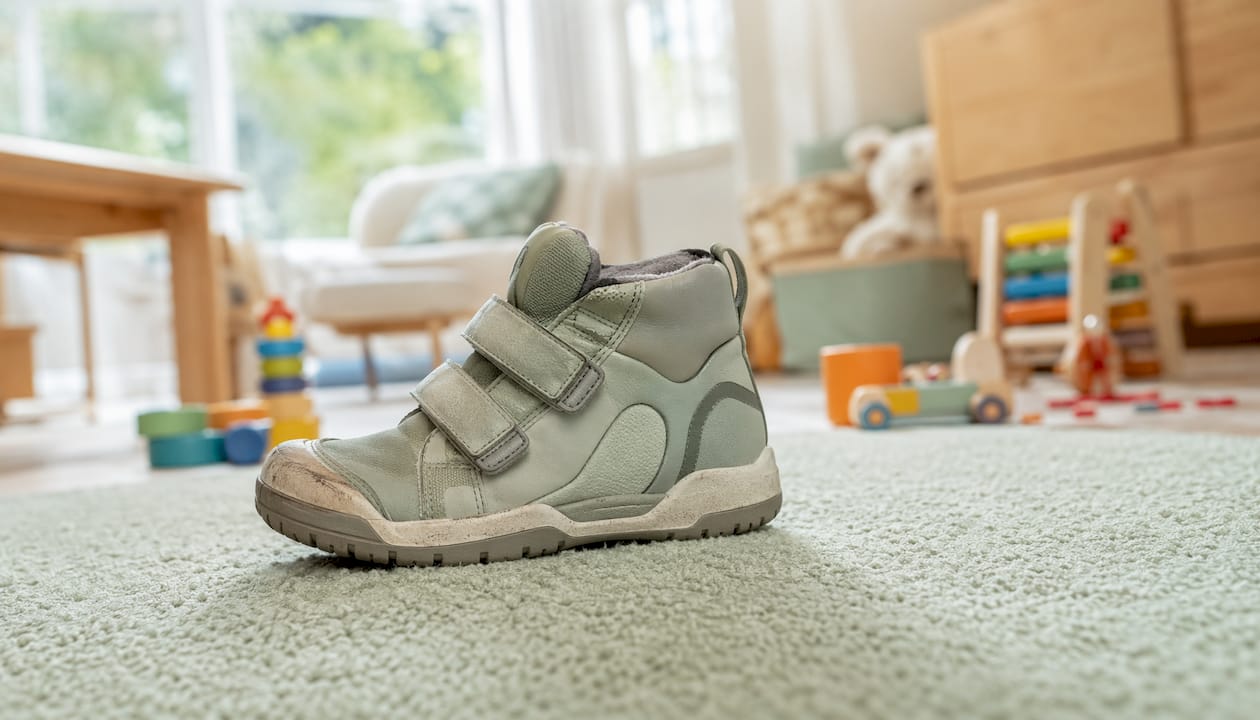
A particularly reliable construction is the so-called bootie construction: the membrane encloses the foot like a sock completely from the inside, which significantly reduces weak points at the seams. Rubber boots, on the other hand, are waterproof but hardly vapor-permeable. Leaving a child in rubber boots for hours risks wet, cold feet from the inside.
DWR Coating
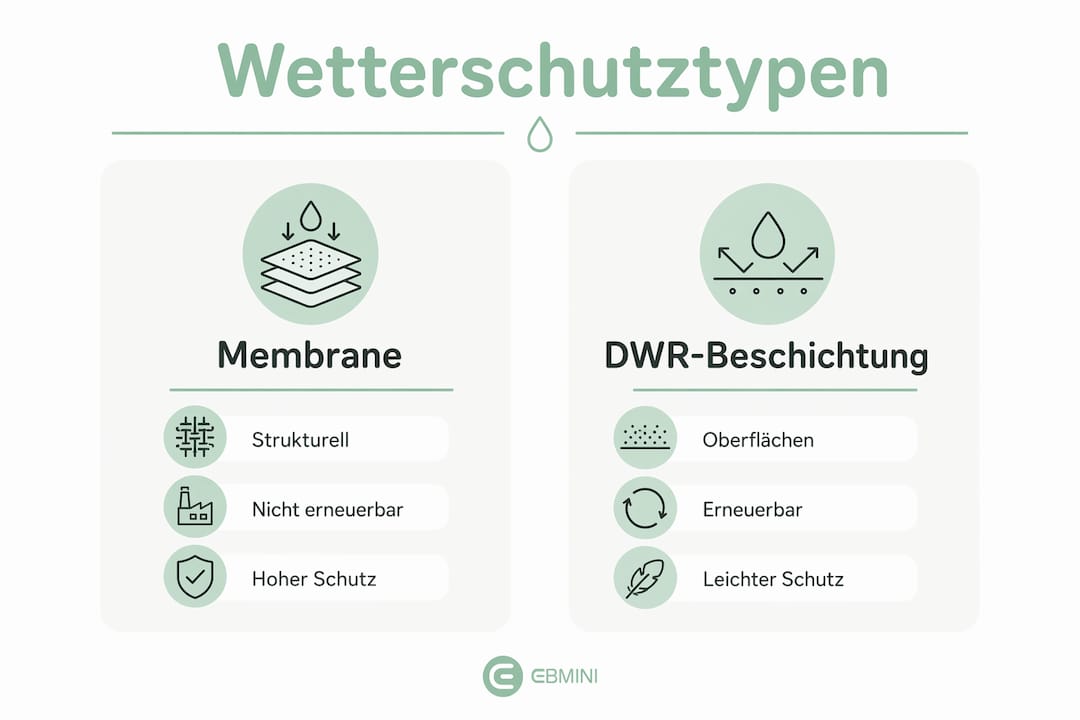
DWR stands for "Durable Water Repellency." This coating is on the outer material and causes water to bead up. When it wears off, the outer material soaks up water. The membrane underneath still protects, but the heavy, wet shoe cools down and loses breathability. Regular re-impregnation keeps the DWR layer active.
Constructive Protective Features
- Sealed seams: Seams are the most common weak point. Fully sealed seams (taped seams) close this gap.
- Rubber rand and toe cap: Protect the transitions between upper material and sole from splashing water.
- Shaft closure: The higher the shaft, the better the protection against water penetrating from above. Low shaft plus wet grass results in capillary action: water rises up the fabric and enters the shoe despite an intact membrane.
Pro-Tip: Ask in the store or at the dealer about the exact membrane designation. If only "waterproof" is stated without mentioning the manufacturer or material in the product text, it is often just a DWR treatment. A genuine membrane is almost always named explicitly.
Why "completely sealed" is not always the best choice
Climate comfort means that moisture is transported from the inside to the outside. Children sweat significantly when playing and running. A shoe that prevents water from entering from the outside but also does not release vapor to the outside creates condensation inside.
The consequences are unpleasant:
- Wet feet due to sweat that cannot escape
- Cooling down because moist skin releases heat faster
- Pressure points and blisters during long activities
- Odor formation due to moisture in the lining
When is a membrane still the right choice? For intensive puddle play, long hikes in rain or snow, external protection is more important than maximum breathability. For a short walk to school in light rain or the playground after a shower, a light, water-repellent model is often sufficient. It is more breathable, lighter, and more comfortable for the child.
The key lies in choosing the right option for the specific situation, not in maximizing a single feature.
Which protection suits which use?
| Situation | Recommended protection type | What to look for |
|---|---|---|
| Playground, dry weather | Water-repellent | Grip, flexibility |
| School run, changeable | Weatherproof or lightly waterproof | Shaft height, reflectors |
| Mud, deep puddles | Membrane, sealed seams | Shaft closure, tread sole |
| Hiking, long stay in wet conditions | Membrane (e.g., GORE-TEX) | Bootie construction, ankle protection |
| Snow, winter | Waterproof plus insulation | Warm lining, high shaft |
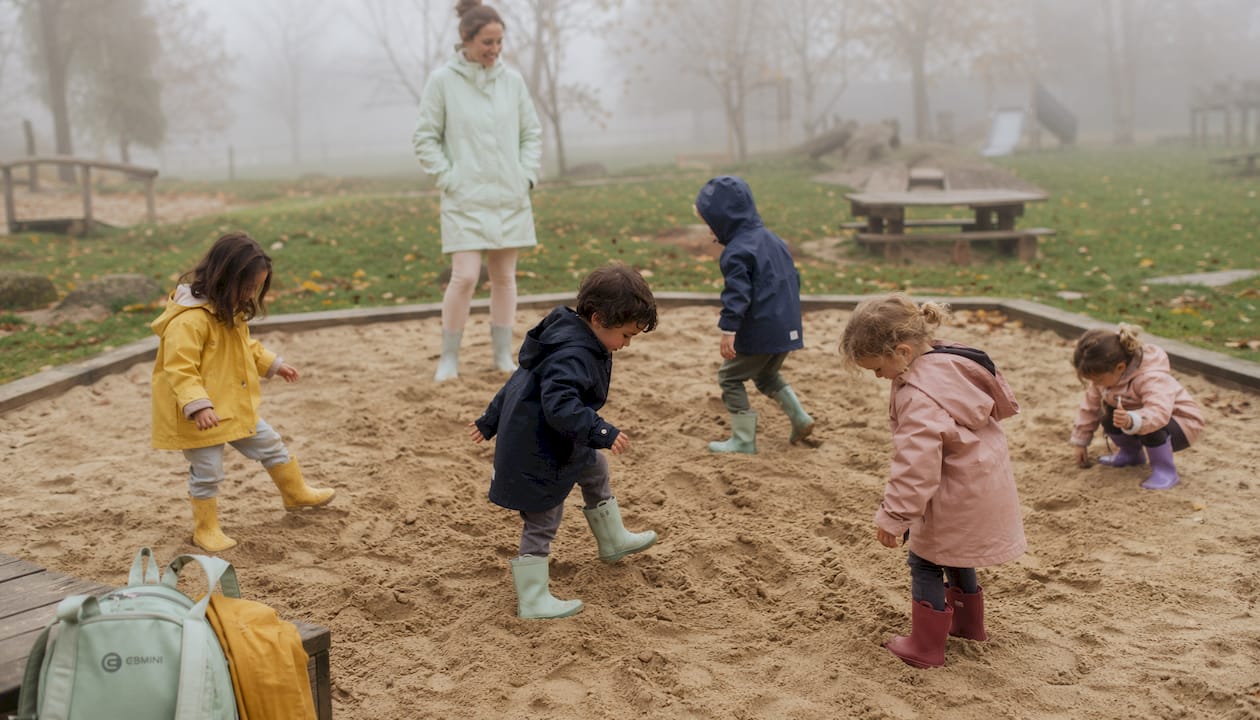
For active children who play a lot in mud and puddles, a membrane is often the most practical solution, as natural materials without a membrane quickly reach their limits.
Red flags when buying:
- Membrane shoe with a very low shaft: Capillary action negates the protection.
- No information on seam sealing: Water penetrates at seams, even if the membrane is intact.
- Missing tread sole: Slippery on wet surfaces, especially for children.
For the darker seasons, reflectors are not an optional extra. Children are often out at dusk in autumn and winter, and ankle protection stabilizes the foot on uneven, slippery terrain.
What to check when buying: Checklist for store and online shop
In the store
- Membrane specification: Is there a specific membrane designation on the label or box?
- Thumb pressure test: Press your thumb firmly on the upper material. If it gives way, it is flexible enough for active children.
- Flex test: Bend the shoe in the middle. It should bend easily without creasing.
- Toe room: At least one centimeter of space in front of the longest toe, thumb fits loosely.
- Shaft closure: High enough for the intended use? For puddles, at least ankle-high.
- Sole grip: Deep tread for wet ground, no smooth outsole.
Pro-Tip: Let the child put on and take off the shoe themselves. Velcro fasteners and pull loops are not comfort details, but decide whether the shoe will actually be used in everyday life.
Buying online
Product images of the inside show whether a membrane is installed. Material descriptions should list outer material, lining, and sole separately. If this information is missing, caution is advised. Check return policies: children's shoes should be returnable for at least 14 days so that the fit can be tested at home. Use size charts with foot length measurements, do not just buy according to age indications.
Care and maintenance: How to maintain weather protection
Even the best membrane loses its effectiveness if the outer material is soaked and the DWR layer is depleted; information on safe and cozy family balconies helps with proper shoe storage and care on the balcony, see Optimize Balcony for Family: Safe and Cozy. Care is not an effort, but significantly extends the protective function.
The process is simple:
- Rough cleaning: Remove dirt with a soft brush or damp cloth. No aggressive cleaning agents.
- Air drying: Let dry at room temperature, never on the heater or in direct sunlight. Heat damages membranes and adhesives.
- Re-impregnation: If water no longer beads off but soaks in, the DWR layer is exhausted. Apply spray impregnation or wash-in impregnation with a product suitable for the outer material. Then dry briefly at a low temperature to reactivate the DWR.
- Storage: Store shoes dry and airy, not in closed plastic bags.
More about proper shoe care in autumn and winter can be found in the Ebmini guide.
What is repairable, what is not? An exhausted DWR layer can be renewed. A punctured membrane, however, is considered irreparable. If you notice that a shoe gets wet from the inside despite fresh impregnation, you probably have a damaged membrane. Then only a new pair will help.
How Ebmini implements weather protection
Ebmini develops children's shoes based on the barefoot principle: wide toe box, zero drop (no heel elevation), flexible and ultralight sole. This construction promotes natural foot development, but at the same time places special demands on weather protection, because the sole must remain thin and flexible.
The Ebmini models combine these requirements through:
- Waterproof, vapor-permeable sole construction: The shoes keep moisture out and at the same time allow moisture to escape from the inside, similar to the principle of a membrane.
- Non-slip tread sole: Designed for wet ground and mud, without sacrificing flexibility.
- Wide toe box: Gives the toes room, which prevents pressure points, especially during long outdoor activities.
- Size advice and return policy: Ebmini offers a detailed size chart and clear return conditions so that the fit can be checked at home.
On the topic of sustainability: PFC- and PFAS-free membranes are a growing decision factor for parents. Ebmini communicates material information transparently, which builds trust. Those who want to delve deeper into the ecological aspects can find a separate guide on waterproof children's shoes.
Pro-Tip: Barefoot shoes with weather protection are not a contradiction. The combination of a thin, flexible sole and waterproof material works, as long as the sole does not become too stiff. With Ebmini models, the sole can be easily bent in the store or when unpacking: if it gives way, the barefoot property is maintained.
Key Takeaways
Weather protection for outdoor children's shoes is not a single feature, but the interplay of membrane, DWR coating, shaft height, and regular care.
| Topic | Details |
|---|---|
| Membrane vs. DWR | Membranes protect structurally; DWR coatings are renewable but not a complete substitute. |
| When membrane is useful | For puddles, snow, and long activities in wet conditions; for the school run, water-repellent is often sufficient. |
| Three buying checks | Check membrane designation in product text, shaft height for use, tread sole for grip. |
| Care as key | Refresh DWR regularly; air dry shoes, never on the heater. |
| Ebmini | Barefoot shoes with waterproof, vapor-permeable construction, wide toe box, and transparent size advice. |
Fit before protection level: A practical note
Anyone advising parents will find that most buy too much shoe. A membrane shoe with a stiff sole that is too tight for the child protects against rain, but harms foot development. Weather protection should be chosen situationally, fit and climate comfort are always mandatory.
A word on marketing terms: "Water-resistant," "weatherproofed," or "splash-proof" without specific material information or a water column value are meaningless promises. Anyone buying a shoe that is only called "weatherproof" without knowing whether it means a DWR treatment or a membrane is buying a pig in a poke. Reputable manufacturers explicitly state membrane designation, material composition, and care instructions. If this information is missing, it is a warning sign.
Foot health and weather protection are not mutually exclusive. But weather protection must never come at the expense of fit or natural foot movement.
Ebmini barefoot shoes: Weather protection without compromising foot health
For parents looking for shoes for their child that work in any weather and simultaneously support natural foot development, Ebmini offers a well-thought-out solution. Ebmini's children's barefoot shoes combine waterproof, breathable materials with a wide toe box, zero drop, and a non-slip tread sole that provides grip on wet surfaces.
What's special: The sole remains flexible enough for the barefoot principle, even when the shoe repels moisture. Size advice, clear material specifications, and a fair return policy make purchasing online straightforward. For parents who don't want to choose between foot health and all-weather suitability, it's worth taking a look at the sneaker models for everyday wear. Simply use the size chart, choose a model, and try it out at home at your leisure.
Further Sources and Manufacturer Information
For in-depth reading on membranes, materials, and care:
- Guide: Waterproof vs. Water-Repellent Children's Shoes: Explains the difference between membrane and DWR coating, with notes on PFC/PFAS-free alternatives.
- GORE-TEX Shoes: Why and When They Make Sense: Technical explanation of bootie construction and breathability, with practical examples.
- Waterproof vs. Water-Resistant Shoes (Intersport): Explains water column values, testing standards, and the care workflow for DWR-coated shoes.
- Hiking Shoes and Mountain Boots for Children: Buying Guide (Bergzeit): Practical recommendations for active children, with scenarios for mud, puddles, and hikes.
- Children's Shoes Breathability Winter: The Guide (Ebmini): In-depth discussion on climate comfort and breathability in winter shoes.


